Kelly family crest: the name and the recorded bearer
A guide to Ó Ceallaigh, specific O’Kelly armorial records and a new decorative design, without a claim of inherited arms.
A Kelly family crest search often leads to a tower, two lions and an elaborate animal above the helmet. Those elements have a history, but they do not belong automatically to everyone called Kelly. The surname is commonly derived from Ó Ceallaigh, descendant of Ceallach, while the personal name’s deeper meaning is debated. This guide keeps the name, the recorded armorial bearer and the new design brief separate. The Fable illustrations are contemporary examples, not recovered Kelly arms.
Keep the uncertainty in the name
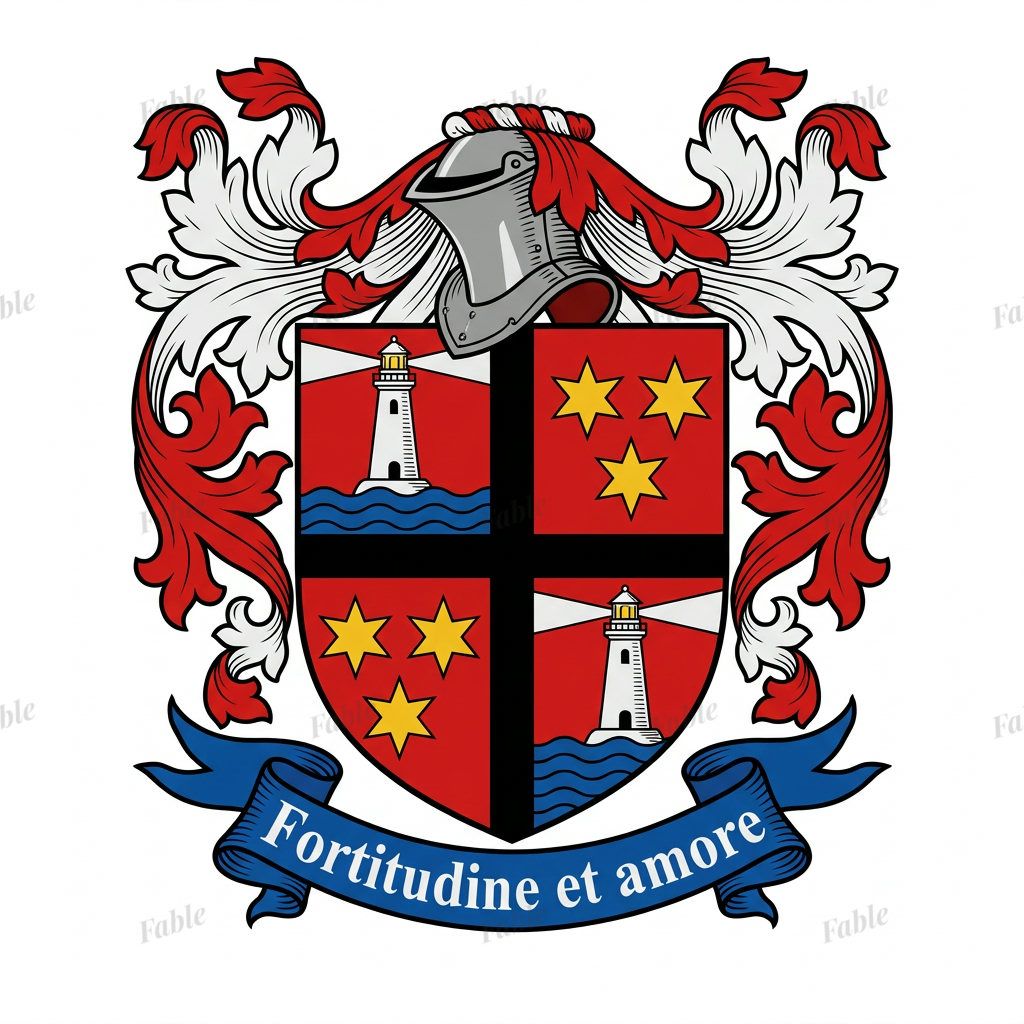
Fable crest demonstration · Fable Heraldry, 2026 · Fable approved web examples. A contemporary decorative design; not historic arms or a customer testimonial.
The relationship between Kelly and the Irish form Ó Ceallaigh is a more secure starting point than a single attractive translation of Ceallach. Different explanations of that personal name circulate, including older and newer scholarly proposals. A careful gift note need not choose one simply because it sounds more complimentary. “Descendant of Ceallach” says something useful without pretending that the remaining question has been settled.
Kelly can also have other geographical or linguistic histories. A particular family’s records may point towards a Scottish place-name origin, for example, rather than the Irish explanation that dominates a general search. The fact that one origin is common does not make it universal. The surname meaning guide explains how to begin with a dictionary and then follow the actual people in your documents.
The Fable example here contains lighthouses and stars on a quartered shield. Its purpose is to show a readable arrangement, not to stand in for an O’Kelly tower. A modern lighthouse selected to remember a coastal home and a historical tower recorded for an armorial bearer are different kinds of reference. Keeping that distinction visible is the foundation of an honest new emblem.
Read the tower with its record
Historical accounts associate a tower between lions with O’Kelly lines, including Uí Maine. But the records are more complicated than a single image caption suggests. The study published by Burke’s East Galway discusses arms attributed to William Kelley of Dublin, who died in 1597, with references to Genealogical Office manuscripts. It also distinguishes separate O’Kelly origins and later evidence rather than presenting every occurrence as one uninterrupted lineage.
That is the level of specificity to preserve: a named person, a date and a manuscript reference. A later armorial compilation or interpretation may be valuable, but it should be identified as such. If an account says that an association is uncertain, keep the uncertainty in your notes. Do not turn a suggested connection into a categorical statement when shortening the text for a label.
The guide to coats of arms for a surname explains why a historical example is not a general permission. Your surname can lead you to the record, but it cannot supply the relationship between you and the recorded bearer. Establishing that connection is a separate task involving documents, not a visual match between a shop’s shield and a family name.
A crest is a separate part of the design
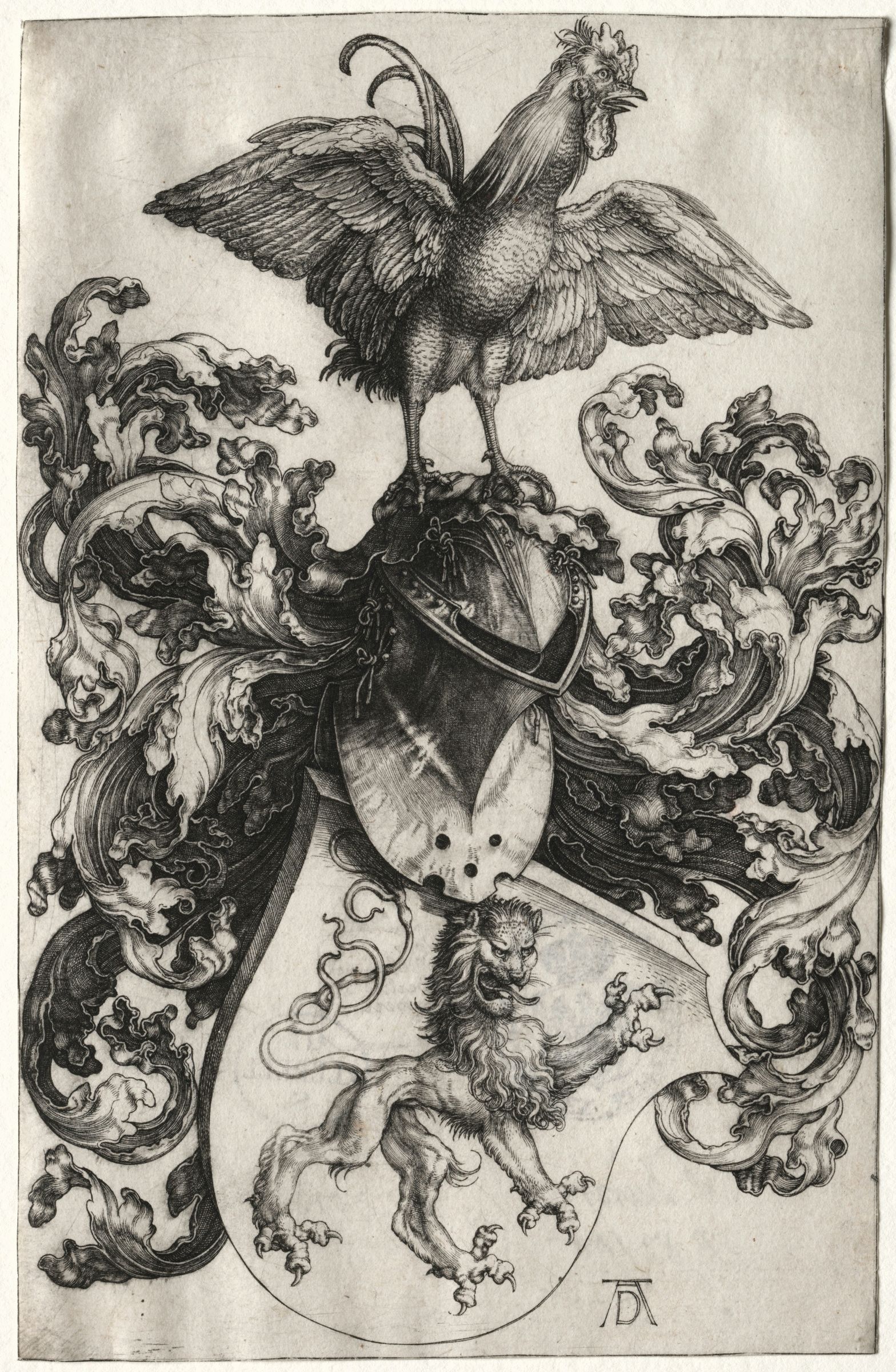
The Coat of Arms with a Lion and Cock · Albrecht Dürer, probably 1503 · Cleveland Museum of Art. Prepared for print by Surrealium at Vaxholm Fortress, Sweden.
Some O’Kelly descriptions include an enfield as a crest. The unfamiliar word can encourage people to treat it as an ordinary dog, fox or wolf. In heraldic description, the identity of a composite creature matters; a simplified silhouette should not erase the details supplied by the record. More broadly, the crest sits above the helmet and is distinct from the charges on the shield.
The historical Dürer print shown alongside this section is not O’Kelly arms. Its cock above the helmet and lion on the shield make that distinction visible in a different, fully identified object. It is a reference for reading the parts of an achievement, not evidence about a Kelly bearer. The heraldry introduction gives the vocabulary in more detail.
When comparing two online images, ask whether they depict the same part of the design. One may show only a crest badge while another shows a complete achievement. Differences in mantling or artistic treatment do not always change the arms, whereas a changed charge or field may do so. A written description and a traceable source help you decide what kind of difference you are looking at.
Research the person before the emblem
Make a short timeline for the earliest securely identified Kelly in your own records. Include where the person lived, the names of close relatives and the spelling used in each document. That timeline gives a better basis for further searching than a general claim that the surname belongs to a famous region. Common names need especially careful attention to dates and relationships.
If a possible armorial connection appears, record it as a separate hypothesis. What evidence would link the known person to the named bearer or branch? Which generations are missing? A compelling story should make you more careful about those gaps, because it is easy to prefer a satisfying connection over an ordinary explanation.
The Murphy guide offers a useful comparison in another widely shared Irish surname. In both cases, a general origin and a specific genealogy are different scales of knowledge. You can enjoy learning about the name while acknowledging that your own line is still being researched. A new decorative keepsake does not require you to resolve every historical question before making something meaningful.
Make a new brief from a real detail
Fable crest demonstration · Fable Heraldry, 2026 · Fable approved web examples. A contemporary decorative design; not historic arms or a customer testimonial.
Choose a subject that the recipient can recognise without a lecture: a place where the family gathers, a plant associated with a home, a trade remembered through tools or a shared activity. Write why it matters in one sentence. If the explanation requires an unproved descent from a medieval bearer, choose a different starting point or state clearly that the connection remains unverified.
The lighthouse demonstration shows how repetition can give a divided shield coherence. It also shows why restraint matters: a limited set of charges is easier to recognise than a different object in every available space. Your design could be simpler still. One strong figure on a contrasting field may be enough, with the name or motto given room to read.
Our guide to making a coat of arms takes this from a written brief to a composition. The result should be described as a contemporary decorative emblem. If you want to mention the surname’s Irish form in an accompanying note, check the spelling carefully and avoid presenting the new symbols as proof that a historical armorial identity has been recovered.
Give the gift without inventing a pedigree
An honest inscription can be warm and specific. Explain that the design was made for the recipient, that a chosen symbol remembers a particular place or person, and that the name has the recorded linguistic connection you have actually researched. Those statements do not need a claim of antiquity to carry emotional weight.
Keep the historical references with the design file. If you discussed a tower-and-lions record, identify its bearer and source there, even if that record did not become the new emblem. This makes it possible for another family member to continue the research without mistaking the decorative result for an archival discovery. The distinction can be especially helpful when an image is copied many times and its original explanation is lost.
Finally, inspect the lettering and the whole silhouette at the likely viewing size. A tiny motto or a crowded crest may need simplifying. The coat of arms overview helps identify the components, but the design’s success also rests on ordinary visual judgement: clear forms, a limited palette and enough space for the most meaningful element to remain visible.
Create a new Kelly emblem in Fable Heraldry from a story you can document or personally explain. Its value can come from that care, while the question of inherited arms remains separate.
- What does Kelly mean?
- The common Irish derivation is descendant of Ceallach. The deeper meaning of the personal name is debated, so a single confident translation should be treated cautiously.
- Do the tower and lions belong to all Kellys?
- No. Armorial descriptions concern particular bearers or branches. A shared surname does not establish a connection to them.
- Can my new design use a tower?
- A tower can be part of a new decorative brief, but copying a specific historical achievement and claiming entitlement is a different matter. Explain your own choice accurately.