Murphy family crest: research before design
Trace the name, distinguish specific historic bearers, and plan a new Murphy emblem with clearly labelled Fable examples.
A search for a Murphy family crest can produce several different shields, and the difference matters. Murphy is widely associated with an Irish name meaning descendant of Murchadh; that linguistic connection does not establish descent from one armorial bearer. Begin with the name’s history, then examine any claimed arms with their place and source attached. The Fable pictures in this guide are contemporary demonstrations for other sample names, used to explain design choices. None is presented as historic Murphy arms. The opening architects’ monogram is also a modern sample: lettering can represent a person or practice without claiming ancestral arms.
What the name can tell you
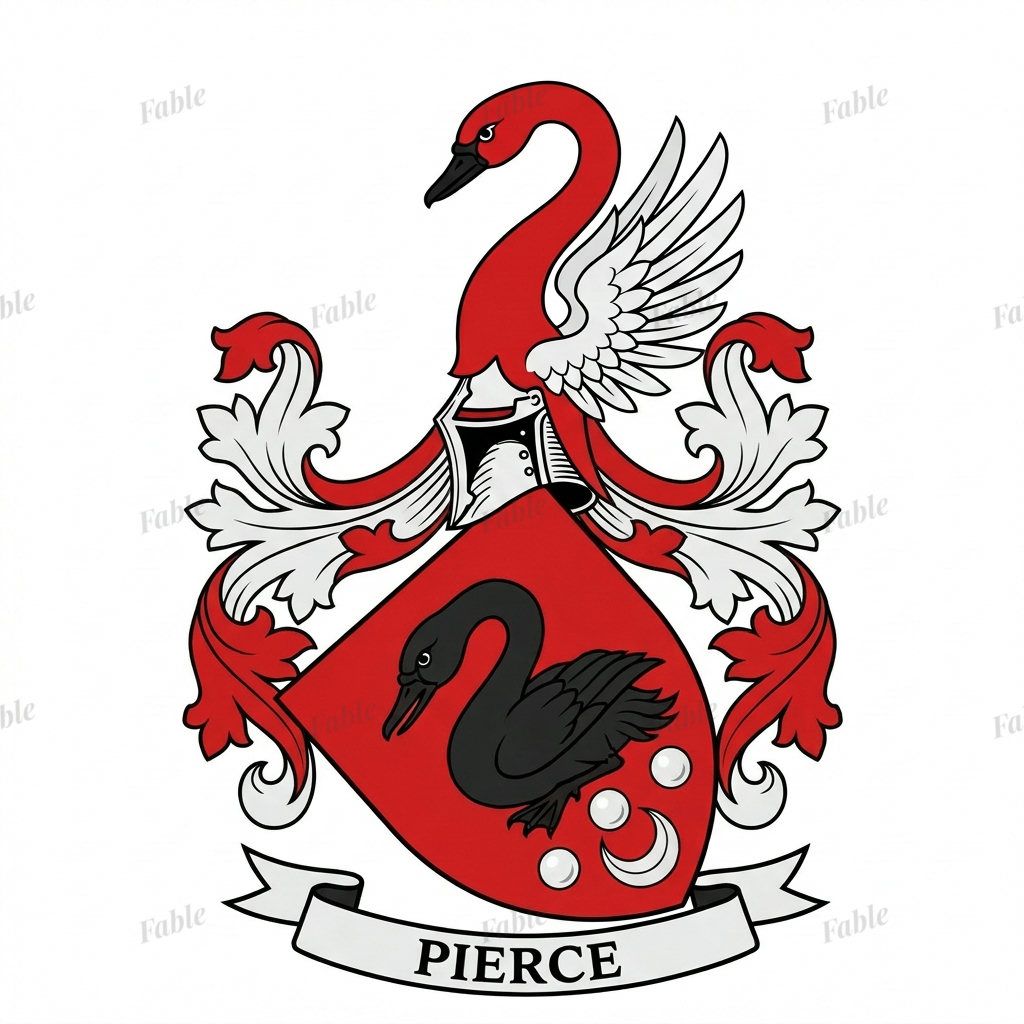
Pierce design demonstration · Fable Heraldry, 2026 · Fable demo archive. Decorative design for an invented example; not historic arms, a customer testimonial or evidence of surname entitlement.
The Dictionary of American Family Names entry reproduced by FamilySearch describes the principal Irish origin as an anglicised form of Ó Murchadha, meaning descendant of Murchadh. The personal name combines elements associated with sea and battle. That is an explanation of a name, not a record of the occupation or character of every person who later bore it. Other origins and spelling histories also need to be considered when the family evidence points elsewhere.
For a gift, it can be tempting to translate the name directly into a ship, a sword and a heroic motto. Pause before doing that. A word’s early components may be interesting without being the most personal thing you know about the recipient. A recorded place, a household craft or a remembered landscape may supply a more meaningful starting point.
Our surname meaning guide explains this distinction between etymology and genealogy. Keep a note of the source and the spelling it discusses. If your own records use Murphey, Morphy or another form, preserve that evidence instead of forcing every document into the spelling used today. The relationship between forms is something to investigate, not an excuse to discard inconvenient differences.
Why there is more than one shield
Historical armorial references can attach different arms to people with the same or similar names. John O’Hart’s nineteenth-century Irish Pedigrees includes a separate O’Murphy account for the O’Morchoe branch of Ouleartleagh in County Wexford. Its armorial description includes an apple tree and a lion, attached to that named branch. The entry is a historical compilation, not a certificate for every modern Murphy.
Other published armorial summaries associate quartered lions and wheat sheaves with particular Murphy bearers and places. Do not combine those elements with the O’Morchoe entry to make an apparently definitive shield. First ask which record is being cited, when it was compiled and whom it names. Differences can be evidence of separate histories rather than errors in drawing.
The useful takeaway is a research method. Copy the full identification beside the blazon: person or branch, place, date and source. If the source is a later compilation, say so. A design seller’s repeated image does not become an original record merely because it appears on several products. For a formal claim, the underlying documentation and a demonstrated family connection would need their own examination.
A demonstration is a design lesson
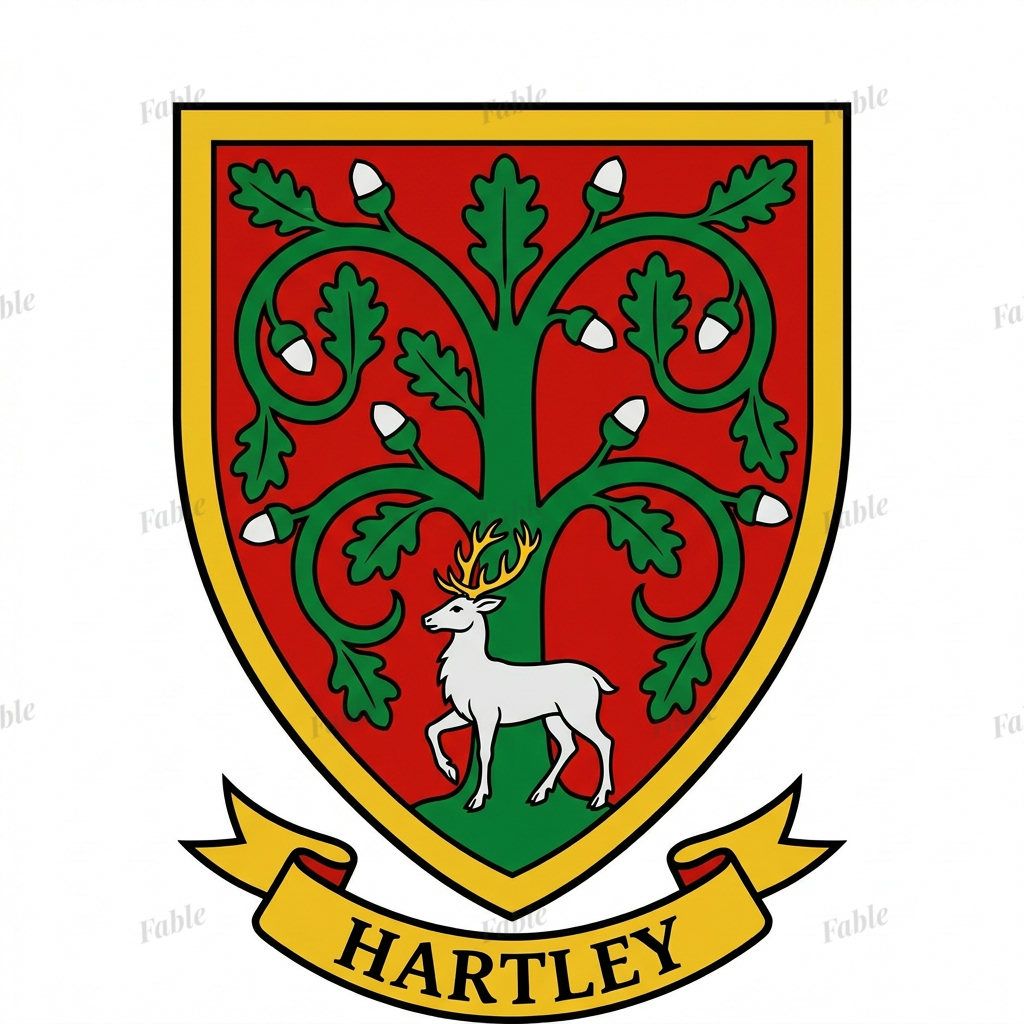
Hartley design demonstration · Fable Heraldry, 2026 · Fable demo archive. Decorative design for an invented example; not historic arms, a customer testimonial or evidence of surname entitlement.
The Hartley example shown here is a new Fable demonstration with an oak, a stag and a name ribbon. It is not the apple-tree arms described in the O’Morchoe entry, and its appearance proves nothing about Murphy ancestry. It illustrates a narrower point: one tree and one animal can establish a clear visual relationship inside a shield without requiring a long scene.
Notice how the central trunk organises the composition. The animal is readable because it has room around it; the border supplies a separate edge. If you were planning a new emblem, you could use that economy without copying the exact design. You might choose a plant actually connected with a home, or a single object associated with a person you want to remember.
Our guide to heraldic symbols offers ways to look at common charges. Treat those associations as prompts, not a dictionary that guarantees historical meaning. A tree chosen to remember a garden has a clear personal explanation. It does not need to be declared an ancient Murphy symbol to make the design worthwhile.
Build the family evidence separately
Start with a relative whose identity is secure and work backwards through records that establish relationships. Dates and places are essential because common names can recur in the same area. A birth entry, a marriage record and a household census may each supply a different part of the connection. Keep the source reference beside the claim so that someone else could retrace the work.
If you encounter a person of the same name in an armorial, do not make the leap simply because the county sounds plausible. Ask what links the documented generations to that individual or branch. A gap remains a gap even when the proposed connection is attractive. It is better to keep an interesting possibility in a separate note than to make it the foundation of a gift’s inscription.
The coat-of-arms-for-surname guide explains why the word on a shield and the entitlement to arms are separate matters. A comparison with Kelly is useful because it shows the same need for specificity in another common Irish surname. The name can open a research question; it cannot answer it on its own.
Choose the story your new emblem will carry
Pierce design demonstration · Fable Heraldry, 2026 · Fable demo archive. Decorative design for an invented example; not historic arms, a customer testimonial or evidence of surname entitlement.
The Pierce demonstration at the beginning of this guide uses a bird, small rounded charges and a crescent. Its ribbon names the invented example plainly. The lesson is that a new emblem can be read as a composition of selected ideas. Your Murphy design would begin with a different brief, and the difference should be intentional rather than a matter of replacing the lettering on someone else’s shield.
Write three short notes: a place, a memory and a value expressed through something concrete. A coastal place might suggest a wave or a lighthouse. A family habit might suggest a book, a tool or a plant. Choose one dominant image, then decide whether a second adds information or merely decoration. If you want a motto, use words you understand and have checked; an English phrase can be more personal than uncertain Latin.
The introduction to a coat of arms helps name the parts, while the design guide helps turn a short brief into a coherent arrangement. Describe the result as a new decorative emblem inspired by your story, without claiming a grant, a registry entry or a recovered inheritance.
Give the image an honest accompanying note
A thoughtful gift can include a small card explaining what was chosen and why. Distinguish the name’s recorded origin from the personal references in the new design. For example, say that the surname has an Irish linguistic history, while the lighthouse was selected to remember a particular home by the sea. That makes the two layers explicit without burdening the recipient with a long research report.
Check the spelling on every ribbon and the order of any dates before keeping the design. Inspect the whole composition at both a large viewing size and the smaller size in which it is likely to be used. Thin lines, crowded lettering and too many small charges can become difficult to read. Reducing an element is often a stronger revision than adding another.
Keep the brief with the final image. If the design is shared later, that note will prevent a contemporary family keepsake from gradually becoming an unsupported claim about medieval ancestors. Its value can rest in the care with which it was made and explained. A well-chosen present does not become less personal because its history is told accurately.
Bring your preferred spelling and one meaningful detail to Fable Heraldry. A new Murphy emblem can celebrate a real family story without presenting itself as inherited arms.
- Is there one Murphy coat of arms?
- No single design can be assigned to every person with the surname. Historical entries concern specific bearers or branches.
- What does Murphy mean?
- The principal Irish derivation is from Ó Murchadha, descendant of Murchadh. The personal name contains elements associated with sea and battle; a particular family’s history still requires records.
- Are the crests pictured here historic Murphy arms?
- No. They are existing contemporary Fable demonstrations for named examples, shown to explain design choices and labelled accordingly.