Surname meaning: from a word to a family story
Separate a name’s linguistic origin from your own family history, then turn a documented detail into a thoughtful new emblem.
A surname meaning can explain how a word began without telling you which people in the past were your ancestors. An occupational name may arise in many unrelated households; a patronymic may be formed independently wherever the same given name is used. Spelling changes, migration and translation add further layers. The most useful approach is to hold two questions apart: what does the name mean, and what can records show about the particular people who carried it in your family?
Begin with the kind of name
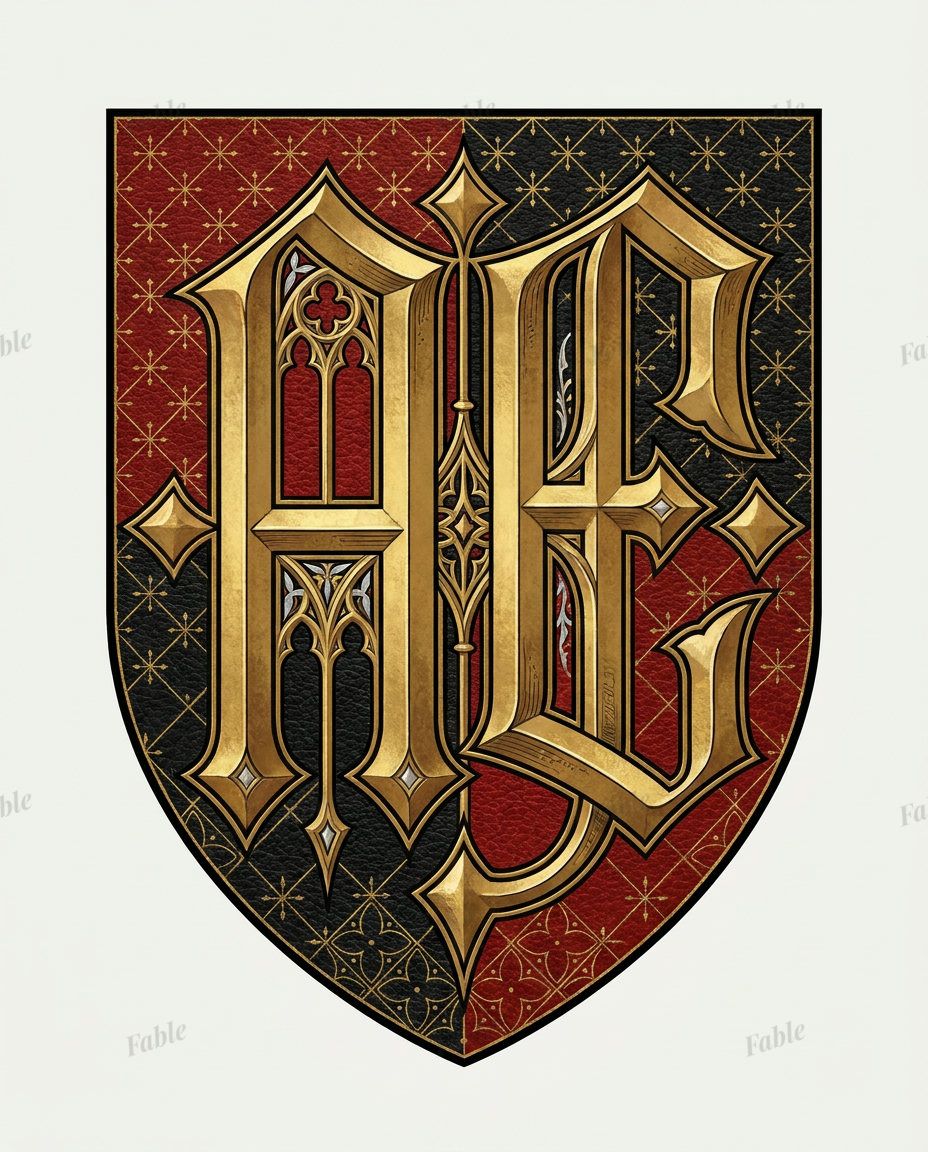
Gothic AE demonstration · Fable Heraldry, 2026 · Fable editorial demo archive. Contemporary studio-directed lettering; not a historical monogram or a customer testimonial.
Many surnames can be discussed through broad linguistic categories. Some derive from an occupation, some from a place, some from a parent’s given name and some from a descriptive nickname. These categories overlap and do not settle every case. A modern spelling may represent more than one earlier form, especially when people moved between languages or when an official wrote down a name by ear.
A dictionary of surnames is useful because it can distinguish those possibilities and identify the language involved. Look for a source that gives the earlier form and explains the proposed development. A cheerful one-word translation without that background is less informative. If scholars disagree, retain the disagreement instead of choosing the most flattering version for a gift.
The Gothic AE image here is a contemporary Fable lettering demonstration. It shows how initials can become a visual composition, not how those letters prove an origin or a lineage. That distinction applies to any attractive mark made from a name. The visual treatment may be personal and expressive while the historical claim remains modest. A monogram can represent someone perfectly well without pretending to be a recovered ancestral device.
A translation is not a family tree
Suppose a name means “son of” a familiar given name. That explanation does not identify one founding parent for everyone who now shares the surname. Likewise, a name associated with a town does not prove that every modern bearer descends from one household there. The linguistic history describes a route by which a name could form. Genealogy asks which route the people in your records actually followed.
Start with the nearest person whose identity is secure. Record dates, places, relationships and the source for each fact. Work backwards through documents that connect one generation to the next, rather than jumping to a famous namesake. A shared occupation, a similar spelling or a plausible county can help frame a search, but it is not the connection itself.
Keep alternate spellings in your notes. They are often useful evidence rather than errors to be corrected. If a record uses a form different from the one your family uses now, preserve both and explain where each occurs. This approach makes a family story more interesting: it shows movement and adaptation without requiring every change to conceal a dramatic secret.
Read three names with different cautions
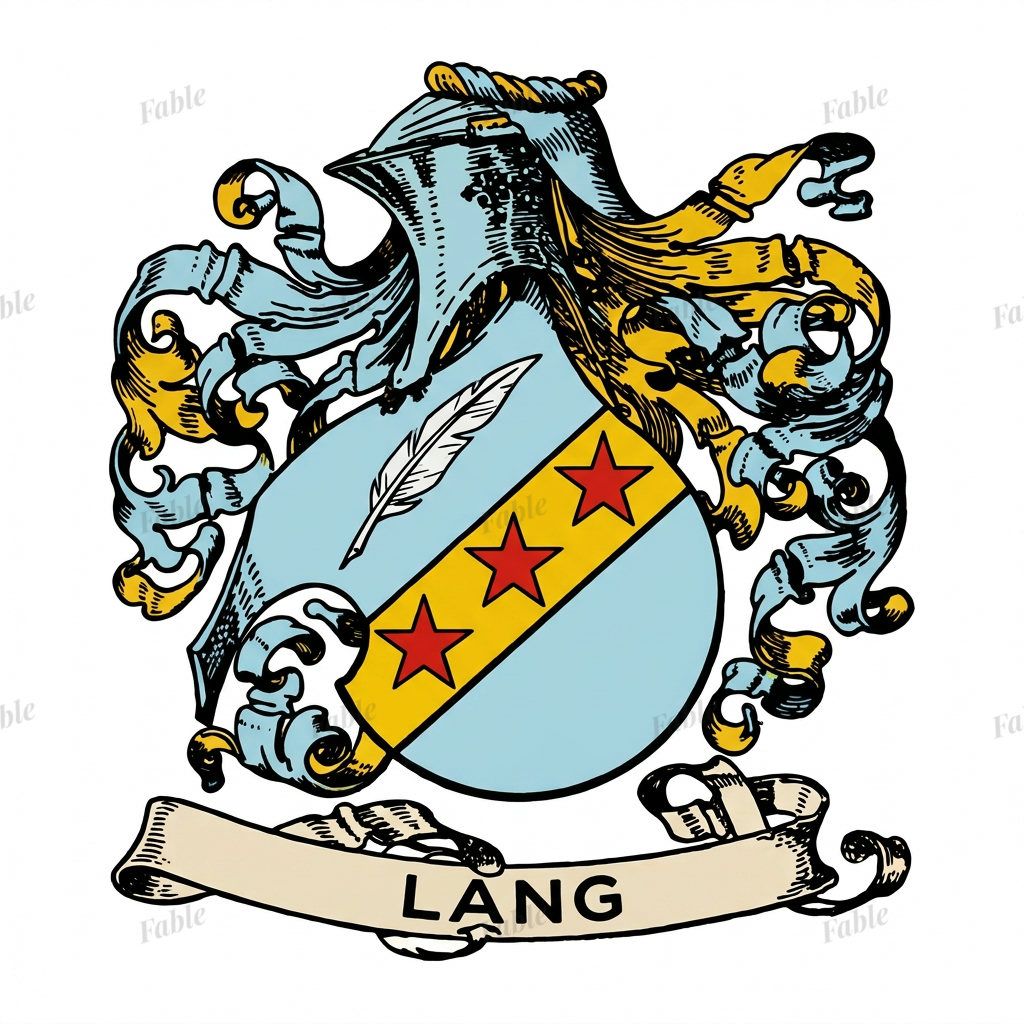
Lang design demonstration · Fable Heraldry, 2026 · Fable demo archive. Decorative design for an invented example; not historic arms, a customer testimonial or evidence of surname entitlement.
The Murphy guide begins with an Irish personal name whose elements are commonly connected with sea and battle. That does not make every Murphy an inheritor of one set of arms, or prove that a particular ancestor was a sailor. The Kelly guide is especially useful for uncertainty: the surname’s relationship to Ceallach is clearer than a single confident translation of that personal name.
The Campbell guide separates a Scottish Gaelic explanation from the heraldry of specific Campbell lines. Even when a name’s usual derivation is well known, the identification of a particular household remains a documentary task. Those examples suggest a good rule for notes: write the name explanation in one paragraph and your family evidence in another.
The Lang demonstration alongside this section is a modern design example bearing its own sample name. It is not an illustration of Murphy, Kelly or Campbell arms. Its stars and quill show the sort of choices a new brief can make. You could choose entirely different symbols after researching a family story, and no historical claim would follow merely from giving the design an old-fashioned visual character.
Names that cross languages and borders
The Stewart guide considers an occupational name with a famous dynastic history. A well-known royal association can easily overshadow the many ordinary people who carried the same name. The Anderson guide takes a different route: a patronymic can have Scottish, English, German or Scandinavian connections, and a modern spelling may have absorbed several forms.
Migration records are valuable because they can place two spellings within the life of one person. Without that connection, it is easy to assume that similar-looking forms must have exactly the same history. Keep the original language when a source supplies it, and avoid turning pronunciation into proof. A name spoken in one household may change again when it enters another language.
If you are making a family gift, ask the recipient which spelling and form they want displayed. The most historically elaborate option may not be the one they use or identify with. A name is also a living choice. Research can inform that choice without overruling it, and a design should not quietly replace someone’s preferred identity with a version selected because it appears more ancient.
Arms require a different kind of evidence
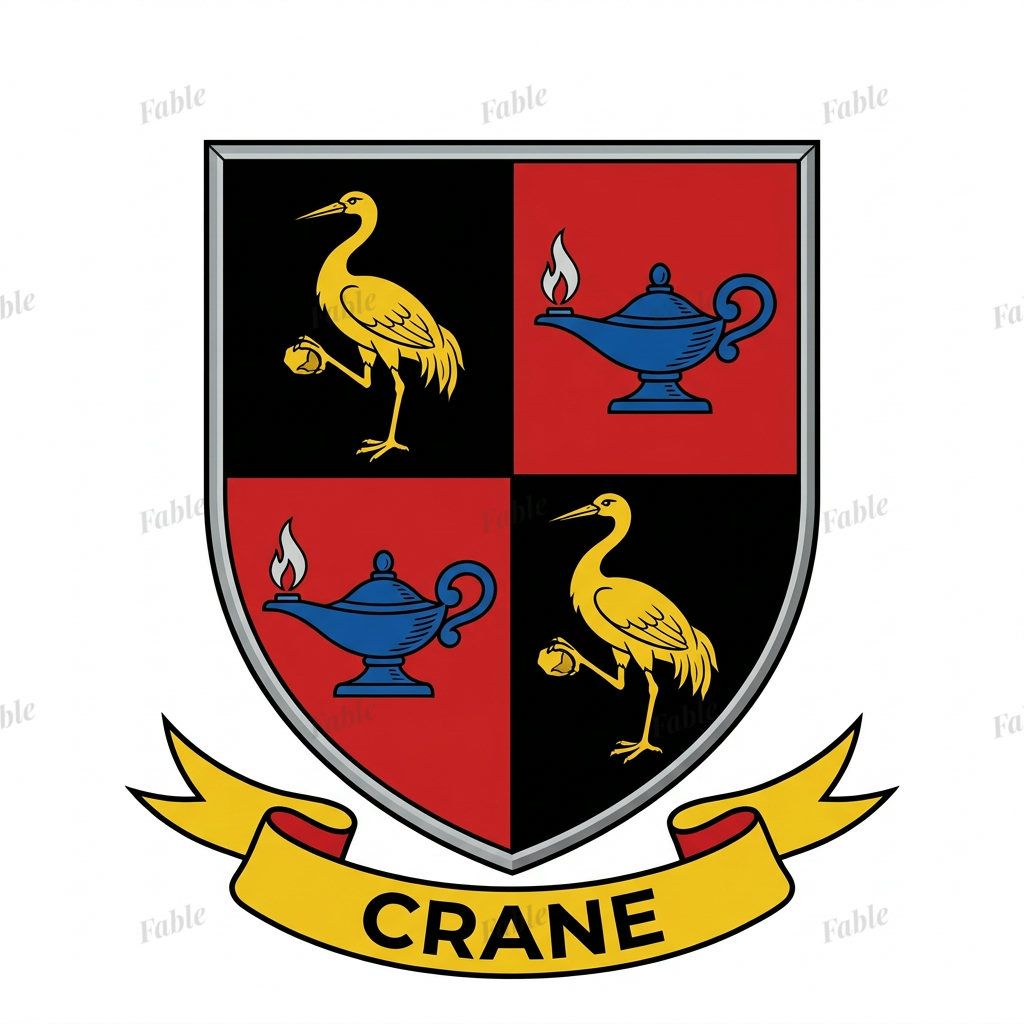
Crane design demonstration · Fable Heraldry, 2026 · Fable demo archive. Decorative design for an invented example; not historic arms, a customer testimonial or evidence of surname entitlement.
A surname entry and an armorial entry answer different questions. The first concerns a name; the second records arms associated with a bearer or line. The guide to coats of arms for a surname explains why matching the word on a product page is insufficient. A historical shield may be accurately drawn and accurately named while still having no established connection to the person shopping for it.
When an armorial gives a place, date or named person, keep those details attached to the description. Do not reduce the record to a surname and discard everything that makes it specific. If two entries differ, investigate whether they concern different bearers rather than assuming one must be a mistake. Repetition of the same image across shops is not independent corroboration.
The Crane demonstration here makes the separation easy to see. Its birds, lamps and lettering belong to an invented contemporary example in Fable’s demo archive. It illustrates arrangement and personal storytelling; it does not establish historic Crane arms, still less the arms of another surname. A new emblem can be satisfying because you know exactly why its parts were chosen.
Turn one documented detail into a design brief
Choose a detail you can explain without exaggeration: a town where several generations lived, a trade recorded in a census, a garden maintained by a relative or a journey documented in a letter. Then decide whether it should become a literal object or a simpler visual reference. A coastline might suggest a wave; a craft might suggest one recognisable tool. The strongest brief usually has fewer elements than the first list you make.
Write a short accompanying note in the same plain language. Separate “this record shows” from “we chose this to remember”. Those phrases keep history and interpretation close without confusing them. Check names and dates with another family member if possible, especially when the design will be given as a surprise.
Finally, consider how the mark will be read at its intended size. Large ornate lettering can become dense on a small card, while a single clear charge can remain legible. Decide what deserves emphasis before adding more ornament. The result need not imitate a grant or advertise a claim of descent. It can be a contemporary object that carries a well-told, carefully limited family story.
Bring the spelling you use and one story you can stand behind to Fable Heraldry. A new decorative crest can honour that story while leaving unproved ancestry unclaimed. The coat of arms guide explains the shared vocabulary behind these choices.
- Does a surname meaning identify my ancestors?
- No. It explains a name’s linguistic history. A family tree requires records connecting specific people across generations.
- Why do websites give different meanings?
- A name may have several origins, uncertain earlier forms or competing scholarly explanations. Prefer sources that explain their evidence and preserve uncertainty.
- Can I create a crest without proving inherited arms?
- You can create a new decorative emblem. Describe it as a contemporary design and do not present it as a grant or evidence of entitlement.