Stewart family crest: beyond the royal surname
Explore an occupational name, the chequered band and specific Stewart records before designing a new decorative emblem.
A Stewart family crest search can jump quickly from a surname to the royal arms of Scotland. That jump is too large. Stewart began as an occupational name associated with stewardship, and particular Stewart lines developed their own armorial histories. The royal dynasty is part of the name’s story, not a pedigree for every bearer. The contemporary Fable examples in this guide illustrate design choices only; they are not historic Stewart arms. The opening guesthouse monogram illustrates that distinction: decorative initials and foliage are a contemporary identity, not a record of Stewart descent.
An office becomes a name
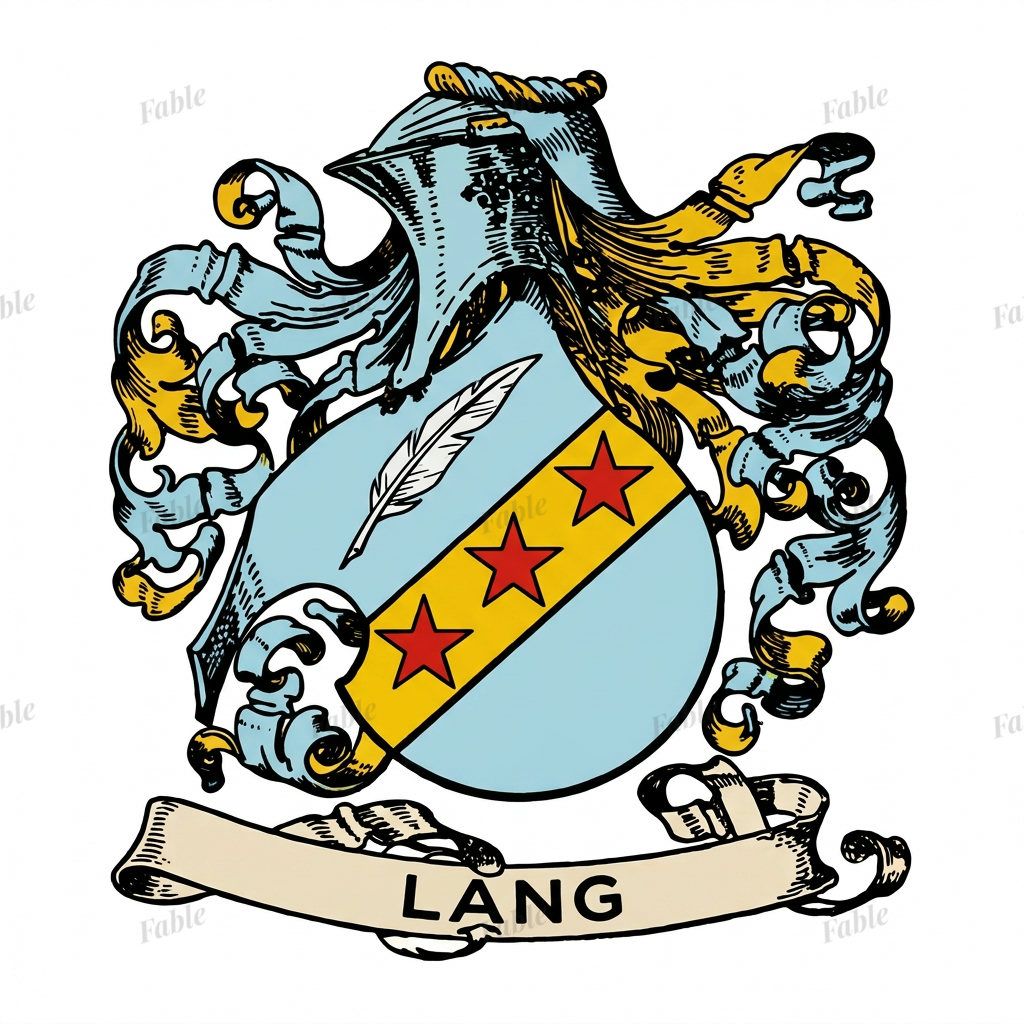
Lang design demonstration · Fable Heraldry, 2026 · Fable demo archive. Decorative design for an invented example; not historic arms, a customer testimonial or evidence of surname entitlement.
Stewart is an occupational surname connected with the office of steward. The well-known Scottish family held the hereditary position of High Steward before its royal history developed. The Dictionary of English Surnames explanation, cited in surname references, relates the word to older terms for household and guardian. That linguistic background gives the name a useful context without identifying one ancestor for every modern Stewart.
Stuart is a familiar related spelling, but spelling alone should not be used to decide which branch a person belongs to. Names can change through language, habit and record keeping. Preserve the form found in each document and connect it to a person through dates, places and relationships. The surname meaning guide explains why a word’s origin and a family’s descent need separate treatment.
The Lang demonstration here uses a diagonal gold band carrying red stars. It is a contemporary Fable example with its own sample name. That band is not the chequered fess associated with historic Stewart arms. Showing the distinction is useful: a heraldic description specifies both the form and the decoration of an element, and changing either can make it a different design.
The chequered band needs a named bearer
Historical Stewart heraldry is strongly associated with a fess chequy, a horizontal band composed of alternating squares. George Seton’s discussion of Scottish heraldry and other armorial studies record variations attached to specific bearers. The historical literature also associates the pattern with the steward’s accounting board, but that traditional explanation should not replace the documentary identification of an actual shield.
A particularly useful example of specificity is the recorded seal of Alan Stewart of Ochiltree in 1377, discussed in the historical literature with a fess and a bend bearing buckles. The extra elements matter. They are not decorative noise to remove when making a simplified surname image. Different branches and bearers can share a recognisable family vocabulary while remaining distinct.
The coat-of-arms-for-surname guide explains how to read such an entry without turning it into a general entitlement. Keep the bearer, date and source beside the description. If a seller supplies only the surname and a picture, the most important information may be precisely what is missing.
A crest, a shield and a royal emblem
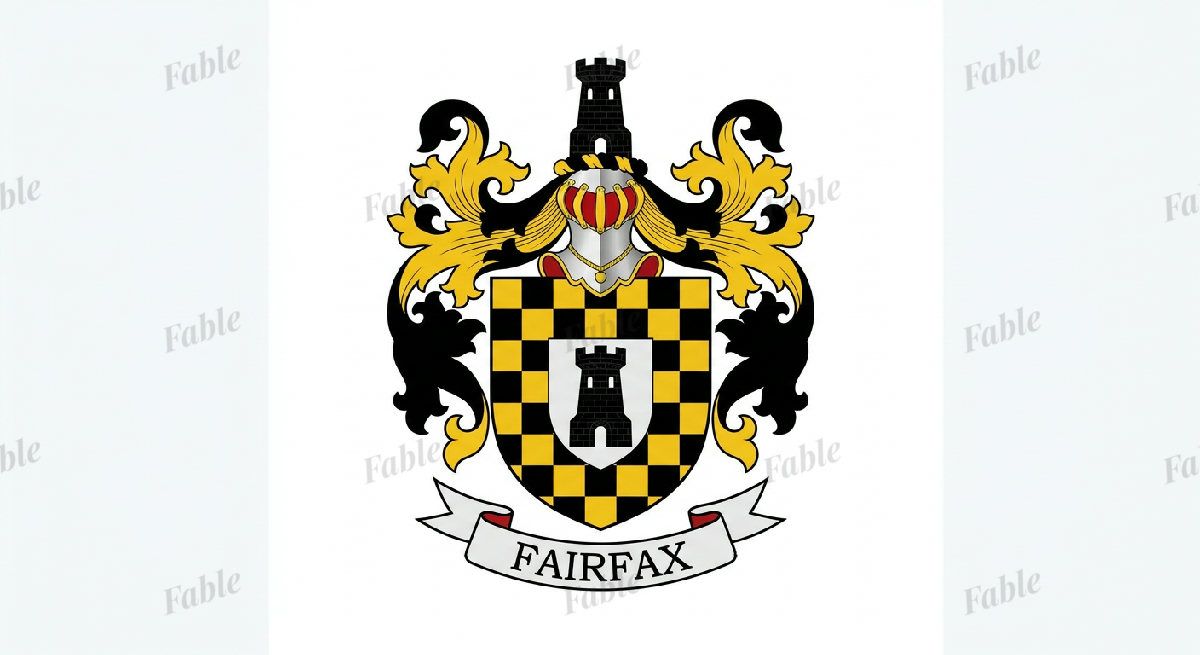
Fairfax design demonstration · Fable Heraldry, 2026 · Fable demo archive. Decorative design for an invented example; not historic arms, a customer testimonial or evidence of surname entitlement.
The Fairfax demonstration provides another geometric comparison: its black-and-gold checks fill a field, while a separate tower appears on a smaller central shape. It is not a Stewart example. A field covered in checks differs from a horizontal chequered band, just as a crest above a helmet differs from the shield itself. Learning to identify those relationships is more valuable than recognising a colour combination at a glance.
Royal arms introduce another category. They identify a sovereign or office within a particular historical setting; they are not a default design for everyone who shares a dynastic surname. A modern decorative project should not blur a personal family story with a claim to royal status. You can discuss the dynasty’s history while keeping the intended identity of the new emblem modest and clear.
The heraldry introduction explains the parts of a fuller achievement. Read it with a picture open and point to each component. That small exercise prevents a common misunderstanding: calling the whole display a crest, then treating every image labelled with the surname as if it represented the same historical thing.
Follow the documents through ordinary lives
The strongest family history often begins with unglamorous records. Establish a person’s parents, spouse, residence and approximate dates before moving backwards. Similar names in neighbouring places may describe different people. A famous pedigree can be easy to find online and difficult to connect to the family actually present in your documents.
Keep a list of uncertain links rather than quietly resolving them in favour of the most exciting account. If a family story mentions a particular estate or branch, ask what record would support the connection. A shared surname or a repeated given name is a clue, not a completed relationship. When the evidence stops, state where it stops.
The Campbell guide offers a parallel lesson in distinguishing a broad surname or clan association from specific arms. That does not make family history less interesting. It gives individual lives room to appear on their own terms: an occupation, a migration, a household or a place can be meaningful without being attached to a celebrated dynasty.
Use stewardship as a personal theme, if it fits
Lang design demonstration · Fable Heraldry, 2026 · Fable demo archive. Decorative design for an invented example; not historic arms, a customer testimonial or evidence of surname entitlement.
A new Stewart emblem might explore stewardship as a chosen theme: caring for a place, keeping a craft alive or passing something on thoughtfully. Present that as a contemporary interpretation inspired by the name, not as a fact about every ancestor. The distinction gives you freedom to make a design that fits the recipient instead of forcing the recipient into a ready-made heraldic story.
Choose one concrete image for the idea. A key might refer to a particular home; a tree could recall a place tended over time; a tool could represent a craft. Avoid piling every association onto the shield. The Lang example shows how a band can organise a small number of charges, but your arrangement should follow your own brief rather than copying the sample and changing its name.
Our design guide recommends beginning with a short written story. Keep any motto equally direct. A phrase the recipient uses or understands may carry more meaning than a borrowed historic motto whose connection has not been established. Check the wording before treating the finished ribbon as a permanent part of the design.
Make the explanation part of the keepsake
Give the emblem a short description that separates three things: the name’s general history, the documented family detail and the new design choices. If only the first and third are known, say so. There is no need to fill the middle with a speculative royal connection. A carefully limited account is easier for later readers to trust and continue.
Inspect the design at the size in which it will be used. A chequered detail that looks crisp at a large scale may become visual noise when reduced. If you choose a pattern, let it support the main figure rather than fight it. A simpler emblem can be more recognisable and more adaptable without losing the story that prompted it.
The coat of arms overview can help you describe the parts accurately. Retain that description with the brief and final image. A contemporary Stewart keepsake can honour a real connection and a thoughtful interpretation of the name while remaining clear that it is a new decorative creation, not a recovered grant or a declaration of inherited status.
Bring a place, a craft or a story of care to Fable Heraldry. A new Stewart emblem can express those connections without borrowing an unproved royal identity.
- Are Stewart and Stuart the same surname?
- They are closely related forms, but a particular family’s spelling history should be established through records rather than assumed from the modern name.
- What is a fess chequy?
- A horizontal band made from alternating squares. It differs from a whole field of checks or a diagonal band.
- Does the surname prove royal descent?
- No. A royal dynasty is part of the surname’s history, but a connection to it requires a documented pedigree.