Campbell family crest: badge, arms and a new design
Understand the chief’s crest badge and specific Campbell arms before planning a contemporary decorative emblem.
The phrase Campbell family crest can refer to three different things: arms borne by a particular Campbell, a clan crest badge associated with the chief, or a newly designed emblem bearing the name. Keeping those categories separate makes the history clearer and the design process more honest. This guide uses labelled contemporary Fable examples to discuss visual choices. They are not pictures of Campbell arms and do not confer any heraldic status.
Start with the name, not the souvenir
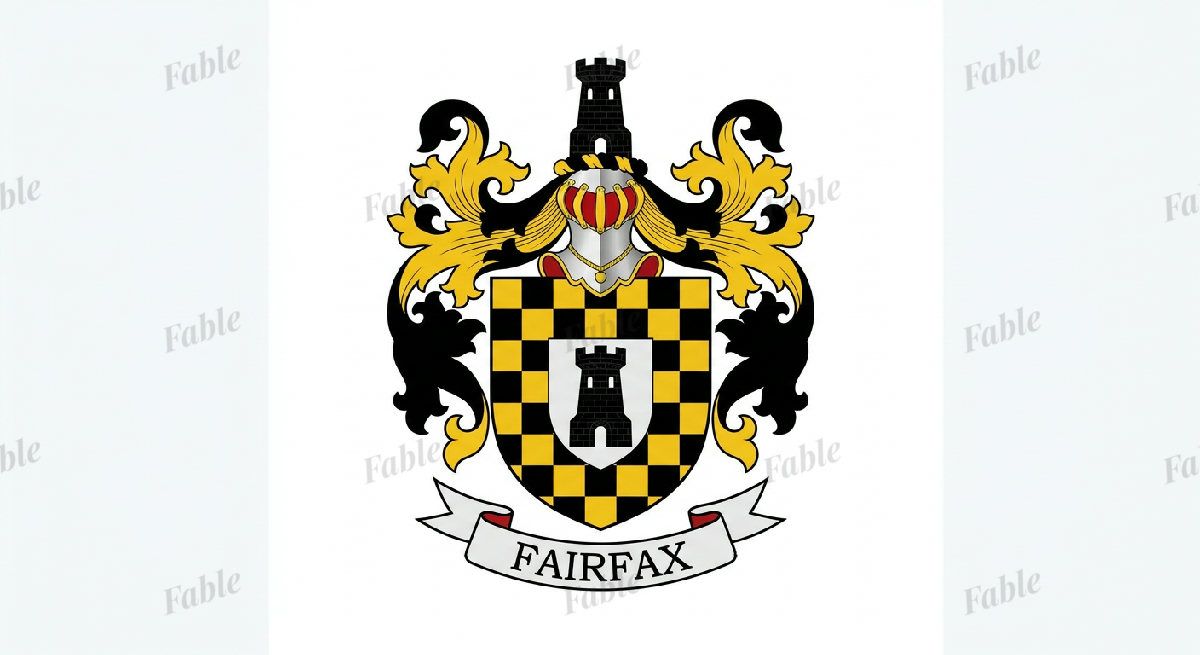
Fairfax design demonstration · Fable Heraldry, 2026 · Fable demo archive. Decorative design for an invented example; not historic arms, a customer testimonial or evidence of surname entitlement.
The familiar Scottish explanation of Campbell derives from Gaelic elements often translated as crooked or wry mouth. Like many surname explanations, it begins with a descriptive name rather than a complete family history. The existence of that explanation does not establish which Campbell line a particular person belongs to. Irish forms and later migration histories can complicate the picture further.
A surname page is therefore a starting point, not the conclusion of research. Record the places and relationships found in your own documents before trying to connect them to a famous house. A shared spelling can be meaningful, but it is too broad to identify one ancestor or one armorial entitlement. The surname meaning guide describes how to keep the linguistic question separate from the genealogical one.
The Fairfax demonstration here has a chequered field and a tower, with its sample name visible below. It was chosen to make the geometry of a shield easy to discuss, not because its checks are Campbell arms. A chequered grid and a shield divided into radiating triangles are different patterns. Accurate naming is part of looking carefully, even when two designs use similar colours.
The chief’s crest is not the whole achievement
The Clan Campbell Society distinguishes the chief’s crest from the full arms. The crest associated with the Duke of Argyll is a boar’s head; a clan member’s crest badge encloses the chief’s crest within a strap and buckle. The surrounding form communicates allegiance rather than possession of the chief’s arms. This is why a badge and a shield should not be treated as interchangeable souvenirs of the same entitlement.
The Court of the Lord Lyon’s guidance explains the distinction between a chief’s use of a crest and a clansperson’s badge. If you intend to use a formal Scottish heraldic device, consult that guidance and the relevant records directly. A commercial product description is not a substitute for them.
For an introductory comparison, the guide to Irish and Scottish crests gives the broader context. It is possible to value a clan association while being precise about what the badge signifies. Precision does not weaken the connection; it prevents the chief’s personal heraldic identity from being casually represented as a design owned by everyone who shares the name.
Read the specific arms with their bearer
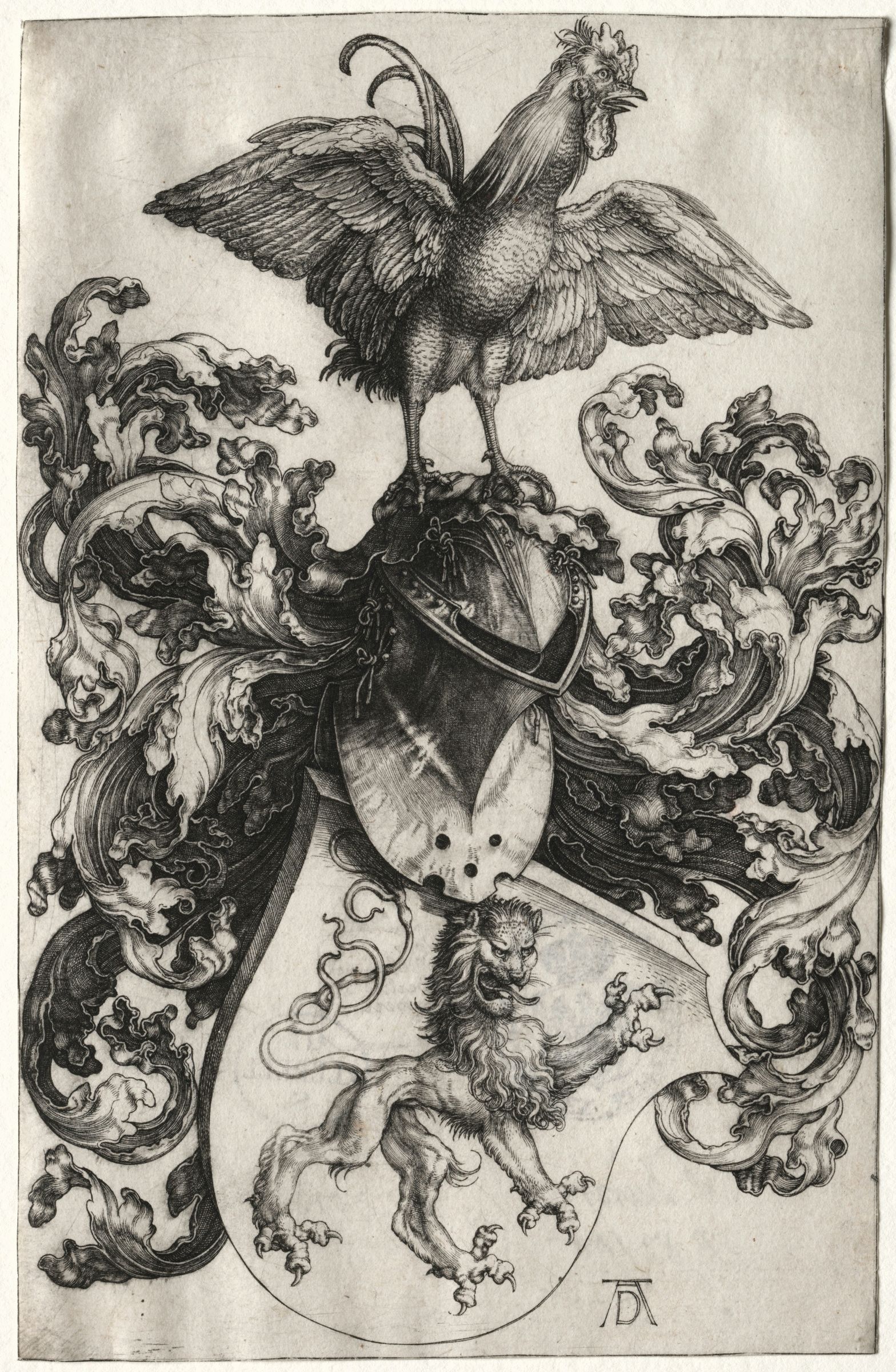
The Coat of Arms with a Lion and Cock · Albrecht Dürer, probably 1503 · Cleveland Museum of Art. Prepared for print by Surrealium at Vaxholm Fortress, Sweden.
The Clan Campbell Society describes the Duke of Argyll’s arms as quartered, combining the Campbell gyronny pattern with the galley of Lorne. Gyronny divides a field into triangular sections radiating from a centre; it is not a checkerboard. The society’s account identifies the bearer and the composition together. Those details should remain attached whenever the arms are discussed.
Other Campbell houses have their own heraldic histories. A familiar surname does not erase differences between branches, and the crest of one house should not be silently substituted for another. If a source names Airds, Inverawe or another specific line, keep that name in your notes. Do not simplify the entry to “Campbell” and discard what makes it identifiable.
Dürer’s lion-and-cock engraving alongside this section is a historical comparison for the parts of an achievement, not Campbell imagery. It separates a shield charge from a crest above a helmet. The heraldry introduction explains that vocabulary. Knowing which part a source describes helps prevent a surprisingly common error: copying a crest description into the shield or treating the mantling as if it were the main identity.
Research a connection without assuming one
If inherited arms are the object of your search, begin with documentary relationships. A family story about a Scottish county or an old photograph of a badge can be a useful clue, but it does not establish every link in a pedigree. Record what each source actually shows, including uncertainty about names, dates or places. Keep a proposed connection separate from a demonstrated one.
Formal Scottish arms are recorded and used within a specific heraldic system. That inquiry is different from choosing a decorative emblem for a household. The coat-of-arms-for-surname guide explains the difference in practical terms. If your aim is a personal gift, you need not pretend to have completed genealogical work that has not been done.
Comparing the Stewart guide can be helpful because a famous dynastic name creates a similar temptation to jump from a surname to a celebrated line. The more recognisable the history, the easier it is to overlook the ordinary documentary steps. A careful account can celebrate an association while still saying plainly what remains unknown.
Design from a story you can explain
Fairfax design demonstration · Fable Heraldry, 2026 · Fable demo archive. Decorative design for an invented example; not historic arms, a customer testimonial or evidence of surname entitlement.
For a new Campbell emblem, start with the recipient’s actual connection to the name. It might be a family place, a shared interest or an event remembered across generations. Choose a symbol for that story rather than assembling the most impressive parts of existing Campbell arms. A new decorative design should have its own rationale.
The contemporary Fairfax example shows how a bold field pattern and one tower can hold together. Your design need not use either. You could choose a simple division, a single charge and a restrained palette, then use the surrounding ornament to give the mark the desired character. If the design becomes crowded, decide which element carries the main meaning and give it more space.
A motto deserves the same care as a symbol. Do not copy a chief’s motto merely because it appears on a popular badge and then present the whole arrangement as newly personal. You may prefer words connected with your own household, in a language you use. Check spelling and meaning before adding them. The design will be easier to explain when every choice has a reason beyond resemblance to a souvenir.
Keep the categories visible when you share it
An accompanying note can distinguish a documented clan connection from a new design inspired by it. If the emblem is contemporary, say so. If a particular historic badge is discussed, identify whose crest it contains and what the surrounding strap and buckle means. A few accurate sentences are more useful than a sweeping claim of ancient ownership.
Inspect the finished mark as a complete picture. Small lettering, crowded helmet ornaments or a tiny central charge can disappear when the image is reduced. Decide how the design will be used before adding complexity. A bookplate and a large decorative print do not ask for exactly the same visual density, even when they share an emblem.
The guide to making a coat of arms offers a practical next step for a contemporary design brief. Keep the research notes and the design notes together, with a clear boundary between them. That way the mark can become a meaningful family object without acquiring a false history as it is copied, gifted or passed from one person to another.
Use Fable Heraldry to develop a new decorative emblem from your own brief. Keep any clan association accurately described, and let the new design carry a story that belongs to its recipient. The coat of arms guide explains the shared vocabulary behind these choices.
- Can every Campbell use the Duke of Argyll’s arms?
- A shared surname does not establish entitlement to a particular bearer’s arms. The chief’s crest badge and his full arms are distinct forms with different meanings.
- What does gyronny mean?
- It describes a field divided into triangular sections radiating from a central point. It is different from a chequered field.
- Are the examples here Campbell heraldry?
- The Fable demonstrations are contemporary design examples for other sample names. The historical discussion identifies Campbell bearers separately.