Anderson family crest: many origins, one personal brief
Separate the patronymic name from specific armorial records, then plan a new emblem using labelled contemporary examples.
An Anderson family crest cannot be identified from the surname alone. Anderson is a patronymic, broadly a name formed from Andrew or a related given-name form, and it has developed in more than one language and place. Scottish, northern English, German and Scandinavian histories can all be relevant. The first task is to identify the people in your records. The second, if needed, is to investigate a particular armorial connection. A new decorative design is a third and separate project.
A patronymic can begin more than once
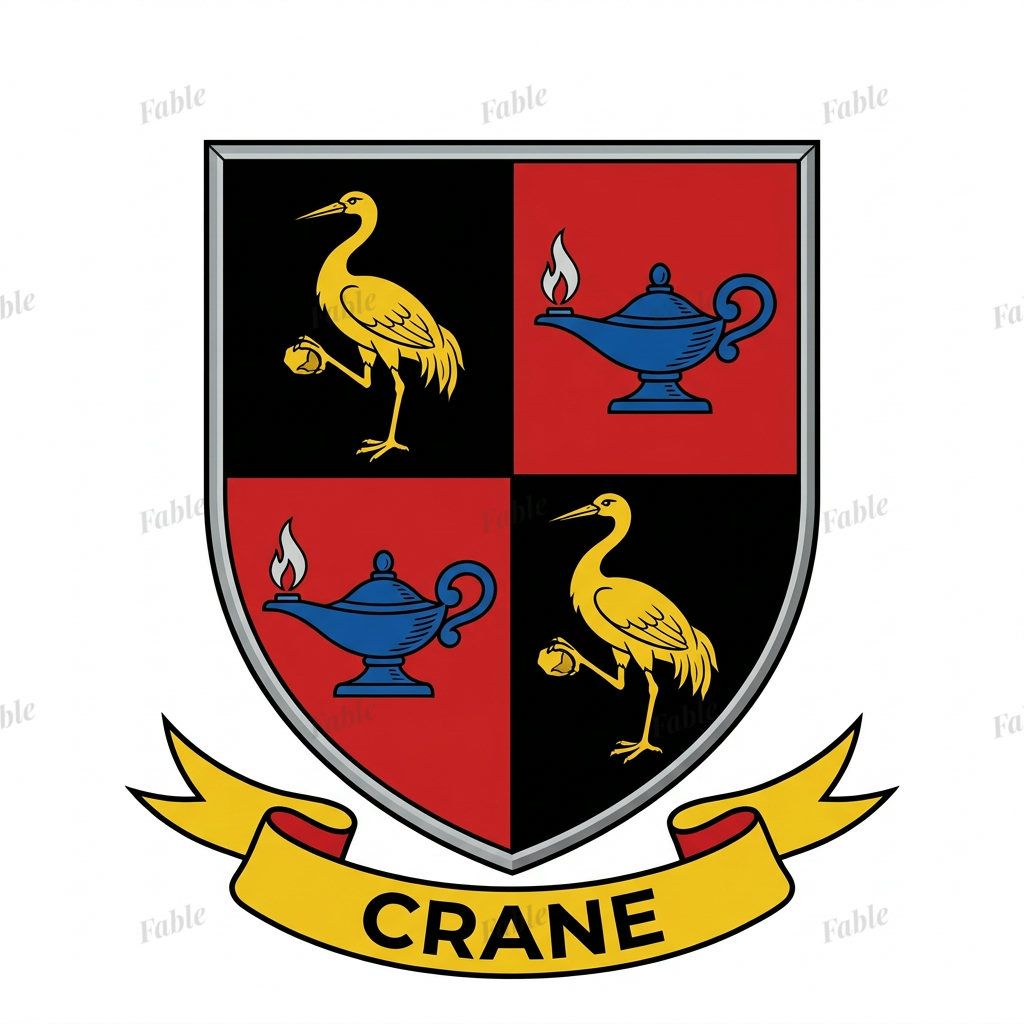
Crane design demonstration · Fable Heraldry, 2026 · Fable demo archive. Decorative design for an invented example; not historic arms, a customer testimonial or evidence of surname entitlement.
The Dictionary of American Family Names entry reproduced by FamilySearch describes Scottish and northern English Anderson as a patronymic from a form of Andrew. It also notes German and Scandinavian connections, including Americanised forms of Andersson, Andersen and related names. The shared modern spelling therefore does not point to one founding household.
This is an especially good name with which to practise restraint in research. A surname map or a familiar clan badge may suggest a direction, but the documents should determine which direction belongs to your family. Record the earliest securely identified place and the spelling used there. If a person emigrated, look for evidence that connects the name before and after the move.
The surname meaning guide explains why a linguistic relationship is not the same as a genealogical one. The Crane demonstration here is a contemporary Fable design with birds and lamps. It is not Anderson heraldry. Its role is to show how repeated charges can organise a new emblem, while the historical question remains grounded in names, people and records rather than visual resemblance.
Be precise about the Anderson record
Accounts of Scottish Anderson heraldry refer to an entry for Anderson of that Ilk in the Forman-Workman manuscript of 1566, while acknowledging uncertainty about the individual’s identification. That uncertainty is part of the record’s modern interpretation. It should not disappear when the story is shortened into a product caption. An early reference can be significant without solving every question about later bearers.
The oak and the words “Stand Sure” are familiar in Anderson crest-badge discussions. Familiarity alone does not establish a right to a particular person’s complete arms. A badge, a crest and a shield must be identified separately, and a connection to a named line needs evidence. Do not assemble the most recognisable pieces from several sources into a supposedly universal Anderson achievement.
The guide to Irish and Scottish crests supplies context for badges and armorial practice. For a formal Scottish inquiry, use the relevant register and guidance directly. A decorative brief can acknowledge an interest in Scottish heritage without pretending that a surname search has resolved an entitlement question.
A tree can be personal without being inherited
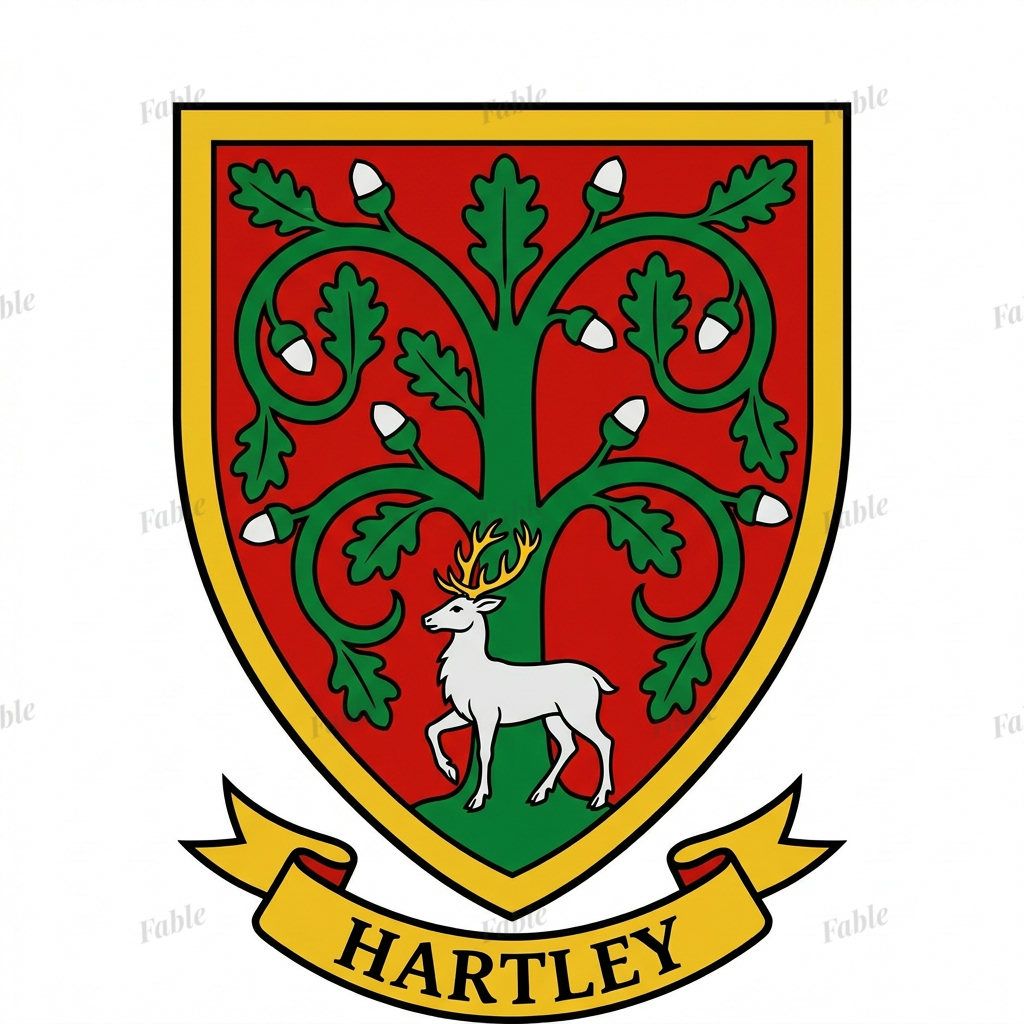
Hartley design demonstration · Fable Heraldry, 2026 · Fable demo archive. Decorative design for an invented example; not historic arms, a customer testimonial or evidence of surname entitlement.
The Hartley demonstration shows an oak and a stag on a red field. It is a newly designed sample, not historic Anderson arms and not evidence of an Anderson branch. Its tree is useful here as a design example precisely because the caption makes that limitation clear. A recognisable plant can carry a personal association without claiming to reproduce an ancestral crest.
Look at the balance between trunk, canopy and animal. The tree gives the composition a vertical structure, and the surrounding space keeps its smaller parts from merging. If an oak genuinely belongs in your brief, you can explain why: perhaps it recalls a particular garden, a place visited together or a story told by a relative. That explanation is stronger than attaching a generic virtue to the tree and calling it historical fact.
The heraldry guide considers how charges function within a shield. It also distinguishes personal interpretation from a documented bearer’s meaning. The same visible object can belong to many different designs. What makes your new emblem personal is the reason you choose it and the way the whole composition is developed, not an assumption that the object has one universal message.
Follow spelling changes through people
When a family has crossed languages, preserve the original forms found in records. Andersson, Andersen and Anderson may be connected within a particular life, but that connection should be demonstrated rather than inferred from similarity. A passenger record, a marriage entry or a naturalisation document may help link the forms. Dates and close relatives can be as important as the spelling itself.
Keep uncertain matches in a separate working list. If two people share a name and approximate age, note what would distinguish them before choosing one. A plausible story can become difficult to correct once it has been printed on a gift or repeated in a family account. Slowing down at the uncertain link is usually easier than unpicking a confident narrative later.
The coat-of-arms-for-surname guide explains why these documentary steps cannot be replaced by finding a matching shield online. For a useful contrast, the Stewart guide explores an occupational surname with a famous dynastic association. Both names show how a broad historical explanation can be mistaken for a personal pedigree if its limits are not kept visible.
Write a brief that belongs to this household
Crane design demonstration · Fable Heraldry, 2026 · Fable demo archive. Decorative design for an invented example; not historic arms, a customer testimonial or evidence of surname entitlement.
Begin with the people who will use the design. Are you making an emblem for one person, a household or a shared project? That decision affects the name, initials and symbols. A household with several surnames may prefer a place or shared interest as its central theme rather than making one name appear to represent everyone automatically.
The Crane example repeats birds and lamps across its quarters. It shows one way of creating rhythm, but a new Anderson design might be much simpler. Choose a dominant image, one supporting detail and colours with enough contrast. If every element needs a long explanation, decide whether some belong in the accompanying note rather than on the shield itself.
Our guide to making a coat of arms helps turn a short story into a coherent decorative brief. Use a motto only if the wording matters to the recipient and has been checked. You can write in a language you actually use. A contemporary emblem does not need to imitate the authority of an archival document in order to become a meaningful family object.
Retain the difference between evidence and choice
A useful note might say that a recorded ancestor used a particular spelling in a particular place, while the new design’s oak was chosen to remember a family garden. Those are two distinct kinds of statement, and both can be true. Avoid a sentence that turns the chosen oak into proof that the ancestor bore an oak crest. The image cannot fill a gap in the documentation.
Before keeping the design, inspect its smallest lettering and its main silhouette. Make sure names are spelled as intended and that no sample wording has been carried over. Consider how the mark will look when reduced to a small card or bookplate. If the tree’s leaves or the shield’s divisions become indistinct, simplifying can improve the result more than adding detail.
Keep the brief, the historical notes and the final image together. Future family members should be able to tell which elements were researched and which were newly selected. That clarity leaves the story open to further discoveries. It also lets a new Anderson emblem stand confidently as a contemporary creation made with care, rather than a historical claim it was never equipped to prove.
Start a new Anderson emblem in Fable Heraldry with the spelling and story the recipient uses. Let the design express that connection while keeping historical claims tied to their sources. The coat of arms guide explains the shared vocabulary behind these choices.
- Is Anderson always Scottish?
- No. The surname has several linguistic and regional histories, including Scottish, English, German and Scandinavian connections. Your own records determine which is relevant.
- Does an Anderson badge prove descent from one clan line?
- A badge or shared surname does not establish a pedigree. A specific connection requires documentary evidence.
- Can I choose an oak for a new emblem?
- Yes, as a contemporary design choice with a clear personal explanation. Do not present that choice as proof of inherited arms.