Saint George and the Dragon: fifteen paintings, seventeen hundred years
From a Roman soldier's tomb to the Pre-Raphaelites, the story of the most painted fight in Western art, told through fifteen masterworks you can hang at home.
A knight on a white horse, a lance, a dragon, a princess who is no longer afraid. Few pictures are recognised so quickly, in so many countries, by people of so many faiths and none.
The man behind it was real. The dragon arrived seven centuries later. Between them they gave painters a scene with everything: courage, a monster, a rescue, a horse in full flight. Here is how the story grew, told through fifteen of the paintings that made it, each one restored from its museum scan and available as a print.
A soldier, then a saint
George was a Roman soldier, probably from Cappadocia in what is now Turkey. Around 303, under the emperor Diocletian, he refused to give up his Christian faith and was executed. His tomb at Lydda, near today's Tel Aviv, became a place of pilgrimage within a generation.
For his first seven hundred years there was no dragon. He was a martyr and a soldier saint, painted standing, in armour, holding a cross. The dragon appears in the eleventh century, first in Georgian and Greek sources, and the earliest pictures that show it are icons.
1. The Miracle of Saint George and the Dragon
Novgorod school, The Miracle of Saint George and the Dragon, 15th century. State Russian Museum, Saint Petersburg.
Painted in tempera on a wooden panel, this icon shows the dragon story at its plainest. A white horse leaps across a cinnabar red ground, the saint's cloak streams behind him, and a slender lance runs straight into the dragon's jaw. There is no princess and no city, only the fight.
Look at the top right corner: a hand reaches out of a blue segment of heaven to bless him. The icon is not about a knight's skill but about where his strength comes from.
Buy as is Create your portrait in this style
2. Saint George and the Dragon
Rogier van der Weyden, Saint George and the Dragon, c. 1432–1435. National Gallery of Art, Washington.
The original is barely larger than a postcard, about fourteen by ten centimetres, and painted with a brush of a few hairs. George rises in the stirrups to drive his lance down into the dragon, the princess kneels in prayer at the left, and behind them a whole Flemish town spreads along the water below a hilltop castle.
Its smallness made it a private object, something to hold in the hand and pray with. Printed larger, the detail Rogier hid in it finally has room.
Buy as is Create your portrait in this style
3. Saint George and the Dragon
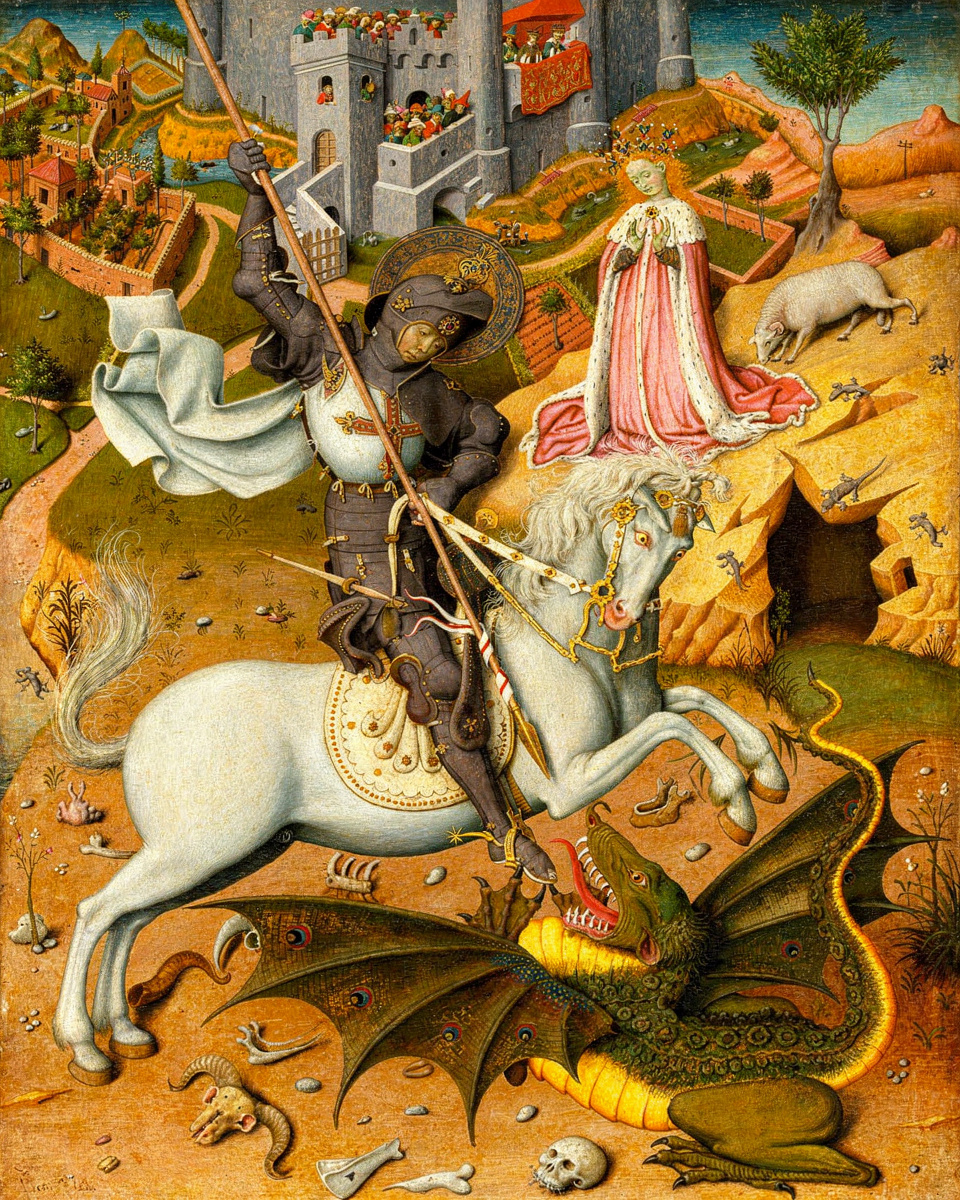
Bernat Martorell, Saint George and the Dragon, 1434–1435. The Art Institute of Chicago.
This was the centre of an altarpiece in Barcelona. Its side panels, now in the Louvre, told the rest of his martyrdom. Here the princess prays on the hillside, the townspeople crowd the castle walls to watch, and the ground is scattered with the bones of the dragon's earlier victims.
In Catalonia he is Sant Jordi, and on his day, 23 April, people still give each other a rose and a book. Martorell's gold and crimson are the colours of that festival.
Buy as is Create your portrait in this style
The Golden Legend
The version everyone knows was fixed around 1260 by Jacobus de Voragine, archbishop of Genoa, in The Golden Legend, the bestselling book of the Middle Ages after the Bible.
In it, a dragon lives in a lake beside the city of Silene in Libya. The townspeople feed it two sheep a day, then, when the sheep run out, their children, chosen by lot. The lot falls on the king's daughter. George rides by, wounds the dragon, and tells the princess to tie her girdle round its neck. It follows her into the city 'like a meek beast', and the whole city is baptised. Painters read it closely.
4. Saint George and the Dragon
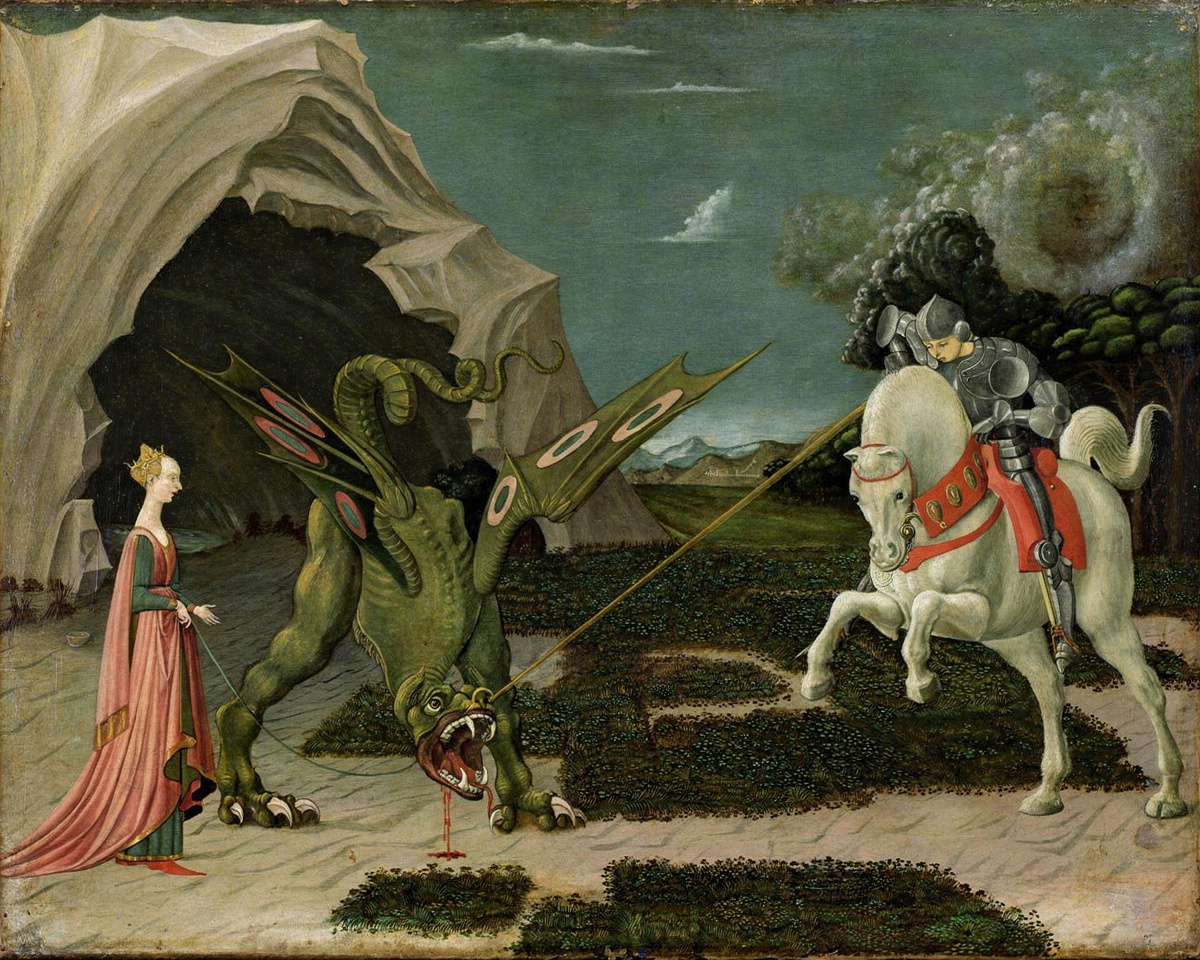
Paolo Uccello, Saint George and the Dragon, c. 1470. The National Gallery, London.
Uccello paints the Golden Legend almost word for word. The princess stands calmly at the mouth of the cave holding the dragon on a leash made from her own girdle, while George's lance strikes home. Behind him a storm spirals in the sky.
Watch the eye of that storm. It lines up with the point of the lance, as if heaven itself is aiming the blow. It is the most famous Saint George in Britain for good reason.
Buy as is Create your portrait in this style
5. Saint George and the Dragon
Vittore Carpaccio, Saint George and the Dragon, 1502. Scuola di San Giorgio degli Schiavoni, Venice.
Painted for the meeting house of Venice's Dalmatian community, where it still hangs. Two charges meet head-on across a long panel, the lance driven clean through the dragon's head, and in the foreground lie the remains of everyone who came before.
Its long format reads like a stage. It is the painting that best shows what was at stake, and it makes a striking piece above a sofa or a sideboard.
Buy as is Create your portrait in this style
6. Saint George and the Dragon
Raphael, Saint George and the Dragon, c. 1506. National Gallery of Art, Washington.
Raphael was in his early twenties when he painted this small panel for the court of Urbino. The white horse wheels, George leans in to drive his lance down the dragon's throat, and the princess kneels in prayer in a soft Umbrian landscape of slender trees.
Look at George's left leg: a blue garter with the letters HONI, the first word of the motto of the English Order of the Garter. The Duke of Urbino had just been made a knight of the order by Henry VII, and the painting was probably a gift to the English king.
Buy as is Create your portrait in this style
The knights' saint
Crusaders brought George home from the East, and Europe's knights adopted him. A soldier who fought for something larger than himself was exactly what chivalry wanted to see in the mirror.
In 1348 Edward III founded the Order of the Garter under his protection, and after Agincourt in 1415 his feast became one of the great days of the English year. His red cross on white became England's flag. Georgia, Portugal, Catalonia, Genoa and Moscow all claim him too, and his day, 23 April, is still kept across them.
7. Saint George
Andrea Mantegna, Saint George, c. 1460. Gallerie dell'Accademia, Venice.
The battle is over. George stands framed in a marble window, his broken lance in hand and the dead dragon at his feet, with a garland of fruit hung above him. Mantegna paints armour as if it were carved, and the saint looks out past us with the calm of a Roman statue.
This is George as he appeared on banners and badges: not mid-fight but victorious, a figure to stand behind. Its tall, narrow format suits a hallway or the side of a doorway.
Buy as is Create your portrait in this style
8. Saint George on Foot
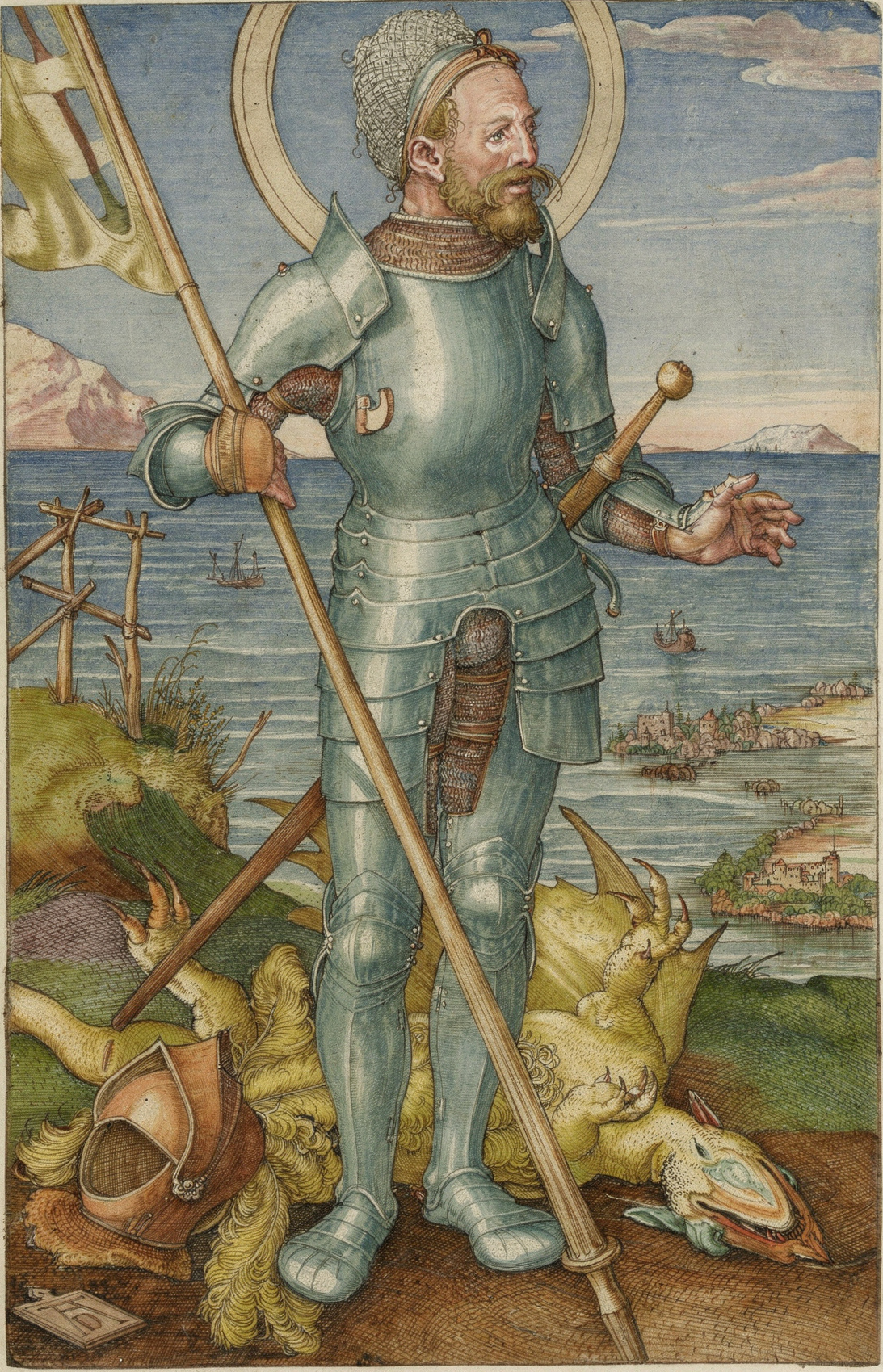
After Albrecht Dürer, Saint George on Foot, c. 1504–1505. Fable Atelier colour edition of the engraving in the Cleveland Museum of Art.
Dürer's engraving shows George standing over the slain dragon, holding his banner, with his famous AD monogram on a tablet. Our Atelier edition interprets the black-and-white print in restrained colour, as if Dürer had painted it, without changing a single line of the figure.
Engravings like this one carried George across Europe. They were cheap, portable and copied everywhere, which is how one Nuremberg image could end up on a farmhouse wall in Sweden.
Buy as is Create your portrait in this style
9. Saint George in the Forest
Albrecht Altdorfer, Saint George in the Forest, 1510. Alte Pinakothek, Munich.
Look for the knight. He is there, small, on a white horse at the bottom of the picture, and the dragon is smaller still. Everything else is forest: thousands of golden leaves painted one by one on parchment.
This is one of the first European paintings in which the landscape matters more than the story. The legend became an excuse to paint the deep German woods, and it makes the most quietly surprising print in this list.
Buy as is Create your portrait in this style
10. Saint George and the Dragon
Sodoma, Saint George and the Dragon, probably 1518. National Gallery of Art, Washington.
Sodoma sets the fight beside a busy harbour, with ships at anchor and a hill town above. George, in a red cloak, leans down from his horse to finish the dragon, while the princess, in red and gold, clasps her hands at the left. The foreground keeps the grim reminders of the dragon's appetite.
Every part of the Golden Legend is here, the city, the princess, the victims, arranged with Renaissance ease. It is the most complete telling of the story in one picture.
Buy as is Create your portrait in this style
Drama
By the middle of the sixteenth century every viewer knew how the story ended. So painters stopped telling it and started staging it, pushing the camera in, turning the princess toward us, and filling the sky with light.
11. Saint George and the Dragon
Jacopo Tintoretto, Saint George and the Dragon, c. 1555. The National Gallery, London.
Tintoretto puts the fight in the background. In front, the princess runs straight toward us in a storm of pink and blue silk. Between them lies one of the dragon's victims, arms spread wide, and above, God appears in a burst of light.
We see the scene through her eyes, mid-escape. It is the moment of fear that every earlier painting skipped, and it is why this picture still feels modern.
Buy as is Create your portrait in this style
12. Saint George and the Dragon
Peter Paul Rubens, Saint George and the Dragon, c. 1606–1608. Museo del Prado, Madrid.
Rubens painted it in Italy, in his early thirties, and filled the canvas from edge to edge. The grey horse rears, the red cloak flies, the feathered helmet tosses, and the dragon writhes underneath. At the left the princess holds a lamb, the sheep the city fed the dragon before it fed it children.
It is the most physical version of all: muscle, mane and motion. On a wall it brings energy into the whole room.
Buy as is Create your portrait in this style
The dream of chivalry
In 1817 the engraver Benedetto Pistrucci put George and the dragon on the British gold sovereign, where he still rides. Victorian Britain, building railways and an empire, looked back to knights with longing, and its painters found in George a hero for the imagination rather than for the church.
What does the story mean? For the church it was faith overcoming evil. For knights it was duty. For the Victorians and Symbolists it became something more private: the self overcoming its own monster.
13. The Wedding of Saint George and the Princess Sabra
Dante Gabriel Rossetti, The Wedding of Saint George and the Princess Sabra, 1857. Tate, London.
Rossetti skips the fight entirely and paints the ending. The princess, named Sabra in Richard Johnson's 1596 romance The Seven Champions of Christendom, draws the armoured George close. Angels ring bells behind them, and in a box at the bottom sits the dragon's head.
A dense, jewel-coloured watercolour, a love story told in the language of medieval manuscripts. It is the romantic choice of the fifteen.
Buy as is Create your portrait in this style
14. The Fight: Saint George Kills the Dragon
Edward Burne-Jones, The Fight: Saint George Kills the Dragon VI, 1866. Art Gallery of New South Wales, Sydney.
The sixth of seven panels Burne-Jones painted for the dining room of the painter Myles Birket Foster's house in Surrey. His lance already broken on the grass, George bends over the dragon and drives his sword into its jaws, while the princess kneels in white and blue, her hands clasped.
Burne-Jones slows the fight down until it looks like a tapestry. It is still, decorative and quietly intense, a Saint George made for a home rather than a church.
Buy as is Create your portrait in this style
15. Saint George and the Dragon
Gustave Moreau, Saint George and the Dragon, 1889–1890. The National Gallery, London.
Moreau turns the scene into a vision. The white horse rears, jewelled like a reliquary, George's haloed head bends to his work as a thin red lance pierces the dragon's throat, and the winged beast coils away into a serpent's tail. High on the rocks the crowned princess prays, a pale tower behind her.
Painted at the end of a century of science and steam, it is George as pure imagination, the last great painting of the legend and a fitting end to this story.
Buy as is Create your portrait in this style
Seventeen centuries on, the fight still works because it is simple. Something frightening is faced, and the person facing it does not turn away. Every one of these fifteen works is restored from its museum scan and printed to order, and any of them can become the setting for a portrait of your own.