St George and the Dragon: the story and what it means
The legend told in full, the real soldier who inspired it, what the dragon stands for, and why England, Catalonia, Georgia and Moscow all call him their own.
A city held to ransom by a dragon. A princess chosen by lot to be its next meal. A soldier on a white horse who happens to ride by. The story of St George and the Dragon is told to children on 23 April, carved over church doors and stamped on British gold coins, and most of us know it only in outline.
Here it is in full, with the questions people ask most about it: who George really was, whether there was ever a dragon, where the fight is supposed to have happened, and what the whole thing means. Each answer is paired with a painting of the scene, restored from its museum scan.
What is the story of St George and the Dragon?
The version almost everyone knows comes from The Golden Legend, a book of saints' lives written around 1260 by Jacobus de Voragine, archbishop of Genoa.
Near the city of Silene, in Libya, a dragon lived in a lake. Its breath poisoned anyone who came close, so the people kept it away from their walls by feeding it two sheep every day. When the sheep began to run out, they gave it one sheep and one person, and the person was chosen by drawing lots among the young people of the city.
One day the lot fell on the king's daughter. The king offered all his gold and silver to spare her, but the people refused: their own children had died, and the law was the law. Dressed as a bride, the princess walked out alone to the lake.
George, a soldier from Cappadocia, was riding past. The princess begged him to save himself and leave, but he stayed. When the dragon came out of the water he made the sign of the cross, rode at it and wounded it with his lance, pinning it to the ground. Then he told the princess to take off her girdle and tie it around the dragon's neck. She did, and the beast followed her into the city like a tame dog.
The people fled in terror. George told them he would kill the dragon if they became Christians. The king and his people were baptised, fifteen thousand men without counting the women and children, and George cut off the dragon's head. The king built a church on the spot, and a spring that healed the sick rose beside its altar.
1. Saint George and the Dragon
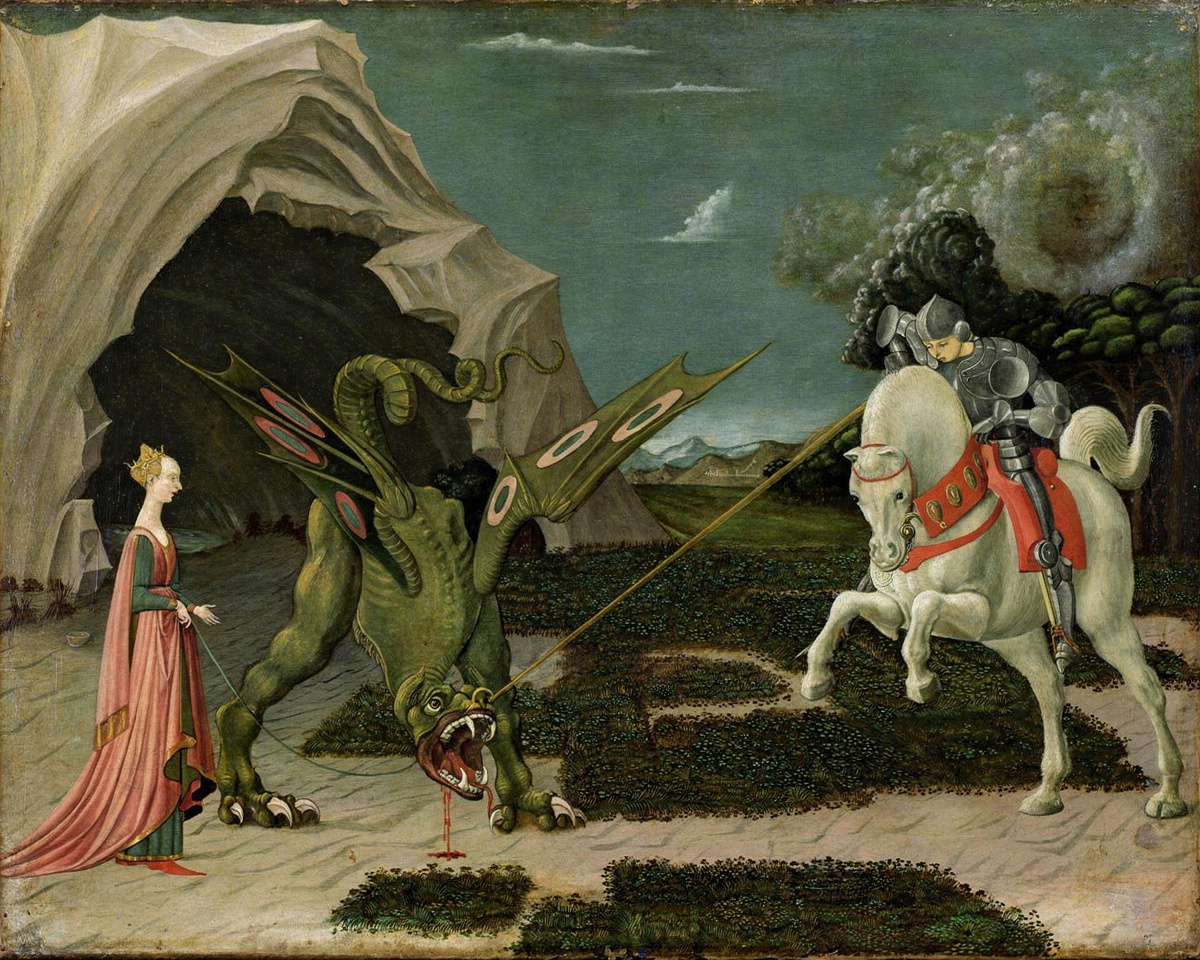
Paolo Uccello, Saint George and the Dragon, c. 1470. The National Gallery, London.
Uccello painted this moment almost word for word: the dragon already wounded, and the princess calmly holding it on a lead made from her own girdle.
The spiral in the stormy sky lines up with the lance, as if heaven is steering the blow. It is the clearest picture of the Golden Legend in any museum.
Who was St George?
Behind the legend stands a real man, though we know very little about him. George was a soldier in the Roman army, most likely born in Cappadocia, in what is now central Turkey, to a Christian family.
In 303 the emperor Diocletian ordered Christians in the army to make sacrifice to the Roman gods. George refused. Tradition says he was tortured and then beheaded at Nicomedia on 23 April 303, which is why his feast falls on that day. His body was taken to Lydda, today's Lod in Israel, where a church still claims his tomb.
He was honoured as a martyr almost at once. Churches were dedicated to him across the eastern Mediterranean within two centuries, and soldiers in particular took him as their patron: a fighting man who would not betray his conscience.
2. Saint George
Andrea Mantegna, Saint George, c. 1460. Gallerie dell'Accademia, Venice.
Mantegna shows George as the early church saw him: a young soldier standing still, the fight already over, his broken lance in his hand.
There is no princess and no rescue here. The painting is about the man's steadiness, which is what his first followers honoured long before anyone told the dragon story.
Was St George real, and did he really kill a dragon?
George was almost certainly real. The dragon was not.
For his first seven hundred years George had no dragon at all. Early accounts of his life are about his trial and martyrdom, and they became so full of improbable miracles that in 494 Pope Gelasius I listed him among the saints whose names are rightly honoured but whose deeds are known only to God.
The dragon appears in the eleventh century, first in Georgian and Greek sources, and spread west with the Crusaders. It probably borrowed from much older stories. The Greek hero Perseus rescued the princess Andromeda from a sea monster at Jaffa, a few miles from George's tomb at Lydda, and dragon-slaying was an old way of showing good defeating evil. The dragon was never meant as natural history. It was a picture of something worse.
3. The Miracle of Saint George and the Dragon
Novgorod school, The Miracle of Saint George and the Dragon, 15th century. State Russian Museum, Saint Petersburg.
This Russian icon is one of the oldest forms of the dragon scene: no city, no princess, just the saint, his horse and the beast on a field of red.
In the top corner a hand reaches out of heaven to bless him. The icon makes the point the legend was built for: the victory is God's, not George's.
Where did St George slay the dragon?
The Golden Legend puts the fight at Silene in Libya, a city no one has ever found. That has not stopped other places from claiming it.
In Beirut, St George Bay is said to be where he killed the dragon, and the city has honoured him for centuries. In Palestine the story is told around Lydda, where he is buried. In England, at Uffington in Oxfordshire, a flat-topped hill below the famous chalk White Horse is called Dragon Hill: local legend says George killed the dragon there, and the bare patch of chalk on top where grass never grows is where its blood was spilled.
Painters, meanwhile, set the fight wherever they lived. Venetians gave it a lagoon, Germans a forest, Netherlandish painters a walled town with spires.
4. Saint George and the Dragon
Sodoma, Saint George and the Dragon, probably 1518. National Gallery of Art, Washington.
Sodoma moves the fight to a busy Italian harbour, with ships at anchor and a hill town looking down, as if it were happening on his own coast.
Every painter put the dragon on their own doorstep. That is part of why the story travelled so well: it could happen anywhere.
What does the dragon represent?
In Christian art a dragon is the devil. The Book of Revelation calls Satan 'the great dragon, that old serpent', and the archangel Michael is shown overcoming him in the same pose George later borrowed. So when George pins the dragon with his lance, the first meaning is simple: faith defeats evil.
The details carry the rest. The lance, often broken, or marked with a cross, is faith itself. The white horse stands for purity. The city that feeds its children to the dragon is a people living in fear and sin, and its baptism at the end is the real rescue. Later readers added their own meanings: for knights the dragon was the enemy, for the Victorians the beast inside each of us.
5. Saint George and the Dragon
Rogier van der Weyden, Saint George and the Dragon, c. 1432–1435. National Gallery of Art, Washington.
Rogier van der Weyden painted this panel no bigger than a postcard. The dragon is small and almost delicate, writhing in the grass.
Next to the vast landscape and the calm city behind, the dragon looks almost pitiful. Evil, in this picture, is real but small.
What is the moral of St George and the Dragon?
Strip away the scales and the armour and the story is about courage. A whole city has accepted something monstrous as normal, paying for its safety with its children. One person refuses to accept it, and rides at the thing everyone else is afraid of.
That is why the legend has outlived the age of knights. Teachers use it to talk about standing up to bullies, the church about faith, writers about facing what frightens us. George is also not saving himself. He has nothing to gain from the fight, and the princess even begs him to leave. The moral is that bravery is for others.
6. Saint George and the Dragon
Vittore Carpaccio, Saint George and the Dragon, 1502. Scuola di San Giorgio degli Schiavoni, Venice.
Carpaccio shows exactly what the city had been paying for. Around the dragon's lair lie bones, skulls and half-eaten bodies of the people it took.
Look past the clash to the ground between them. The horror is so carefully painted that George's charge feels less like heroics and more like necessity.
Who was the princess in St George and the Dragon?
In The Golden Legend she has no name at all: she is simply the king's daughter. Later retellings gave her one. In Richard Johnson's popular English romance The Seven Champions of Christendom, published in 1596, she is Sabra, daughter of the king of Egypt, and she and George marry. Later Italian retellings call her Cleodolinda.
In the earliest pictures she is barely there. By the Renaissance she is almost as important as George, and painters show her in every mood from prayer to terror. For the church she stood for the soul, or the Church itself, rescued from the devil. For the Victorians she was a heroine of romance.
7. The Wedding of Saint George and the Princess Sabra
Dante Gabriel Rossetti, The Wedding of Saint George and the Princess Sabra, 1857. Tate Britain, London.
Rossetti skips the fight and paints the happy ending of Johnson's romance. Sabra draws George close with a lock of her hair, and the dragon's head lies in a box.
It is the only painting here where the princess is the centre of the story, and it shows how far the legend had travelled from a saint's martyrdom to a love story.
Why is St George the patron saint of England?
George never set foot in England. He arrived as a soldier's saint, carried home by Crusaders who believed he had fought beside them at Antioch in 1098.
Kings took him up next. In 1348 Edward III founded the Order of the Garter, England's highest order of knighthood, under George's protection, with its chapel at Windsor. After Henry V's victory at Agincourt in 1415, his feast day on 23 April became one of the great holidays of the English year, and he gradually replaced older English saints such as Edmund the Martyr as the country's patron. His red cross on a white ground became England's flag and is still the centre of the Union Flag.
He has stayed. Shakespeare's Henry V cries 'God for Harry, England, and Saint George!', George and the dragon have ridden on the British gold sovereign since 1817, and the George Cross, created in 1940, is Britain's highest award for civilian bravery.
8. Saint George and the Dragon
Raphael, Saint George and the Dragon, c. 1506. National Gallery of Art, Washington.
Raphael painted this small panel around 1506 for the Duke of Urbino, who had just been made a knight of the Garter. Look below George's knee: he wears the Garter itself.
The blue band is inscribed HONI, the first word of the order's motto. It may be the only great Renaissance painting that ties George so directly to the English crown.
When is St George's Day, and how is it celebrated?
St George's Day is 23 April, the traditional date of his death. If it falls in Easter week, the church moves it to after Easter, but the celebrations usually keep the date.
In England it is a day for the red cross flag, red roses on lapels and, in some villages, mummers' plays in which George fights the dragon or a Turkish knight and a comic doctor brings the loser back to life.
In Catalonia, where he is Sant Jordi, the day is one of the most loved of the year: people give each other a rose and a book, and the streets of Barcelona fill with flower and book stalls. Because Cervantes and Shakespeare both died around 23 April 1616, UNESCO made it World Book Day in 1995. In Georgia he is honoured twice, on 6 May and on 23 November.
9. Saint George and the Dragon
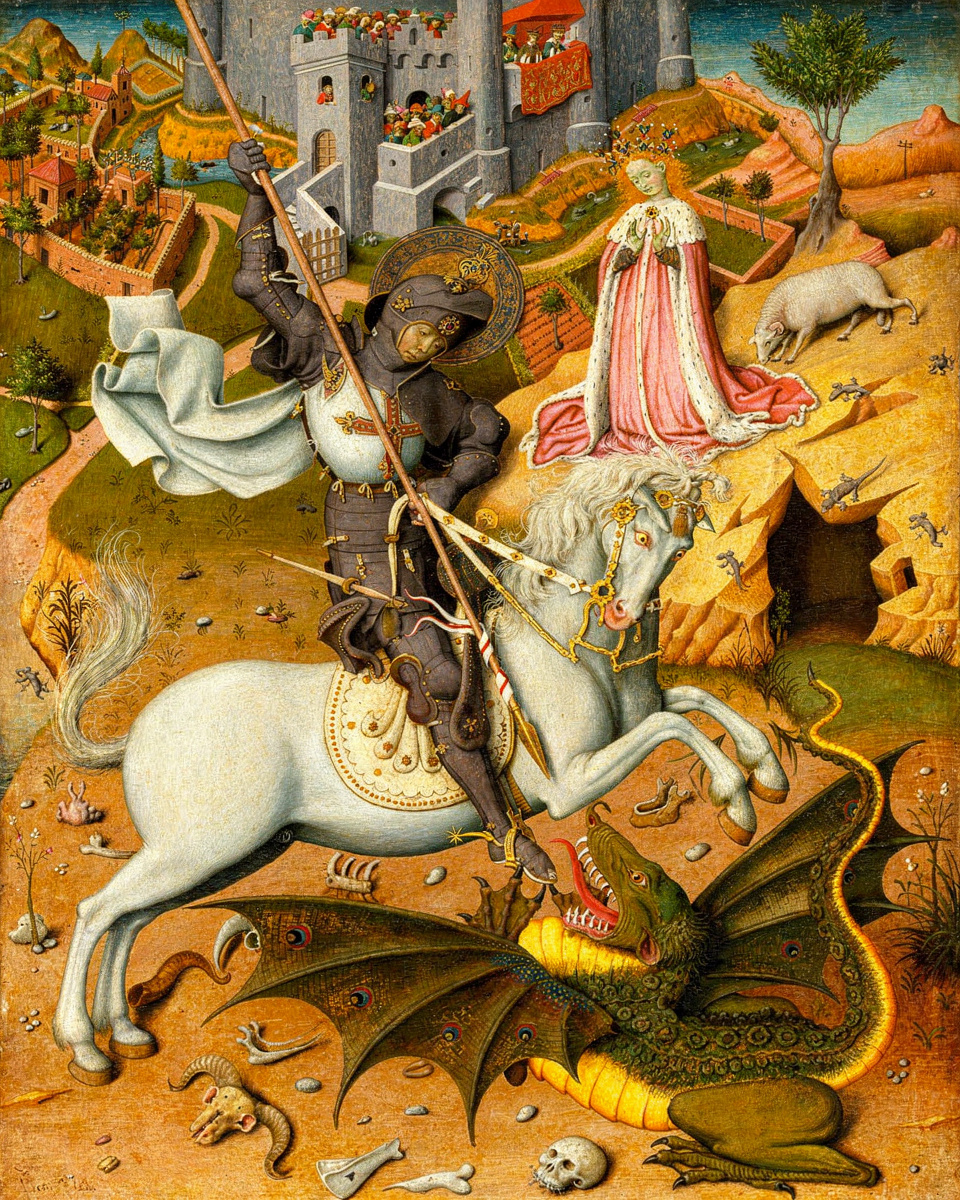
Bernat Martorell, Saint George and the Dragon, 1434–1435. Art Institute of Chicago.
Bernat Martorell painted this for an altarpiece in Barcelona, where George is Sant Jordi. The princess prays on the hillside, and the townspeople line the walls to watch.
Look at the faces on the city walls. It is the whole town's story, and in Catalonia it is still the whole town's day.
Which countries have St George as their patron saint?
England is the best known, but far from alone. George is patron saint of Georgia, whose flag carries his red cross, and of Portugal, whose soldiers went into battle crying 'Portugal and Saint George!'. He is patron of Catalonia and Aragon, of Ethiopia, where he is one of the most loved saints, and of cities from Genoa, whose red cross flag closely matches England's, to Moscow, whose coat of arms shows him spearing the dragon.
He crosses faiths too. In Palestine and Lebanon some Muslims honour him and link him with al-Khidr, the green man of Islamic tradition, and his churches in the Middle East are visited by Christians and Muslims alike.
10. Saint George on Foot
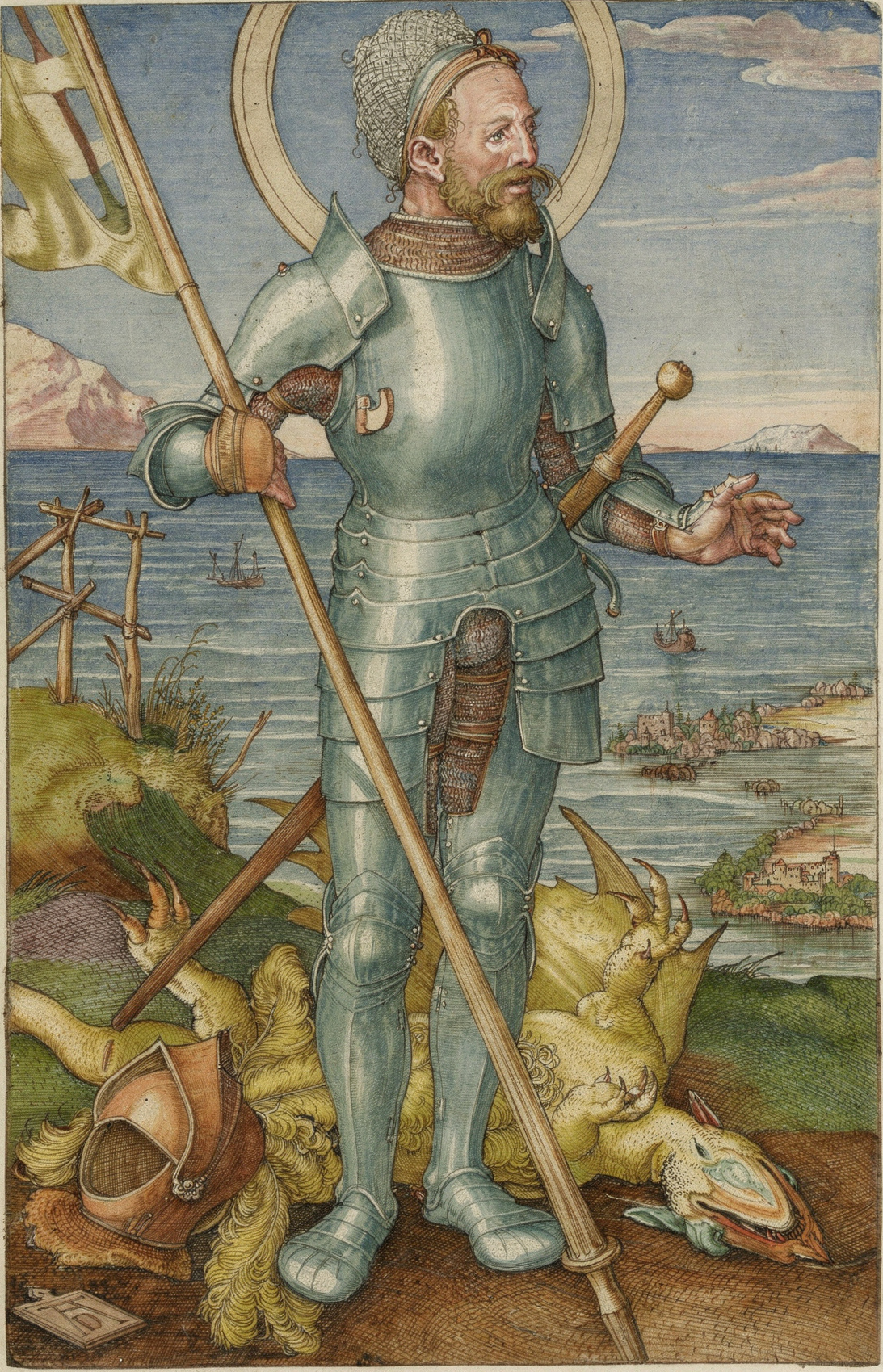
After Albrecht Dürer, Saint George on Foot, c. 1504–1505. Engraving in the Cleveland Museum of Art; Fable Atelier edition.
Dürer's engraving shows George standing over the dead dragon, holding his banner with the cross, his AD monogram on a tablet at his feet. Our Atelier edition interprets it in colour.
The banner is the point. George's cross travelled further than the story, onto the flags of nations and cities that might never have read the Golden Legend.
Why is the story still so popular?
George is not the only saint to beat a dragon. The archangel Michael throws one out of heaven, Saint Margaret bursts out of one's belly, and Saint Theodore, another soldier saint, killed one long before George. In older myths Perseus, Sigurd and Beowulf all face monsters.
George's version won because it has everything at once: a hero, a monster, a princess, a rescue, a horse in full flight and a happy ending. It is easy to tell a child and rich enough for a theologian. And it gave painters one of the most dramatic scenes in all of art, which they painted again and again for a thousand years.
11. Saint George and the Dragon
Peter Paul Rubens, Saint George and the Dragon, c. 1606–1608. Museo del Prado, Madrid.
Rubens painted it in Italy in his early thirties and filled the canvas from edge to edge: the grey horse rearing, the red cloak flying, the dragon twisting underneath.
Everything moves at once. After centuries of quiet icons, Rubens turned the legend into an action scene, and that energy is why it still feels alive.
Common questions
Is St George and the Dragon a true story?
No. St George was a real Roman soldier who was executed for his Christian faith around 303, but the dragon story was added about seven hundred years later. It was told as a picture of good defeating evil, not as history.
When is St George's Day?
St George's Day is 23 April, the traditional date of his death in 303. In years when 23 April falls in Easter week, the church feast moves to after Easter. In Georgia he is honoured on 6 May and 23 November.
Was St George English?
No. George was most likely born in Cappadocia, in what is now Turkey, served in the Roman army and never visited England. English Crusaders and kings adopted him, and by the fifteenth century he had become England's patron saint.
Where is St George buried?
Tradition places his tomb at Lydda, today's Lod in Israel, where the Church of Saint George still marks the site.
What does the St George's cross mean?
The red cross on a white ground is George's emblem, a crusader's cross standing for his faith. It became England's flag and also appears on the flags of Georgia, Genoa and Barcelona.
What is the moral of St George and the Dragon?
That courage means facing what everyone else fears, for the sake of others. For the medieval church it also meant that faith defeats evil, with the dragon standing for the devil.
Seventeen hundred years after a Roman soldier refused to give up his faith, his story is still told every spring. Every painting here is restored from its museum scan and printed to order, and any of them can also become the setting for a portrait of your own. To see how painters shaped the legend over the centuries, read our companion story, Saint George and the Dragon in art: the story in 15 paintings.