Tarot de Marseille, seen through Payen’s surviving cards
tarot de marseille: A visual essay on Jean-Pierre Payen’s cards at Yale, their woodblock details and reflective use.
Tarot de marseille is a name for a historic visual tradition, but the most useful way to meet it is through a particular surviving deck. Fable's Marseille cards are photographs of a complete Jean-Pierre Payen copy in Yale's Cary Collection of Playing Cards, held at the Beinecke Library as FRA166. The woodblocks are signed and dated 1713 on the Two of Coins. That date identifies the blocks; it should not be casually turned into a more precise claim about when every surviving impression was printed.
The cards shown here retain the character of that object: narrow proportions, printed lines, stencil colouring and the details of individual cards. They are not newly drawn historical lookalikes. Looking at them can be rewarding before any reading begins. If you do choose a reading, Fable treats tarot as a symbolic tradition for reflection, not a way to predict the future. Your own judgement remains the centre of the experience.
A deck with a place in a collection
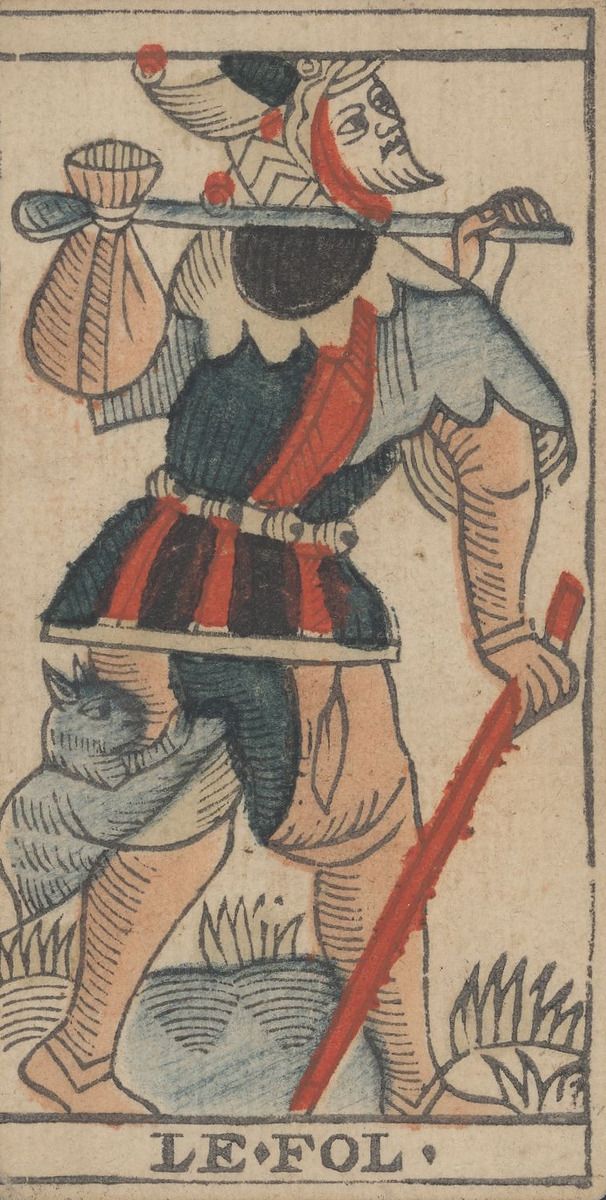
The Fool · Jean-Pierre Payen, Tarot de Marseille, blocks dated 1713 · Cary Collection of Playing Cards (FRA166), Beinecke Rare Book and Manuscript Library, Yale University
A named collection changes how we look at a historic deck. These cards are not anonymous images circulating without a source. The Cary Collection identifier FRA166 and the Payen attribution give the object a route back to its holding library. The site's deck registry records the photographs and their relation to that surviving copy.
The Fool is a useful first image because it immediately introduces the deck's visual scale. Look at the whole card rather than treating the central figure as a detachable icon. Its border, lettering and proportions belong to how the printed object presents its subject. The historical card remains itself even when a modern reader makes a personal association with it.
Explore a reading with the Marseille deck
A woodblock line, kept visible
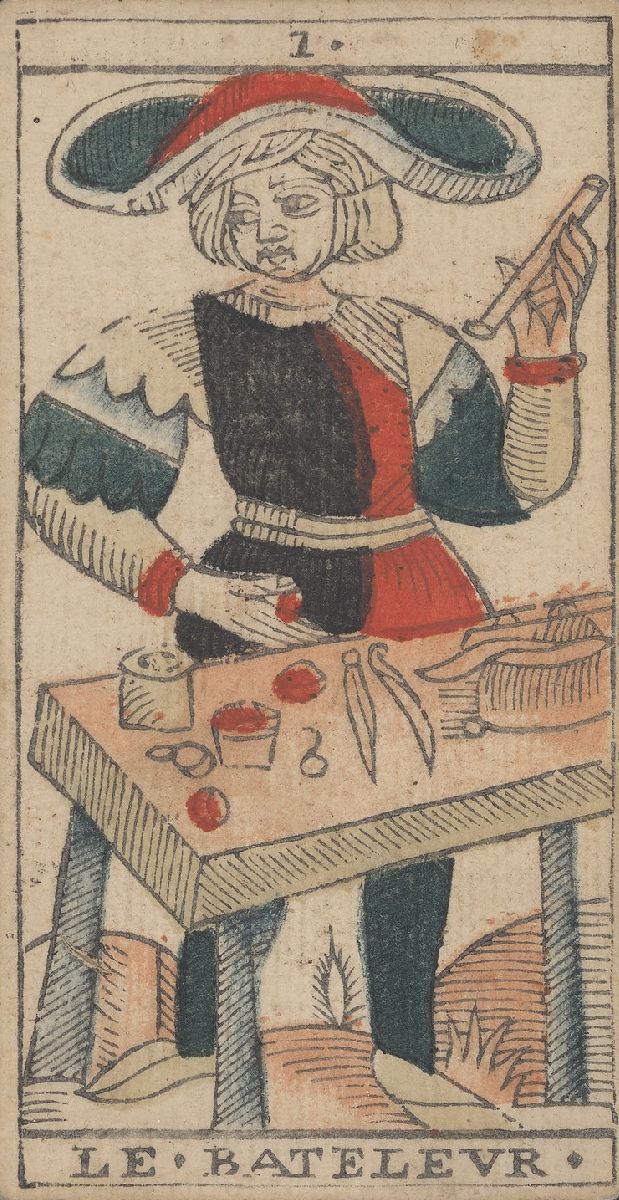
The Magician · Jean-Pierre Payen, Tarot de Marseille, blocks dated 1713 · Cary Collection of Playing Cards (FRA166), Beinecke Rare Book and Manuscript Library, Yale University
The Magician gives another point of entry into the printed language of the deck. The lines and areas of colour are part of a physical print process rather than evidence of a modern illustration imitating an old style. Payen's deck was printed from woodblocks and coloured through stencils, as recorded in the source information used by Fable.
That process need not be made artificially smooth to be worth looking at. A historic card can retain a different relationship between contour and colour from a contemporary digital drawing. Give the complete image enough space to see those differences. The texture of the tradition is found in a specific surviving object, not in a general promise that something looks “vintage”.
Begin a reflective tarot reading
A historical title is not a label for the reader
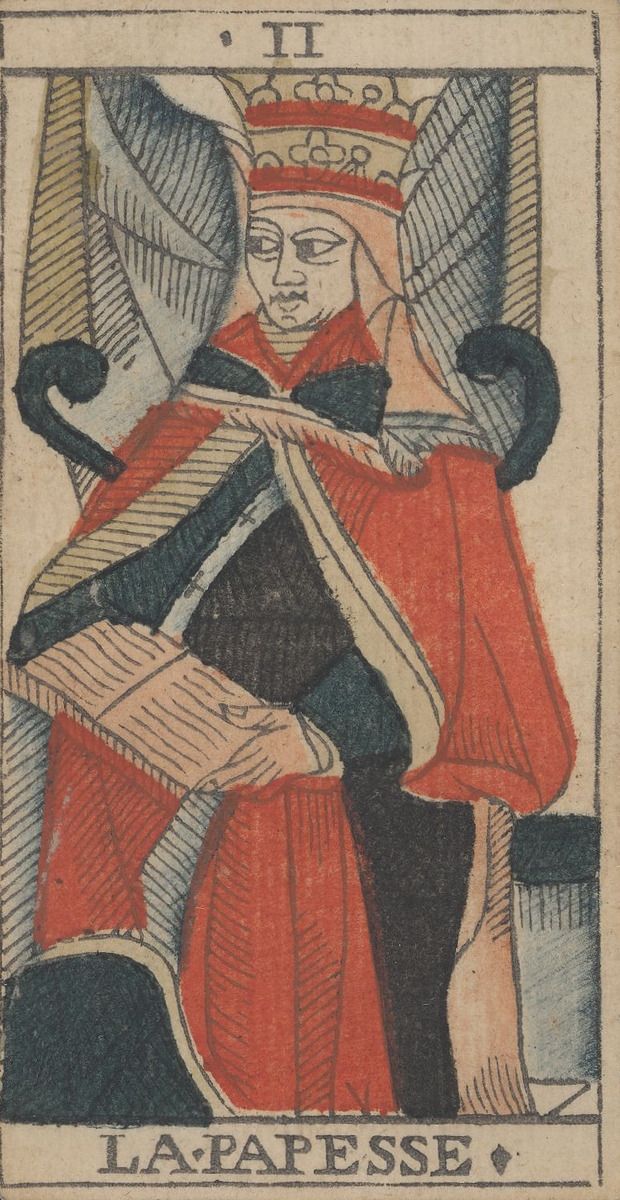
The Popess · Jean-Pierre Payen, Tarot de Marseille, blocks dated 1713 · Cary Collection of Playing Cards (FRA166), Beinecke Rare Book and Manuscript Library, Yale University
The Popess carries a title that belongs to this deck's historical imagery. A modern reading may invite associations with inwardness, knowledge or privacy, but it should not turn the title into a fixed description of the person taking part. The card has its own visual history before it enters anyone's personal story.
That distinction is helpful throughout a reflective reading. You can ask what an image makes you notice without accepting it as a diagnosis or instruction. The old title remains accurately identified in the caption. Your interpretation can remain tentative, private and subject to change, rather than becoming a claim that the card has revealed an objective fact about you.
The numerals belong to the printed cards
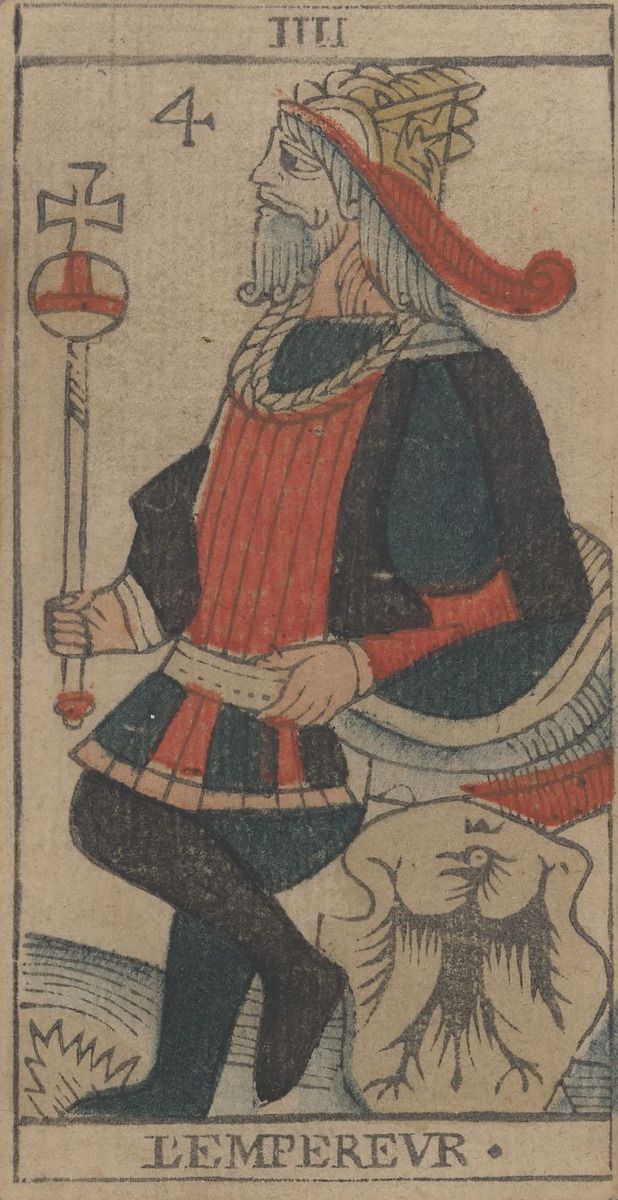
The Emperor · Jean-Pierre Payen, Tarot de Marseille, blocks dated 1713 · Cary Collection of Playing Cards (FRA166), Beinecke Rare Book and Manuscript Library, Yale University
The Emperor's numeral is given as IIII in the deck registry, preserving the form printed on the card. Small details like this help distinguish looking at a particular object from looking at a standardised modern list of card names. The historic spellings and numerals are part of what survives.
They also remind us that a deck is a set of printed objects, with its own conventions. There is no need to correct every difference into a modern expectation before allowing the images to be used. Keep the historical label visible, then approach any personal symbolism separately. A title associated with authority does not confer authority on a person or tell them how they must act.
A misprint can be part of the evidence
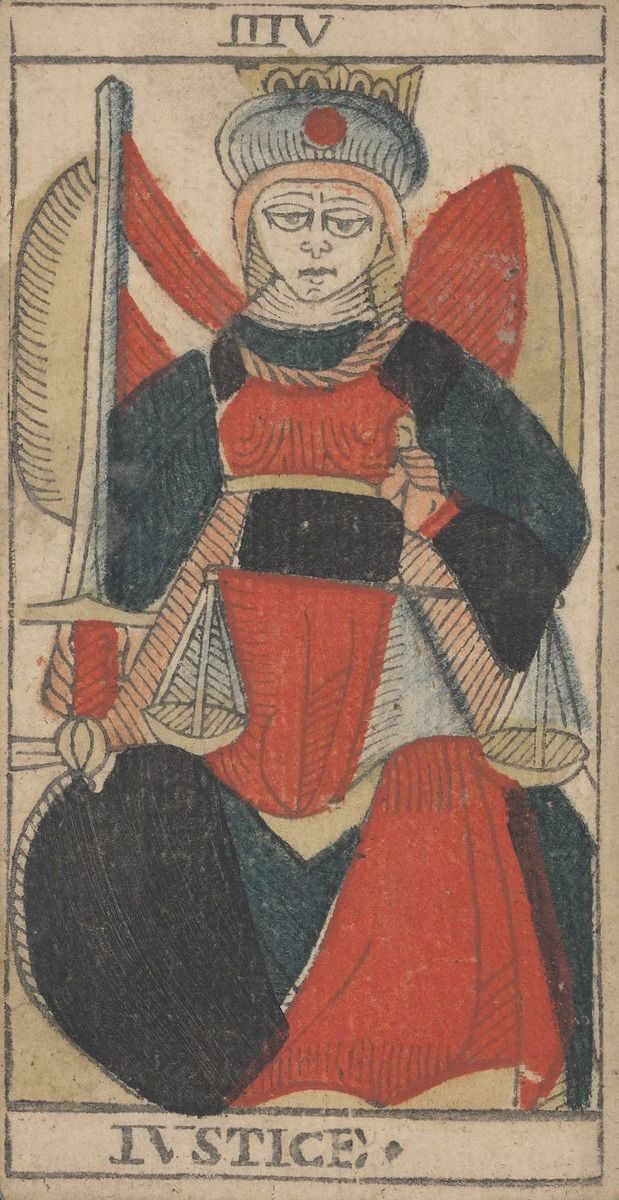
Justice · Jean-Pierre Payen, Tarot de Marseille, blocks dated 1713 · Cary Collection of Playing Cards (FRA166), Beinecke Rare Book and Manuscript Library, Yale University
The source registry notes two numeral misprints in this Payen copy. Justice is printed IIIV and the Hanged Man IIX; the reading catalogue gives them as VIII and XII. That is a small but useful distinction between the surviving print and the names used to navigate a present-day experience.
The old image is not redrawn to make it agree with a modern index. A caption can explain the difference while the photograph retains its evidence. Justice is therefore a good card to examine slowly. It shows why historical accuracy can include an irregularity, and why using an archive does not require pretending that every printed detail was perfectly consistent.
An unsettling image does not make a prediction
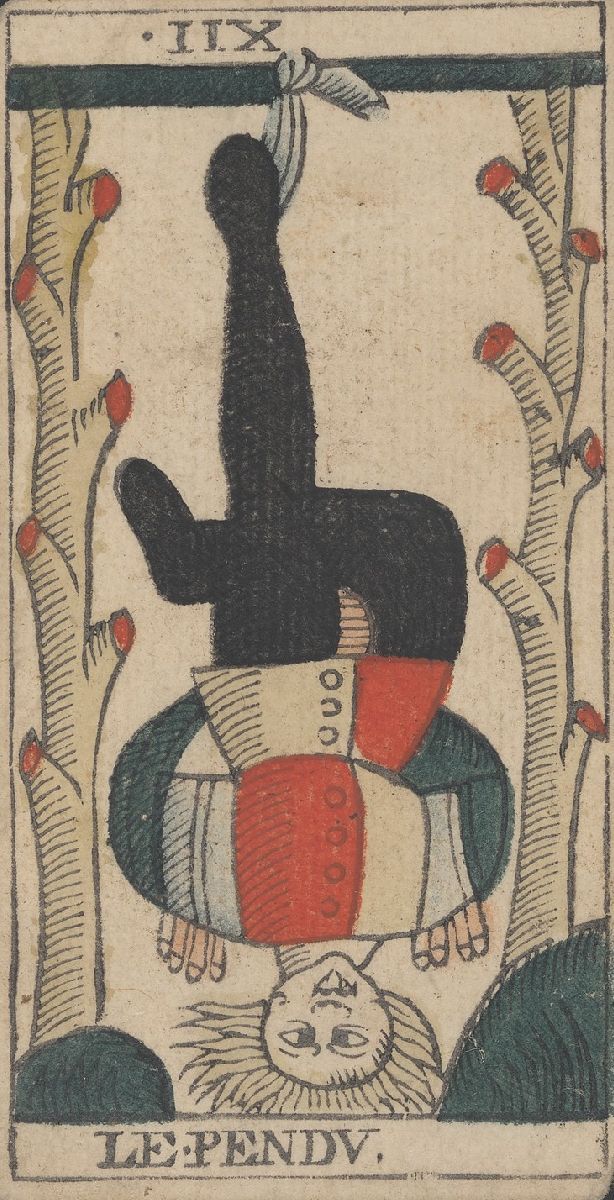
The Hanged Man · Jean-Pierre Payen, Tarot de Marseille, blocks dated 1713 · Cary Collection of Playing Cards (FRA166), Beinecke Rare Book and Manuscript Library, Yale University
The Hanged Man can be approached as a historical image before anyone asks it to mean something personal. Its visual subject may feel unfamiliar or uncomfortable, and a reflective reader is free to notice that response. The card does not establish that a corresponding event will happen to the person looking at it.
This is one reason to keep tarot's symbolic status explicit. An image can prompt a question about a situation, a pause or a different perspective without becoming a verdict. If an interpretation does not help, you can set it aside. A reading should leave room for the person's own judgement, rather than using the authority of an old-looking object to close a question down.
Explore the reading at your pace
The date lives on a particular card
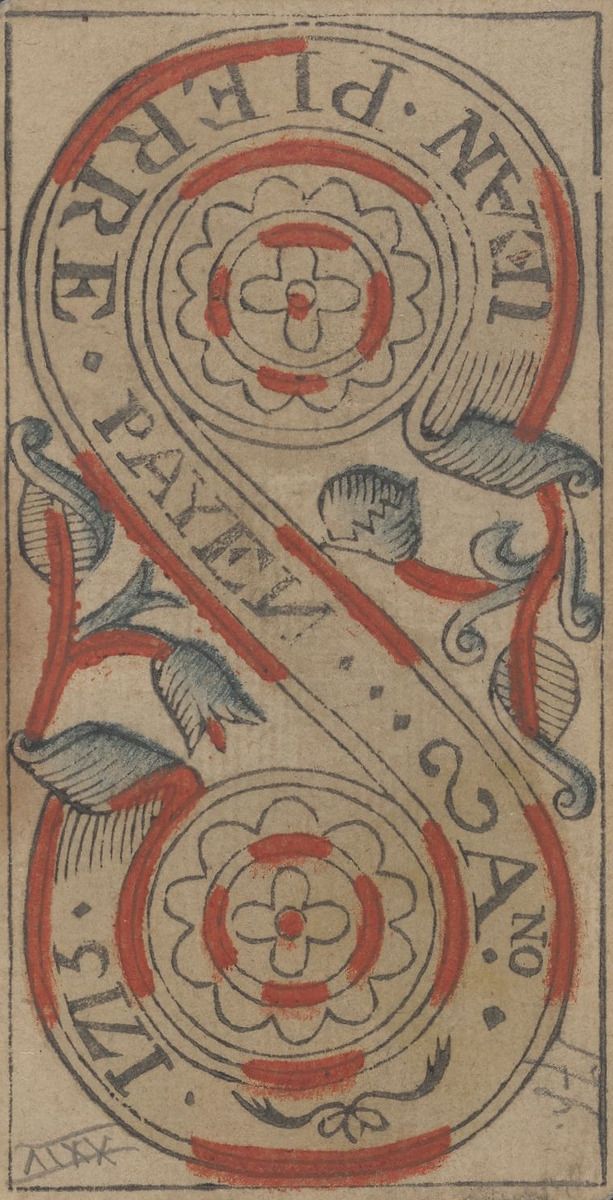
The Two of Coins · Jean-Pierre Payen, Tarot de Marseille, blocks dated 1713 · Cary Collection of Playing Cards (FRA166), Beinecke Rare Book and Manuscript Library, Yale University
The Two of Coins carries the signature and date associated with Payen's woodblocks. It is more precise to say that the blocks are dated 1713 than to assume the photographed object can be dated to a particular day or year from that detail alone. The complete copy is held in Yale's Cary Collection under the identifier recorded above.
A seemingly small numbered card can therefore carry important evidence about the deck as an object. The history is not confined to the better-known figures. Looking beyond the trumps makes the pack feel more complete: a set of seventy-eight cards with repeated structures, individual details and a physical printing history, rather than a handful of isolated emblems.
Explore a reading with Marseille cards
The suits have their own visual rhythm
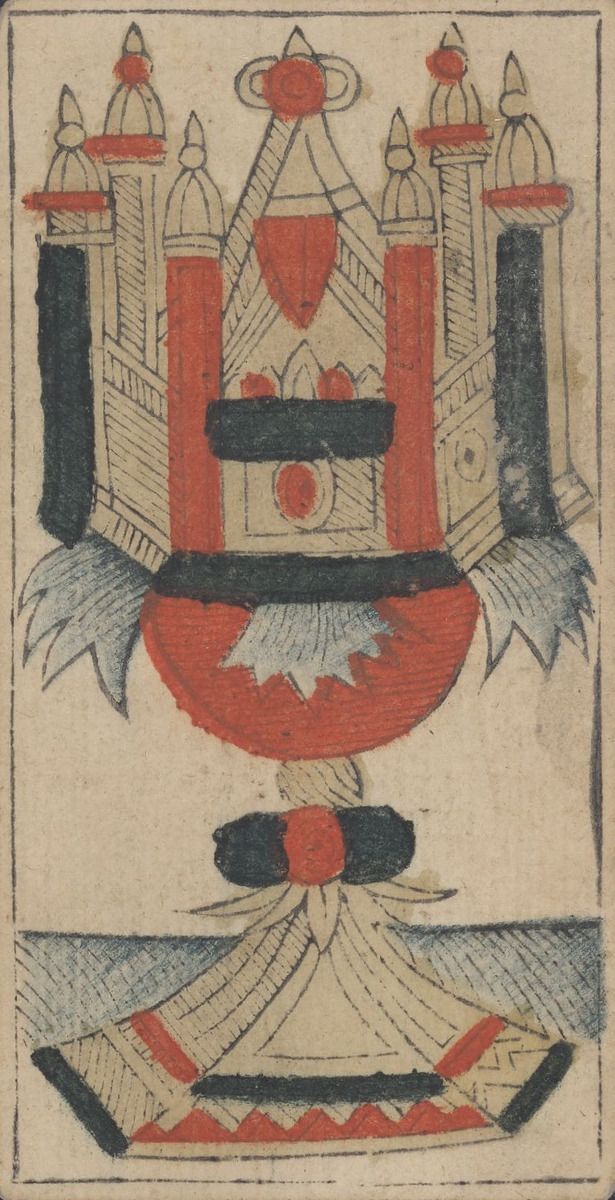
The Ace of Cups · Jean-Pierre Payen, Tarot de Marseille, blocks dated 1713 · Cary Collection of Playing Cards (FRA166), Beinecke Rare Book and Manuscript Library, Yale University
The Ace of Cups offers a change from a named human figure to a suit image. A complete deck asks the eye to move between those kinds of subjects rather than treating every card as a small character portrait. Repetition, number and the space around a pictured object become part of the experience of looking.
You do not need to assign one compulsory meaning to every shape before appreciating the card. Begin with what is actually visible, then distinguish that observation from any symbolic association you bring to it. The holding source and caption identify the historical image; a personal reading is a present-day reflective use of that image, with a different purpose.
Keep the card whole
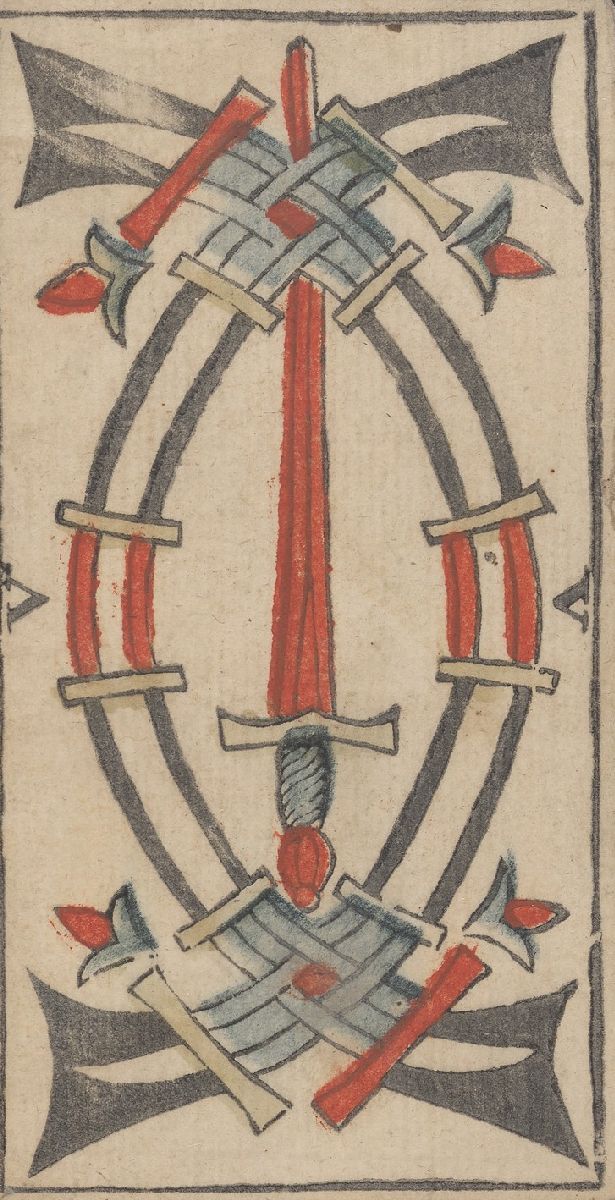
The Five of Swords · Jean-Pierre Payen, Tarot de Marseille, blocks dated 1713 · Cary Collection of Playing Cards (FRA166), Beinecke Rare Book and Manuscript Library, Yale University
The Five of Swords is another reason to show a historic card at its own proportions. The complete design matters, including the relationships among its repeated forms and the surrounding space. Cropping the image into a fashionable tile can remove part of the very structure the viewer is trying to understand.
Fable's deck photographs are taken from Yale's source images and presented at the card's own edge. That approach preserves the printed object as the object being shown. It is different from extracting a motif for a new illustration. When the reading later connects with a personal portrait experience, that portrait is a new artwork; it does not make the historic photograph into a customer example.
Explore the reading and portrait experience
An old deck, used in the present
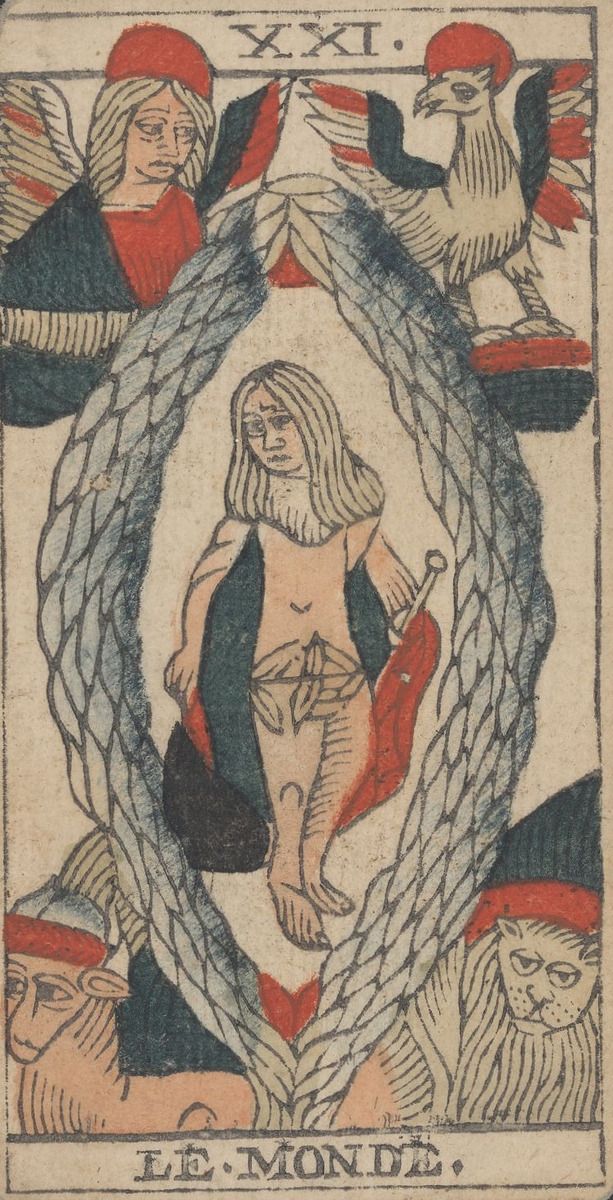
The World · Jean-Pierre Payen, Tarot de Marseille, blocks dated 1713 · Cary Collection of Playing Cards (FRA166), Beinecke Rare Book and Manuscript Library, Yale University
The World can close a first look through these cards without closing off their meanings. A museum or library source gives the image a historical identity, while a reader encounters it from a particular present-day life. Those two contexts can sit together if neither is mistaken for the other.
If you want to continue, begin the Marseille reading through the linked route with your own intention. The live experience explains its current reading and portrait offer before a purchase. There is no need to believe that the old deck predicts a fixed future. It can provide a set of images through which to notice, question and reflect, while leaving the choices about your life with you.
Begin a reflective Marseille reading
The Payen cards are most interesting when their identity stays specific: a complete surviving copy, a named holding collection and woodblocks dated on one of the cards. Their photographs give the reading a real historical image language without needing a newly invented antique appearance. To take the next step, begin the Marseille tarot experience with your own intention and inspect its current offer before deciding whether to continue towards a portrait. Let the images open a question, and keep your own judgement at its centre.
Begin a Marseille tarot reading
- Which Tarot de Marseille does Fable show?
- The historic Marseille images are photographs of a complete Jean-Pierre Payen copy in Yale’s Cary Collection of Playing Cards, Beinecke Library, identifier FRA166. The source registry records woodblocks signed and dated 1713 on the Two of Coins.
- Are these newly drawn reconstructions?
- No. The deck registry uses the historical card photographs from Yale’s source images, presented at the card’s own edge. A personal portrait offered through the reading is a separate new artwork, not a replacement for the archive image.
- Does a Marseille tarot reading predict the future?
- Fable treats tarot as a symbolic tradition for reflection, not prediction. You can use the images as prompts and set aside an interpretation that does not help. The experience should leave your own judgement and choices with you.