The Swing painting: a garden full of glances
Look closely at Fragonard’s famous scene, its documented commission and the details that make the whole picture matter.
The Swing painting by Jean-Honoré Fragonard is easy to recognise and easy to reduce to a single pink dress. The complete image is more complicated. A woman rises through a dense garden, a shoe leaves her foot, a man reclines below and another figure works the swing from behind. Sculpture and foliage surround an encounter that depends on who can see whom.
The Wallace Collection connects the commission to an account written by Charles Collé in October 1767. It records a provocative request passed from Gabriel-François Doyen to Fragonard, while leaving the patron’s identity unconfirmed. That uncertainty is worth preserving: the composition is specific enough without supplying a name the document does not establish. Begin with the visible arrangement, then use the history to sharpen what you notice. The Rococo art and style story gives the wider visual setting for its curves, colour and cultivated playfulness.
Follow the movement across the whole canvas
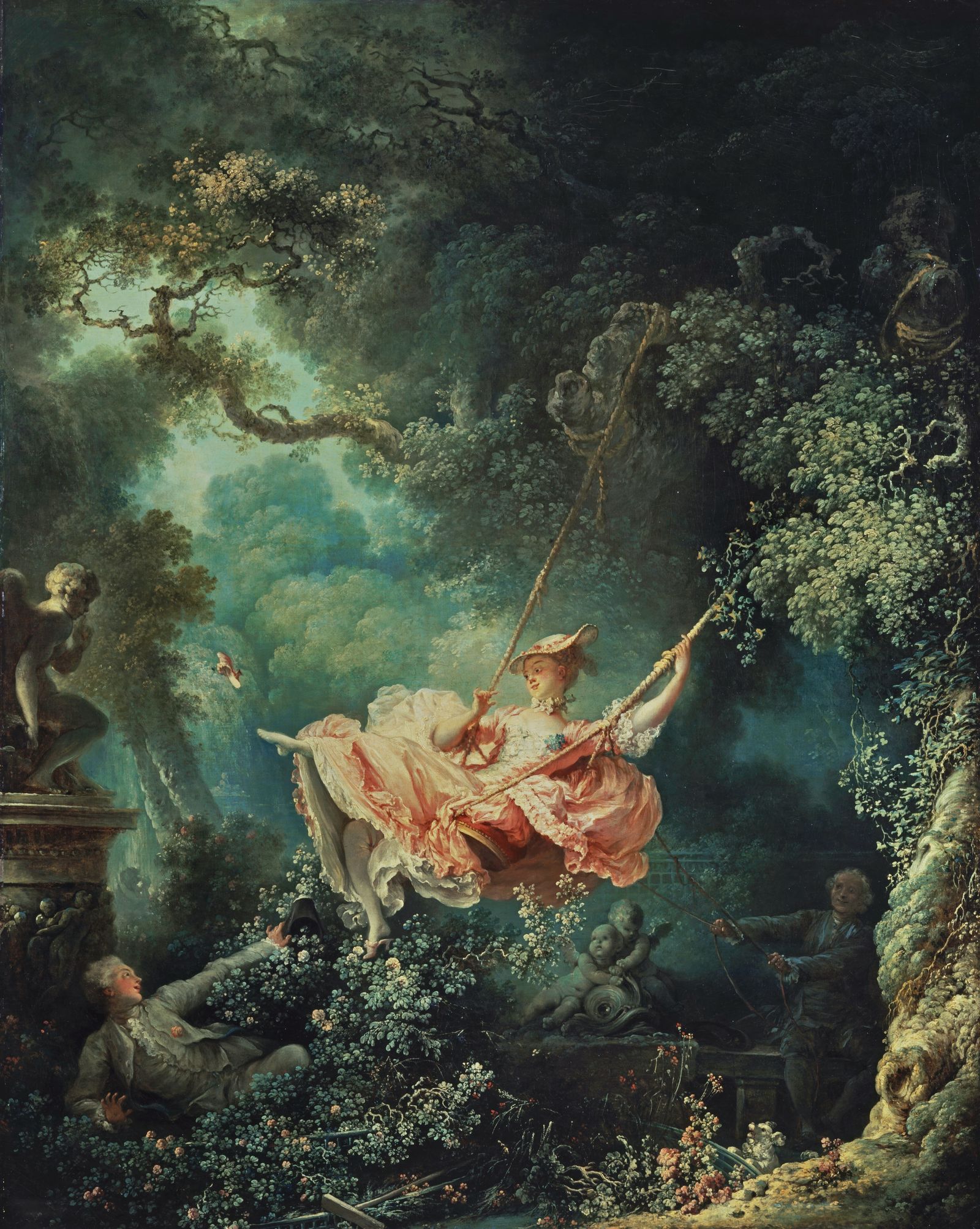
The Swing · Jean-Honoré Fragonard, 1767 · The Wallace Collection, London. Restored by Surrealium at Vaxholm Fortress, Sweden.
Start with the woman’s body and the ropes above her, then trace the direction of the raised leg and the flying shoe. Those lines lead out into the garden rather than staying inside the dress. The picture’s movement is distributed across several objects, so the viewer seems to arrive during an action that has already begun and will continue after the painted moment.
Now look at the figures lower in the composition. Their positions make the swing’s arc more than a decorative curve. A glance from below and the effort from behind give the central movement a social arrangement. The foliage hides and reveals enough to make looking itself part of the subject. A crop focused only on the sitter would preserve the most famous colour but remove much of the situation. The full painting is necessary because the joke, the tension and the pleasure depend on the distances between people, not merely on the appearance of the woman at its centre.
Keep the commission story within its evidence
The Wallace Collection’s account of Collé’s journal explains that Doyen was approached first and directed the commission toward Fragonard. The requested scene involved a woman on a swing and a privileged view from below. The name of the man who requested it remains uncertain. That is enough to establish the broad character of the commission without converting a long-standing identification into a proven fact.
When retelling the story, distinguish the recorded request from what the finished painting visibly contains. A commission can change as an artist develops it. The painting also has its own formal intelligence: the garden, the placement of sculpture and the relation between light and dark do more than illustrate a verbal joke. It is possible to recognise the erotic situation without treating every leaf as a coded message. Stay close to the details you can point to, and allow the composition to remain more inventive than a simple diagram of the anecdote that helped bring it into being.
Compare an intimate portrait by the same artist
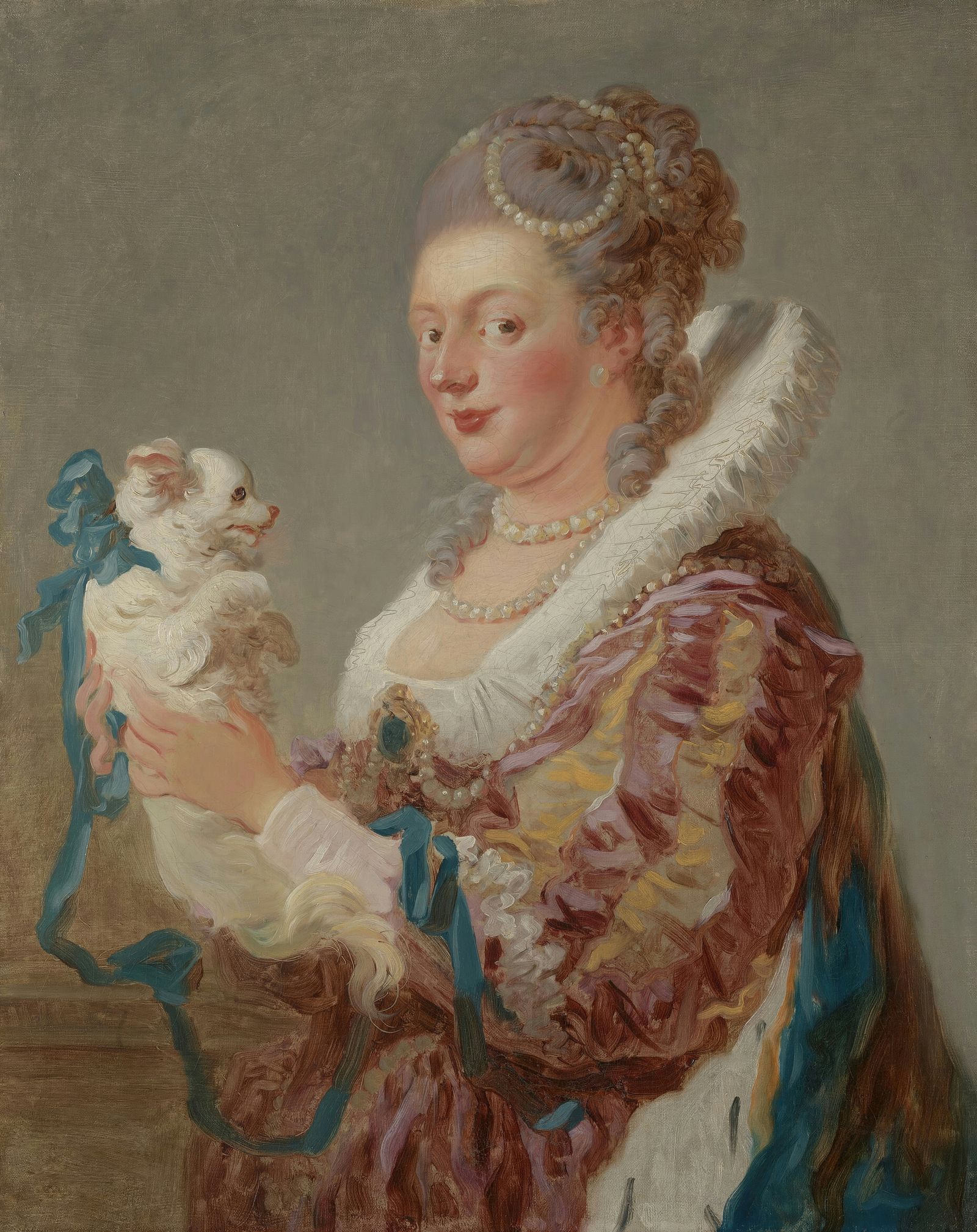
A Woman with a Dog · Jean-Honoré Fragonard, 1769 · Metropolitan Museum of Art, New York. Restored by Surrealium at Vaxholm Fortress, Sweden.
A Woman with a Dog offers a different Fragonard encounter. The sitter and animal are brought close, with fabric, skin and fur occupying much of the image. Instead of a garden spread through several depths, the picture gives the viewer a more immediate relationship between bodies. It is useful to compare the two without assuming that every work by the artist repeats the same story.
Notice how the dog changes the sitter’s pose and the distribution of attention. An animal can make an image feel intimate through physical proximity alone; it does not need to become a human character. The famous paintings of women story places this kind of close arrangement beside other approaches to the figure. Returning to The Swing afterwards, you may notice how much its effect depends on distance. The central woman is brilliant and visible, but the people around her make the space socially charged in a way that a close portrait need not be.
Look at the garden as an active part of the scene
The garden is not an empty backdrop waiting for the figures to arrive. Branches, foliage and stone forms divide the space, making some routes easy to follow and others difficult to see. Areas of bright fabric emerge against darker greenery. The contrast gives the sitter immediate emphasis, while the surrounding density keeps the viewer looking for the rest of the action.
Try covering the central figure mentally and following the remaining shapes. You can still see a network of curves, openings and interruptions. Then return the figure to that structure and notice how the dress gathers the surrounding movement into one conspicuous form. This exercise makes the composition easier to understand without reducing it to a list of symbols. For another kind of closely arranged scene, compare classical paintings. The point is not to make every picture obey the same visual rule, but to recognise how a setting can organise attention before you have identified every person or understood every historical reference within it.
A fountain gives sculpture a different role
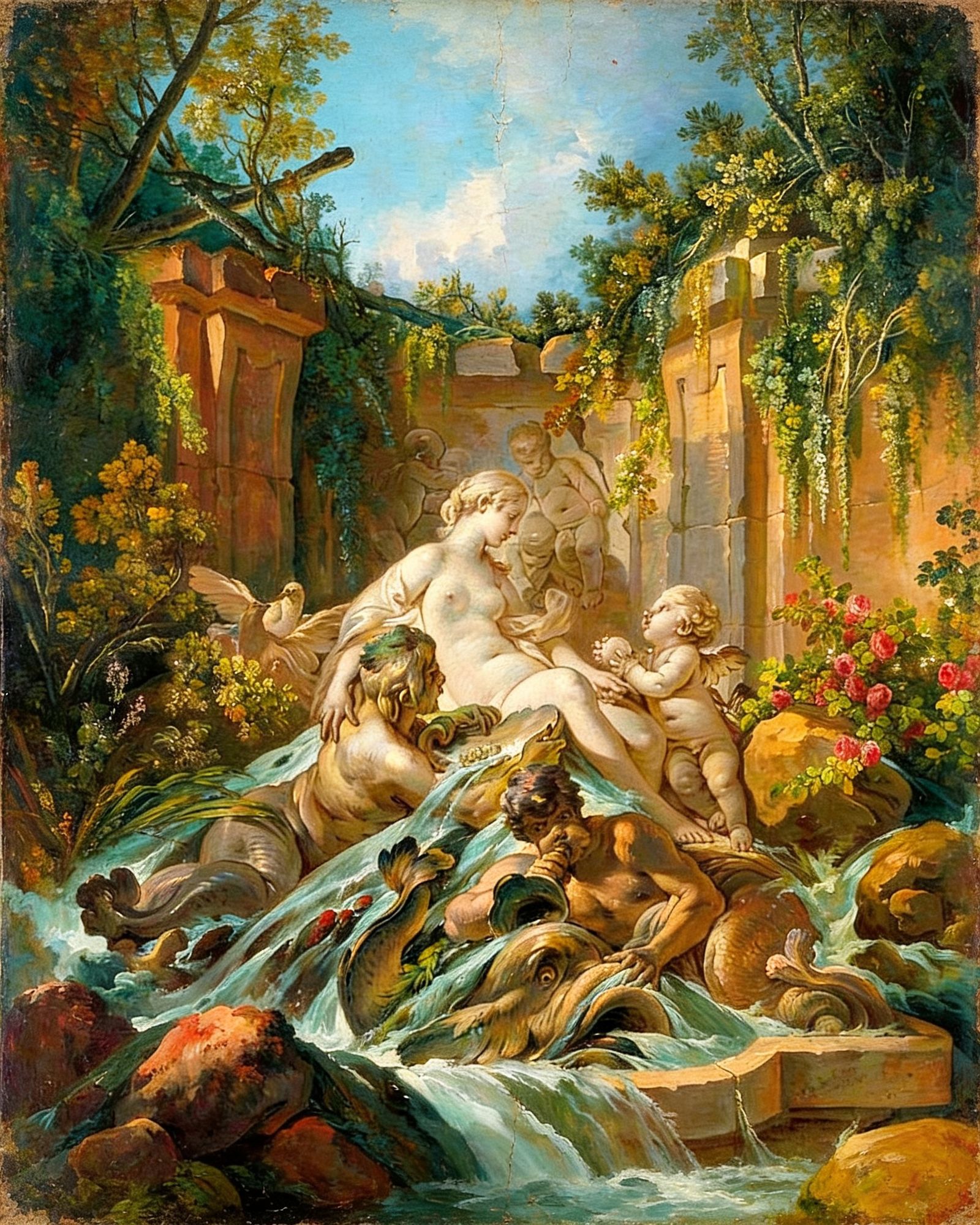
Fountain of Venus · François Boucher, 1756 · Cleveland Museum of Art. Restored by Surrealium at Vaxholm Fortress, Sweden.
Fountain of Venus offers a comparison from Boucher, whose art belongs to the wider Rococo context discussed by the Wallace Collection. Its figures and sculptural forms invite the eye to move through a constructed world of bodies, ornament and water. It is a separate work with its own composition, not an explanatory detail cut from The Swing.
The comparison helps distinguish atmosphere from direct narrative. In Fragonard, the small statue at the left participates in a garden full of watching and concealment. In the Boucher work, sculptural abundance helps establish the world the figures occupy. You can enjoy both without assigning the same meaning to every curve or every classical body. The Rococo Masterworks collection is a useful place to compare the period’s different kinds of figure arrangement. Keep the works whole while doing so: the relation between sculpture, living bodies and empty space is often what makes an apparently decorative detail matter to the larger picture.
Choose a print that preserves the relationships
The Swing rewards a format in which the lower figures and the surrounding garden remain visible. A narrow crop may make a striking fragment, but it cannot give the same account of the painting. Before choosing a print, look at the entire image and decide where you will stand when viewing it. The smaller gestures need room to remain readable, especially if the picture will be seen mainly from across a room.
The work can suit someone who enjoys theatrical scenes, lush landscapes or the history of Rococo art. It is less useful to assume that every image of a couple or a flirtation makes an appropriate romantic gift. The romantic paintings by the sea story offers a different emotional register for comparison. Choose The Swing for the particular scene it is: playful, staged and attentive to unequal viewpoints. Its identity becomes clearer when the dress, garden, sculpture and observers remain together rather than being separated into a generic image of romance.
The famous pink dress is an entrance into the painting, not its entire subject. Follow the glances, the ropes and the spaces between the figures, and the garden becomes a carefully arranged place in which looking has consequences. The commission story adds context while leaving some questions open.
Browse the whole work and its caption before selecting a print. Keeping the composition intact preserves the very relationships that made it memorable, and lets you return to details that a familiar reproduction may have taught you to overlook.
Compare the gentler and more theatrical encounters in Rococo romance paintings before choosing a romantic subject.
- Who painted The Swing?
- Jean-Honoré Fragonard painted the work held by the Wallace Collection. The documented commission was underway in 1767. The patron’s identity is not established by the contemporary account discussed by the museum.
- Why is the flying shoe important?
- It extends the visible movement beyond the sitter’s body and directs attention through the garden. Its role can be appreciated within the whole composition without assigning a fixed symbolic meaning to every small object.
- Should a print crop closely around the woman?
- A close crop removes the observers, sculpture and much of the garden that give the scene its structure. To understand and enjoy the complete composition, choose a presentation that preserves the whole painting.