Bird paintings: ten ways to look beyond the feathers
Explore bird paintings, prints and a manuscript page through ten whole works, from peacocks and parrots to an empty nest.
Bird paintings can make a bird the centre of attention, tuck it into a human story, or suggest its presence through something it has left behind. This selection follows those differences through ten works. Alongside paintings are Japanese prints and a manuscript illustration, each identified in its caption; they are different kinds of objects, not interchangeable examples of painting.
Begin by asking what the bird does to the composition. A long tail can connect the top of a picture to its lower edge. A tiny perched body can make a large moon feel larger still. A parrot beside a person may alter the direction of a gaze or introduce a sharp note of colour. These are visible relationships you can test by looking, without assigning every species a universal symbolic meaning.
The plant life matters too. Our guide to vintage botanical prints follows that neighbouring tradition, and Japanese woodblock prints explains another of the forms represented here. Read the whole image before settling on the bird alone; its setting often supplies the most interesting part of the story.
1. A peacock that organises the picture
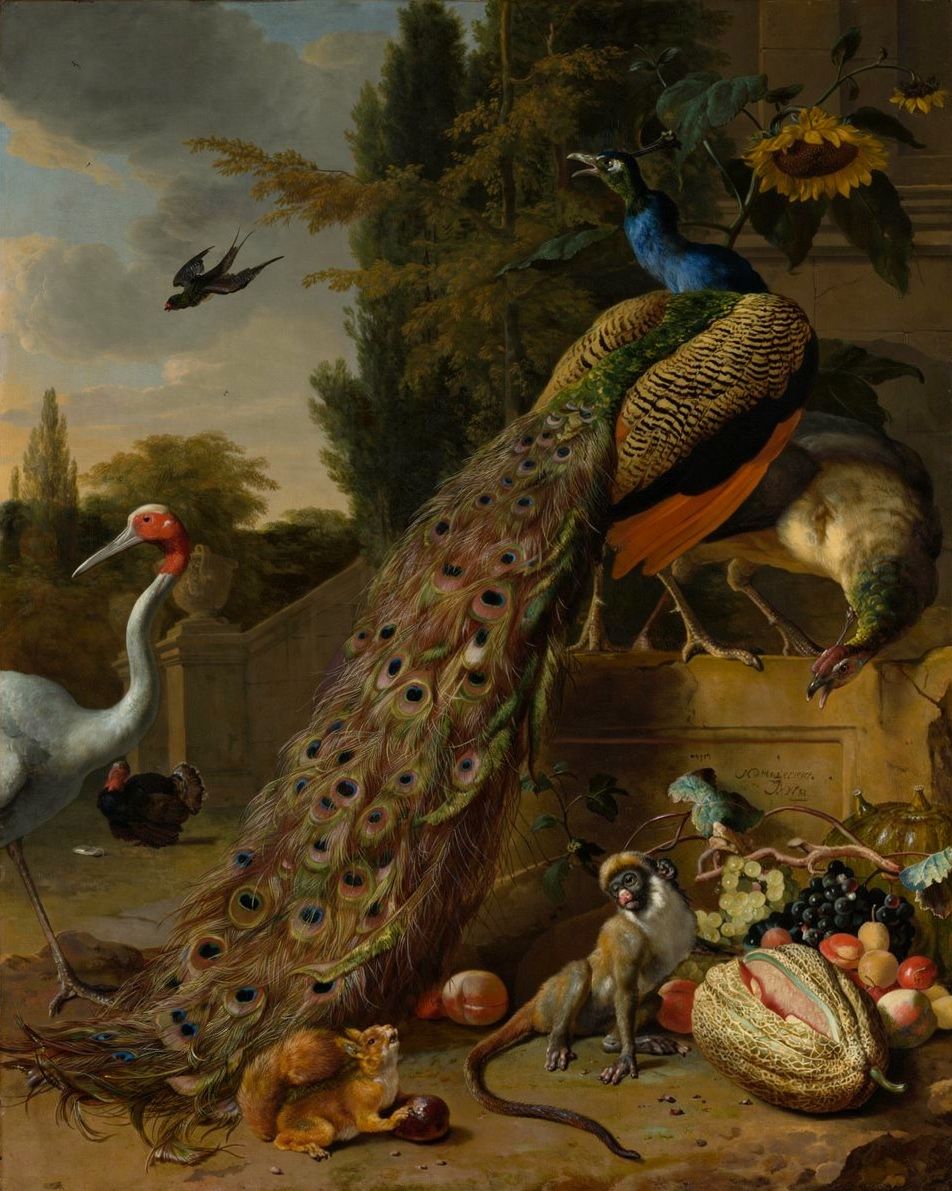
Peacocks · Melchior d' Hondecoeter, 1683 · The Metropolitan Museum of Art, New York. Restored by Surrealium at Vaxholm Fortress, Sweden.
In Melchior d’Hondecoeter’s Peacocks, the long feathered train runs diagonally through a busy gathering of birds, fruit and architectural details. Its patterned surface connects the elevated bird to the lower foreground, where smaller creatures compete for attention. Look first at the large silhouette, then at the little interruptions around it; the painting rewards both a view from across a room and a slower inspection of its crowded lower edge.
2. A bird picture without a visible bird
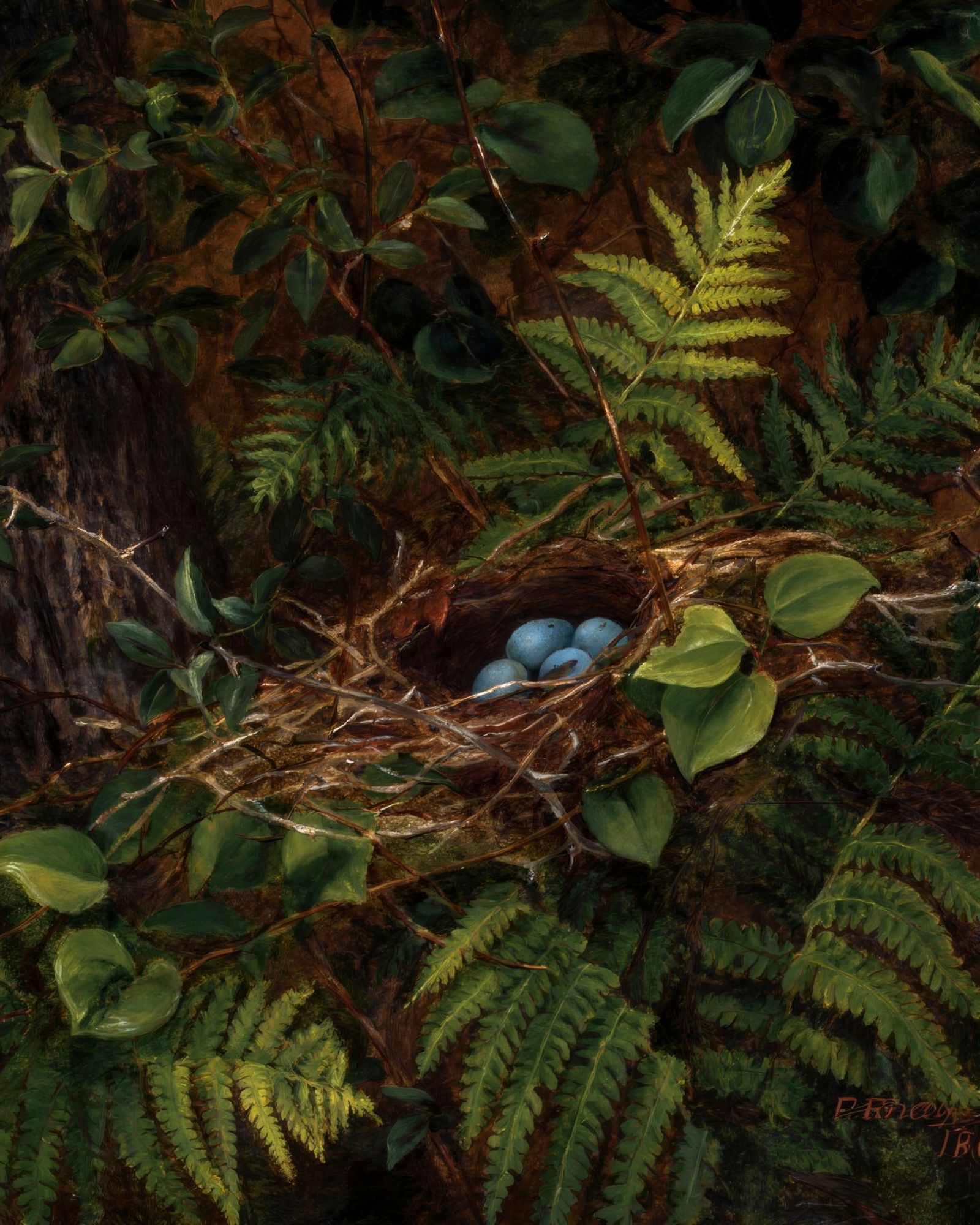
Bird's Nest and Ferns · Fidelia Bridges, 1863 · Art Institute of Chicago. Restored by Surrealium at Vaxholm Fortress, Sweden.
Fidelia Bridges’s Bird’s Nest and Ferns brings the nest close, its blue eggs set among branching stems and finely divided foliage. The absent parent makes the scene a study of a small inhabited place rather than a portrait of an animal in action. Follow the crossing stems around the nest before looking at the eggs, and notice how much of the image’s intimacy comes from the surrounding density instead of from a sentimental gesture.
3. Small birds among carefully arranged fruit
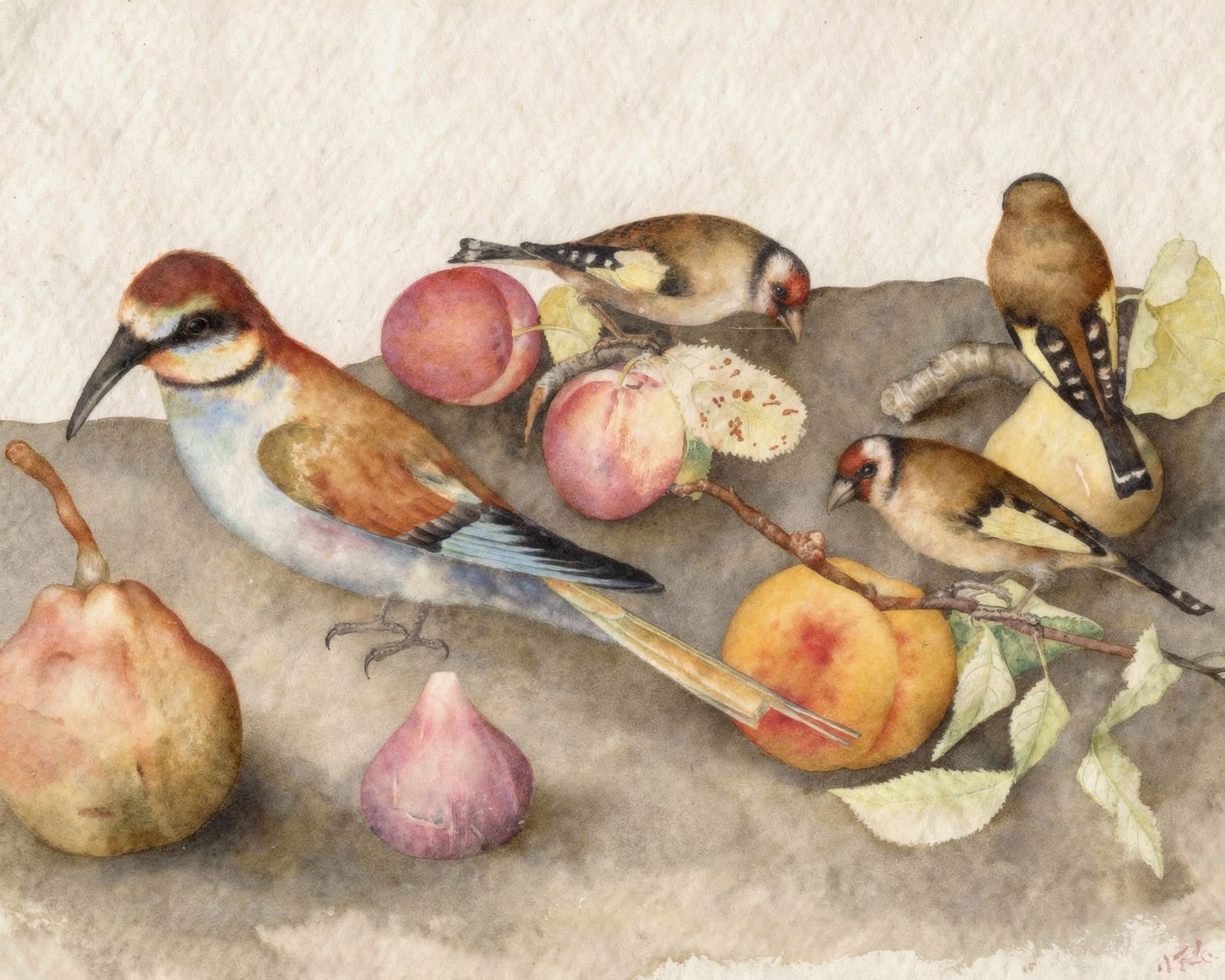
Still Life with Birds and Fruit · Giovanna Garzoni, c. 1650 · Cleveland Museum of Art. Restored by Surrealium at Vaxholm Fortress, Sweden.
Giovanna Garzoni sets compact birds beside fruit on a pale ground, with a pear and a bulb-like form occupying the open foreground. The slight changes of direction in the birds’ heads prevent the still life from becoming a rigid row of specimens. Comparing feathers with peel and leaves reveals the pleasure of close description; the picture offers many textures without needing the deep, theatrical shadows found in some European still-life paintings.
4. Birds and flowers across a screen pair
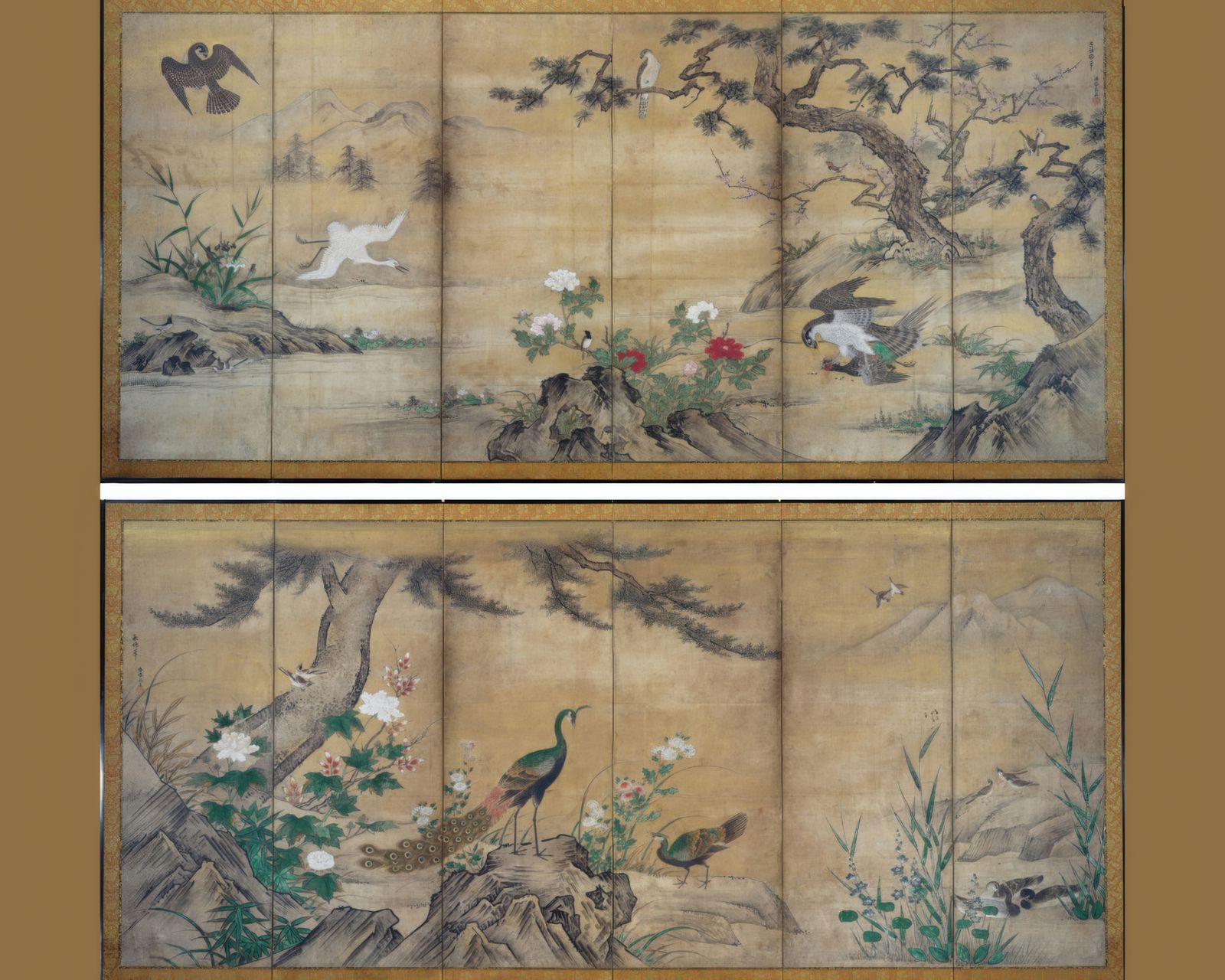
Birds and Flowers · Kano Mitsunobu, Kano Shōei, late 1500s · Cleveland Museum of Art. Restored by Surrealium at Vaxholm Fortress, Sweden.
The paired Birds and Flowers screens attributed in the collection record to the Kanō tradition distribute trees, blossom and birds across an extended surface. The complete reproduction shows both screens, so the pauses between groups belong to the composition as much as the most prominent bird. Read from one side to the other rather than isolating a single panel, and notice how a branch can carry the eye across a fold before another creature brings it to rest.
5. A peacock within a wider habitat
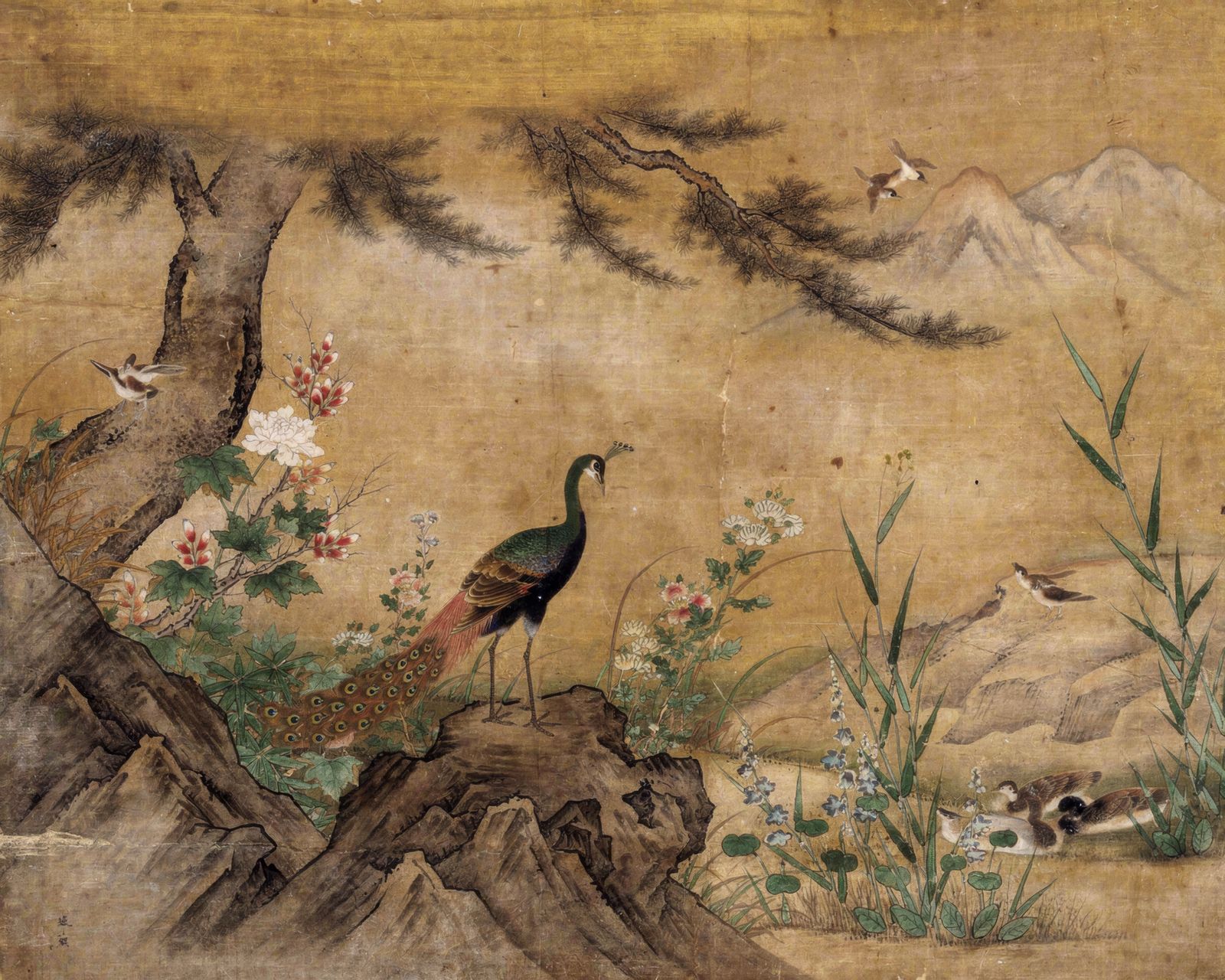
Birds and Flowers · Kano Mitsunobu, late 1500s · Cleveland Museum of Art. Restored by Surrealium at Vaxholm Fortress, Sweden.
The second Birds and Flowers work gives the peacock a rocky perch, with flowering plants, water birds and a branching tree spreading around it. The tail participates in a larger set of directional lines instead of filling the entire picture as an independent ornament. Compare this image with d’Hondecoeter’s opening painting: both contain many creatures, but the distribution of open space changes how you move between them and how quickly the principal bird announces itself.
6. A pheasant held against snow
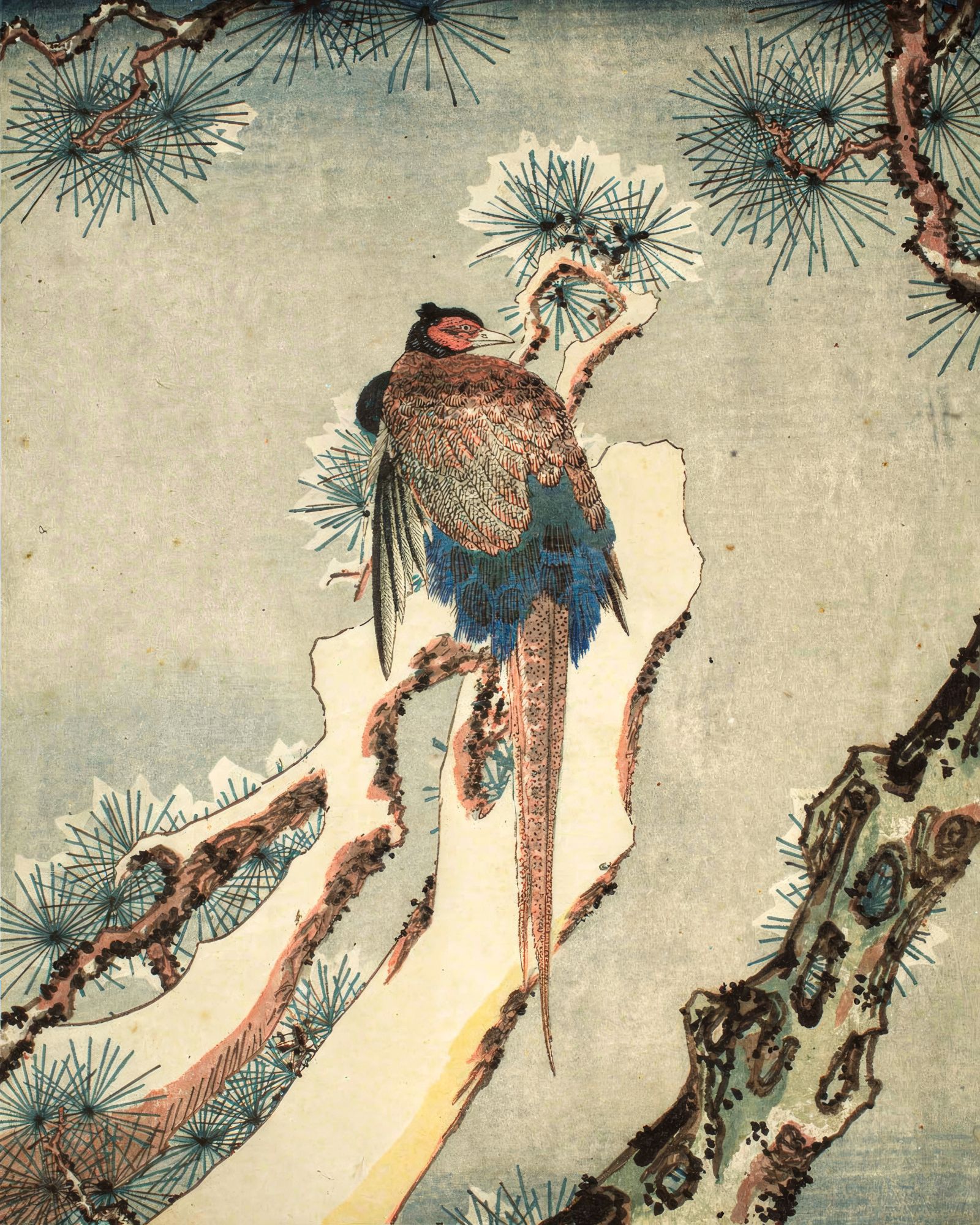
Pheasant on a Snow-Covered Pine Tree · Utagawa Hiroshige 歌川 広重, mid–1830s · Art Institute of Chicago. Restored by Surrealium at Vaxholm Fortress, Sweden.
Hiroshige’s pheasant sits high on a snow-covered pine, its long tail descending through the tall image. The white areas around the branch sharpen the coloured body and make a relatively small bird feel emphatic. This is a woodblock print rather than an oil painting, and its clean divisions of shape are part of the effect; keep the whole vertical composition in view to understand the balance between the perched weight above and the open space below.
7. A warbler against the moon
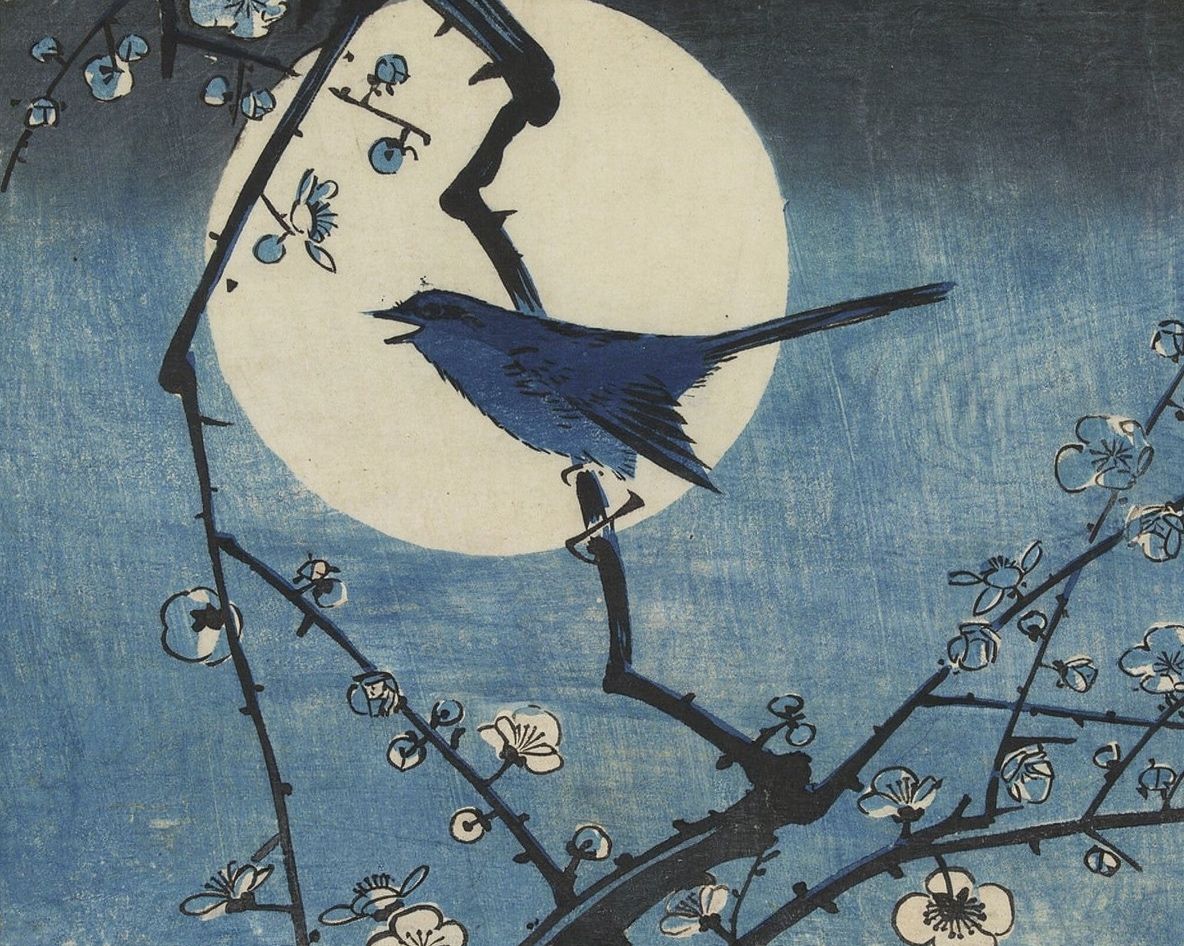
Bush Warbler on a Plum Tree in Moonlight · Hiroshige, Utagawa, ca. 1840-1842 · Victoria and Albert Museum, London. Restored by Surrealium at Vaxholm Fortress, Sweden.
A dark bird crosses the pale disc of the moon in Bush Warbler on a Plum Tree in Moonlight, while blossoms interrupt the surrounding blue. The bird’s body is small, but the contrast gives it immediate visual importance. The image suggests how little detail a composition may need to establish a clear subject: a branch, a silhouette and a luminous circle can hold attention without a crowded collection of competing motifs or a complicated narrative.
8. A parrot beside a modern sitter
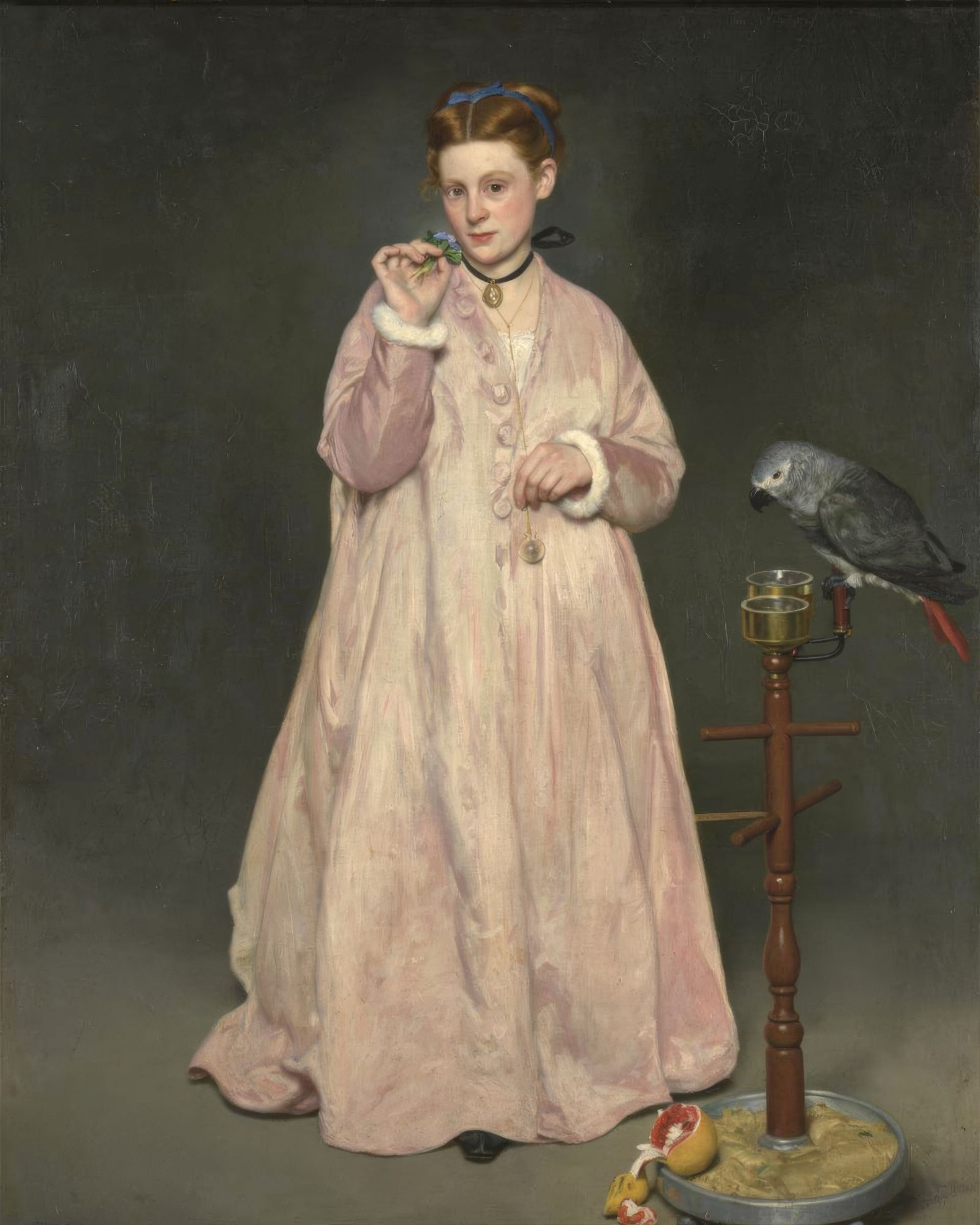
Young Lady in 1866 · Edouard Manet, 1866 · The Metropolitan Museum of Art. Restored by Surrealium at Vaxholm Fortress, Sweden.
Manet’s Young Lady in 1866 places a grey parrot on a tall perch beside the standing woman, with small objects scattered near the base. The pink robe occupies most of the composition, so the bird works as a counterweight rather than its dominant subject. Follow the relationship between the sitter’s hands, the perch and the floor; the painting becomes more interesting when the parrot is read as part of that arrangement instead of extracted as a decorative emblem.
9. A bird that belongs to a story
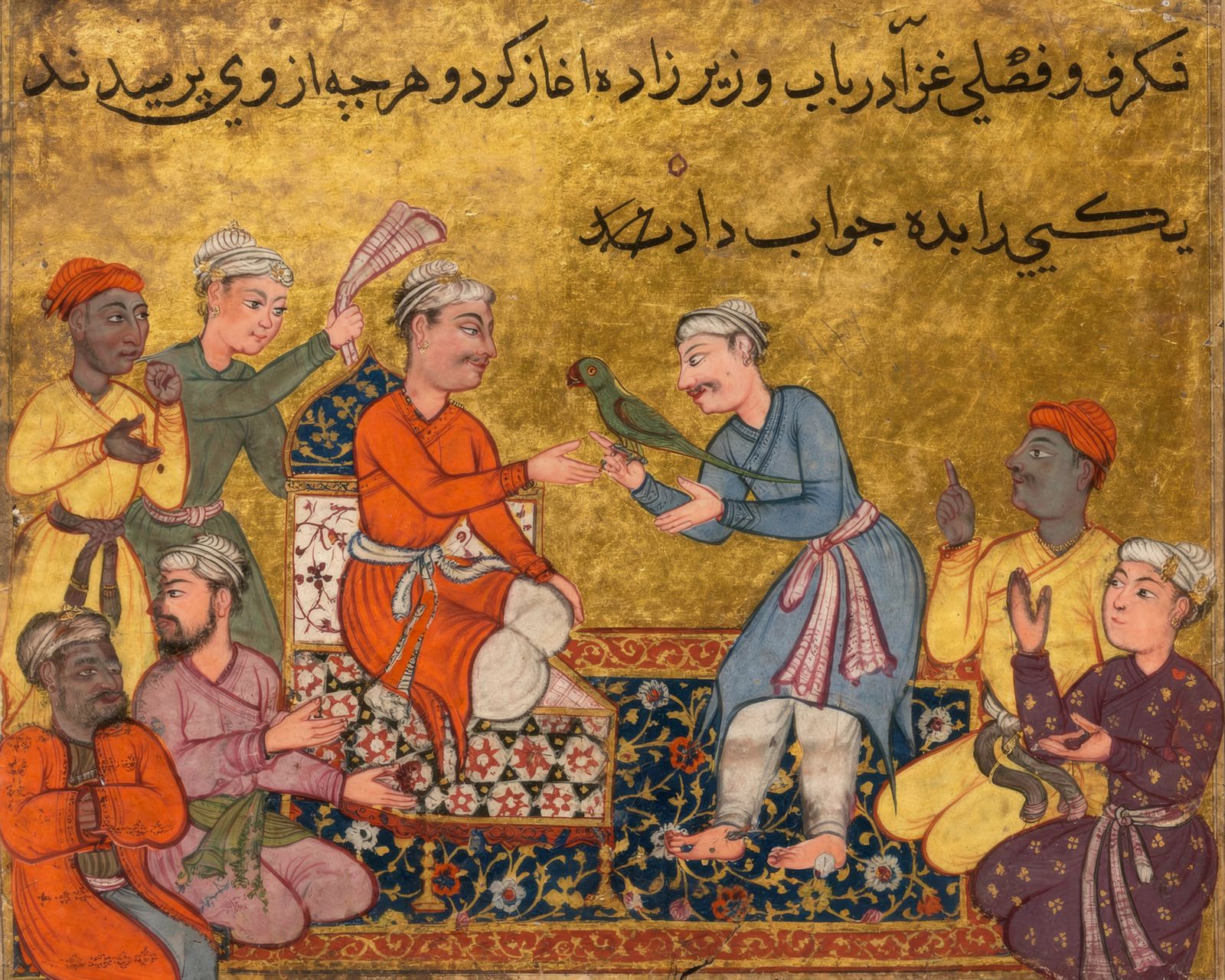
The Vizier’s Son and the Parrot · Lalu, c. 1560 · Cleveland Museum of Art. Restored by Surrealium at Vaxholm Fortress, Sweden.
In Lalu’s manuscript illustration, a small parrot is presented within a courtly gathering, surrounded by brightly dressed figures and a band of writing. Its modest scale contrasts with the importance suggested by the people attending to it. The caption identifies the narrative scene, but a viewer need not invent a translation of the visible text to enjoy it; look at the converging gestures and the way the composition makes a small creature the focus of a larger exchange.
10. A parrot among canine companions
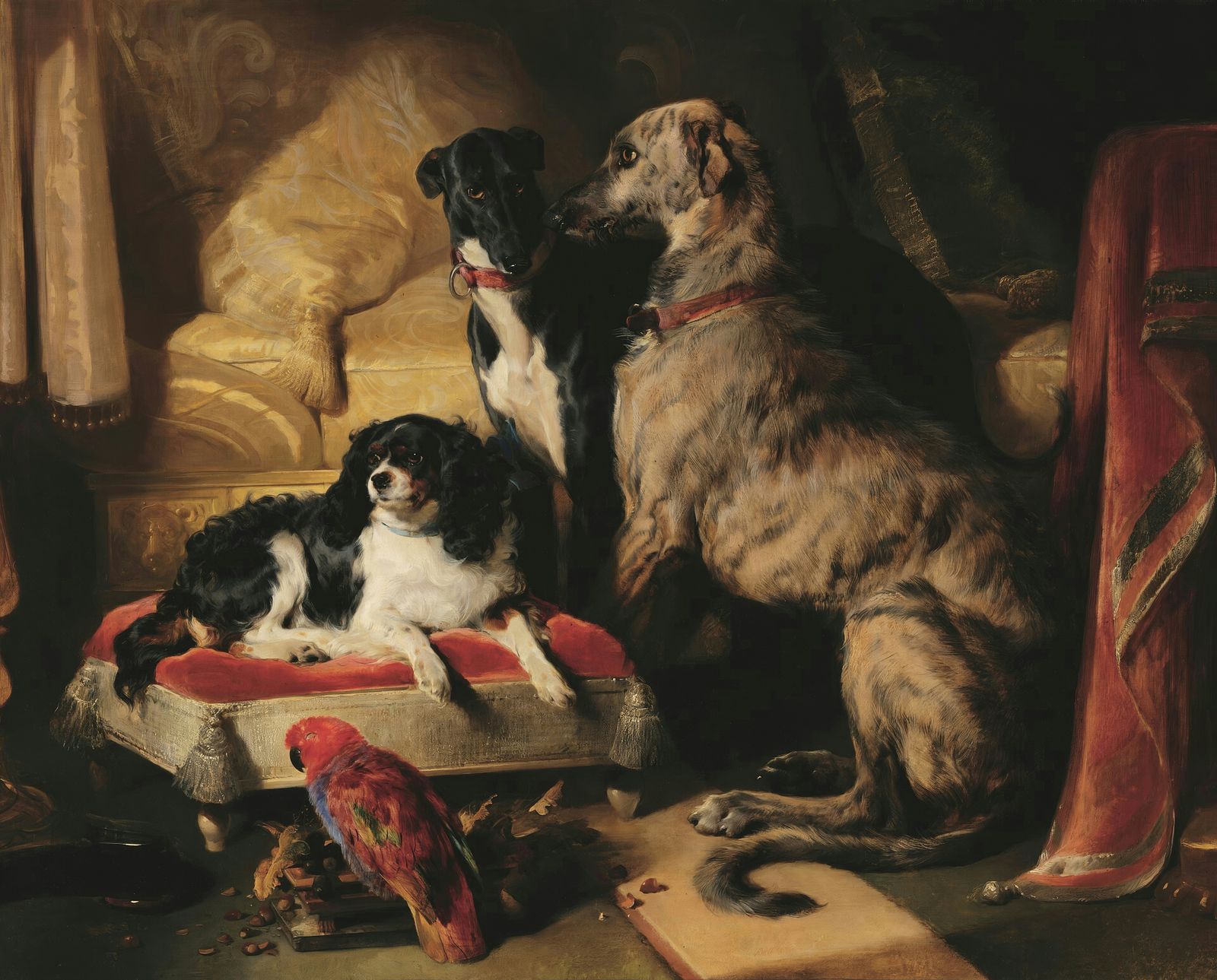
Hector, Nero, and Dash with the parrot, Lory · Edwin Landseer, 1838 · Royal Collection. Prepared for print by Surrealium at Vaxholm Fortress, Sweden.
Landseer’s Hector, Nero, and Dash with the parrot, Lory groups three dogs in a richly furnished interior, with the parrot near the lower edge. The bird’s warm colour answers the red cushion and helps connect an otherwise very low position to the rest of the scene. This is a useful last comparison because the parrot is neither a solitary specimen nor an accessory to a human sitter: its place among other animals gives the picture a different kind of social space.
To choose a work for home, decide whether you want a single clear silhouette or a picture that keeps revealing small incidents. The Peacocks masterwork lets you inspect the busy opening composition, while the Japanese collection offers a different rhythm of line and space. Manet paintings continues the story of the parrot’s companion, and vintage botanical prints returns to the plants that make these birds feel situated. Keep the margins and the complete artwork when comparing proportions.
Choosing vintage bird prints
For readers choosing vintage bird prints, this selection also offers a buying guide: decide whether you want a bird study, a decorative composition or a scene in which the bird has a smaller role. The works are historical; the prints offered today are new reproductions.
A natural-history plate, a Japanese print and a painting with a parrot are not interchangeable choices. Start with the kind of looking you enjoy. A clearly isolated bird rewards a close view; a patterned composition can hold a wall from farther away. Read each caption for its medium and subject rather than assuming every bird image is a scientific illustration.
Choose a position before a size. A pair beside a bookcase might share a pale ground or a repeated accent colour; a peacock with an expansive tail may work better alone. Keep the full image visible, including the space around a small bird. Cutting away the setting can remove the very relationship that made the picture appealing.
Open a work from the selection to see its current print choices. Compare the complete composition, dimensions and selected finish before purchase. For a mixed bird-and-flower wall, use the botanical print guide to plan the relationship between the pictures.
Are vintage bird prints original old prints?
The age of a pictured work does not date a new reproduction. Read the product description for the object being sold; these recommendations concern modern prints after historical art.
How do I pair bird prints?
Repeat a background tone, a colour or the birds’ visual scale. Preview the two complete images together and allow each its own proportions.
Which bird image works best as a gift?
Begin with the recipient’s favourite bird or way of decorating, then confirm the subject in the caption. A recognisable species and a suitable wall size matter more than a generic claim that a picture suits every bird lover.
- Are all ten works bird paintings?
- No. The selection includes paintings, Japanese woodblock prints and a manuscript illustration. Their captions identify the objects; the broader subject is how artists arrange birds within an image.
- Does a bird always have a fixed symbolic meaning in art?
- No. Meaning depends on the individual work, its context and its sources. A visible compositional role, such as balancing a figure or drawing attention to a branch, can be described without inventing a universal code.
- Why include a nest without a bird?
- The nest makes a bird’s activity visible through its surroundings. It also offers a different kind of close looking, with eggs, stems and ferns taking the place of a posed animal.
- Are vintage bird prints original old prints?
- The age of a pictured work does not date a new reproduction. Read the product description for the object being sold; these recommendations concern modern prints after historical art.
- How do I pair bird prints?
- Repeat a background tone, a colour or the birds’ visual scale. Preview the two complete images together and allow each its own proportions.
- Which bird image works best as a gift?
- Begin with the recipient’s favourite bird or way of decorating, then confirm the subject in the caption. A recognisable species and a suitable wall size matter more than a generic claim that a picture suits every bird lover.