Book of Hours: a small book with a daily rhythm
A Book of Hours organised private devotion through text and images. Learn its structure with clearly labelled contextual works.
A Book of Hours was a portable structure for devotion. Its prayers and pictures helped a reader move through a recurring pattern of observance, joining the passing hours to a much larger sacred story. These books could be modest or lavish, and their contents varied, but they were made to be used rather than merely admired as miniature galleries. Understanding that purpose changes how we look at a decorated letter or a scene of the Annunciation.
The manuscript cutting shown here is catalogued as an Italian fifteenth-century cutting. Its source record does not establish that it came from a Book of Hours, and we do not identify it as one. The two Memling paintings below are also contextual comparisons, not manuscript pages. Together they help explain initials, devotional images and reading spaces while keeping the identity of each object clear.
Hours are a structure, not a page count
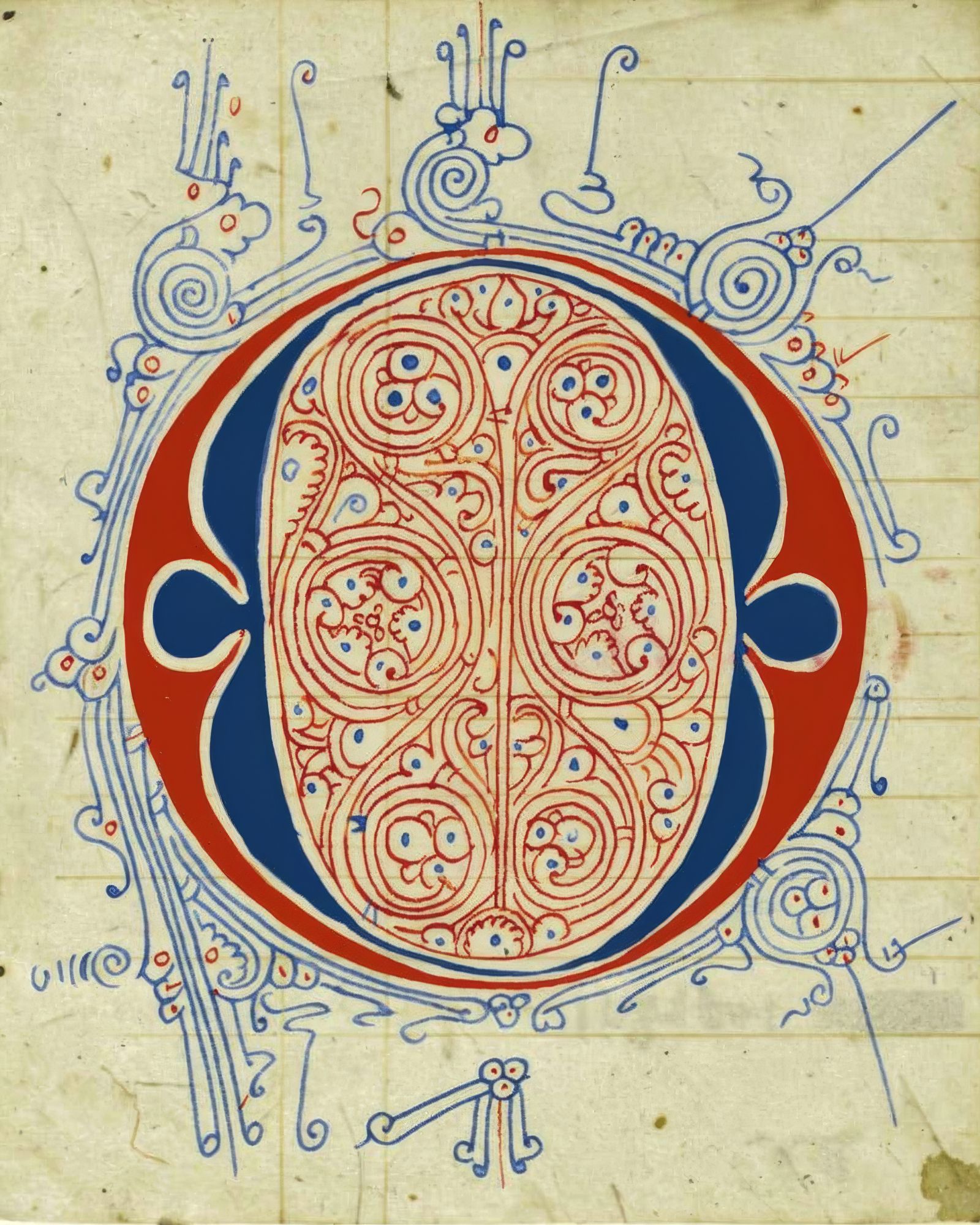
Manuscript cutting · Unidentified Italian illuminator, 1400-1499 · Victoria and Albert Museum. Restored by Surrealium at Vaxholm Fortress, Sweden. Not securely identified as a Book of Hours leaf.
The word hours refers to a pattern of prayer, not to the amount of time required to finish the book. A typical Book of Hours included the Hours of the Virgin, organised into a sequence of offices. Calendars and other prayers could surround that central material, making the volume both a repeated daily resource and a personal object. No single surviving manuscript should be assumed to contain every possible section.
The Victoria and Albert Museum’s account of the Playfair Hours offers a concrete example of how these parts fit together. Its late medieval book connects a calendar, Gospel passages, devotional offices and further prayers within one carefully made object. When looking at an unfamiliar page, ask where it belongs in that structure before interpreting it as a freestanding composition. A large initial may announce a textual beginning; an image may prepare the reader for a particular office. The page’s job helps explain its visual hierarchy, including why one part receives more space and emphasis than the text around it.
A letter can organise the act of reading
The red and blue initial in the cutting shown above gives a letter a scale and visual emphasis different from ordinary script. Even without identifying its original book, we can see how a decorated beginning directs attention. The surrounding space, the letter’s shape and the finer ornament work together to establish a point of entry. Decoration can therefore have a practical relationship to reading as well as a visual pleasure of its own.
Our illuminated manuscript guide explains the broader family of objects to which such a cutting belongs. The distinction matters: a Psalter, an antiphonal and a Book of Hours may share decorated letters without serving the same reader or following the same textual sequence. A detached leaf or cutting has also lost information supplied by its original neighbours. Its beauty should not tempt us to reconstruct a precise owner, devotional routine or page order when the surviving evidence does not support those claims. Preserving uncertainty is part of paying attention to the object, rather than a refusal to interpret it.
The Annunciation and the beginning of attention
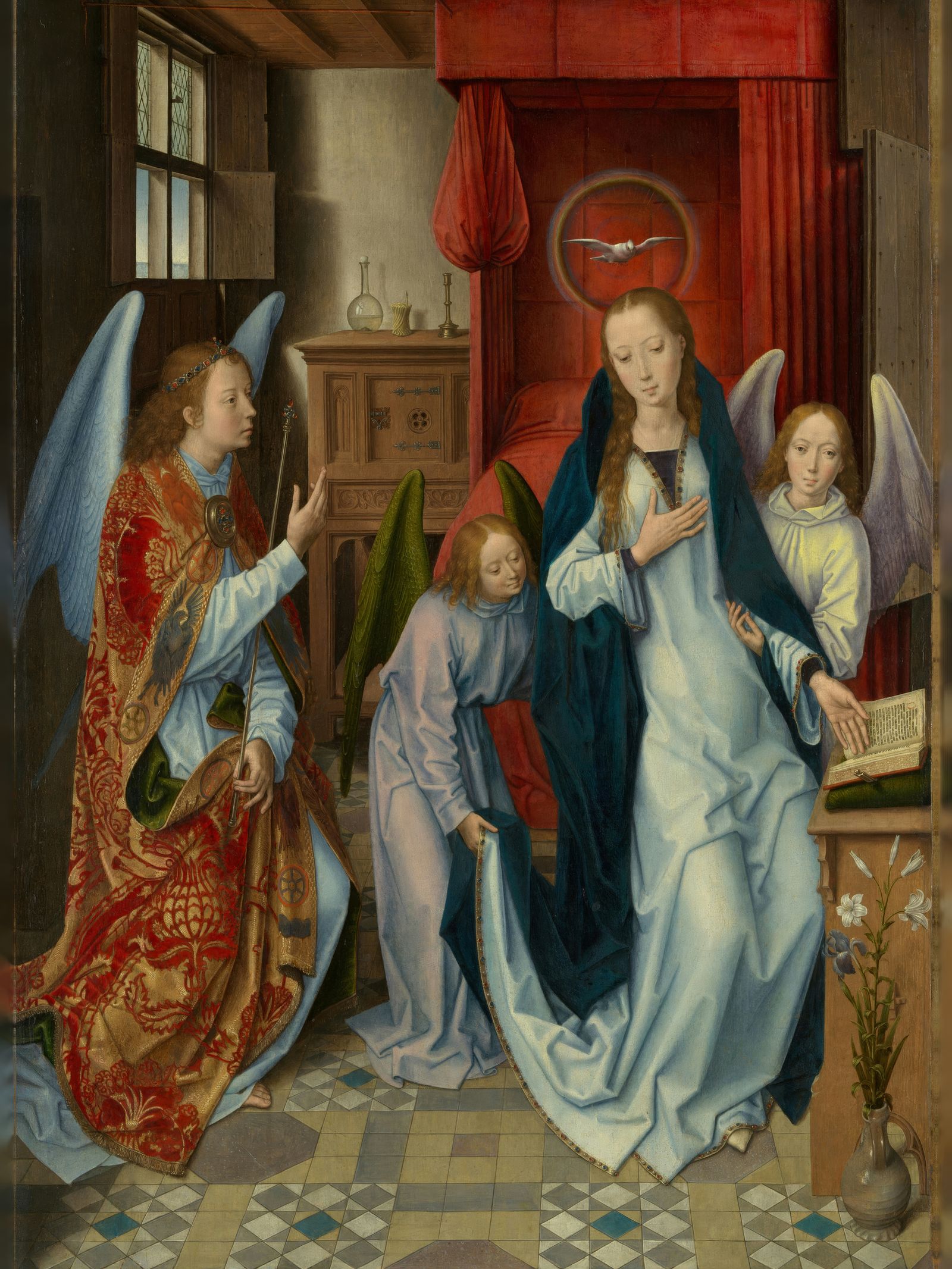
The Annunciation · Hans Memling, 1480–89 · The Metropolitan Museum of Art. Prepared for print by Surrealium at Vaxholm Fortress, Sweden.
The Annunciation was a major subject in devotional art, joining a spoken message, a listening figure and the arrival of a moment with sacred consequence. In a Book of Hours, such an image could introduce a section of prayer. The Memling painting shown here belongs to a different kind of object, yet it offers a useful comparison for the visual relationship between a reader, an interior and an encounter that interrupts ordinary time.
Look at the placement of the Virgin and the messenger, the treatment of the room and the details that direct attention between them. Those are visible choices. Their devotional significance belongs to a Christian tradition and should not be flattened into a general claim that the scene is simply about relaxation or self-care. The Annunciation art story provides a wider comparison of the subject. Here the painting helps us imagine the density of associations that a small manuscript image could bring into the reader’s hands, without claiming that this panel was itself a book illustration or that every manuscript used the same arrangement.
Private does not mean solitary in every sense
Books of Hours are associated with lay devotion, but the reader’s apparently private activity remained connected to shared religious texts, festivals and practices. Personal ownership did not make the contents an entirely individual invention. At the same time, choices of prayers, saints, decoration and inscriptions could make one volume distinct from another. A book could participate in a common tradition while carrying traces of a particular household or patron.
The Fitzwilliam Museum’s manuscript studies make that variety visible through specific surviving books and their histories. They also help correct the assumption that every elaborately decorated Book of Hours was made for a woman or that every reader had the same relationship to its text. Look for evidence about a particular volume rather than allowing a modern category to supply its owner automatically. A name, an inscription, a coat of arms or a documented commission can be informative, but each requires interpretation. An attractive border alone cannot tell us who held the book, how often it was opened or which page mattered most to its owner.
A room painted for devotion
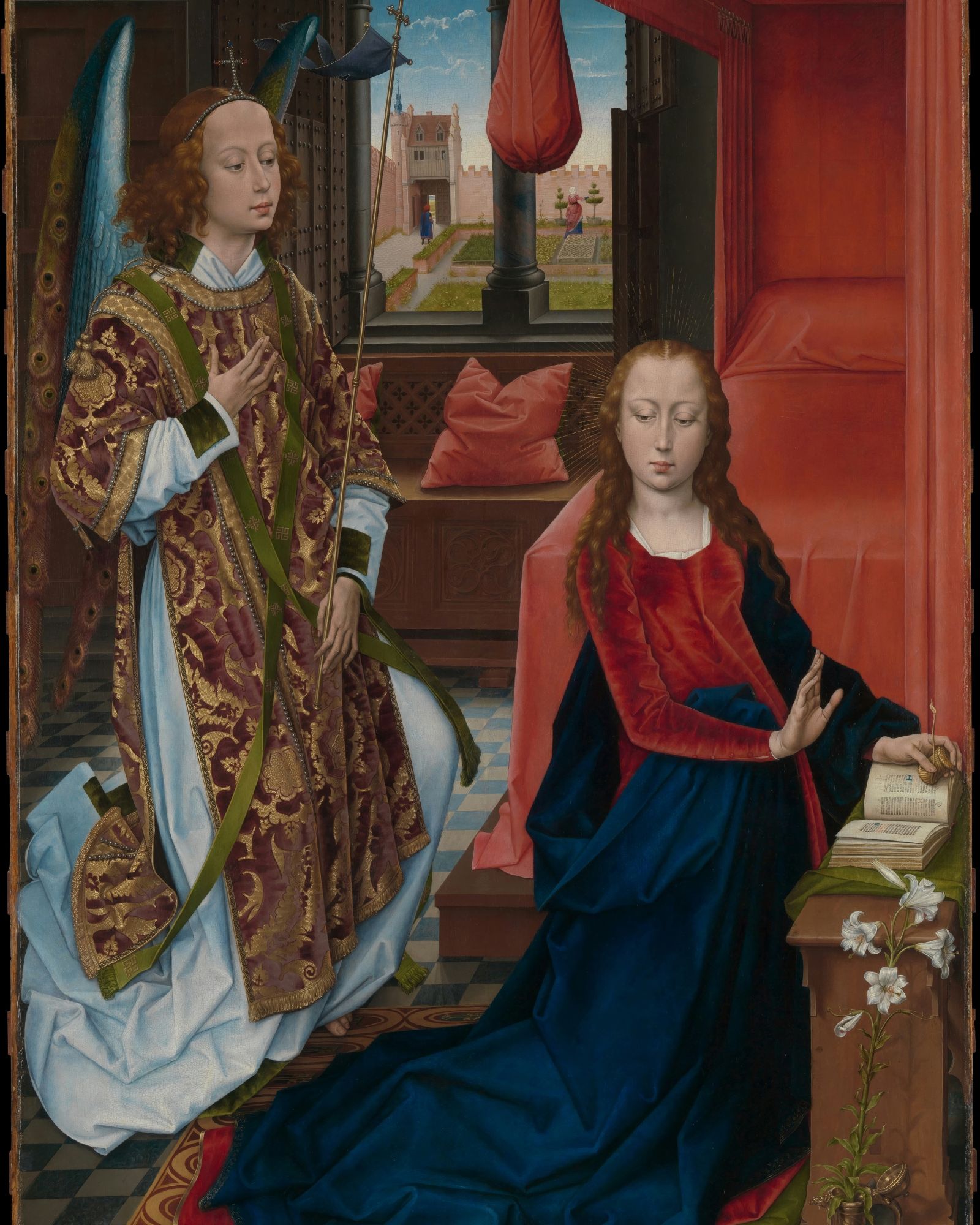
The Annunciation · Hans Memling, ca. 1465–70 · The Metropolitan Museum of Art. Prepared for print by Surrealium at Vaxholm Fortress, Sweden.
Memling’s other Annunciation shown here gives us a second comparison, with its own arrangement of figures and domestic space. Place the two paintings side by side and describe what changes before deciding which feels more intimate or more formal. The task is useful because devotional images were not all interchangeable: a familiar subject could be organised differently, affecting the viewer’s approach to the scene.
The same principle applies to manuscript pages. A border can enclose an image closely or allow it to seem open; a figure can dominate a miniature or share attention with architecture. Our medieval art guide offers a broader setting for those decisions, while the heraldry guide explains why a shield in a manuscript needs a precise identification rather than a surname-based guess. Different kinds of evidence answer different questions. A painted room helps us discuss pictorial space; an ownership inscription helps us discuss a book’s history. Neither should be made to do the other’s work, even when both appear together on one richly decorated page.
How to look without inventing the missing book
Begin with the object’s supplied title and catalogue description. Note whether you are looking at a complete manuscript, a leaf, a cutting or a later reproduction. Then separate three observations: what the text or image visibly contains, what the catalogue establishes about it, and what remains uncertain. This method may sound modest, but it protects the interest of the real object from an attractive story attached too quickly.
For the cutting here, the useful certainty is its identity as a historic Italian manuscript fragment with a decorated initial. Its original daily use is not established by the available record. If you want an image for a room, the Masterworks collection allows you to consider the complete surviving object as it is. If your interest is reading history, explore a documented whole Book of Hours through a museum’s manuscript catalogue. Following the sequence of pages will teach you things that a detached ornamental letter, however beautiful, cannot supply on its own, including the pace at which text and images return through the volume.
A Book of Hours brings time, text and image into a small physical space. Its richness lies in that relationship, not only in the amount of gold or ornament on a page. Looking carefully means preserving both the pleasure of the surface and the limits of what the surviving object can tell us. The Renaissance collection places the surviving cutting among other works of its broad period.
- What is a Book of Hours?
- A devotional book associated especially with lay readers, usually centred on the Hours of the Virgin and often containing a calendar and additional prayers.
- Is every illuminated manuscript a Book of Hours?
- No. Illumination appears in many kinds of manuscripts. The text and its organisation are needed to identify the type of book.
- Are the illustrations here pages from a Book of Hours?
- No. The cutting is not securely identified as coming from one, and the Memling works are paintings. They are labelled contextual comparisons.