Frederic Leighton: the embrace and the escape
Frederic Leighton gives bodies and drapery a dramatic purpose. Three paintings move from a dangerous embrace to marriage and rescue.
Frederic Leighton can make an embrace look secure in one painting and perilous in another. A mermaid draws a fisherman towards the water; a married couple stand beneath an arch; Andromeda twists beside a monster while a rescuer approaches from above. The bodies are carefully arranged, but their arrangements carry very different stories.
Leighton House identifies Frederic, Lord Leighton as a leading Victorian painter, sculptor and public figure. These three works give a narrower, more useful introduction to his pictures than a list of honours: follow the arms, the folds of cloth and the surrounding space. The Greek mythology paintings story offers a wider set of encounters; here the focus is Leighton’s handling of contact and distance.
An embrace at the water’s edge
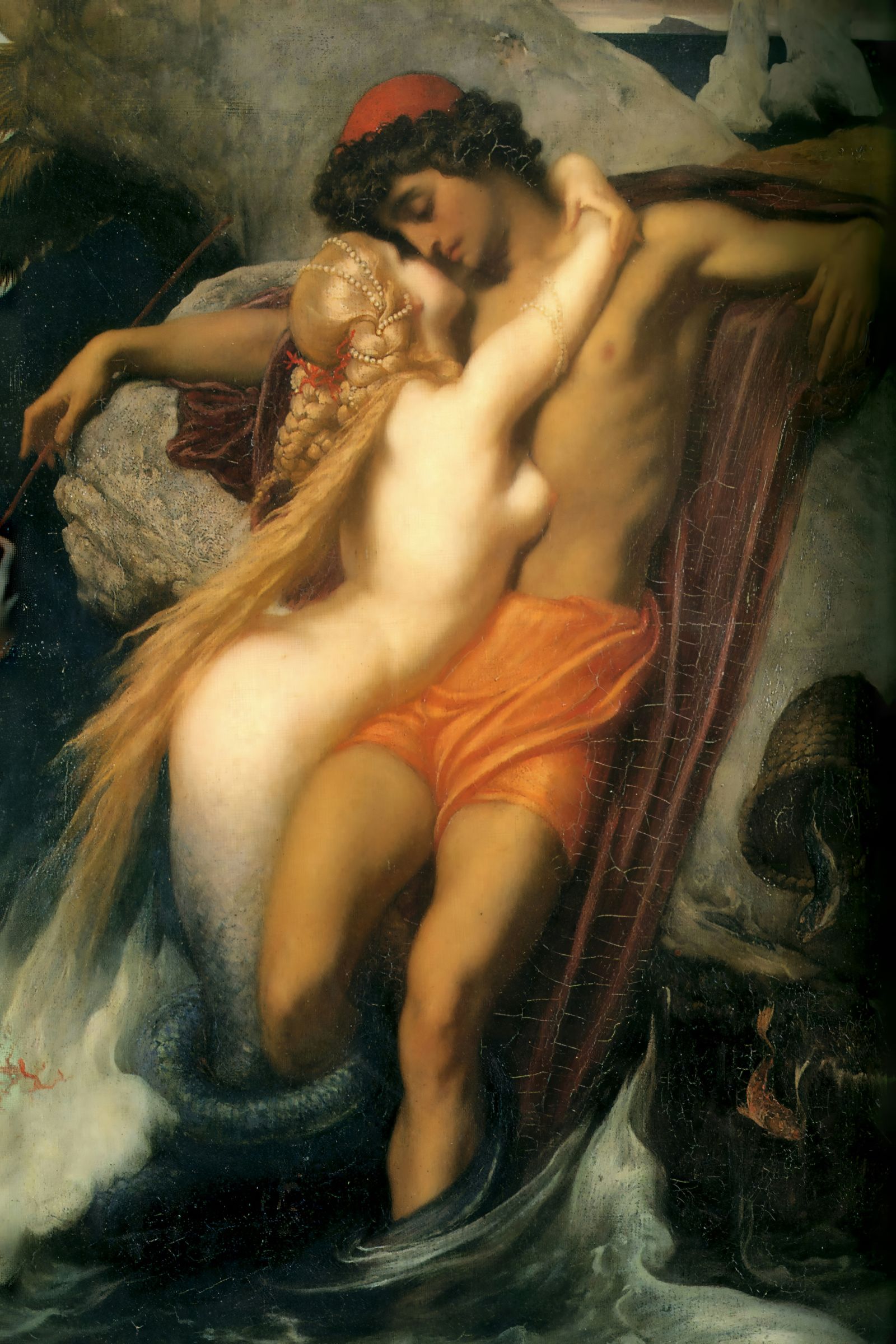
The Fisherman and the Syren · Frederic Leighton, c. 1856–58 · Bristol Museum & Art Gallery. Prepared for print by Surrealium at Vaxholm Fortress, Sweden.
The Fisherman and the Syren, dated about 1856–58, places a pale mermaid against a seated fisherman in orange cloth. Her arms reach around his neck. His body rests against rock, while the net at his side helps identify his work. Below them, the curve of her scaled tail returns towards the water.
The two bodies make a linked shape, but their positions are not equivalent. The fisherman has a place on land; the mermaid rises from a different element. The close contact joins them while the setting keeps that difference visible. Water, rock and net give the embrace consequences beyond the touching of faces and arms.
Bristol Museums connects the painting with Goethe’s poem about a mermaid who draws a fisherman into the water. That source explains the danger behind the image’s beauty. Without it, we might see only an intimate encounter. With it, the curved body and descending tail also suggest a direction of movement away from the fisherman’s secure place.
A story can change the meaning of a line
Follow the mermaid’s body from her raised arms down towards the water. The line is graceful, but grace does not settle the moral or emotional meaning of the scene. In the poem’s context, the same movement that appears attractive also carries the fisherman towards disappearance. Beauty and danger occupy the same form.
Leighton gives the orange cloth a different role. It is a compact area of warm colour around the fisherman’s hips, tying his body to the darker rock and net. The pale mermaid cuts across that arrangement. The eye moves between them partly because their colours and positions differ, not simply because the subject asks us to recognise a supernatural creature.
This is a useful way to approach narrative painting. Read enough to identify the story, then return to the visible organisation. The source tells us what is at stake; the composition determines how we encounter it. Neither replaces the other. A plot summary alone would miss the held weight of the fisherman’s body and the continuous pull of the mermaid’s curve.
Wedded makes contact into shelter
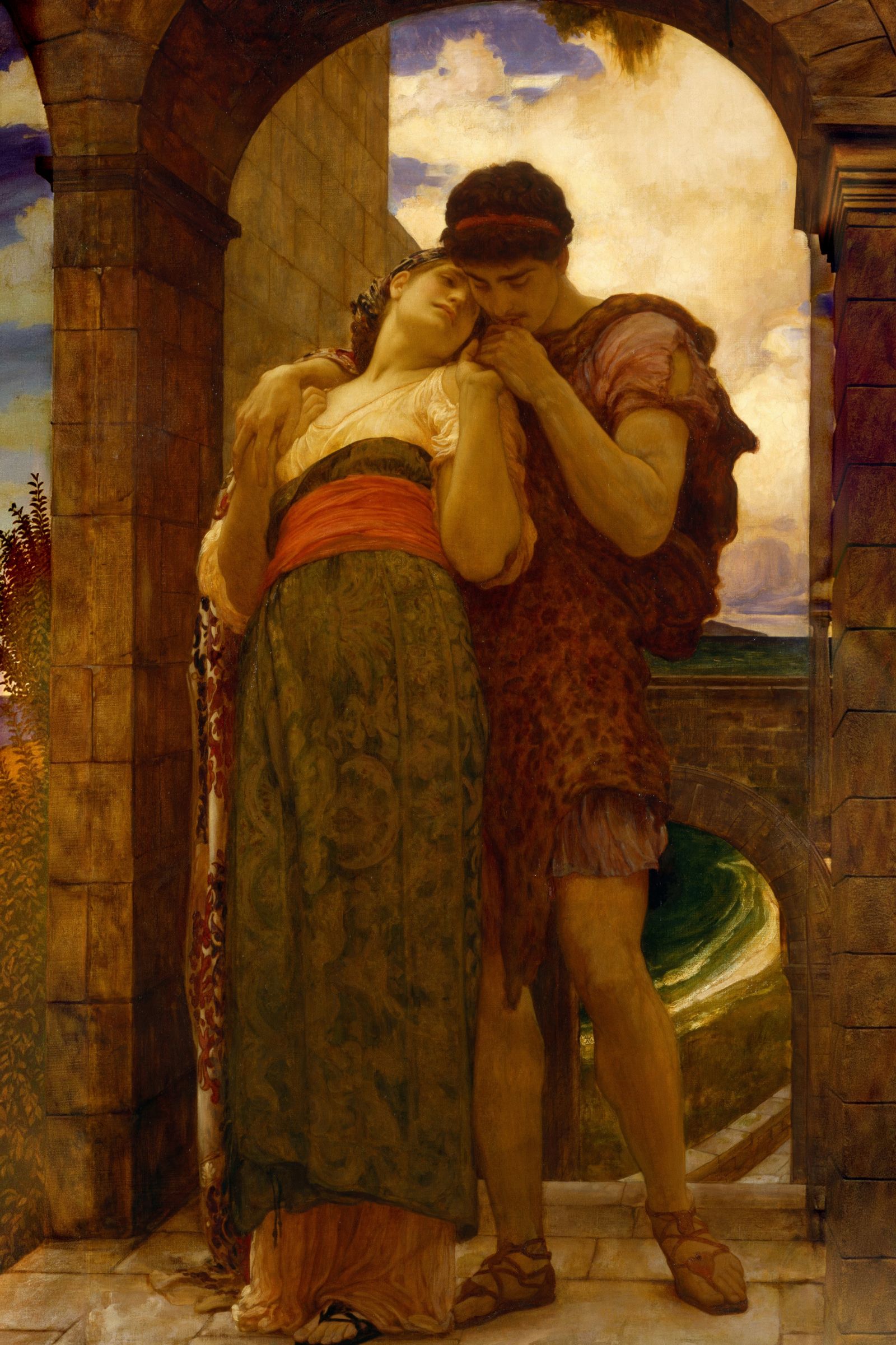
Wedded · Frederic Leighton, 1882 · Art Gallery of New South Wales, Sydney. Prepared for print by Surrealium at Vaxholm Fortress, Sweden.
Wedded, painted in 1882 and held by the Art Gallery of New South Wales, gives the embrace a more sheltered setting. The couple stand beneath a stone arch. The woman leans towards the man, who lifts her hand near his face. Their joined bodies form a narrow upright group, framed by architecture and a bright opening behind them.
The gallery identifies the setting as the Greek theatre at Taormina in Sicily. That specific place belongs to the painting’s account, though the figures and their clothing make the scene feel removed from an ordinary modern street. The arch gathers the couple into a shared space, and the steps establish a firm place for their feet.
Compare the hands with those in the fisherman picture. There, the arms encircle the neck and the body bends towards the water. Here, a lifted hand creates a smaller, more contained gesture. The composition can suggest closeness through restraint. The difference depends as much on the surrounding support as on the expressions of the people.
Drapery helps a body occupy space
The long garments in Wedded do several kinds of work. They give the figures distinct areas of colour, carry the eye down towards the feet and reveal changes in the bodies beneath them. Folds do not merely decorate a surface; they help explain which parts hang, bend or press against another form.
The stone arch provides an instructive contrast. Its divisions are firm and repeated, while the cloth falls in less regular patterns. The figures therefore feel both held by the architecture and different from it. Their soft outlines remain legible against a setting built from harder edges.
Look at the lower portion before returning to the faces. The full-length format makes the couple’s stance part of the encounter. We can see how much of the picture is devoted to standing together, with no large outward action. A crop around the embrace would retain the sentiment but lose the support that makes it feel settled. In Leighton’s painting, the feet, steps and arch are participants in the scene.
Andromeda occupies a much less secure place
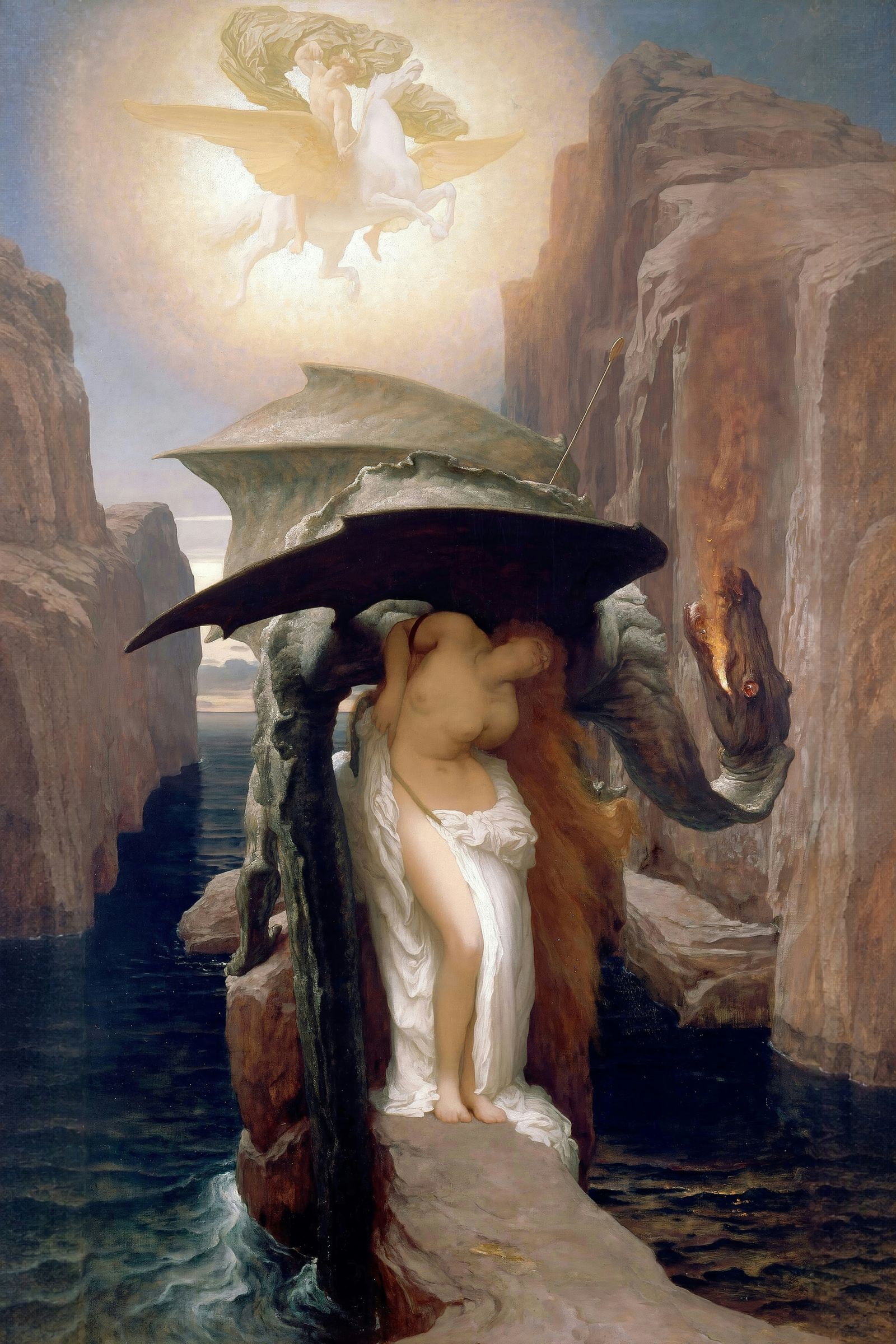
Perseus and Andromeda · Frederic Leighton, 1891 · Walker Art Gallery, Liverpool. Prepared for print by Surrealium at Vaxholm Fortress, Sweden.
Perseus and Andromeda, dated 1891, places a pale figure within the dark, twisting form of a monster. Rock rises around them; water occupies the space below. High above, Perseus approaches on Pegasus in a bright area of sky. The vertical distance between danger and rescue is one of the first things the composition makes us feel.
The Walker Art Gallery’s account identifies the moment as an imminent rescue, with the monster already struck by an arrow. The picture holds the outcome just beyond the central figure’s immediate position. Andromeda turns within the creature’s enclosing shape, while the rescuer remains comparatively small and distant.
The contrast with Wedded is sharp. An arch can shelter; a wing can enclose without protecting. Pale skin against darker surroundings appears in both works, but its effect changes with the forms around it. Leighton reuses broad compositional resources for different stories. Lightness does not always mean safety, and a beautiful curve does not always offer a comfortable place to rest.
Read the whole arrangement before the label
These paintings can be grouped under broad terms such as Victorian, academic or mythological art. Those labels help locate them, but they do not explain why their encounters feel different. The fisherman has land beneath him and water drawing him away. The married couple share an architectural shelter. Andromeda is held near danger while escape enters from far above.
The Lady of Shalott painting essay considers another relationship between a literary subject and an image. Comparing the discussions is useful as long as the artists and works remain distinct. A poem can establish a narrative situation; the painter still has to choose the moment, the viewpoint and the distribution of light. James Tissot’s farewell offers a contemporary social setting in which a smaller gesture carries a comparable narrative burden.
For a print, give those decisions room to remain visible. The narrow vertical compositions here depend on the full span between head and foot, sky and water, arch and step. Choose the scene whose complete arrangement interests you. Its continuing attraction may lie in the tension between a compelling shape and the less comfortable story that shape carries.
Find the fisherman again in the Realism-era collection, then compare his curved encounter with the more settled group in Wedded. Leighton makes contact visible through the whole body and its surroundings. Keeping that whole structure in view allows a graceful surface to retain the narrative force beneath it.
- Which Leighton painted these works?
- They are by Frederic, Lord Leighton, the Victorian painter associated with Leighton House. He should not be confused with Edmund Blair Leighton, a different artist with a similar surname.
- What is the story behind The Fisherman and the Syren?
- Bristol Museums relates it to Goethe’s poem about a mermaid who draws a fisherman into the water. The essay summarises that context without reproducing the poem.
- Where are the three original paintings held?
- The Fisherman and the Syren is in Bristol; Wedded is at the Art Gallery of New South Wales; Perseus and Andromeda is at the Walker Art Gallery in Liverpool. Their individual captions identify the collections.