The Lady of Shalott painting: a story at the water’s edge
The Lady of Shalott painting brings Tennyson to the river. Read its story through clearly identified companion works by Waterhouse.
The Lady of Shalott painting most people mean is John William Waterhouse's 1888 work at Tate. It shows the woman leaving her tower by boat after the curse in Tennyson's poem has been brought upon her. The painting is not reproduced on this page: Fable's available pictures here are other works by Waterhouse, each named in its caption. They help us compare the artist's ways of staging a meeting, an invitation and a dangerous edge.
That distinction matters. La Belle Dame sans Merci, the lead image, comes from Keats rather than Tennyson and shows a different woman with a different story. The family resemblance is a reason to compare the paintings, not a reason to substitute one title for another. Begin with Pre-Raphaelite painting for the wider visual tradition, then keep the individual narratives in view.
What happens in Tennyson’s story
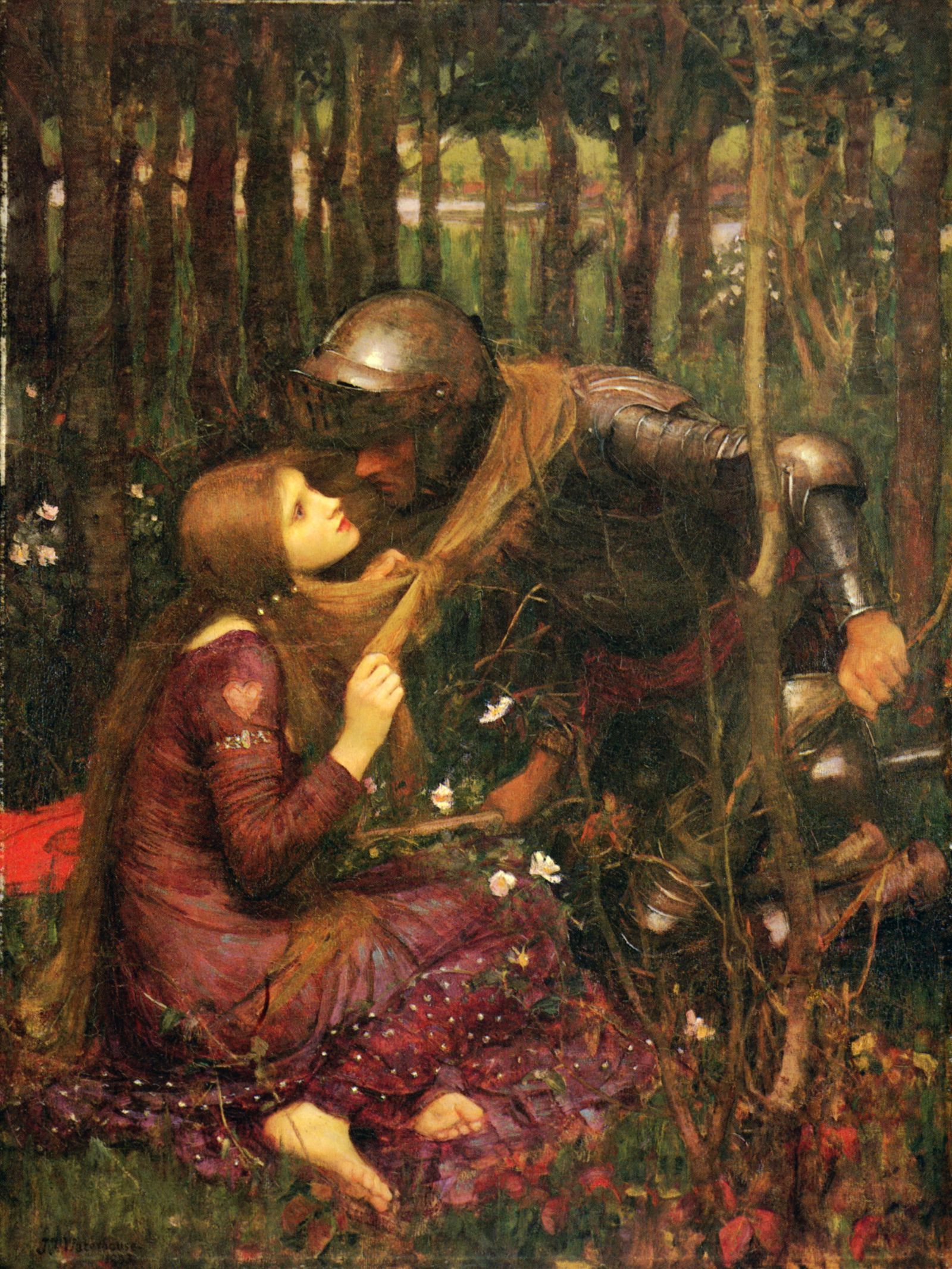
La Belle Dame sans Merci · John William Waterhouse, 1893 · Hessisches Landesmuseum, Darmstadt. Prepared for print by Surrealium at Vaxholm Fortress, Sweden.
The Lady of Shalott lives apart from Camelot, seeing the outside world through a mirror and weaving what she sees. A prohibition keeps her from looking directly out; when she turns towards Lancelot, the mirror breaks and the curse takes effect. She leaves the tower, finds a boat and travels towards Camelot, dying before she arrives. This is the narrative background, not a claim that Waterhouse paints every event at once.
The 1888 painting chooses the departure. Tate's account identifies the woven fabric across the boat, the chain in the woman's hand, a crucifix and three candles, two of them extinguished. Those objects connect the visible moment to what has happened and what is approaching. The viewer needs neither a complete quotation of the poem nor a list of secret meanings to understand that the journey is already marked by loss.
Why the choice of moment matters
A painter illustrating a long poem has to choose what can be held within one image. The breaking mirror would make the curse an immediate event; arrival at Camelot would shift attention towards those who discover the woman. Departure keeps her alive and active, but gives that action a direction the reader of the poem knows will end badly. The picture's time is therefore larger than the instant it depicts.
That structure helps explain why the painting remains memorable even to viewers who do not know the poem well. An action as ordinary as releasing a mooring can become a threshold. The narrative does not need to be reduced to a claim that the woman is simply passive or simply free. The poem and the picture allow the cost of her movement towards the world to remain part of the question.
La Belle Dame is a different encounter
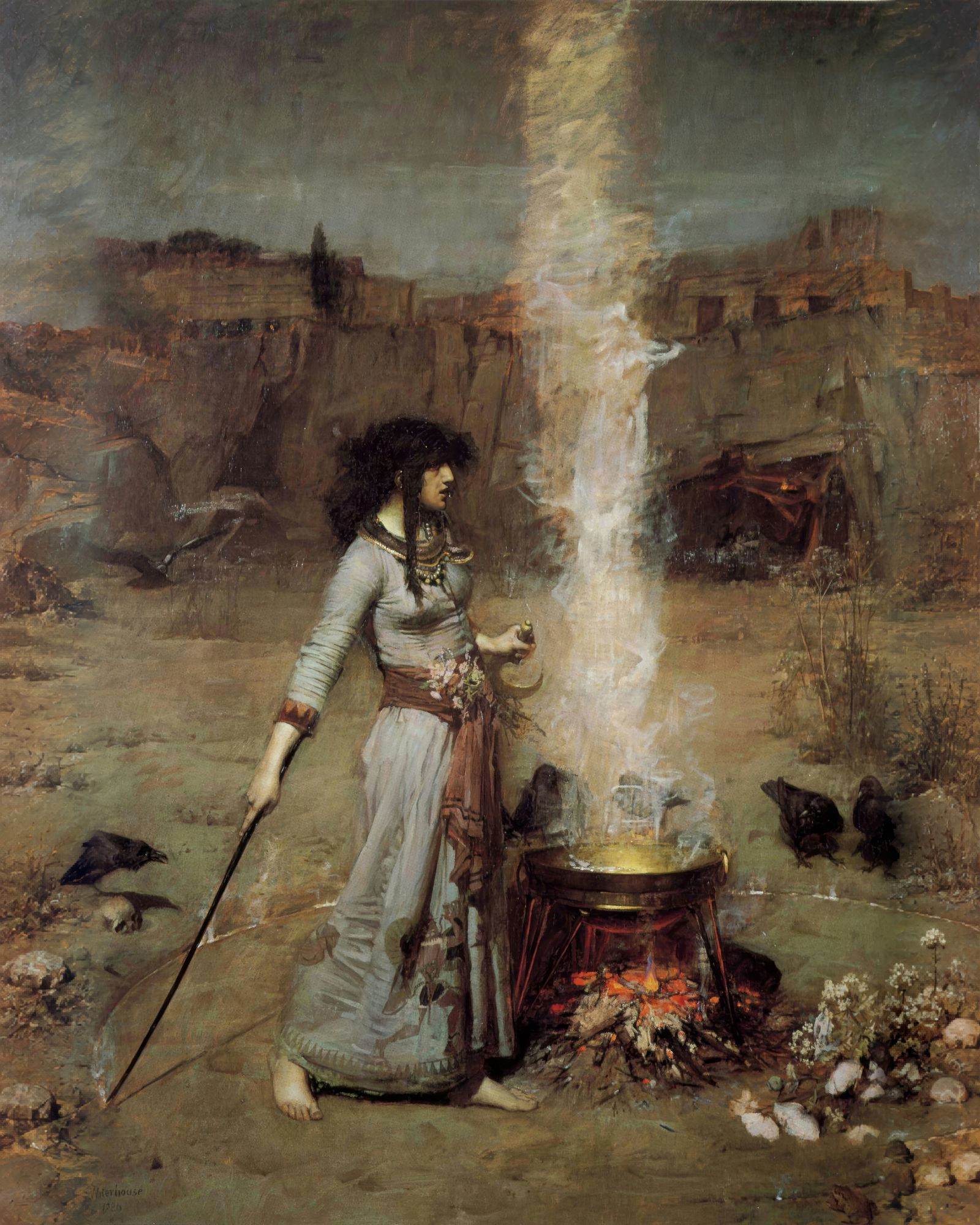
The Magic Circle · John William Waterhouse, 1886 · Tate, London. Prepared for print by Surrealium at Vaxholm Fortress, Sweden.
In the Waterhouse painting shown here, a seated woman and an armoured knight lean towards each other among trees. Their close faces and the angle of his body make the meeting intimate, while the armour brings a harder surface into the surrounding softness. The work is La Belle Dame sans Merci, dated 1893, and belongs to the Hessisches Landesmuseum in Darmstadt. Its literary point of departure is Keats's ballad.
Unlike the departing Lady of Shalott, this woman meets another figure within the scene. The knight's attention has an object directly before him, and the viewer can follow the exchange through their gazes and hands. That makes the painting a useful companion when considering Waterhouse's treatment of enchantment, but it does not supply missing visual evidence for the boat in the Tate painting.
A later painter and an earlier movement
Waterhouse is often discussed alongside the Pre-Raphaelites, although he was born in 1849, after the Brotherhood's formation in 1848. The connection lies in subjects and visual interests rather than membership in the founding group. Literary narratives, carefully observed natural settings and emotionally charged figures give his work a place in the later life of that tradition.
This chronology helps avoid a common shortcut. Calling a painting Pre-Raphaelite can be useful as a broad description, but it should not erase the differences between artists or decades. Waterhouse's 1888 Shalott belongs to a later Victorian return to a familiar poem. When comparing works, ask what the individual painter does with the subject: how close the figures come, how the landscape contains them, and which moment of the narrative becomes visible.
The Magic Circle: an action with a boundary
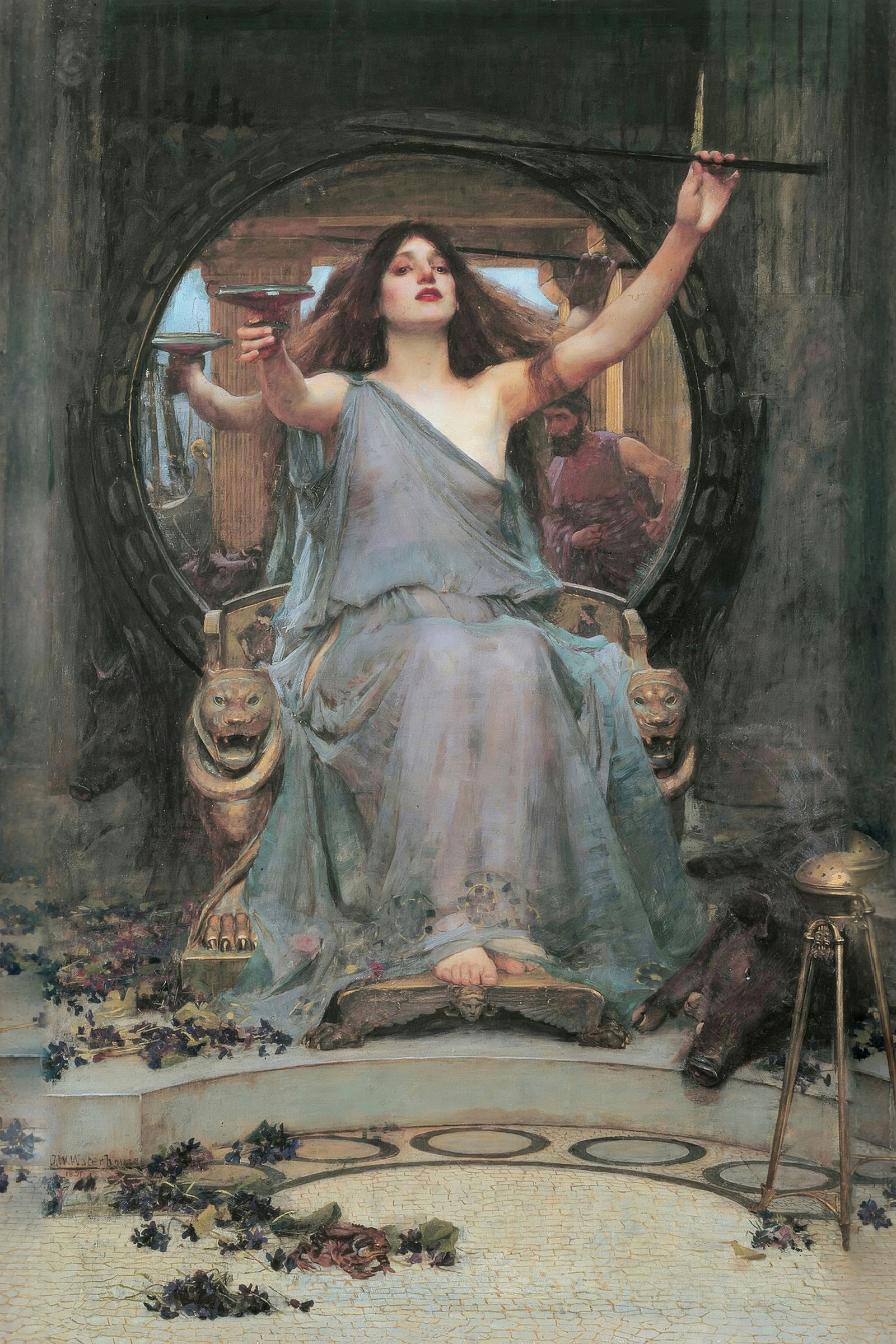
Circe Offering the Cup to Ulysses · John William Waterhouse, 1891 · Gallery Oldham. Prepared for print by Surrealium at Vaxholm Fortress, Sweden.
The Magic Circle, shown here, gives its standing woman a deliberate task beside a vessel and rising smoke. The long implement reaches towards the ground, while animals and objects gather around the scene. A line being made on the earth becomes a boundary the viewer can follow. The figure's concentration differs from the encounter in La Belle Dame, because no second human figure holds her gaze.
The comparison is about composition, not a claim that the two women share an identity or a single moral meaning. Waterhouse can organise a scene around an act of making, a dangerous invitation or a departure. The Magic Circle demonstrates how an object and a line can give a figure agency within the picture, even when the subject belongs to an imagined or supernatural setting.
Circe: the viewer becomes the visitor
Circe Offering the Cup to Ulysses places the seated figure frontally, with the cup extended into the space from which we look. The round mirror behind her adds another view and complicates the simple arrangement of a person facing an audience. Her raised arm and the objects around her establish an active invitation. The story belongs to classical myth, not to Tennyson's Arthurian world.
Seen beside the Shalott narrative, the difference is instructive. Circe controls an encounter that approaches her, while the Lady of Shalott moves out towards a world she has seen indirectly. This is an interpretive comparison of two stories and their staging, not a declaration about women's roles in every Waterhouse painting. The specific direction of movement gives the comparison its value.
Hylas: water is more than scenery
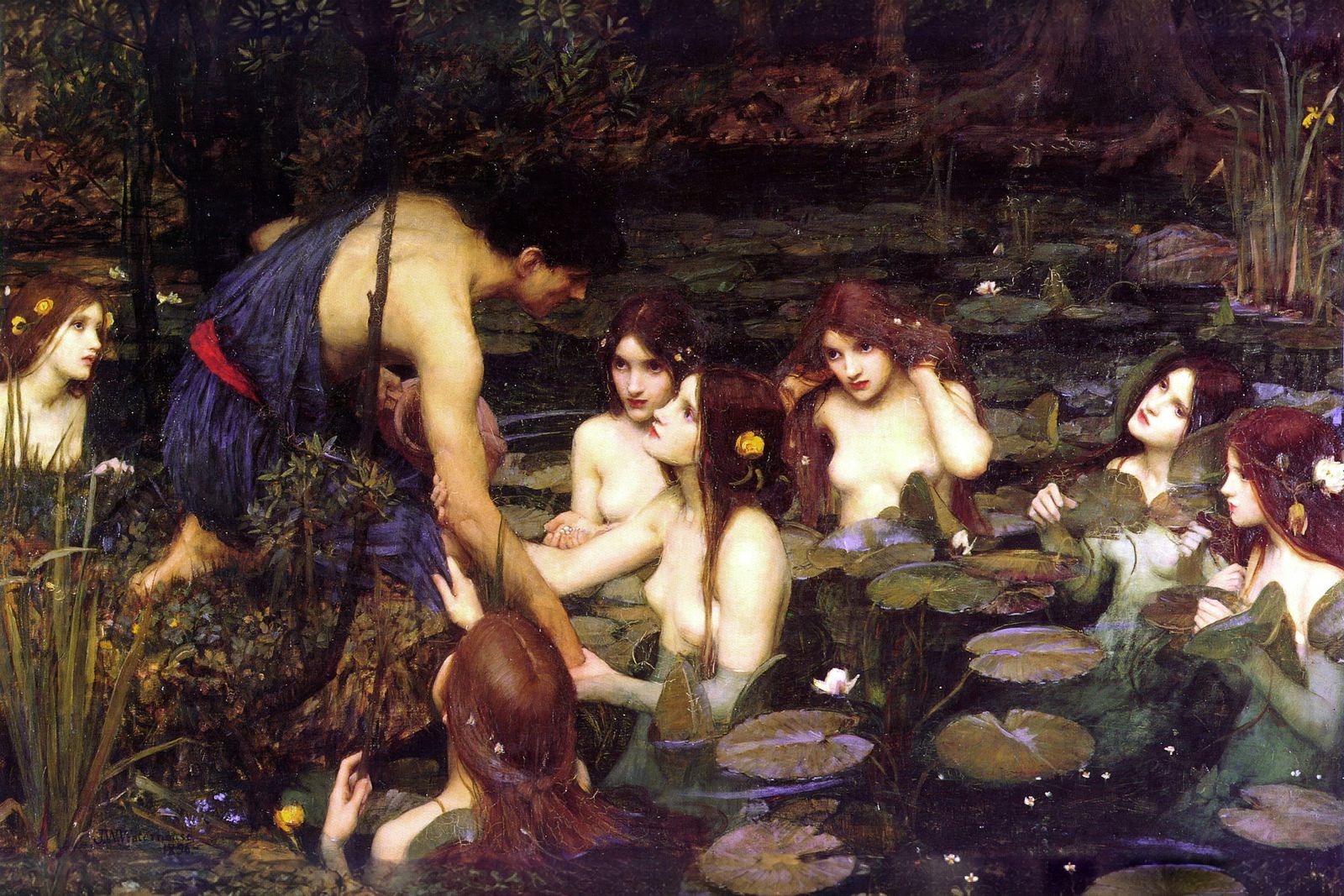
Hylas and the Nymphs · John William Waterhouse, 1896 · Manchester Art Gallery (1896.15). Prepared for print by Surrealium at Vaxholm Fortress, Sweden.
In Hylas and the Nymphs, the bank places the young man above figures emerging among leaves and water lilies. The reach of hands and the proximity of faces make the surface of the pool a meeting place. The water is therefore part of the action, not simply a beautiful background. Its dark horizontal field gathers the pale forms into a pattern that draws both Hylas and the viewer's attention.
Water works differently in the Lady of Shalott's departure, where it provides a route away from the tower. Comparing those functions is more useful than collecting every image with a woman beside a river under one mood. The guide to Greek mythology paintings follows the separate stories of Circe and Hylas, preserving the distinction between a shared visual interest and a shared plot.
Choosing a companion work honestly
If you want the 1888 Lady of Shalott itself, the related works on this page should not be presented as a substitute with the same title. You may instead discover that what attracts you is Waterhouse's woodland colour, the closeness of an encounter or the way an object changes the direction of a story. Those preferences can lead to a different work on its own terms.
Study La Belle Dame sans Merci within the Impressionist collection, the catalogue's current grouping for that work. Then compare Symbolism, where an image can remain suggestive without becoming a literal illustration. A clear caption should keep the work, date and story attached, leaving your response free to develop without beginning from a mistaken identity.
The Lady of Shalott is most rewarding when the poem, the particular painting and its later companions remain distinct. Waterhouse gives a moment enough detail to carry what comes before and after it. Looking closely means recognising that choice, then allowing each neighbouring work to tell its own story.
- Who painted the famous Lady of Shalott?
- John William Waterhouse painted the well-known 1888 work held by Tate. Other artists and other versions exist, so the artist and date should accompany the title.
- Is the lead image on this page The Lady of Shalott?
- No. It is Waterhouse’s La Belle Dame sans Merci of 1893, a work based on Keats. The Shalott painting is discussed but is not reproduced here.
- What is the painting’s connection to Tennyson?
- It depicts a moment from his poem in which the woman leaves her tower by boat after the curse takes effect. The painting concentrates that longer narrative into the departure.