George Washington portrait: looking at Edward Savage
A George Washington portrait by Edward Savage, with clearly labelled Stuart comparisons: how pose, clothing and setting shape a public image.
A George Washington portrait is not a single fixed image. Different painters presented the same sitter through different poses, clothes and settings. Edward Savage’s 1793 panel gives us a seated figure in civilian dress, with a paper in his hand and a red curtain behind him.
That is the work shown here. Gilbert Stuart’s famous Washington compositions provide context in words, while two other Stuart sitters and a Perronneau child portrait offer visible comparisons. Keeping artist and subject separate makes it possible to study the familiar presidential face without confusing one painting with another.
Begin with Edward Savage’s seated Washington
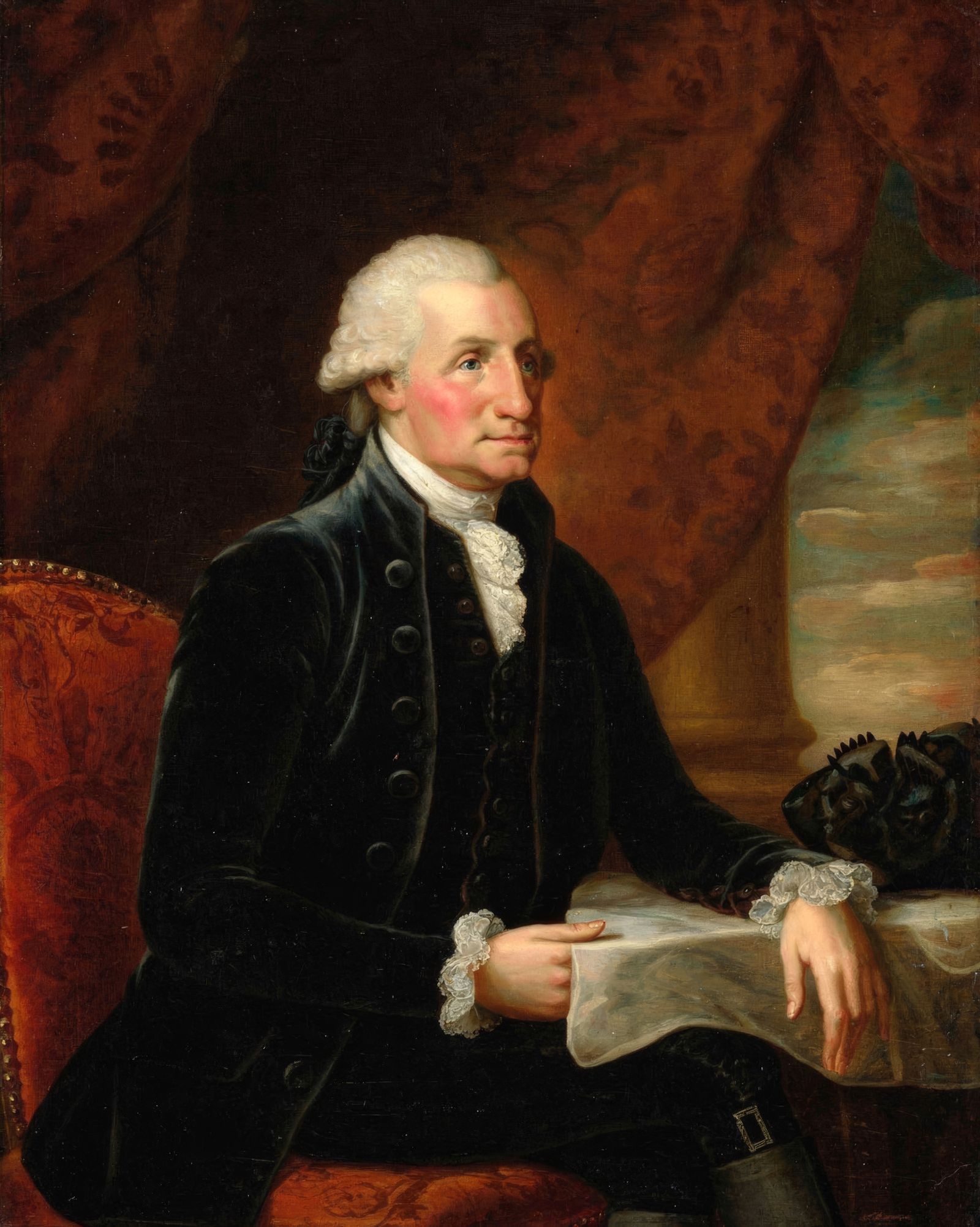
George Washington — Edward Savage, 1793. Art Institute of Chicago. Restored by Surrealium at Vaxholm Fortress, Sweden.
Savage’s Washington sits in a dark suit with a folded paper in his hand. A red curtain and a column give the figure an architectural setting, while an opening behind him extends the room towards sky. The face is relatively small within the entire composition. It is the arrangement of body, objects and setting that establishes the public presence.
The Art Institute identifies the work as an oil on mahogany panel dated 1793. Its small scale matters: this is not a life-sized figure towering over a viewer, even though the composition uses the language of formal portraiture. Keep the complete edges in view. A detail of the head alone would lose the paper, seated posture and surrounding space that distinguish this particular George Washington portrait from another version of the same sitter.
The famous face has more than one author
A search for Washington often leads first to Gilbert Stuart. Stuart’s unfinished Athenaeum likeness and the full-length Lansdowne portrait are different compositions, and both differ from Savage’s seated figure shown here. The National Gallery of Art’s account of Washington’s painted images is useful precisely because it treats the familiar face as something made and remade by several artists.
The distinction is practical when identifying a picture. Read the artist, date, pose and collection together. A white-haired man in dark clothing is not enough to identify a particular work, nor does a familiar face make every image an original sitting. Portraits could be repeated, adapted and reproduced. The painting on this page is the Savage panel in Chicago; the Stuart works discussed for context are not substituted for it or claimed as images held in this selection.
A Stuart comparison with a different sitter
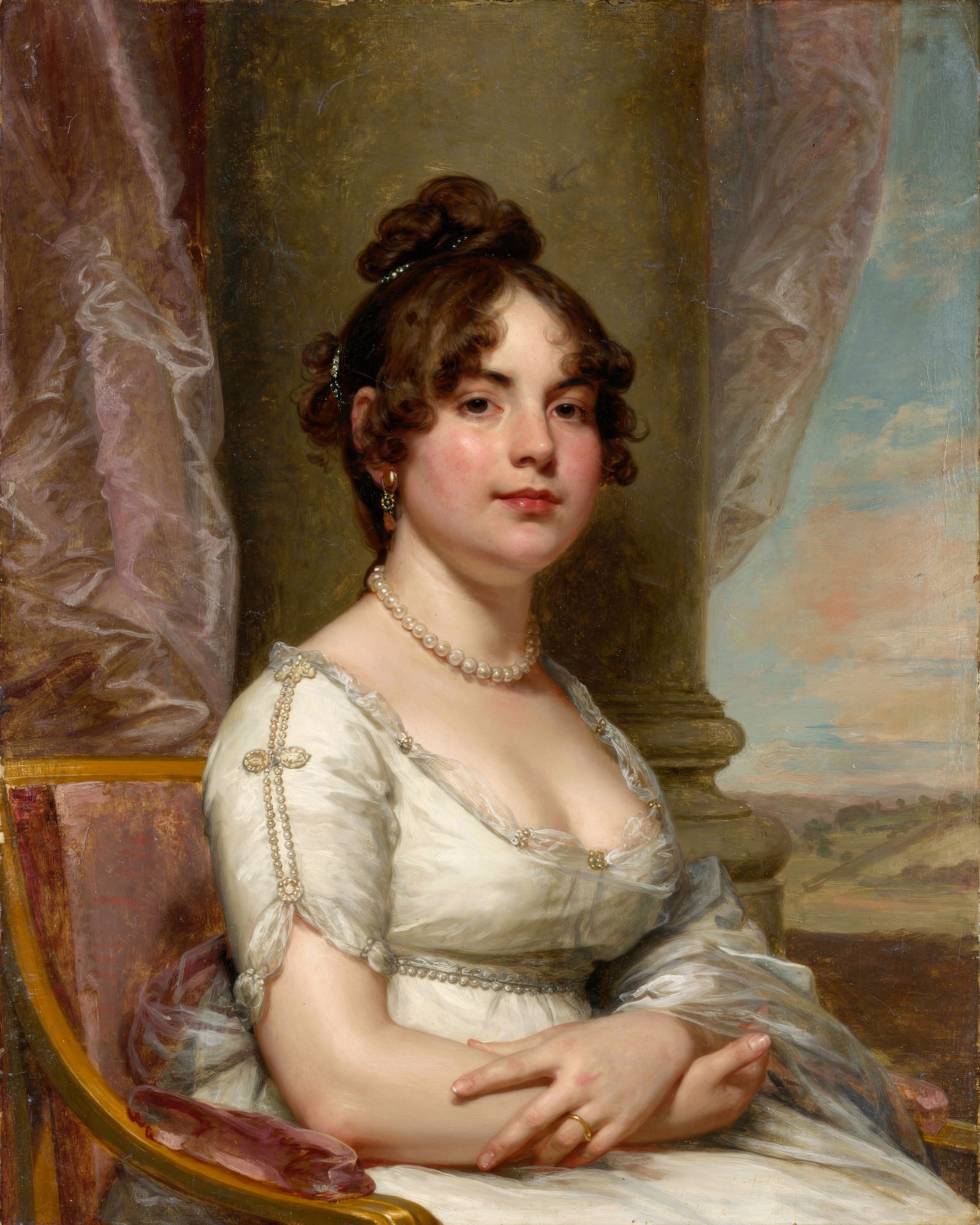
Elizabeth Beltzhoover Mason — Gilbert Stuart, c. 1803–5. Cleveland Museum of Art. Restored by Surrealium at Vaxholm Fortress, Sweden.
Elizabeth Beltzhoover Mason sits in a pale dress between drapery and a column. This is a portrait by Gilbert Stuart, but it is not a portrait of Washington. Its value here is comparative: the architecture and fabric show how elements associated with a formal public image also appear around another sitter.
Look at how the light clothing separates the figure from the setting. In Savage’s Washington, the dark suit forms a more concentrated mass, with the pale face and paper becoming distinct accents. The comparison does not establish that one sitter was more open, private or powerful than the other. It shows artists making people visible through different distributions of light and dark. That is a more dependable observation than turning a painted expression into a factual description of somebody’s character.
Clothing changes the kind of authority shown
Savage’s black civilian clothing is worth noticing before the presidential identity supplies an automatic interpretation. The picture does not need a crown or a battlefield to establish importance. The upright seated body, formal surroundings and document provide other visual means of presenting someone as a person whose actions matter.
An Art Institute exhibition catalogue describes this panel as a civilian variant of Savage’s earlier uniformed Washington. That comparison is a documented connection between works, rather than a guess about what the dark suit means. It also shows why a portrait’s details cannot be treated as incidental decoration. Changing the clothing changes the relationship between the represented person and the role being displayed, even when the face remains recognisable. Our royal portrait story offers another setting in which costume and public identity are deliberately arranged.
Stuart’s Baron FitzGibbon and the standing body
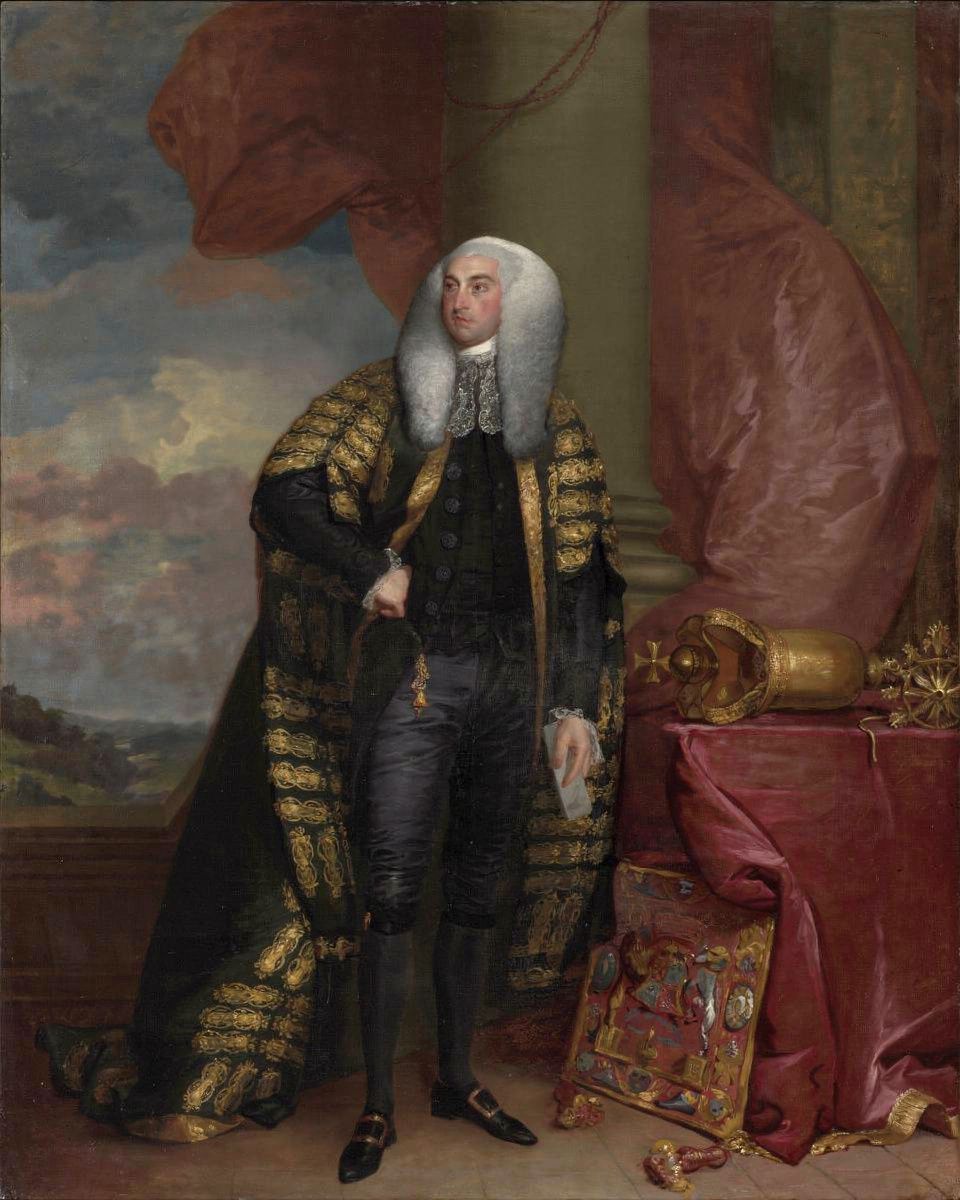
Baron FitzGibbon — Gilbert Stuart, 1789. Cleveland Museum of Art. Restored by Surrealium at Vaxholm Fortress, Sweden.
Baron FitzGibbon stands in formal black and gold robes beside a table and column. The tall body and heavy fabric create a different encounter from the seated Washington, although both rely on architectural surroundings and restrained movement. This is another clearly labelled Stuart comparison, not an additional Washington likeness.
Follow the figure from head to hem. The robe carries the eye down through the composition, while the table provides an intermediate level between face and floor. Such structural choices explain how a full-length portrait can remain organised even when much of its surface is clothing. They also help separate the painter’s arrangement from the sitter’s actual biography. A robe tells us something about the role being displayed; the image alone cannot establish how its wearer exercised power or how other people experienced it.
Documents, curtains and the limits of a picture
The folded paper in Washington’s hand is easy to notice and tempting to identify. Unless a source establishes a specific document, it is better to call it a paper than to give it a famous constitutional title. The same care applies to the setting: a column can function in a portrait without proving that the sitter occupied that exact room.
This does not make the picture empty of historical information. It tells us what the artist chose to present, and it can be studied alongside records of the commission, the sitter and the work’s later circulation. What it cannot do is replace that evidence. Begin with a visible fact, ask what the museum can support, then leave room around what remains unknown. The famous portrait paintings guide applies that distinction across other sitters and periods.
A smaller face-to-face encounter
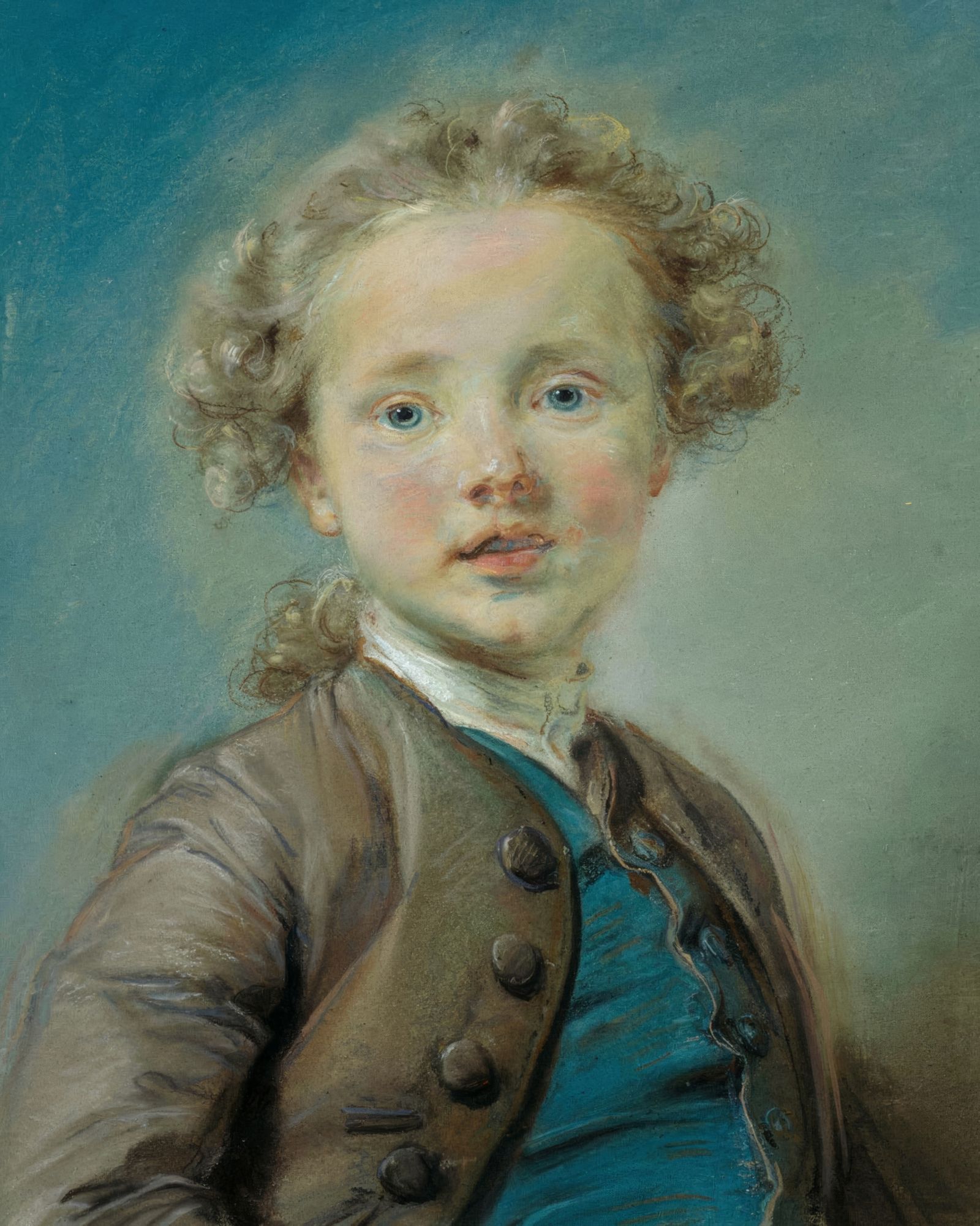
Portrait of a Young Boy with Blue Eyes — Jean-Baptiste Perronneau, c. 1750. Art Institute of Chicago. Restored by Surrealium at Vaxholm Fortress, Sweden.
Perronneau’s young boy with blue eyes provides a final comparison at a different scale of attention. The child’s curly hair, direct gaze and blue waistcoat hold the picture together without the extensive public setting around Savage’s Washington. He is included as a separate historic sitter, not as a childhood image of the president.
Compare how much space each picture gives to face, clothing and background. Neither arrangement is automatically more truthful. A close portrait still selects a pose and an expression, while a formal setting can preserve specific features of a person. The contrast makes the choices easier to see. If you are thinking about a custom portrait, it also offers a useful question: how much should the surrounding scene explain, and how much attention do you want the face itself to carry?
Choose the whole composition, with its name attached
A historic portrait can be chosen for its handling of light, its formal structure or an interest in the person depicted. Keeping those reasons distinct makes the choice more thoughtful. Admiring Savage’s arrangement does not require treating a public image as a complete account of Washington’s life or legacy.
Start by looking at the panel as a whole, then return to the paper, chair and curtain. Compare those details with the clearly labelled Stuart and Perronneau works rather than merging them into a generic old-master style. The Masterworks collection preserves a route back to each separate image. A print keeps that particular historic composition available for looking; a new portrait would be a different work made from a new reference, with a different person at its centre.
Return to the complete panel before choosing a detail to remember. The dark suit, pale paper and red curtain work together around the face. Follow Savage’s Washington into Masterworks to consider that particular image as a print, with its artist, date and collection kept attached.
- Who painted the Washington portrait shown here?
- Edward Savage painted this 1793 oil on mahogany panel, held by the Art Institute of Chicago. It should not be credited to Gilbert Stuart simply because Stuart made other familiar images of Washington.
- Is this the portrait used for the dollar bill?
- No. The familiar currency image derives from Stuart’s Athenaeum likeness. Savage’s seated composition is a different work, with its own pose and setting.
- Why include portraits of other people?
- They make specific comparisons possible: Stuart’s drapery and formal clothing, or Perronneau’s concentration on a face. None is presented as another image of Washington.