German coat of arms: reading the eagle and the shield
Distinguish Germany’s federal eagle from historic and personal heraldry, with a Dürer print as a clearly identified comparison.
A German coat of arms may mean Germany’s federal eagle, the arms of a city or state, or the design of a particular historic bearer. Those are different subjects, even when they share a colour or an animal. This guide begins by separating them. The Dürer engraving shown here is a German Renaissance heraldic composition, not the federal arms of Germany. It helps explain the visual language without pretending that one decorative shield represents an entire national tradition. The opening colour presentation of Merian’s Two Eagles is an alchemical comparison from 1618, not a national coat of arms. Its paired birds show why an eagle’s presence alone does not identify a state symbol.
Identify the institution before the symbol
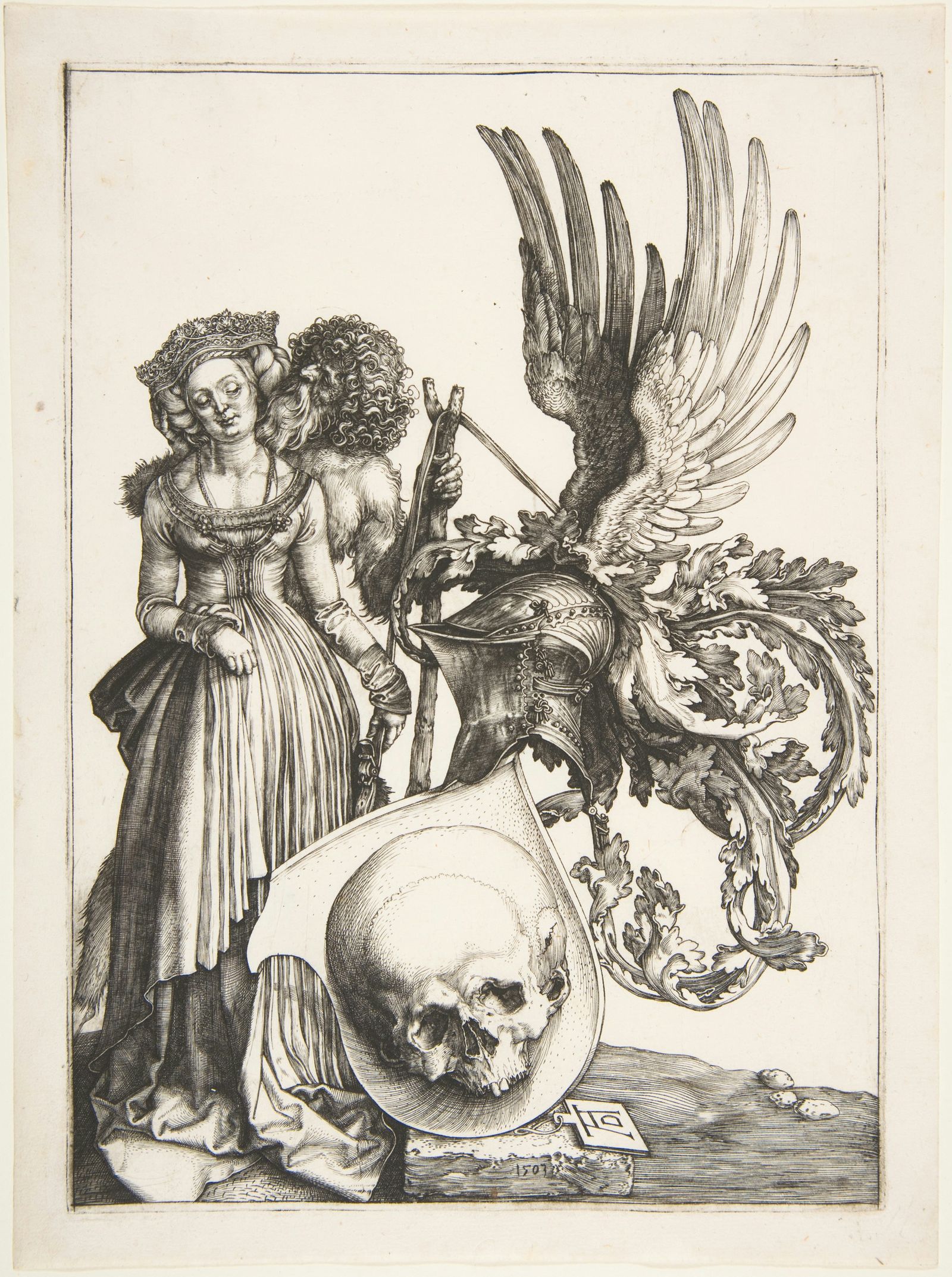
Coat of Arms with a Skull · Albrecht Dürer, 1503 · The Metropolitan Museum of Art. Prepared for print by Surrealium at Vaxholm Fortress, Sweden.
The modern federal arms use a black eagle on a gold field, with red details at the beak, tongue and feet. The Bundestag’s account traces the emblem through several political settings and explains that official versions can differ in their drawing. A recognisable heraldic description does not require every feather to be identical in every use. The identity comes from the defined form and its authorised context.
Before interpreting an eagle, ask what object you are looking at. Is it a federal emblem, a municipal shield, a coin, an architectural ornament or a historical print? The answer determines which source is relevant. A photograph of an eagle on an old building may need the building’s date and patron before it can be read accurately. The bird alone cannot supply those facts.
Our heraldry introduction explains why a charge and its bearer should remain connected. It also helps distinguish the shield from a crest above a helmet. In ordinary conversation, people often call any national emblem a crest. For research, more precise language makes it easier to locate the correct description and avoid combining unrelated designs.
One head and two heads are not interchangeable
The eagle has a long history in German and imperial symbolism. The Bundestag distinguishes the one-headed royal eagle from the double-headed imperial emblem used in the later Holy Roman Empire, and follows later changes through the nineteenth and twentieth centuries. The modern federal form is one-headed and uncrowned. Those differences are historically meaningful; they should not be treated as interchangeable artistic flourishes.
A useful way to study an image is to make a brief inventory before naming it: number of heads, presence of a crown, shape of the shield, objects held and any surrounding text. Then compare the inventory with a source for that exact period or institution. This is more reliable than choosing the closest-looking result from an image search and assuming it is the same emblem.
Do not read a modern state backwards into every older example. Political boundaries, offices and dynastic relationships changed. A design on a seal or a print belongs first to the setting in which it was made. Keeping its date visible prevents an old imperial symbol from being casually labelled as the current national arms.
What Dürer’s print can show us
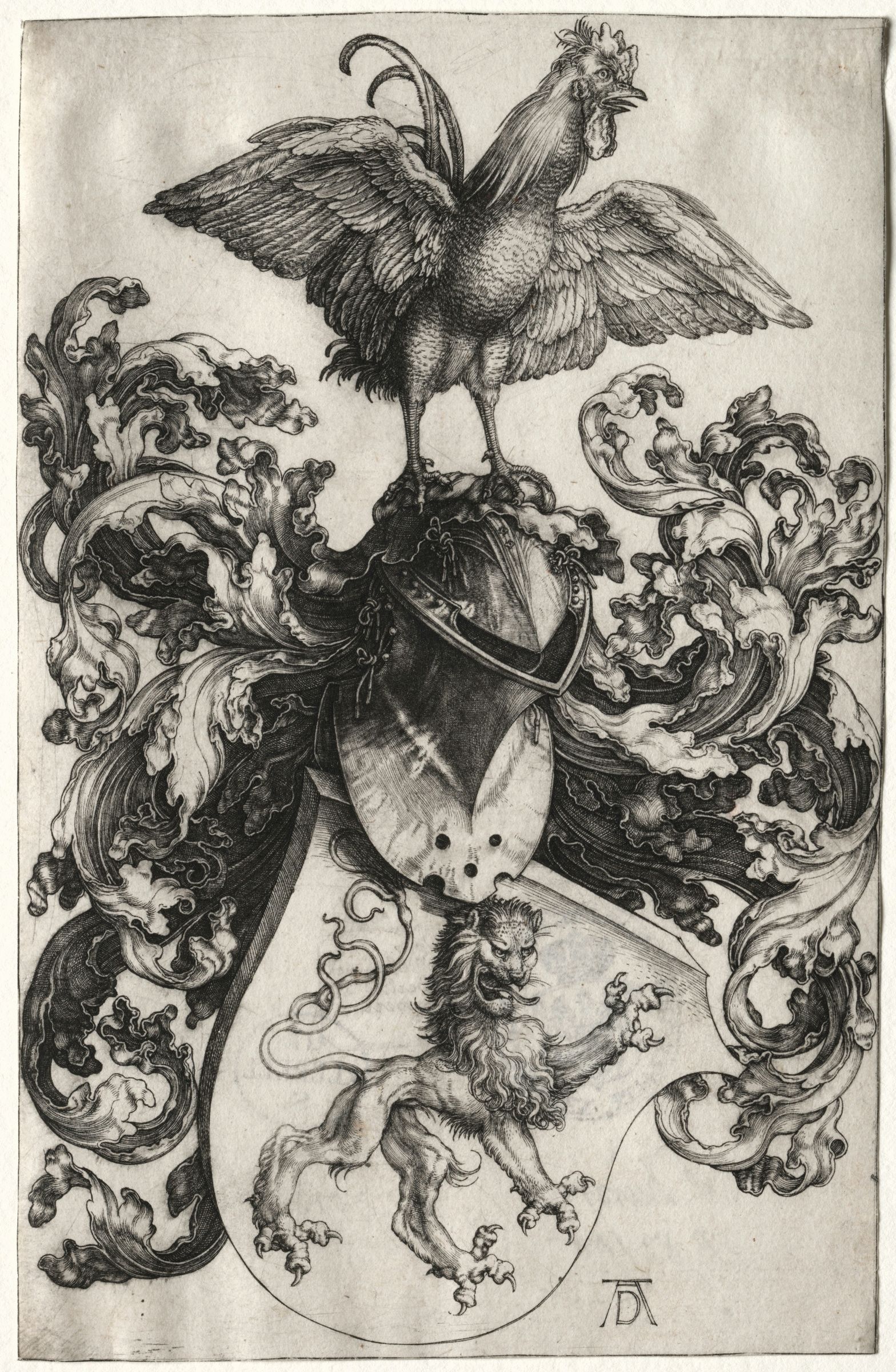
The Coat of Arms with a Lion and Cock · Albrecht Dürer, probably 1503 · Cleveland Museum of Art. Prepared for print by Surrealium at Vaxholm Fortress, Sweden.
The two Dürer prints in this guide belong to a different discussion from the federal eagle. One puts a skull on the shield amid a woman, a wild-looking male figure and elaborate helmet ornament. The other combines a lion shield with a cock above the helmet. They demonstrate how heraldic forms could support an artist’s composition, including strange and memorable subjects that are not simply state identifiers.
Look at the division of labour in the lion-and-cock print. The shield establishes a bounded field, while the crest and mantling expand above and around it. The whole image has a much more complex outline than the shield alone. That distinction is useful when reading an old catalogue: a description of one charge should not be assumed to describe every part of the print.
The prepared historical scans shown here are distinct from contemporary colour editions available elsewhere in the catalogue. The Masterworks record identifies the related edition. Neither the original engraving nor a later colour treatment is Germany’s federal coat of arms. Their value here is as accurately labelled examples of a broader heraldic visual culture.
Family research needs a specific bearer
If your question concerns a German surname rather than the federal emblem, begin again with the family records. A national origin does not identify personal arms. Nor does a shared surname prove a relationship to an armorial entry. Look for a named bearer, place and date, and retain those details when you save the image or description.
The surname guide separates the history of a word from the history of particular people. The coat-of-arms-for-surname guide explains the next distinction: a recorded armorial design and a claim to use it are not the same thing. If a website supplies only a surname, a colourful shield and an offer to print it, the missing documentation remains missing regardless of how polished the presentation appears.
The Irish and Scottish comparison also shows why one country’s practice should not be projected onto every other tradition. A useful research note says which jurisdiction or historical setting it concerns. Broad claims that all European heraldry follows one rule are usually less helpful than a careful account of the record actually being examined.
A national emblem is not a design shortcut
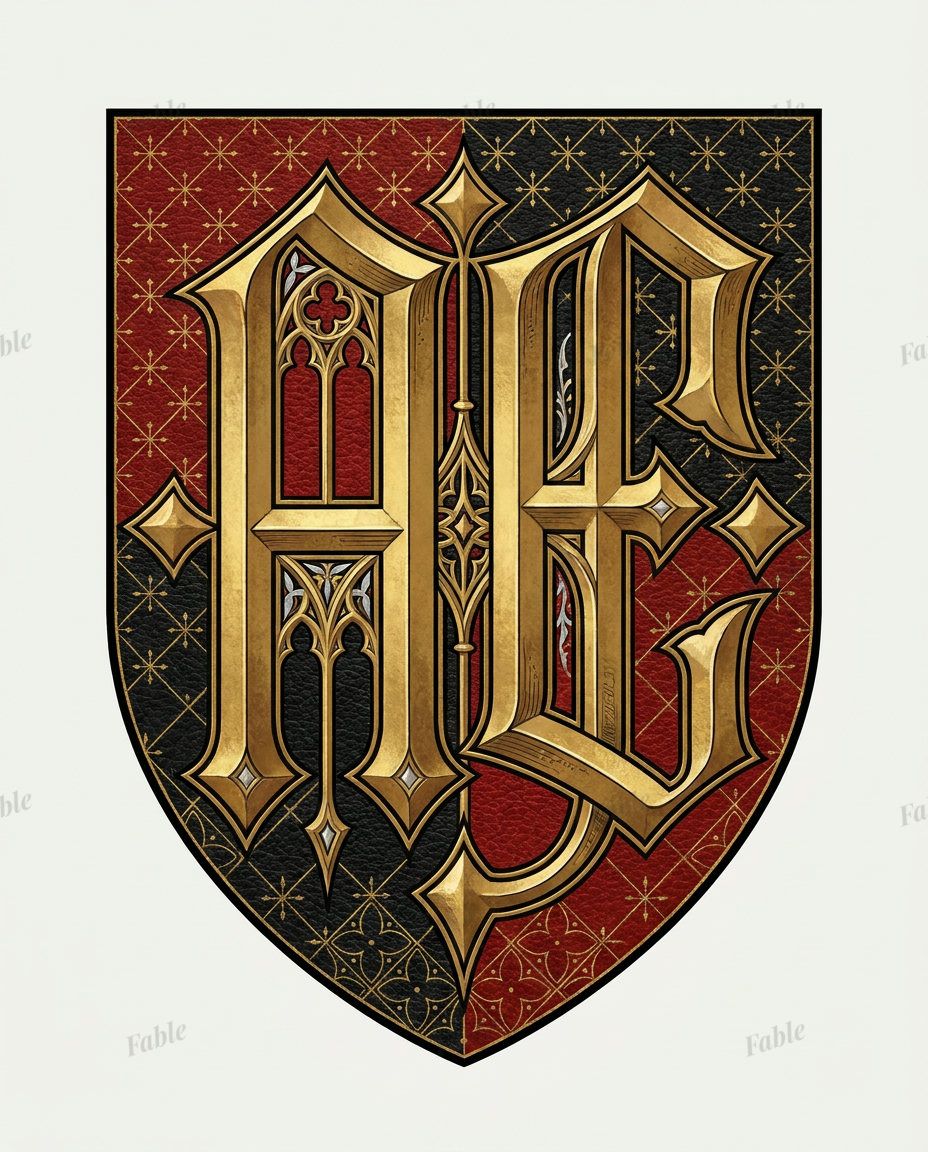
Gothic AE demonstration · Fable Heraldry, 2026 · Fable editorial demo archive. Contemporary studio-directed lettering; not a historical monogram or a customer testimonial.
Official state symbols have rules governing their use. Germany’s federal service information directs requests to use the federal eagle through the responsible authority. A decorative project should not assume that an official emblem is an unrestricted personal logo merely because its basic form is old. If the intended use concerns a state symbol, consult the current official guidance for that use.
For a personal keepsake, you can usually begin with a different question: what story are you trying to tell? A place, a craft, a landscape or a shared interest may offer a more specific subject than a national emblem. The Gothic lettering demonstration here is contemporary Fable work, not a historic German monogram. It shows how a strong visual character can be created without borrowing the federal eagle or claiming an official identity.
Keep the explanation of any choice accurate. A new design inspired by a remembered town is not the town’s arms. A decorative eagle is not automatically a state emblem, but making it resemble a particular official design can create confusion about what it represents. Clear intent should be reflected in both the brief and the caption.
Make the new design readable and accountable
Write the intended identity in one sentence before choosing symbols. Is the emblem for a household, an individual or a private project? Then list the facts you want it to remember. Choose a small number of objects that can carry those facts without copying a complete historic achievement. A clear charge on a contrasting field often communicates more than a crowded collection of national references.
Check the result at its likely viewing size. If the design includes lettering, read it letter by letter rather than trusting the overall impression. Keep any historical source with the brief, and explain which elements are new. That record will help later viewers understand the emblem without assuming it came from an archive.
The coat of arms overview supplies the vocabulary for describing the parts. Use that vocabulary to make the design clearer, not to make unsupported claims sound more authoritative. A contemporary emblem can honour a German connection through a documented place or personal memory while remaining plainly distinct from federal, municipal or inherited arms.
Bring a personal place or story to Fable Heraldry for a new decorative design. Keep official national symbols and documented historical arms attached to their proper identities.
- Is every German eagle the federal eagle?
- No. Eagles occur in different state, municipal, dynastic and decorative contexts. Identify the object, date and bearer before naming the emblem.
- Why do some historic eagles have two heads?
- The double-headed eagle belongs to particular imperial traditions. It should not be substituted for the modern one-headed federal form.
- Do the Dürer pictures show Germany’s arms?
- No. They are identified Renaissance heraldic compositions used to explain visual form, not depictions of the current federal emblem.