Medieval Christmas: devotion, season and the painted room
Late medieval sacred pictures illuminate part of Christmas culture, while a later panel shows how devotional subjects continued to change.
Medieval Christmas was more than a single feast or an early version of a modern family gathering. Religious preparation, worship, charity and celebration took different forms in different places. A monastery in late medieval England cannot stand for every household in Europe, and a Netherlandish devotional panel cannot tell us exactly what everyone ate or how they decorated a room.
The paintings here offer a narrower, more useful view: two Annunciations and a Virgin and Child from the fifteenth century, followed by an early-sixteenth-century comparison. None is presented as a documentary picture of a Christmas party. They help us see the sacred story and devotional attention that can sit behind seasonal imagery, while keeping the limits of the evidence in view.
For a related starting point, read illuminated manuscript.
An Annunciation belongs before the birth
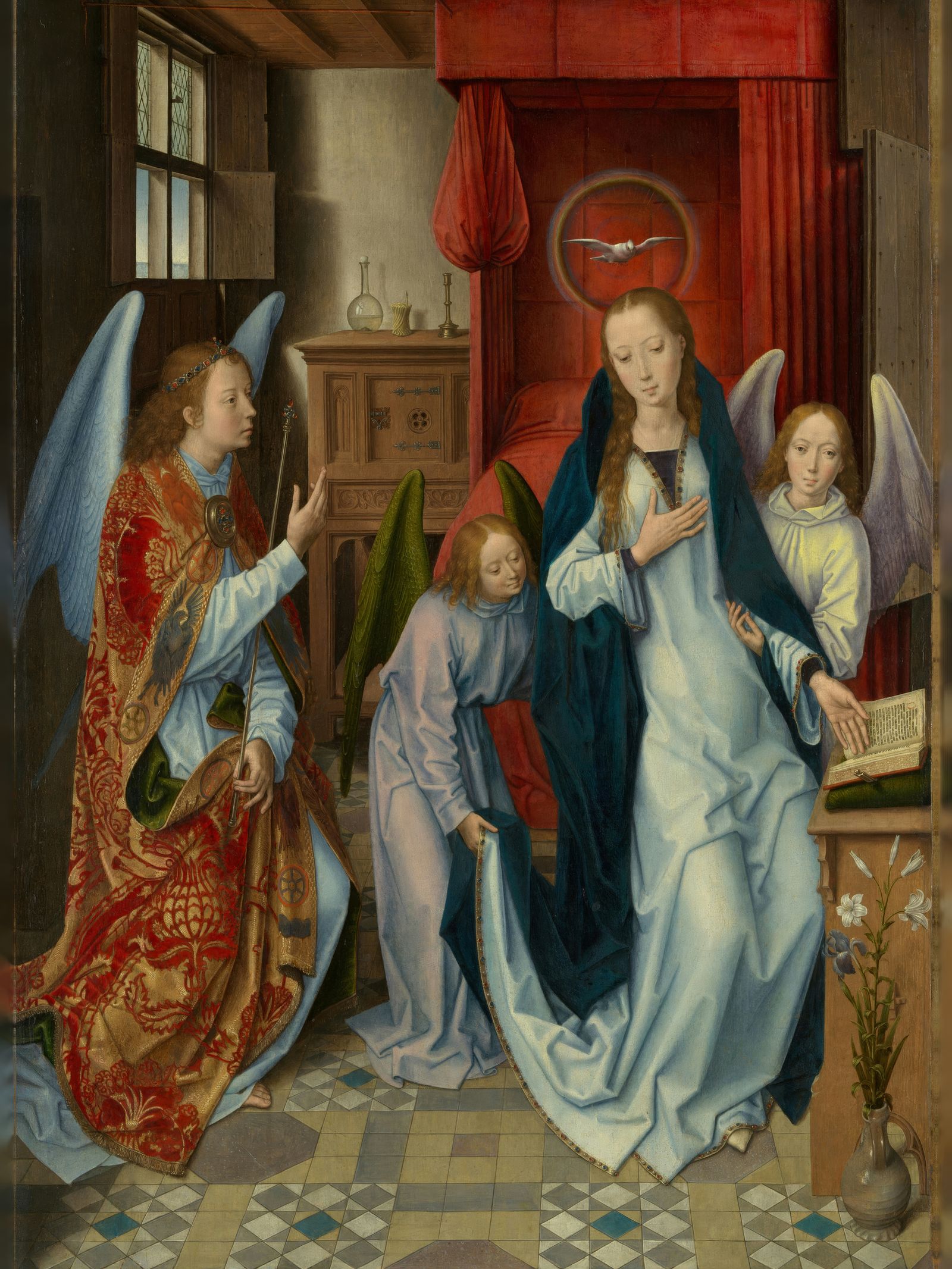
The Annunciation — Hans Memling, 1480–89. The Metropolitan Museum of Art, New York. Prepared for print by Surrealium at Vaxholm Fortress, Sweden.
Hans Memling’s Annunciation of 1480–89 places the sacred encounter in a carefully described room. Mary is supported by two angels, while Gabriel appears at the side. The Metropolitan Museum of Art identifies the unusual fainting posture and the surrounding symbolic objects; it is not simply a picture of someone receiving an ordinary visitor.
The subject precedes the Nativity in the Christian narrative. That makes it relevant to reflection on the coming of Christ, but it should not be renamed a Christmas birth scene. Notice how the room gives a visible setting to an event understood as sacred. The bed, vessel and other furnishings are not evidence that every medieval home looked like this. They belong to the artist’s composition and to the devotional meanings described in the object’s record.
Advent and Christmas were not interchangeable periods
English Heritage’s account of late medieval English monastic life describes Advent as a time of preparation and austerity. Christmas brought a different rhythm of worship and celebration. This is a specific institutional setting, not a rule that can be applied without qualification to every medieval person or region.
The distinction is still useful when looking at art. An image associated with expectation can differ from one centred on birth or adoration, even when both are used in today’s Christmas season. Instead of searching every panel for a tree or a gift, ask which moment the subject represents. That approach lets a historical image keep its own meaning. A modern greeting can draw on that meaning without claiming that the medieval calendar worked exactly like a contemporary month of parties and shopping. The historical practice described here comes from English Heritage’s monastic account.
A second Annunciation changes the room and the encounter
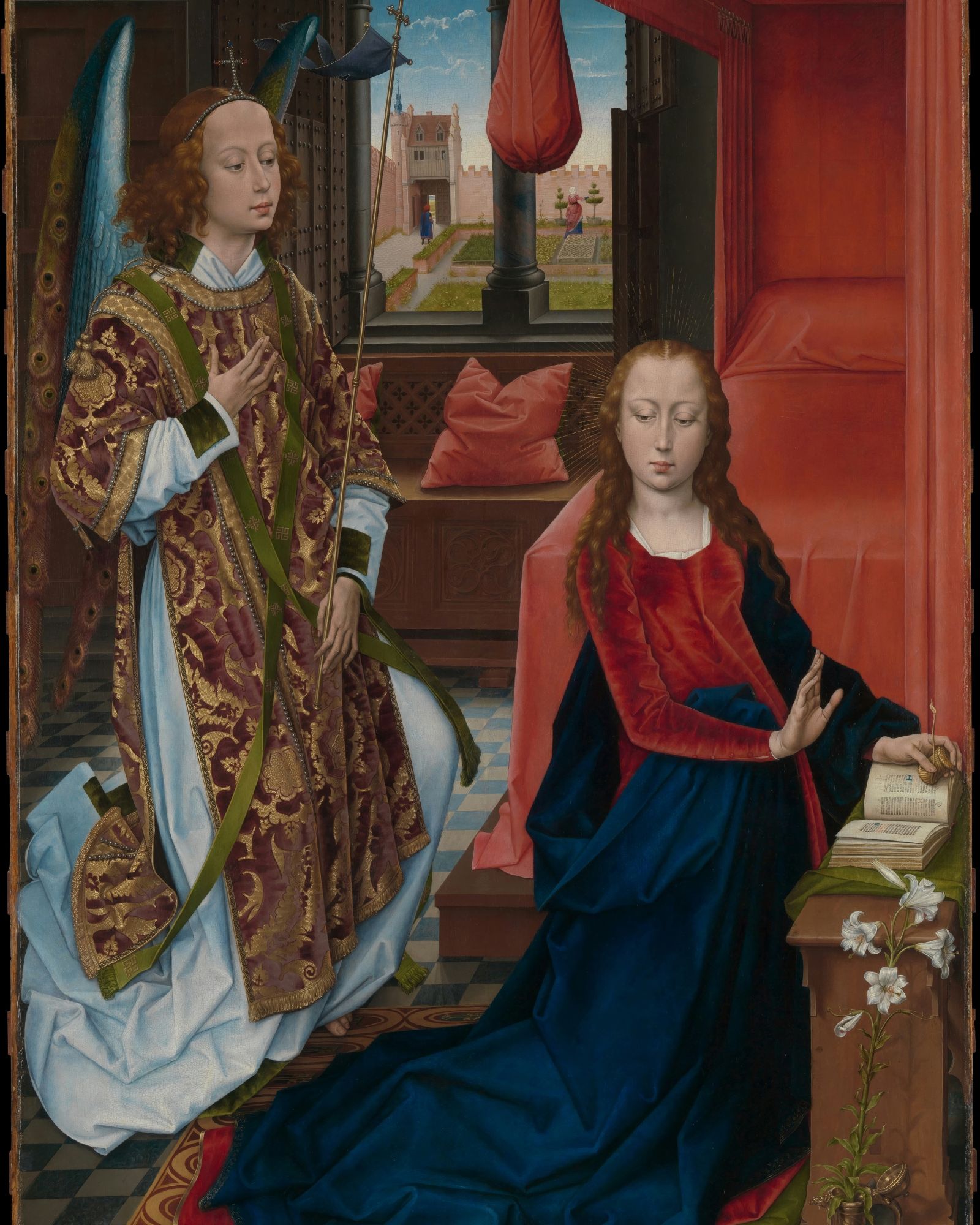
The Annunciation — Hans Memling, ca. 1465–70. The Metropolitan Museum of Art, New York. Restored by Surrealium at Vaxholm Fortress, Sweden.
Memling’s earlier Annunciation, dated about 1465–70, arranges the encounter differently. Mary and the angel occupy an elaborate interior, with architecture and furnishings giving structure to the space. Set it beside the later painting and notice how the same subject can produce a different balance of gesture, distance and attention.
The Metropolitan Museum of Art connects the earlier work with Ferry de Clugny and identifies heraldic details within the image. Those particulars remind us that devotional paintings could also carry the circumstances of a commission. They were not anonymous seasonal illustrations made for an interchangeable audience. When choosing an image today, preserve its title and attribution, and avoid inventing a universal custom from a detail that may belong to a particular patron, workshop or intended setting.
A feast had a sequence as well as a meal
For the monastic setting it describes, English Heritage notes three Christmas Day Masses, celebrated at night, dawn and during the day, alongside the usual offices. Its account also places the celebrations within a season continuing to Epiphany. These details show why reducing medieval Christmas to a single banquet leaves out much of the structure of the observance.
The paintings cannot supply that timetable on their own. A panel’s subject and an institutional account answer different kinds of question, so use them together without making one impersonate the other. The image can show how sacred figures were represented; a historical source can explain particular practices. Neither justifies an invented menu or a claim that every person celebrated identically. The pleasure of the history lies partly in keeping those different kinds of evidence clear.
The Virgin and Child makes attention intimate
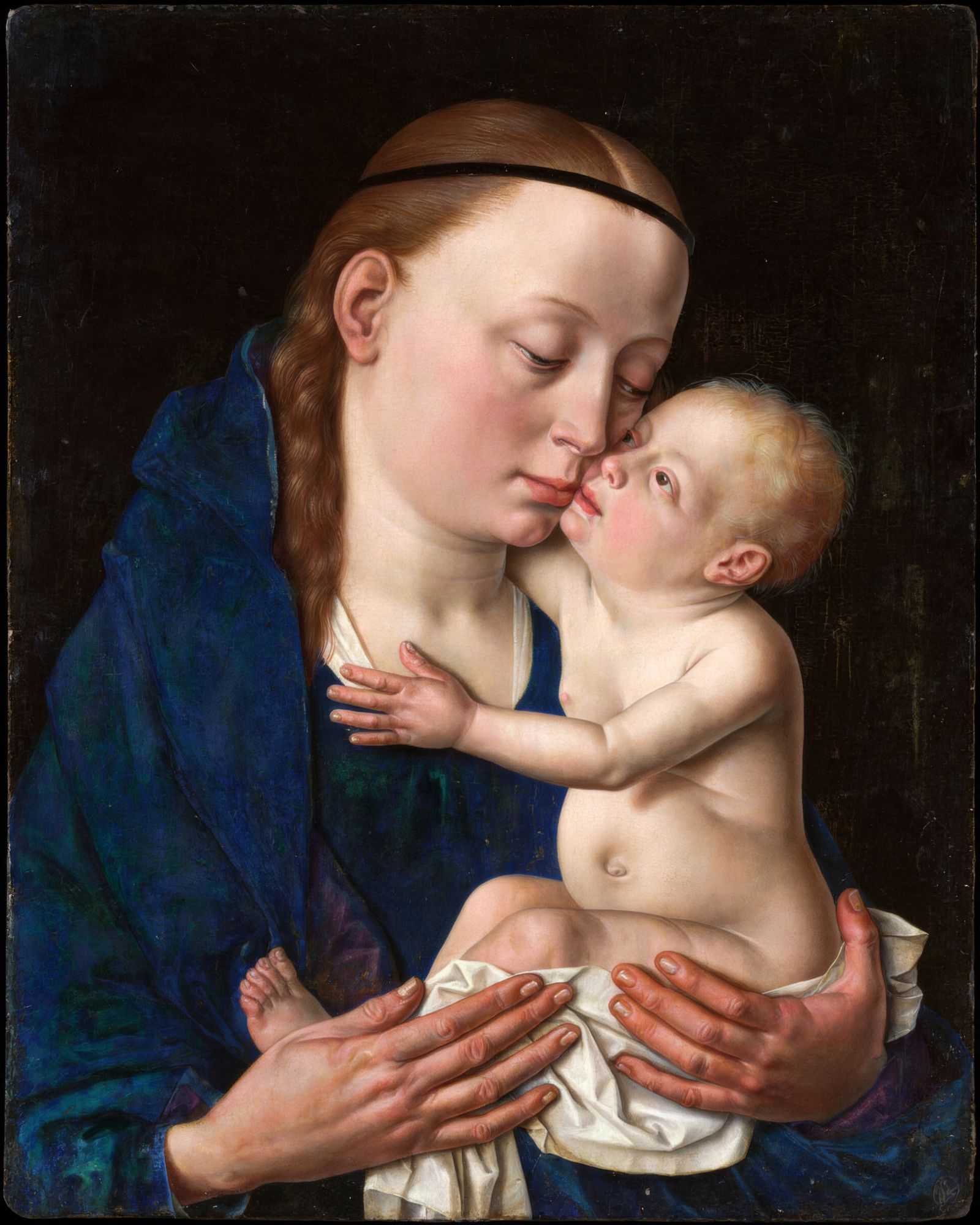
Virgin and Child — Dieric Bouts, ca. 1455–60. The Metropolitan Museum of Art, New York. Restored by Surrealium at Vaxholm Fortress, Sweden.
Dieric Bouts’s Virgin and Child, dated about 1455–60, brings the figures close together. Their faces and touch carry the composition, with little need for a crowded narrative around them. It is a devotional image of the mother and child, not an illustrated record of the night of the birth.
That distinction makes the picture more, not less, interesting for a Christmas reader. It asks the viewer to attend to tenderness and proximity rather than to identify a sequence of visitors. Look at the relationship between the faces and the child’s body, and at how much of the effect depends on keeping the two figures together. A modern card should preserve that relationship. Treating either face as a separate decorative element would lose something central to the painting’s quiet focus.
Charity belongs in the account, with its setting named
English Heritage describes monasteries giving food and warmth to poor people at Christmas, and records of seasonal benefits for servants. This adds another dimension to the feast beyond private comfort. It also calls for careful wording: these are examples from a particular historical account, not proof that medieval society was uniformly generous or that hardship disappeared during the season.
A modern greeting can take care and hospitality as themes without borrowing a romantic picture of the past. If you want to act generously, choose a practical act that fits the recipient or community rather than making the card announce your own virtue. The art can accompany a wish for peace or companionship. It does not need to carry an unsupported claim about how much better, simpler or more united people were centuries ago.
A later panel shows continuity beyond a period label
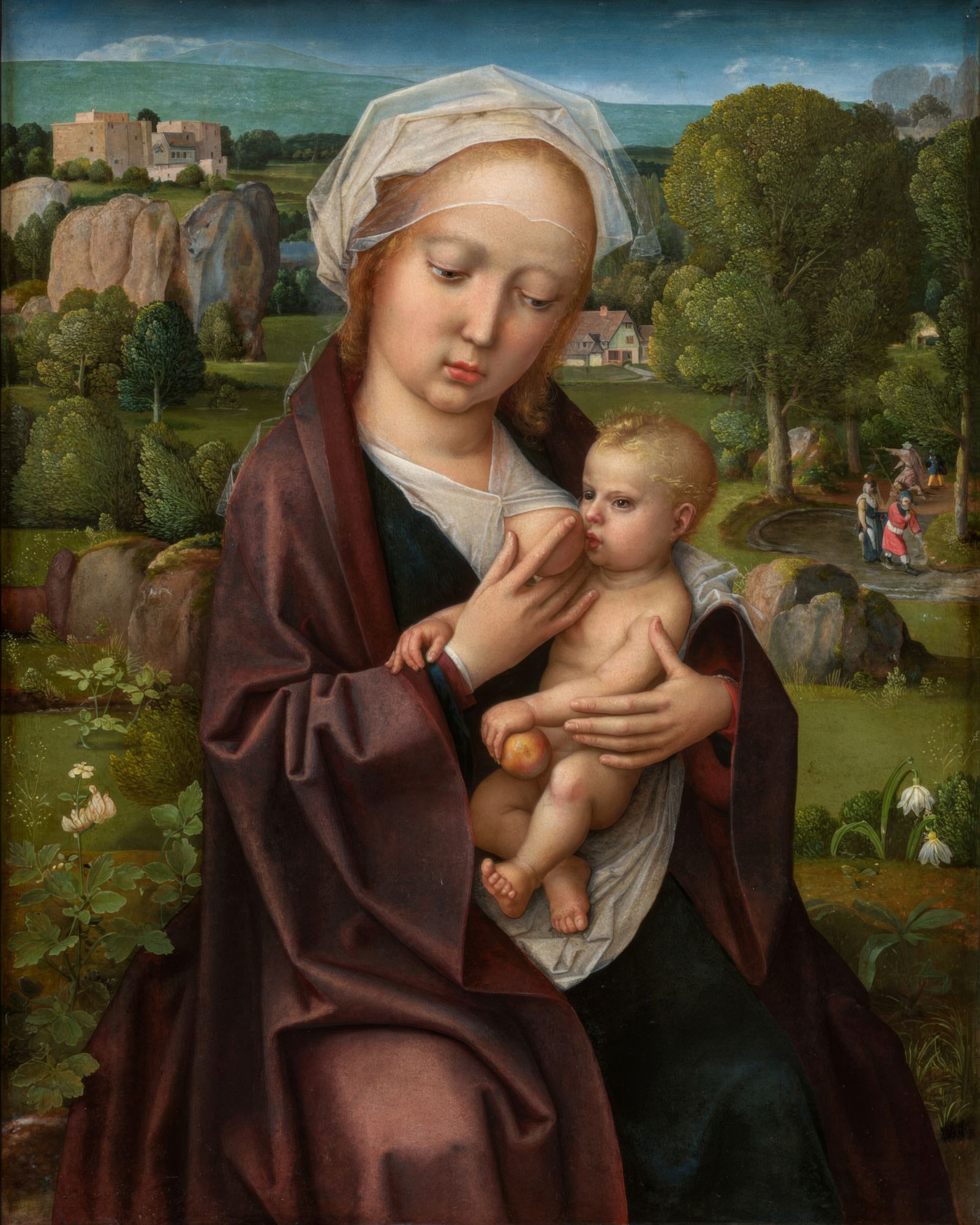
Virgin and Child — Workshop of Adriaen Isenbrant, c. 1520. Art Institute of Chicago. Restored by Surrealium at Vaxholm Fortress, Sweden.
The Workshop of Adriaen Isenbrant’s Virgin and Child, dated about 1520, is included as a later comparison. It belongs to the early sixteenth century and should not be silently treated as another fifteenth-century medieval panel. The subject continues, while the setting and treatment offer a different experience of the mother and child.
This is a useful boundary for the phrase “medieval Christmas”. Period names help organise history, but they do not make devotional subjects stop at one year and restart in a wholly different form the next. Compare the image with Bouts’s earlier panel: look at the surrounding space, the figures’ scale and the degree of intimacy. Describe what changes in the picture without claiming that one artwork can stand for the beliefs or daily life of an entire age.
Choose a historical sacred image without turning it into folklore
If the image is for a Christmas card, begin with the recipient’s relationship to the subject. An Annunciation, a Virgin and Child and a Nativity carry related but distinct meanings. Name the chosen work accurately and let your message agree with it. A simple original blessing can be more appropriate than an invented “medieval saying” with no source.
Keep the whole composition visible in the real preview. Small symbolic details and the space between figures may matter, even when the card is viewed on a phone. These are historical artworks, not finished card faces or examples of a medieval greeting-card industry. Use the current Christmas masterwork card route for available designs, while the paintings and historical sources help you understand the subject you are choosing to share.
The most useful way into medieval Christmas is through specific places, sources and images. Late medieval English monastic practice gives one account of the season; Netherlandish panels give another kind of evidence about devotional subjects. Neither should be made to explain everything. Look closely, keep the names and dates clear, and choose a sacred card image for the meaning it holds rather than for a vague promise of an old-fashioned Christmas.
Continue with the Christmas card picture guide, reading a Nativity scene.
- Did medieval Christmas mean only Christmas Day?
- No. In the late medieval English monastic account used here, Christmas belonged to a longer sequence of observances extending towards Epiphany. Practices varied, so that example should not be treated as a universal timetable.
- Is an Annunciation painting a Nativity scene?
- No. The Annunciation represents an earlier event in the Christian narrative. It can be relevant to the season’s devotional meaning, but its subject should remain accurately named.
- Do these paintings show ordinary medieval Christmas celebrations?
- No. They are sacred and devotional images, not documentary pictures of household festivities. The later Isenbrant workshop panel is also explicitly identified as an early-sixteenth-century comparison.
- Can I use a Virgin and Child image for a Christmas greeting?
- Yes, when it suits the recipient and message. Keep the work’s correct title and do not claim it depicts the birth itself unless the collection identifies the subject that way.