Nativity paintings: learn to read the people around the child
Three Nativity and Adoration scenes, followed by a Holy Family comparison, show how closely related sacred subjects tell different stories.
Nativity paintings can share a mother, a child and a group of attentive figures while describing different moments and devotional ideas. An Adoration of the Christ Child is not automatically an Adoration of the Magi, and a Holy Family picture need not depict the night of the birth. Reading the title and looking carefully at the people makes those distinctions easier.
This essay follows three birth or adoration scenes in Fable’s collection, then uses a Holy Family picture as a comparison. The aim is to look closely at a small, correctly identified group and choose a sacred image with an understanding of what it shows, rather than treating every mother-and-child picture as an interchangeable Christmas symbol.
Explore the wider tradition in Christmas paintings through the centuries, or use the distinctions here when choosing religious Christmas cards.
An adoration gathers attention around a small body
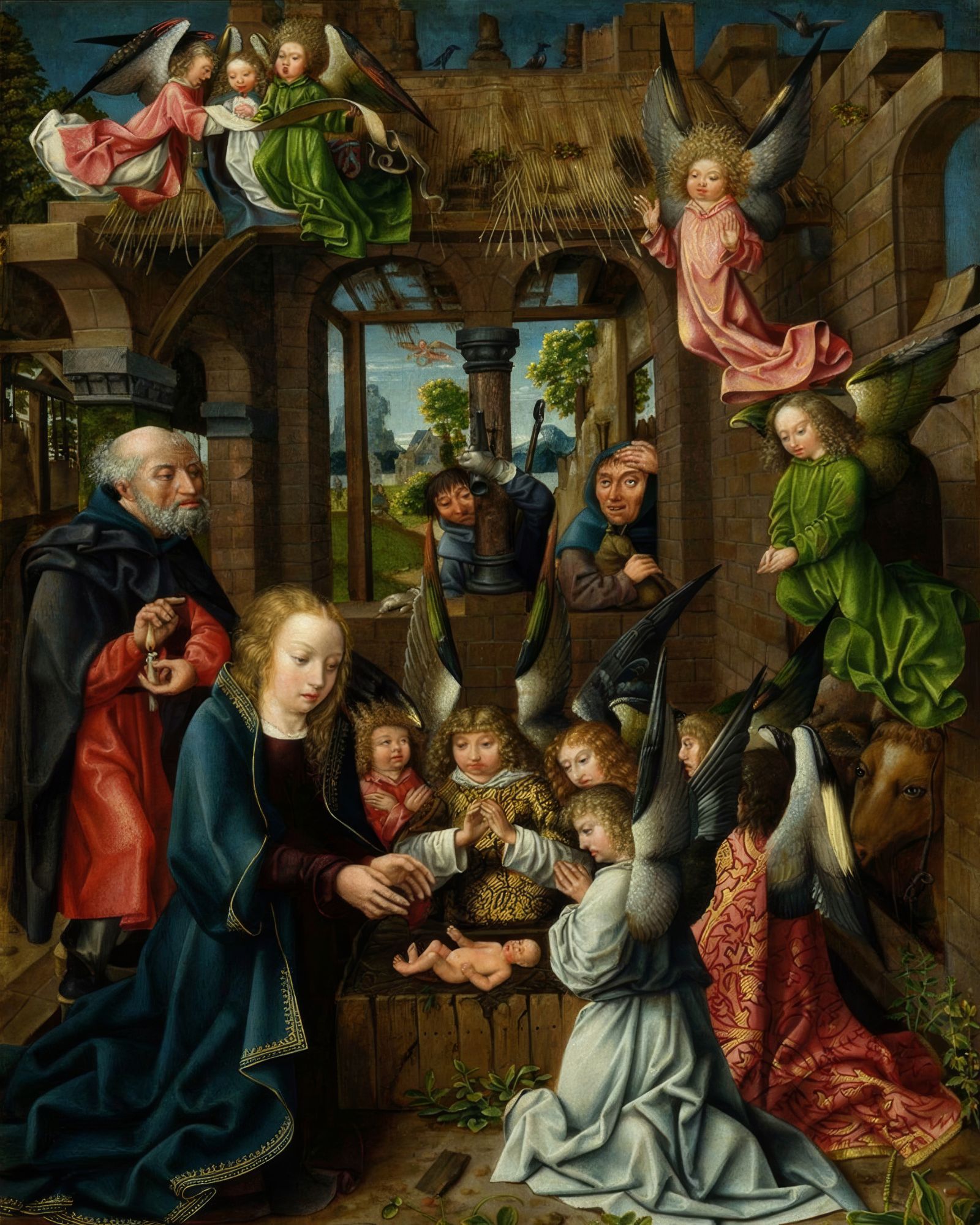
The Adoration of the Christ Child — Workshop of the Master of Frankfurt, possibly 1496–1502. The Metropolitan Museum of Art, New York. Restored by Surrealium at Vaxholm Fortress, Sweden.
The Workshop of the Master of Frankfurt’s The Adoration of the Christ Child places the infant at the centre of a group of kneeling and attentive figures. The adults’ postures direct the viewer towards the child. Look at how the surrounding architecture and the animals establish a setting while the gestures concentrate the devotional focus.
The Metropolitan Museum of Art dates the work tentatively to 1496–1502 and attributes it to the workshop, not simply to the named master alone. Both qualifications belong in an accurate caption. The painting offers a clear example of why a title matters: “adoration” describes an act of reverence here. It does not, by itself, mean that the richly dressed visitors conventionally called the Magi are present. Identify the figures from the work and its record rather than from a seasonal assumption.
Begin with title, figures and gesture
A useful first reading asks three questions. What does the collection call the work? Who is present? What are the people doing in relation to the child? Those questions keep the interpretation attached to the picture. You do not need to identify every small object before noticing whether the composition centres on birth, worship, a visit or an intimate family grouping.
Then look at the direction of attention. A kneeling adult, an open hand or a downward gaze can lead the viewer towards the infant. A landscape or architectural opening may carry the eye beyond the immediate group. These are observations about the composition, not proof of a particular theological meaning in every case. Where a museum record identifies a symbol or person, keep that attribution visible instead of turning your own visual association into a historical fact.
Fra Bartolommeo makes the family a balanced group
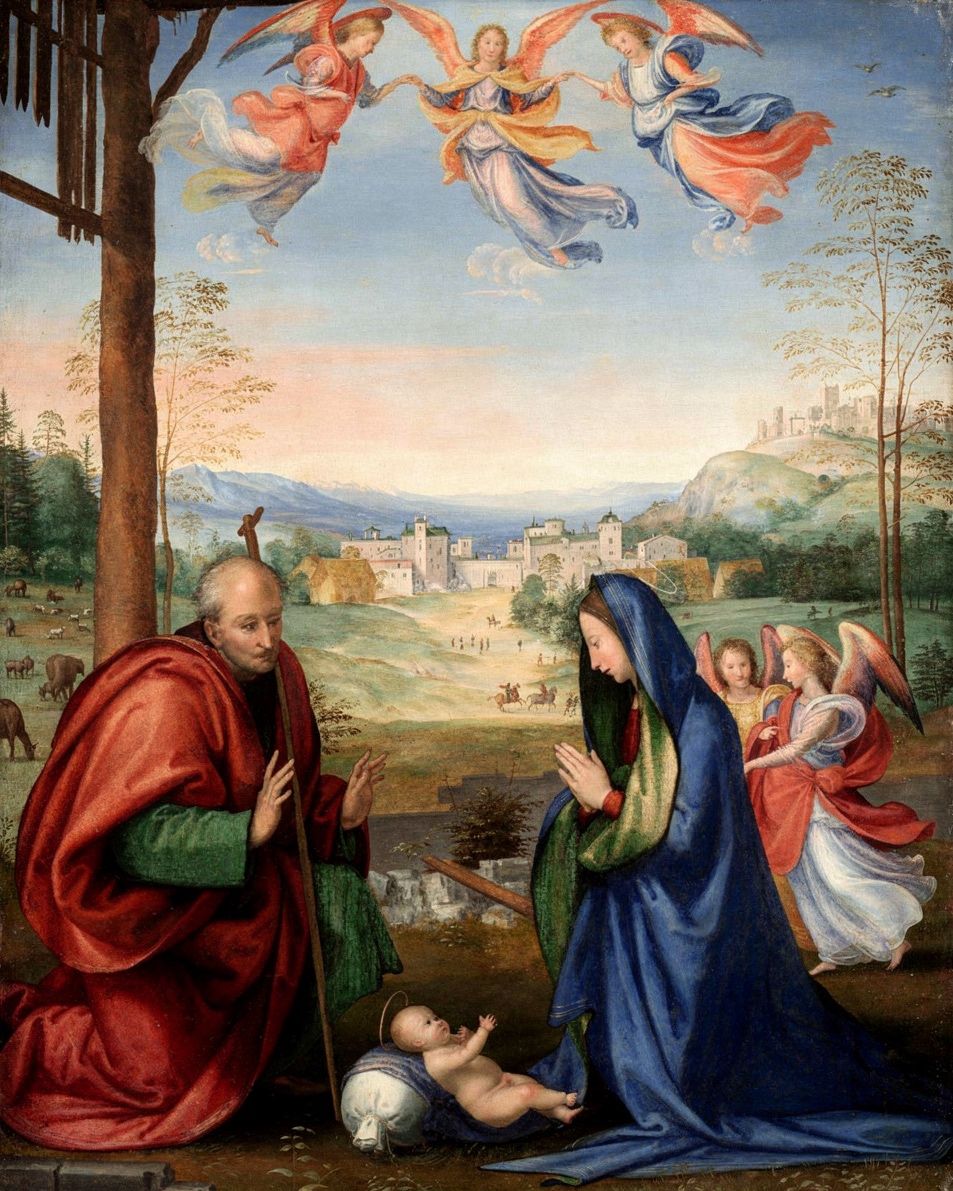
The Nativity — Fra Bartolommeo, 1504–7. Art Institute of Chicago. Restored by Surrealium at Vaxholm Fortress, Sweden.
Fra Bartolommeo’s The Nativity, dated 1504–7 by the Art Institute of Chicago, places Mary and Joseph on either side of the infant, with angels above. The child lies low in the composition, so the adults’ attention moves down towards the ground. The arrangement gives the small figure a central role without making it physically large.
Look at the relationship between the earthly group and the figures above it. The picture’s vertical structure joins different zones, while the family’s poses keep the immediate focus clear. For a Christmas card, that distinction matters: a greeting or decorative overlay should not obscure the child or break the relationship between the kneeling figures. The entire composition is useful to the meaning, not merely the most recognisable face or the brightest patch of colour.
Do not confuse the Magi with every group of visitors
A search for Nativity art often includes Adoration of the Magi paintings, but related subjects should still be named accurately. Richly dressed gift-bearing visitors, shepherds and devotional figures do not all play the same narrative role. A busy group around the child is not enough to identify which episode a work represents.
Use the collection’s title as the first guide and its object record for uncertain identifications. If a work includes a donor or a saint from another historical period, the image may bring devotional presences together rather than record a literal gathering at one moment. That is not an error in the painting; it is a reason to read it on its own terms. The cards and prints we choose today can preserve those distinctions through a precise title and a thoughtful accompanying message.
Gerard David includes more than an intimate family
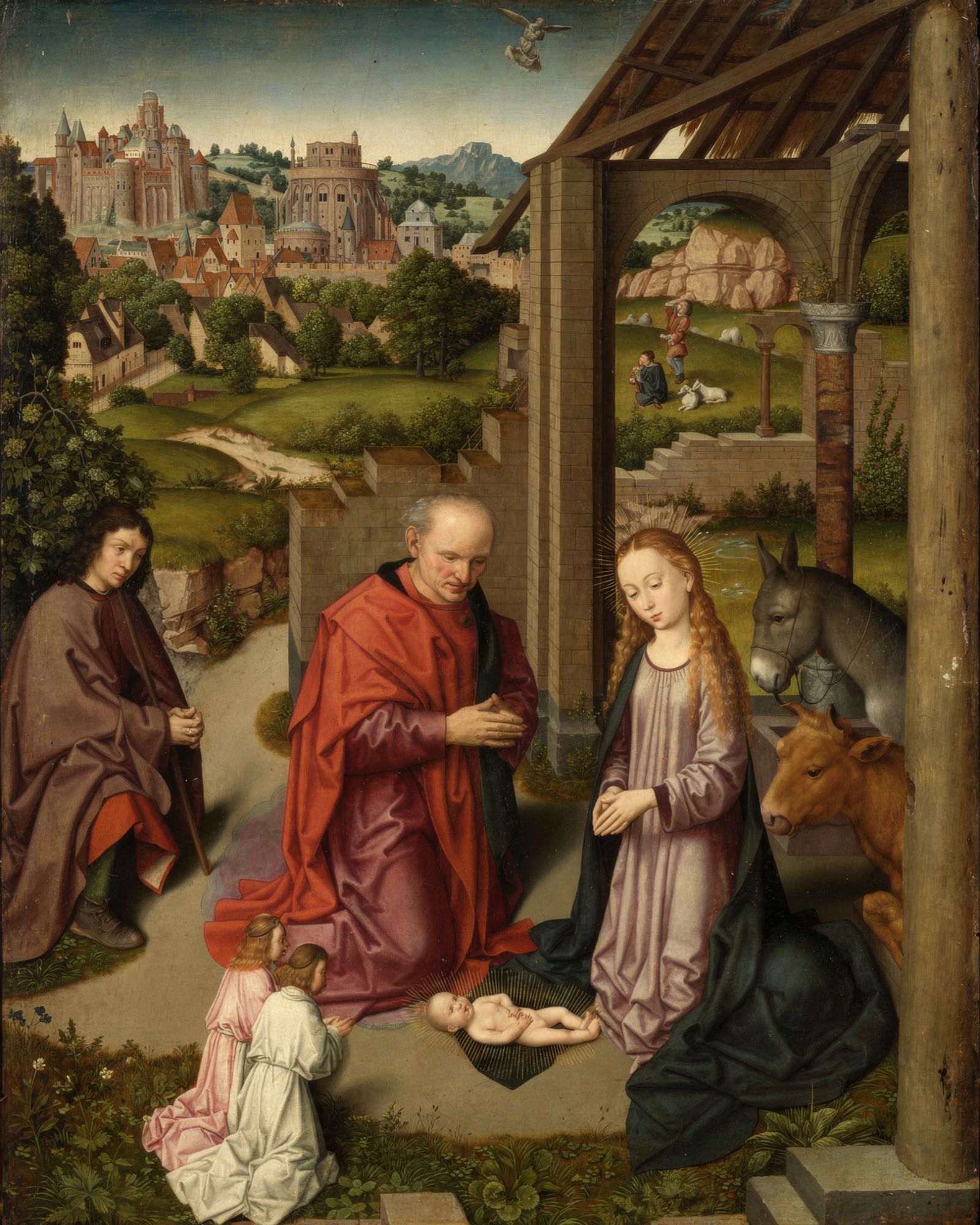
The Nativity — Gerard David, c. 1485–90. Cleveland Museum of Art. Restored by Surrealium at Vaxholm Fortress, Sweden.
Gerard David’s The Nativity, dated about 1485–90 by the Cleveland Museum of Art, places the birth scene within a detailed setting and includes additional kneeling figures. Notice how the surrounding space and the people at the side broaden the image beyond a simple three-person group. The composition asks the viewer to move between the infant and those attending the scene.
Resist assigning every extra figure a role merely because the picture is called a Nativity. A devotional painting may include a patron or saint as well as the central sacred figures. Read the collection record when you need a specific identification. For choosing a greeting, the practical point is simpler: keep the whole image available to view so that these relationships remain visible. A tight crop around the child would remove part of the work’s particular character.
Light and setting shape the way we look
Compare the spaces around the child in the three works. Architecture, open ground and distant landscape can make the scene feel sheltered, exposed, intimate or expansive. Those effects belong to the individual composition. They are more useful to a close reading than assuming that every Nativity painting must use the same stable, darkness or arrangement of animals.
Look also at the scale of the figures. A small infant can hold the centre through the attention of much larger adults. A surrounding crowd may intensify the focus rather than distract from it, depending on how the gestures and sightlines work. These are good reasons to view the paintings whole. If you are comparing card designs on a phone, enlarge the preview when available and check that the important relationships can still be understood at the actual viewing size.
A Holy Family picture provides a useful boundary
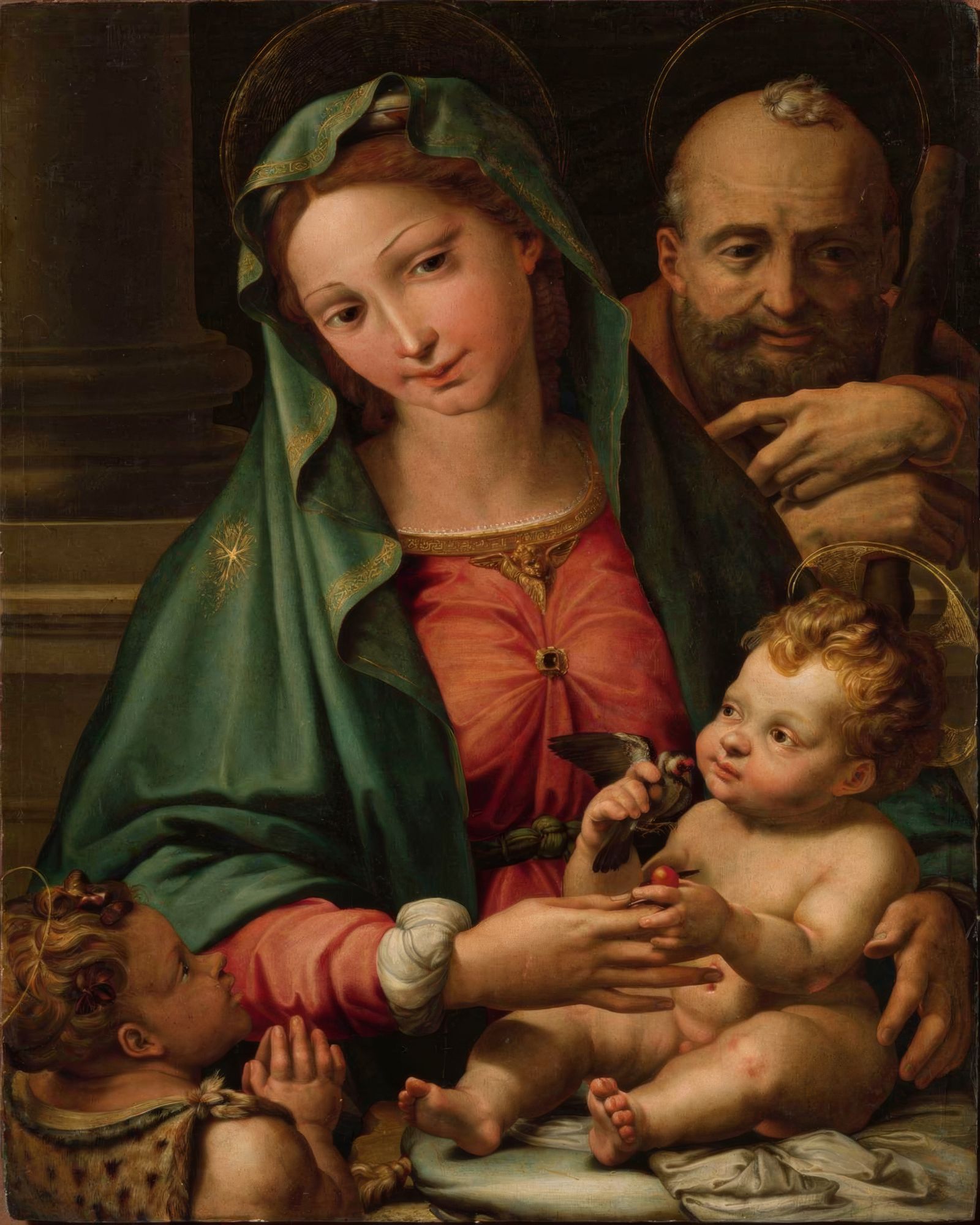
The Holy Family with the Infant Saint John the Baptist — Perino del Vaga, ca. 1524–26. The Metropolitan Museum of Art, New York. Restored by Surrealium at Vaxholm Fortress, Sweden.
Perino del Vaga’s The Holy Family with the Infant Saint John the Baptist is a related sacred subject, but its title does not identify it as a Nativity. The presence of the infant Saint John and the close arrangement of the group give the viewer different information. Including it here as a comparison helps show why “mother, child and other figures” is not a sufficient classification.
The work can still be meaningful for a Christian greeting. That use does not require relabelling it as the birth scene. Choose the subject because it suits the recipient and the message, then preserve its correct title. A card about family affection, faith or care can make room for a Holy Family image while a card explicitly about the Nativity can lead with a work that the collection identifies that way.
Choose sacred imagery with a clear purpose
Consider what the recipient will recognise and welcome. Someone who values a Nativity scene may appreciate a quiet composition centred on the child; another may respond to a more populated devotional image. Avoid assuming that every recipient shares the same beliefs or wants a religious card. The picture’s meaning should be part of the choice, not an accidental decoration.
Write a message that agrees with the subject. An original blessing can be simple, and it should not be presented as scripture unless it is an accurately sourced quotation. Check the available masterwork card designs and the actual preview before deciding. These illustrations are historical artworks, not photographs of finished cards. The current card flow determines the design and format you can use, while the museum information helps you name the image honestly.
A careful choice begins with a small distinction: which sacred subject is this? Read the title, follow the figures’ attention and check the record before adding a specific identification. The three birth and adoration scenes here reward that approach, while Perino del Vaga’s Holy Family shows the boundary of the category. Choose a Christmas masterwork card for the meaning it can carry to the recipient, with the whole composition and its proper name intact.
Continue with the Christmas card picture guide, religious Christmas card messages.
- Are Nativity and Adoration paintings the same thing?
- They can overlap, but the titles describe different emphases. An Adoration of the Christ Child focuses on reverence towards the infant; an Adoration of the Magi names particular visitors. Check the work’s collection record.
- Is every Virgin and Child painting a Christmas scene?
- No. A Virgin and Child or Holy Family image may be devotional without depicting the birth. It can still be used for a religious greeting, provided the subject is named accurately.
- Why do some sacred paintings include extra people?
- They may include visitors, saints or patrons as well as the central family. The identities vary by work. Use the museum’s record for a specific identification rather than guessing from the number of figures.
- Can I choose a religious card without quoting a Bible verse?
- Yes. An original wish or blessing can accompany the image. Make sure it suits the recipient and do not present newly written words as scripture, a hymn or a historical quotation.