Vermeer paintings: light, rooms and careful comparisons
Read Vermeer paintings through their subjects and light, with clearly named Dutch companion works from Fable’s existing collection.
Vermeer paintings often make a small action feel sufficient for a whole picture: pouring milk, holding a letter, turning towards a light. The room seems quiet, but its quiet is constructed through the placement of objects and the distribution of attention. A window is not merely an opening in a wall. It can organise the relationship between the figure, the task and the viewer.
No Vermeer painting is reproduced on this page. Fable's available companion works here are by Pieter de Hooch and Jacob van Ruisdael, and every caption keeps the artist's name attached. They provide comparisons within Dutch Golden Age painting, not substitutes sold under Vermeer's name. We can discuss The Milkmaid and View of Delft while being precise about which pictures are actually shown.
The Milkmaid: an ordinary action given weight
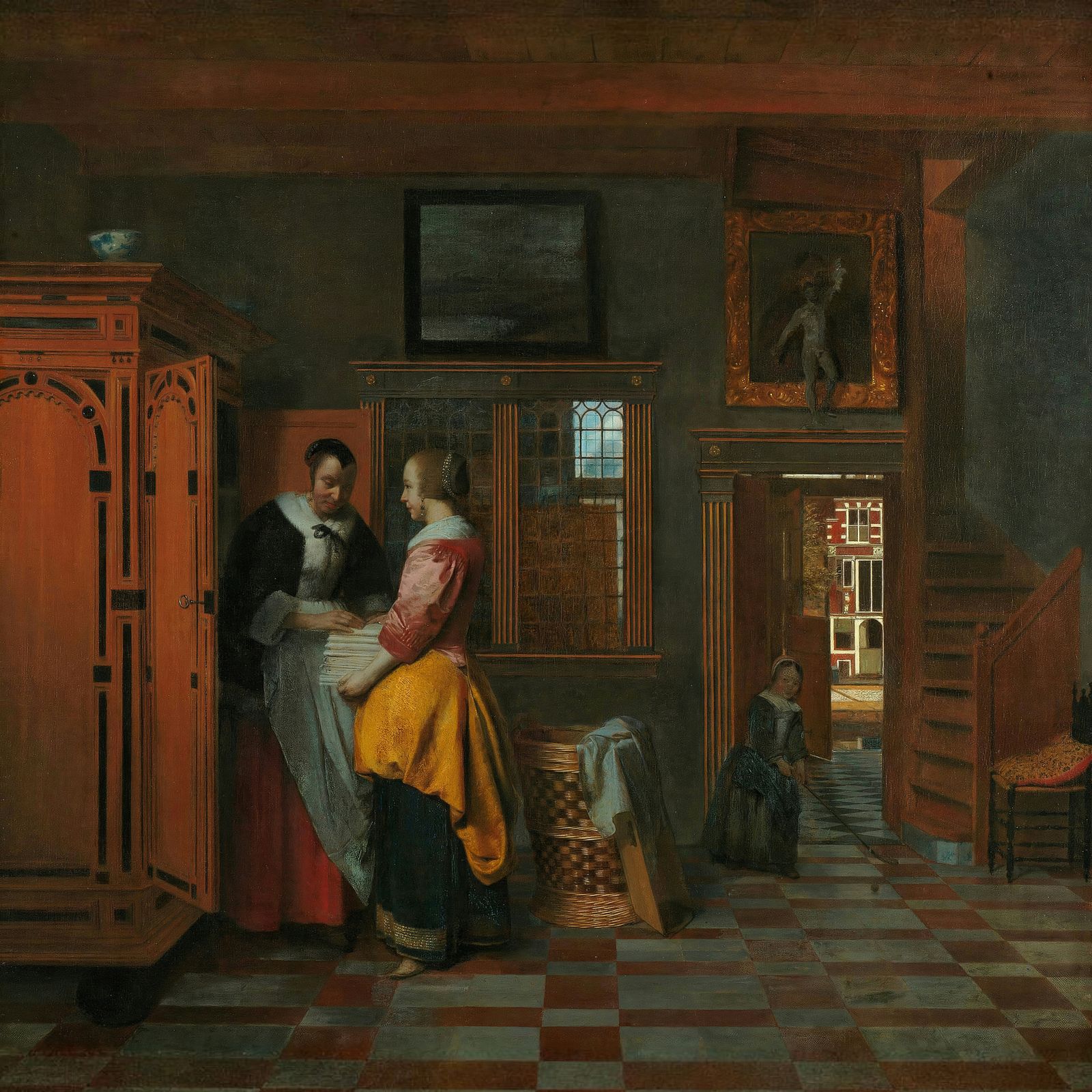
Interior with Women beside a Linen Cupboard · Pieter de Hooch, 1663 · Rijksmuseum, Amsterdam. Prepared for print by Surrealium at Vaxholm Fortress, Sweden.
The Rijksmuseum dates The Milkmaid to around 1660 and describes a kitchen servant pouring milk. The familiar English title should not make us imagine that she is shown outdoors milking a cow. Her activity is domestic and specific, and the museum's record identifies the painting as oil on canvas. The distinction between the work's title and the exact task helps us begin with what the image represents.
The museum also points to the small marks of light across objects. Those effects matter because the scene's stillness is not the same as a flat surface. An apparently simple task can hold a great deal of visual activity. We do not need to assign a secret meaning to every piece of bread or vessel before recognising how attention is concentrated around the act of pouring.
A room is an arrangement of permissions
Interior painting places the viewer somewhere: inside a room, at a threshold, looking past furniture or through another doorway. That position affects what we can see and how close we seem to come to the people represented. A quiet scene may still be carefully controlling access. The viewer's sense of intimacy is therefore a compositional effect, not proof that the painter has revealed a sitter's private life.
This is a useful way to approach Vermeer without relying on a list of mysterious symbols. Ask what the room lets the eye reach directly and what it makes us look around. Notice whether a figure returns our gaze or remains occupied. These questions can be carried into related Dutch interiors, where they reveal differences between painters who are too often grouped together simply because both depict light entering a house.
De Hooch’s linen cupboard: rooms within rooms
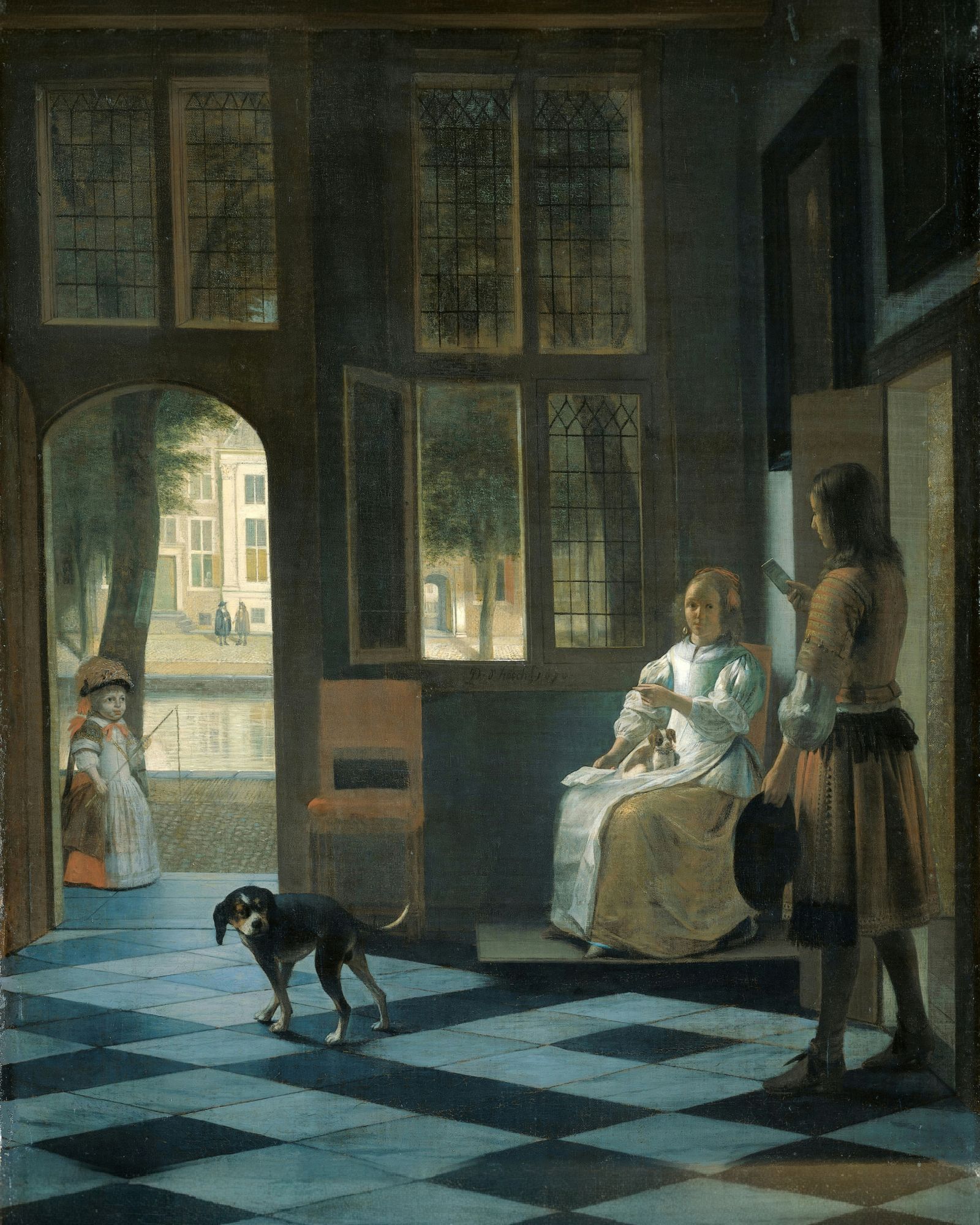
The Letter in the Entrance Hall · Pieter de Hooch, 1670 · Rijksmuseum, Amsterdam. Prepared for print by Surrealium at Vaxholm Fortress, Sweden.
Interior with Women beside a Linen Cupboard, shown here, gives the eye a sequence of doors, frames and spaces beyond the foreground figures. The cupboard's strong structure belongs to a room that continues elsewhere. Clothing, tiled floor and woodwork establish different kinds of surface, while the smaller distant opening draws attention away from the immediate exchange.
The painter is Pieter de Hooch. That name should remain visible even when the picture helps explain a question prompted by Vermeer. De Hooch's arrangement makes domestic space a route through the image, and the depth has its own appeal. Rather than calling it “Vermeer-like” and stopping, look at how many thresholds the eye passes and how the figures occupy only part of a larger architectural order.
View of Delft: quiet beyond the interior
Vermeer's View of Delft, held by the Mauritshuis and dated around 1660–61, moves the subject outside. The museum describes the relation of water, city and sky, and notes that the buildings were adjusted rather than copied as a perfectly literal record. The painting's calm therefore belongs to a made composition, even though it presents a recognisable place.
That is a useful correction to the idea that Vermeer simply recorded whatever was before him with exceptional accuracy. A city view, like a room, can be organised to direct attention. Light and shadow connect separate buildings into a visual whole. We can recognise the achievement without claiming that one technical device explains everything, or presenting debated theories about optical aids as settled facts about every painting.
The Letter in the Entrance Hall: the outside comes in
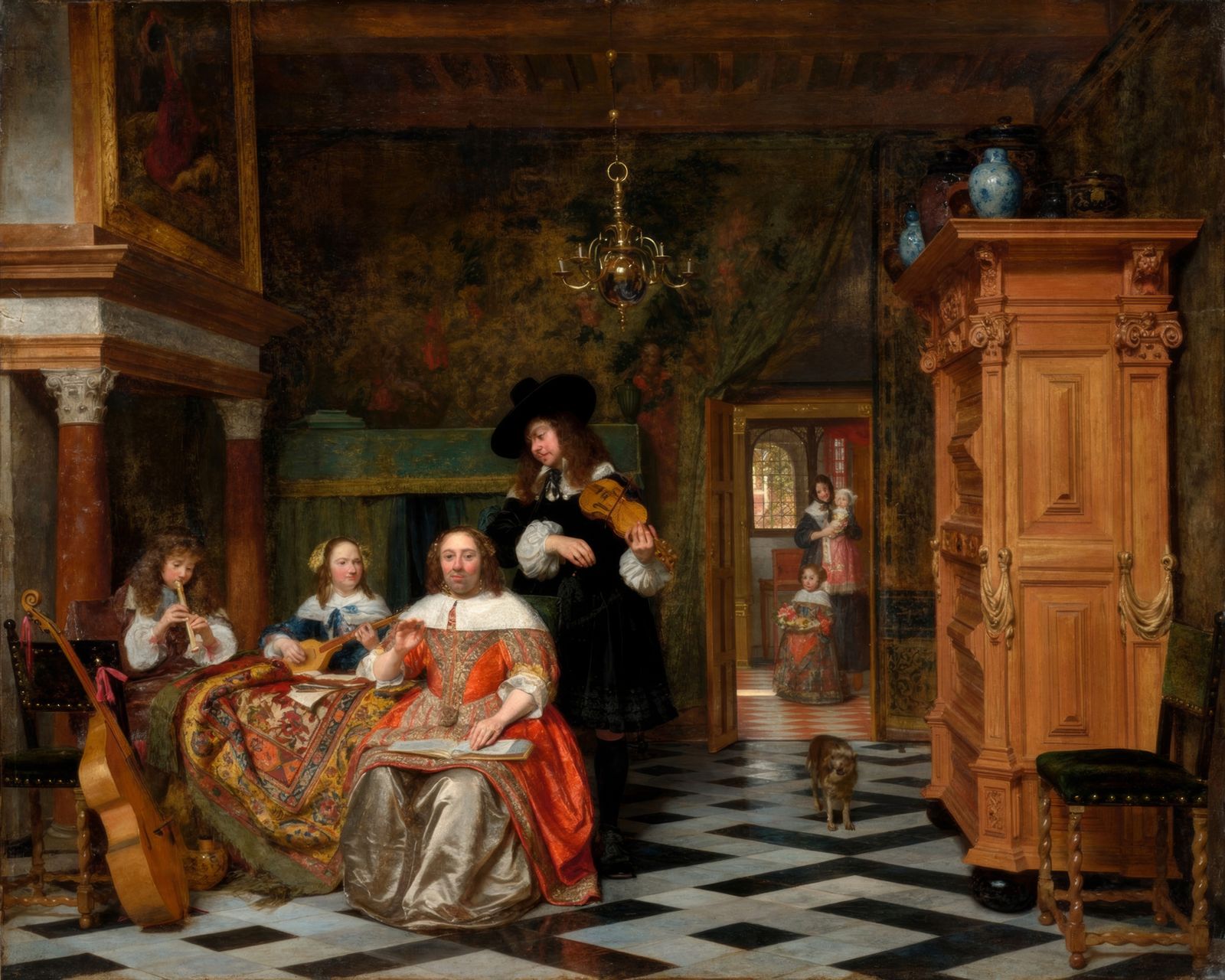
Portrait of a Family Playing Music · Pieter de Hooch, 1663 · Cleveland Museum of Art. Restored by Surrealium at Vaxholm Fortress, Sweden.
De Hooch's letter scene places figures in a high interior, with a bright opening beyond and a dog crossing the tiled foreground. The document makes a small exchange possible, but the surrounding architecture gives that exchange a larger field. Different areas of light keep the scene from collapsing into one evenly illuminated room.
The work is captioned here under its recorded title, with the catalogue slug retaining an alternative description of a man handing a letter. Such differences in naming should be handled openly rather than treated as evidence of two separate pictures. Look at the relation between the figures and the open doorway. A letter can connect the room with a world outside it, while the painting gives that connection a visible spatial form.
A musical family: quiet need not mean empty
Portrait of a Family Playing Music brings several figures, instruments, a patterned cloth and an elaborate room into one composition. The image is much more crowded than the popular idea of a solitary Vermeer figure beside a window. Yet the arrangement can still feel controlled through the repeated verticals, the floor and the different positions of the people.
This is another De Hooch work, and its inclusion is a comparison of domestic subjects rather than an attribution to Vermeer. Music supplies a shared activity, while the furnishings establish a particular social setting. Resist inventing an ideal family relationship from the coordinated scene. A portrait can present a household as it wishes to be seen, and the visual order is evidence of the picture's design before it is evidence of everyday harmony.
Ruisdael’s stream: a comparison in light
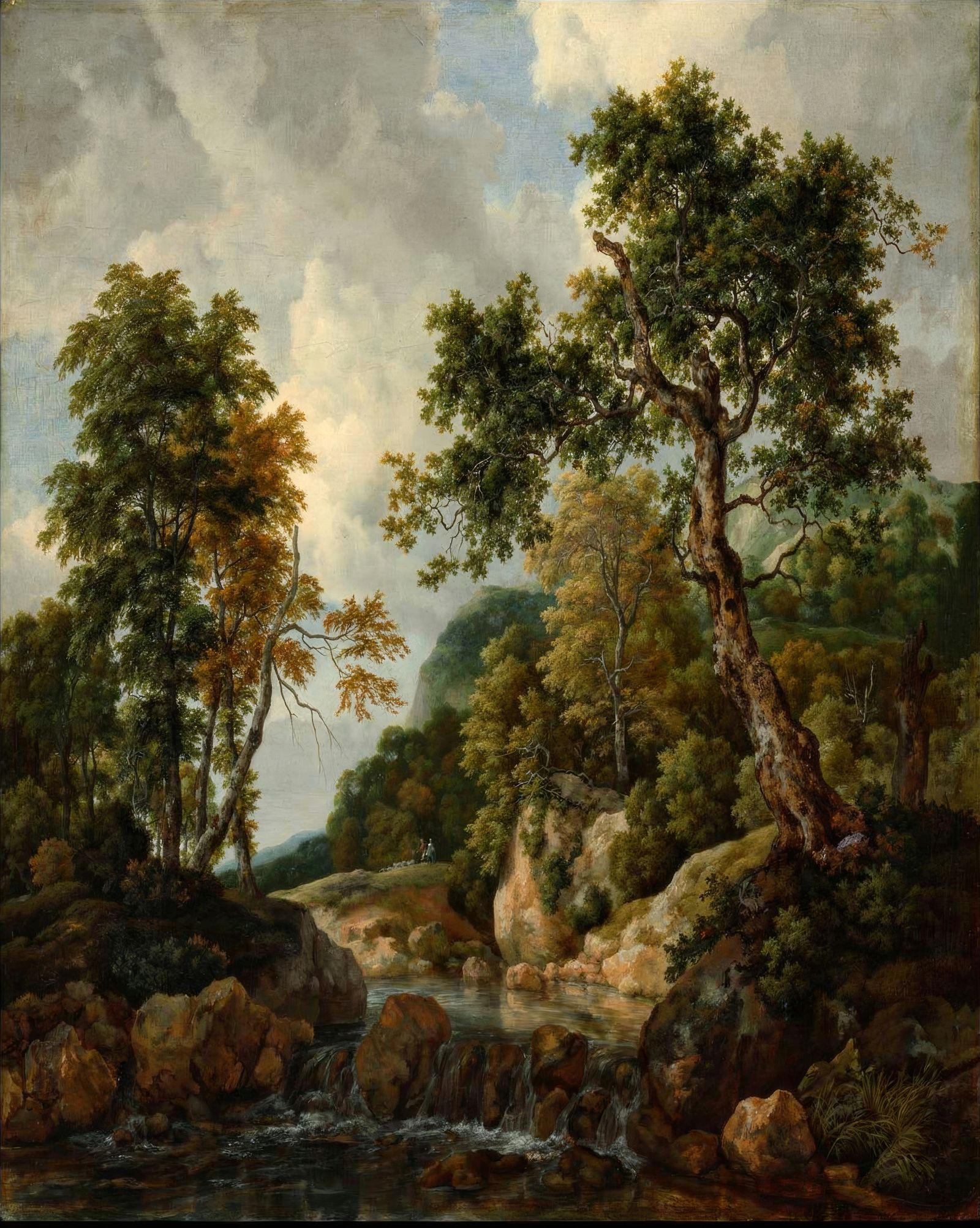
The Forest Stream · Jacob van Ruisdael, ca. 1660 · The Metropolitan Museum of Art. Restored by Surrealium at Vaxholm Fortress, Sweden.
The Forest Stream belongs to a different subject and another artist, Jacob van Ruisdael. Trees, rocks and running water replace the room, but the relation of dark enclosure to brighter openings offers a useful comparison. Light does not fall equally on everything. It gives the eye a path and makes some forms emerge while others remain within a deeper mass.
The comparison should stay modest. A shared interest in light does not make Ruisdael a landscape version of Vermeer, and the painters' individual methods and subjects matter. What the viewer gains is a question that travels: how does brightness organise attention? In a room it may gather around a task; in a forest it may reveal a passage between trees or a shifting area of water.
Choosing the work, keeping the name
If your interest is specifically in owning a reproduction of a Vermeer, the companion works here should not be offered as though they fulfil that request. They may instead help you discover an interest in Dutch interiors, thresholds, letters or the relation of light to a dark setting. Those are legitimate reasons to choose a different painting, provided the different artist remains clear.
Explore De Hooch's linen cupboard within the Baroque collection, and compare Rembrandt's prints and John Constable's landscapes for other uses of concentrated light. The historical discussion and the available print should meet through an honest connection. A recognisable visual pleasure does not need a more famous name attached to make it worth your attention.
Vermeer's rooms and city views reward precision: a particular task, a particular place, a particular distribution of light. The same precision should govern how we label the works beside them. Comparison opens the eye when it preserves the differences it asks us to notice.
- Where is The Milkmaid by Vermeer?
- It is held by the Rijksmuseum in Amsterdam. The museum dates it to around 1660 and identifies the figure as a servant pouring milk indoors.
- Did Vermeer paint landscapes?
- View of Delft is a major outdoor city view held by the Mauritshuis. His surviving work is not limited to women in interiors, even though those scenes are especially familiar.
- Are the paintings shown here by Vermeer?
- No. They are explicitly identified companion works by Pieter de Hooch and Jacob van Ruisdael. The article discusses Vermeer while keeping the reproduced works and their artists distinct.