Dutch Golden Age paintings: 15 masterworks from Rembrandt to Potter
Rembrandt, Hals, Steen, de Hooch, Ruisdael and Kalf: fifteen pictures from the century when a small country of merchants painted itself better than anyone before.
In the 1600s the Dutch Republic was a young, rich country of traders, and its painters invented a new kind of art for them. Instead of altarpieces for churches and allegories for kings, they made pictures for ordinary homes: a brewer’s portrait, a sunny courtyard, a windmill, a table laid with fruit and silver. Painters specialised, and each specialism produced its masters.
The fifteen works below run through the whole range, from Rembrandt’s portraits and etchings to the great landscape painters, the seascapes and the still lifes. Every one can be ordered as a print, and where a picture has its own Fable portrait style you can also send a photo and see yourself, or your pet, painted in it.
1. The Toilet of Bathsheba
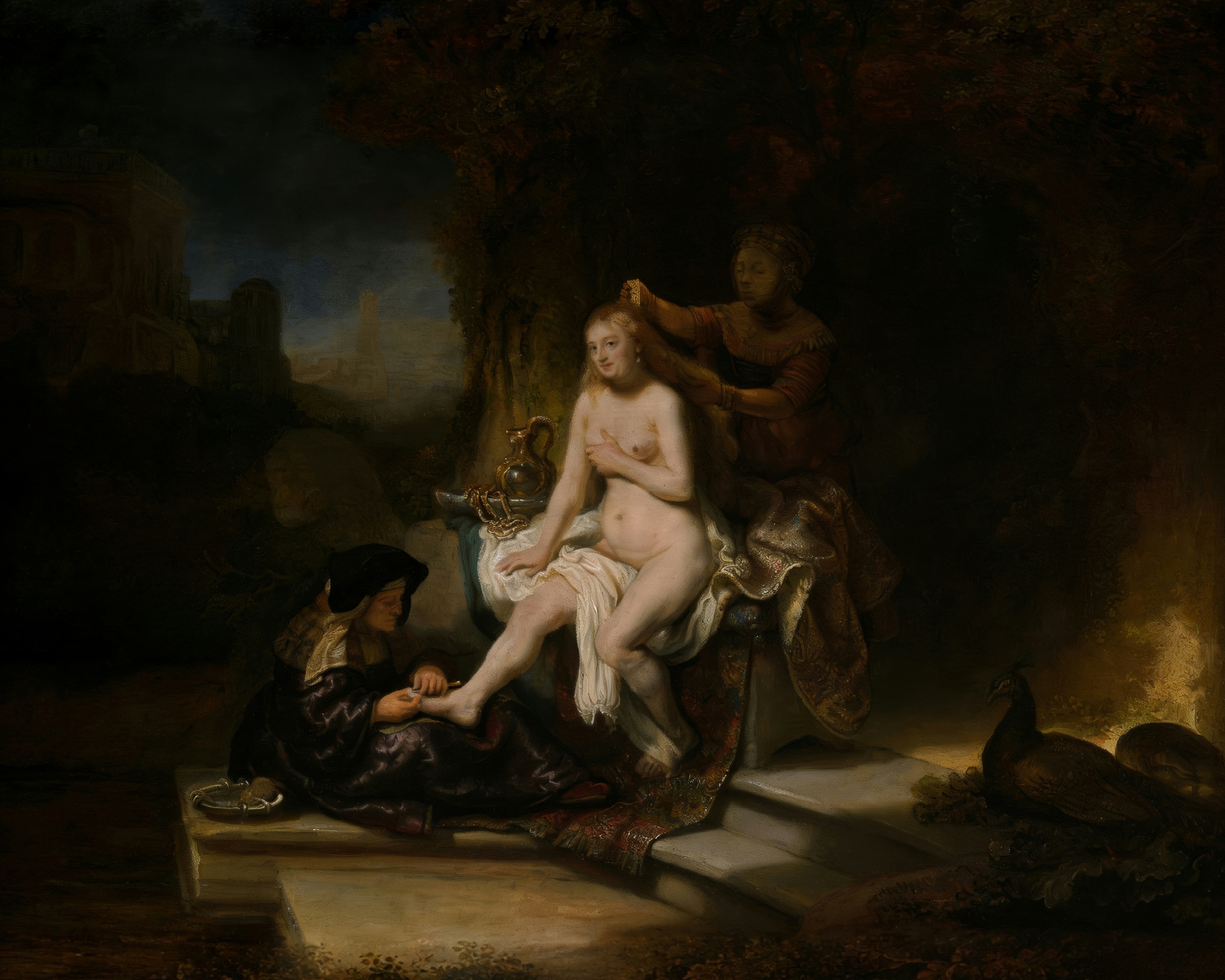
Rembrandt, The Toilet of Bathsheba, 1643. Oil on wood. The Metropolitan Museum of Art, New York.
Rembrandt painted this small panel in 1643, the year after The Night Watch. Bathsheba is being prepared by her maids, and the warm light falls on her skin while the rest of the room sinks into brown shadow. It is a private, gentle picture, closer to a scene of everyday life than to a Bible story.
A rich, dark picture for a bedroom or a dressing room, where its glow reads best in lamplight.
2. Portrait of Nicolaes van Voorhout
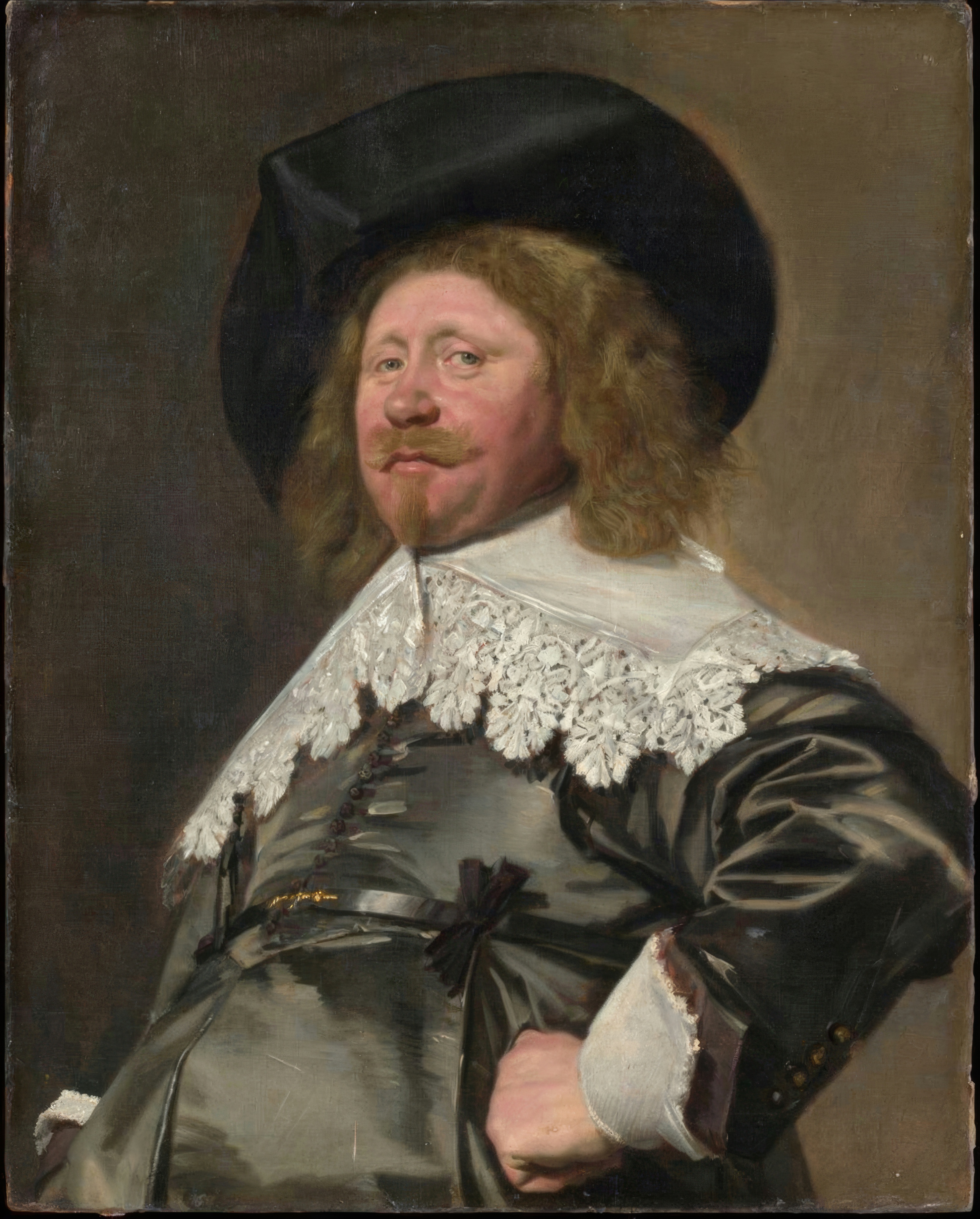
Frans Hals, Portrait of Nicolaes van Voorhout, ca. 1636–38. Oil on canvas. The Metropolitan Museum of Art, New York.
Frans Hals painted the merchants of Haarlem with a speed nobody else dared. The sitter is probably the brewer Nicolaes van Voorhout, and Hals sets down his collar, his hand and his amused face in quick, open strokes that still look modern. It is the confidence of the new Dutch middle class in one face.
A portrait with real presence for a study or a hallway, where it greets everyone who comes in.
3. The Family Concert
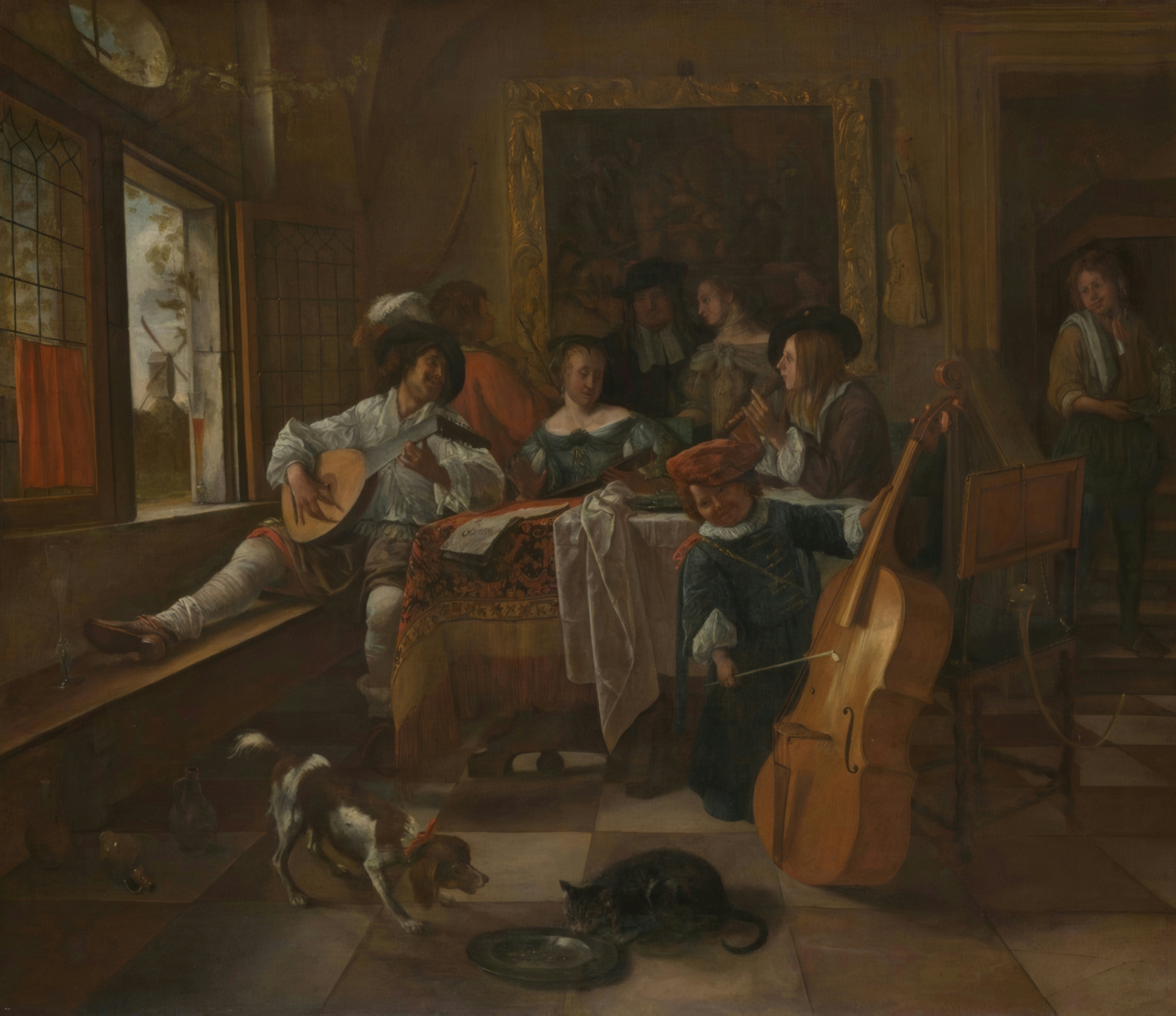
Jan Steen, The Family Concert, 1666. Oil on canvas. Art Institute of Chicago.
Jan Steen was the storyteller of Dutch painting, and his crowded, cheerful households gave the Dutch a proverb: a Jan Steen household means a happy mess. In this family concert of 1666 everyone joins in, from the grandparents to the children, and the picture is full of little jokes to find.
A warm, lively picture for a family room or a kitchen with a long table.
4. Interior with Women beside a Linen Cupboard
Pieter de Hooch, Interior with Women beside a Linen Cupboard, 1663. Oil on canvas. Rijksmuseum, Amsterdam.
Pieter de Hooch made the Dutch house his subject: tiled floors, open doors and daylight falling from room to room. Here two women put away the household linen in 1663, while through the doorway you see the canal houses across the street. Nothing happens, and that is exactly the point.
A calm, orderly picture that suits a hallway, a kitchen or a bedroom with white walls.
5. The Oude Kerk, Delft
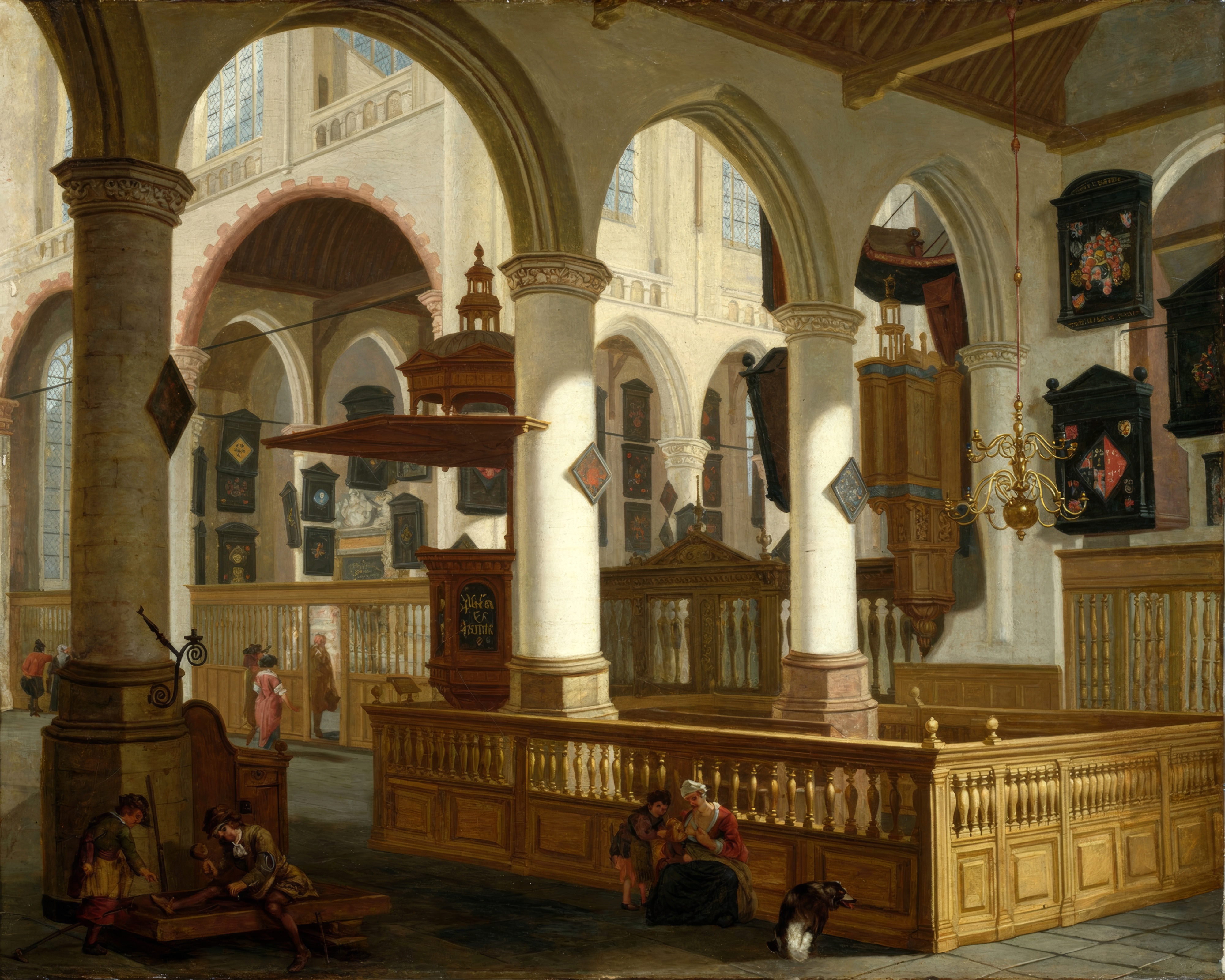
Cornelis de Man, The Oude Kerk, Delft, c. 1665. Oil on canvas. Art Institute of Chicago.
Church interiors were a Delft speciality, and Cornelis de Man painted the city’s Old Church, where Vermeer would be buried a few years later. The whitewashed walls and pale columns catch the light, and the small visitors and dogs on the floor show how big and how quiet the space is.
A light, airy picture that brings height to a narrow hall or a stairwell.
6. The Three Trees
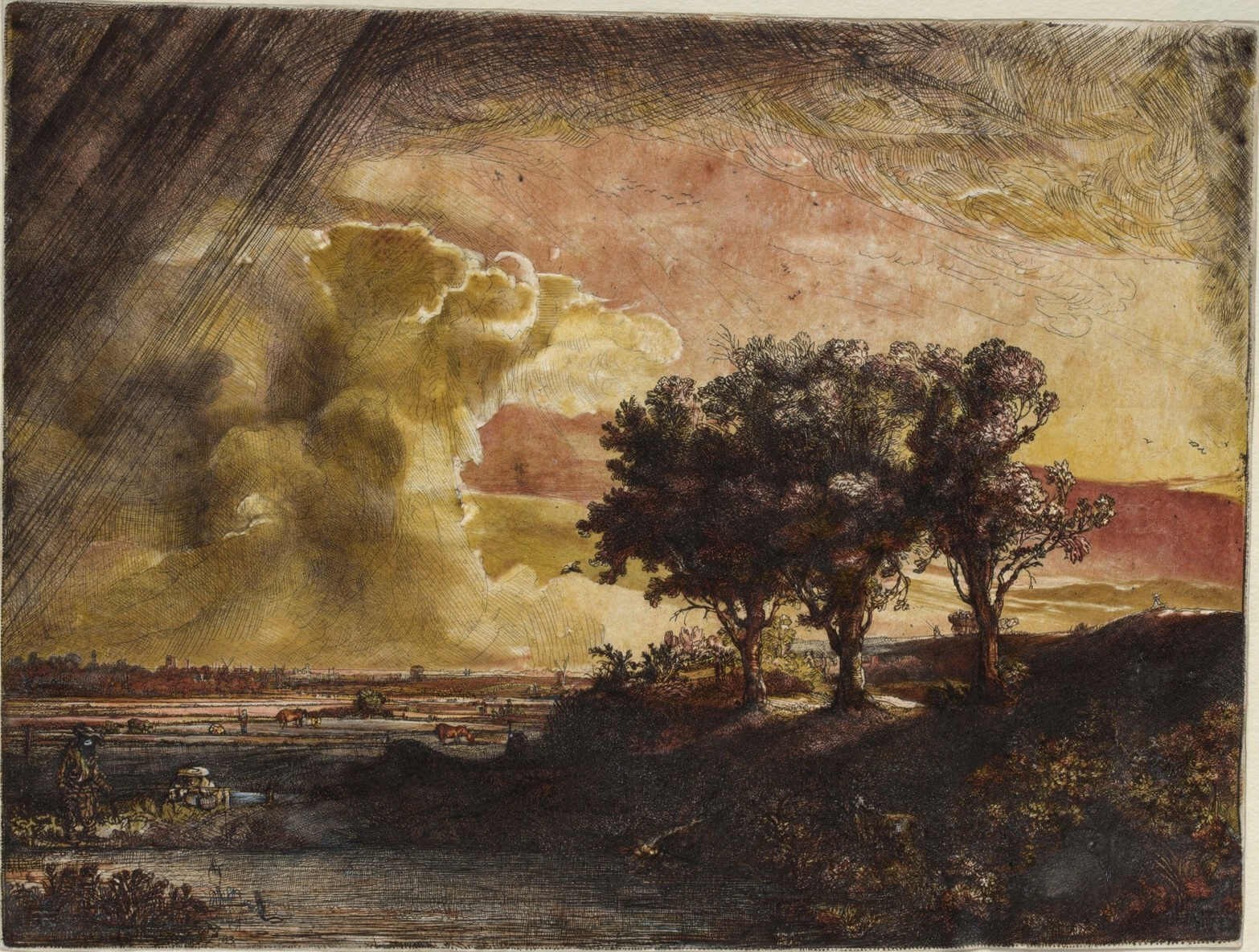
Rembrandt van Rijn, The Three Trees, 1643. Atelier colour edition of the etching. Cleveland Museum of Art.
The Three Trees of 1643 is Rembrandt’s largest landscape etching and one of the most dramatic prints ever made. Rain sweeps in on the left, sunlight breaks through on the right, and between them the flat Dutch countryside runs to the horizon. Our atelier edition adds soft colour to Rembrandt’s lines.
A wide, atmospheric landscape for above a sofa or a desk.
7. The Windmill
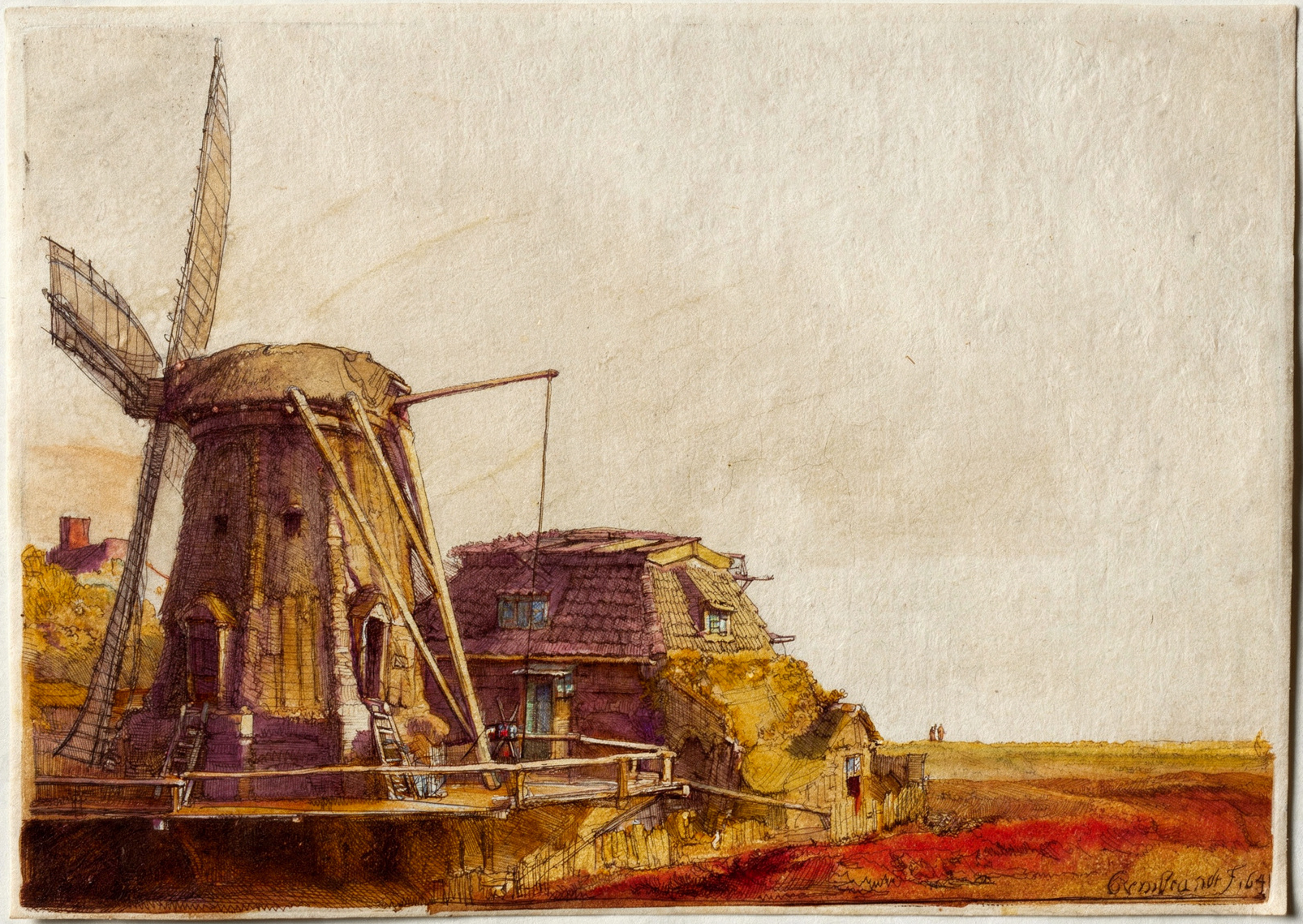
Rembrandt van Rijn, The Windmill, 1641. Atelier colour edition of the etching. Cleveland Museum of Art.
Rembrandt etched this mill on the old city walls of Amsterdam in 1641. Nineteenth-century collectors believed it was his father’s mill and called it Rembrandt’s Mill, which made the print famous all over again. It is simple and monumental: one building against a big sky.
A quiet print for a study or a reading corner, especially in a pair with The Three Trees.
8. A Cottage with White Paling
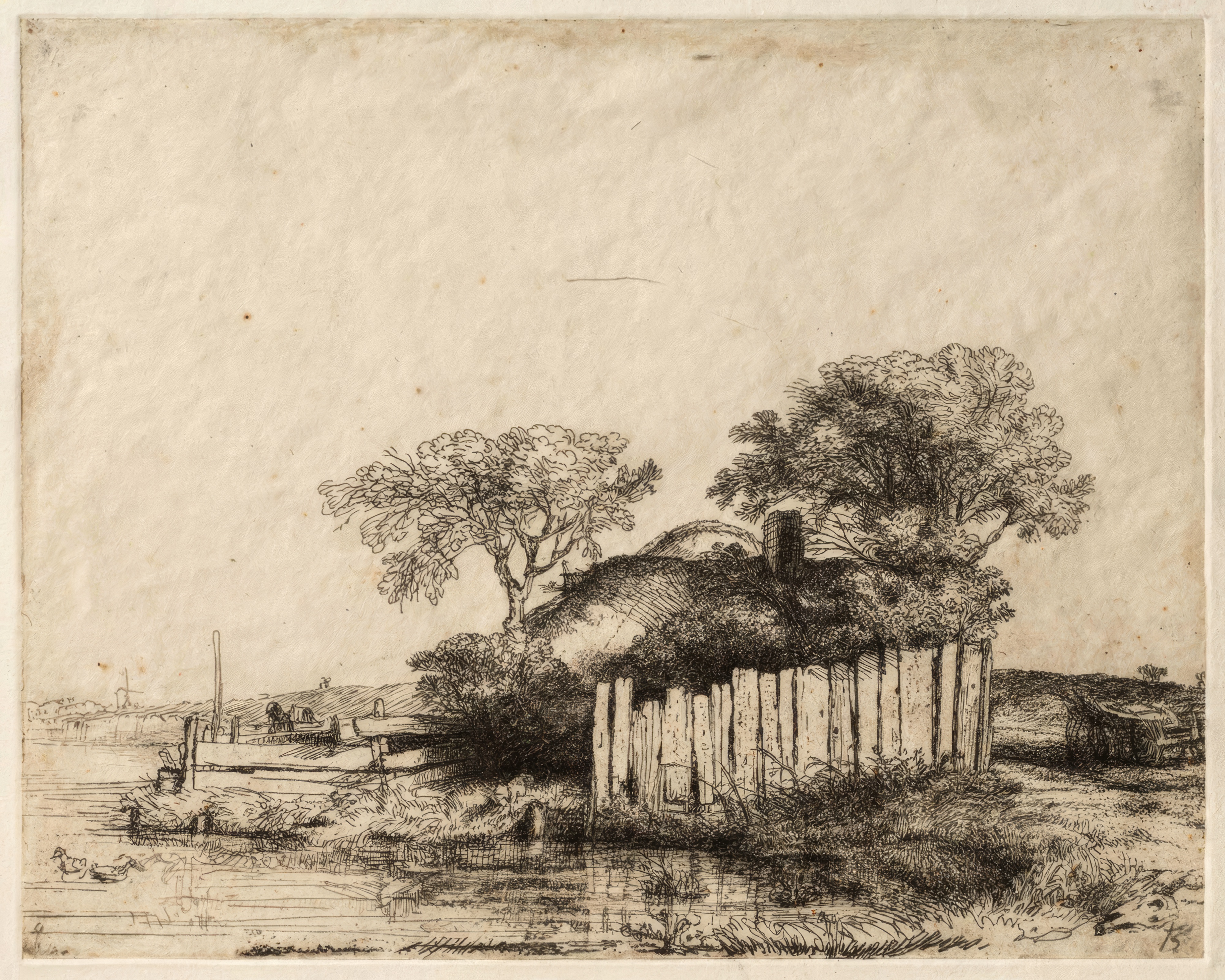
Rembrandt van Rijn, A Cottage with White Paling, 1648. Etching on ivory laid paper. Art Institute of Chicago.
Rembrandt often walked out of Amsterdam to draw the farms along the dykes. This cottage of 1648 sits behind its white fence like a portrait sitter, and every line of thatch and wood is set down with the same care he gave to faces. It shows how much he could do with very little.
A small, graphic print that suits a white wall in a cottage, a kitchen or a guest room.
9. View of Haarlem and the Haarlemmer Meer
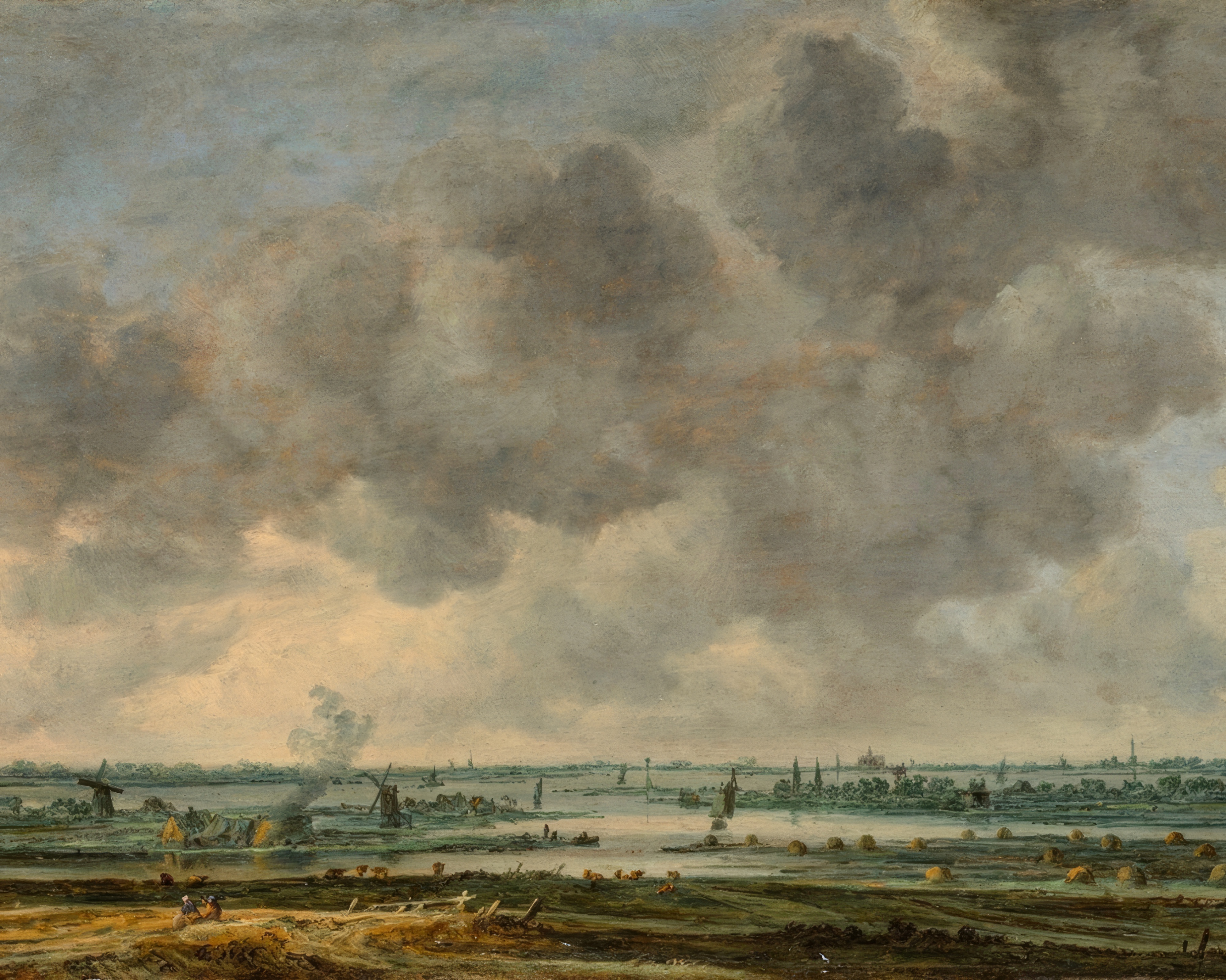
Jan van Goyen, View of Haarlem and the Haarlemmer Meer, 1646. Oil on wood. The Metropolitan Museum of Art, New York.
Jan van Goyen painted Holland in a few tones of grey, brown and green, and gave three quarters of the picture to the sky. In this view of 1646 the great church of Haarlem rises on the horizon beside the lake, and the clouds do all the work. It is the flat Dutch landscape as people still picture it.
A soft, low-contrast landscape that calms a living room or a bedroom.
10. Landscape with a Village in the Distance
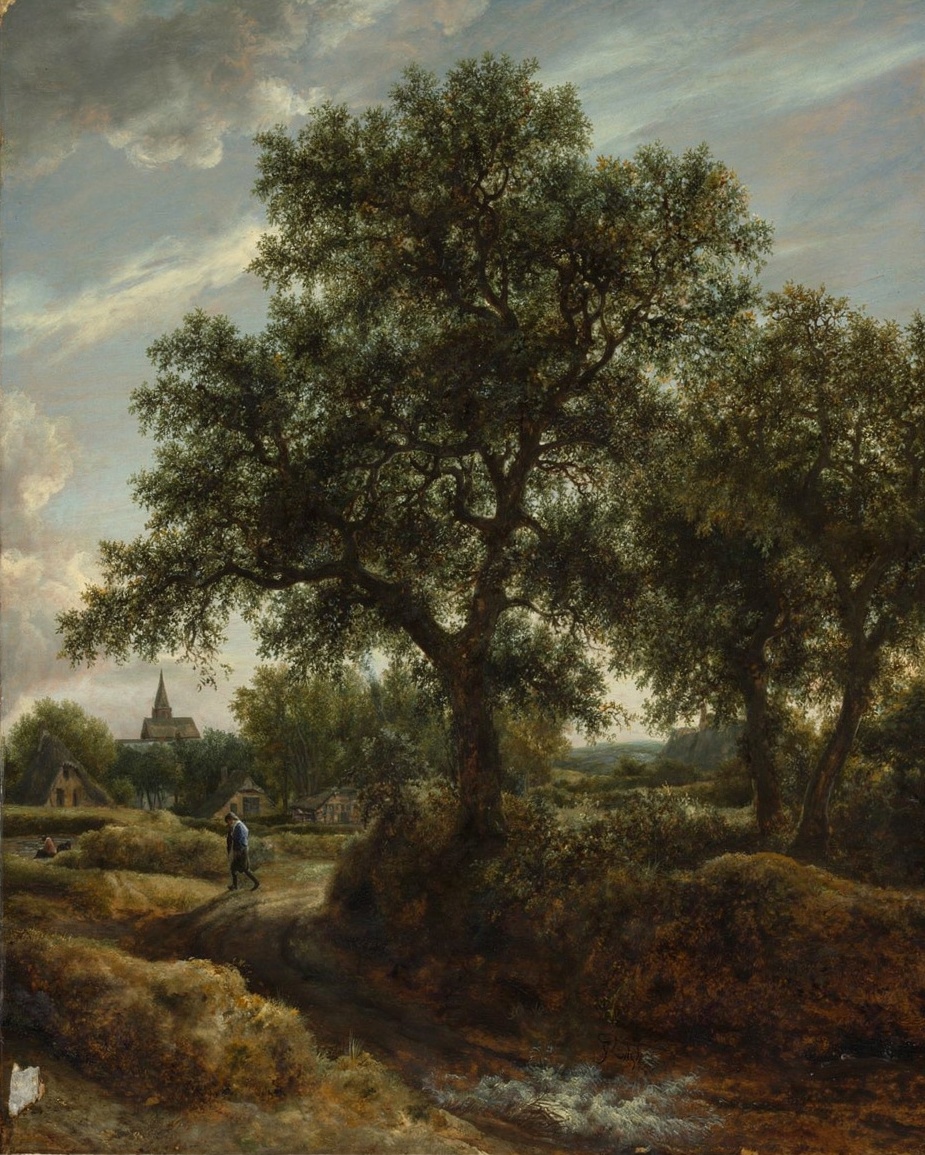
Jacob van Ruisdael, Landscape with a Village in the Distance, 1646. Oil on wood. The Metropolitan Museum of Art, New York.
Jacob van Ruisdael was about seventeen when he painted this in 1646, and he would become the greatest landscape painter of the century. Already you can see what made him famous: a sandy road, a few trees bent by the wind and a sky that feels about to change.
A moody landscape for a study, a library or a dark green room.
11. A Farm in the Sunlight
Meindert Hobbema, A Farm in the Sunlight, c. 1668. Oil on canvas. National Gallery of Art, Washington.
Meindert Hobbema learned landscape from Ruisdael and made it gentler. In this farm of about 1668 sunlight breaks through the trees and falls on the yard, and the whole picture feels like a quiet afternoon in the country.
A sunny, restful landscape for a kitchen, a dining room or a country house.
12. An English Galliot at Sea Running before a Strong Wind
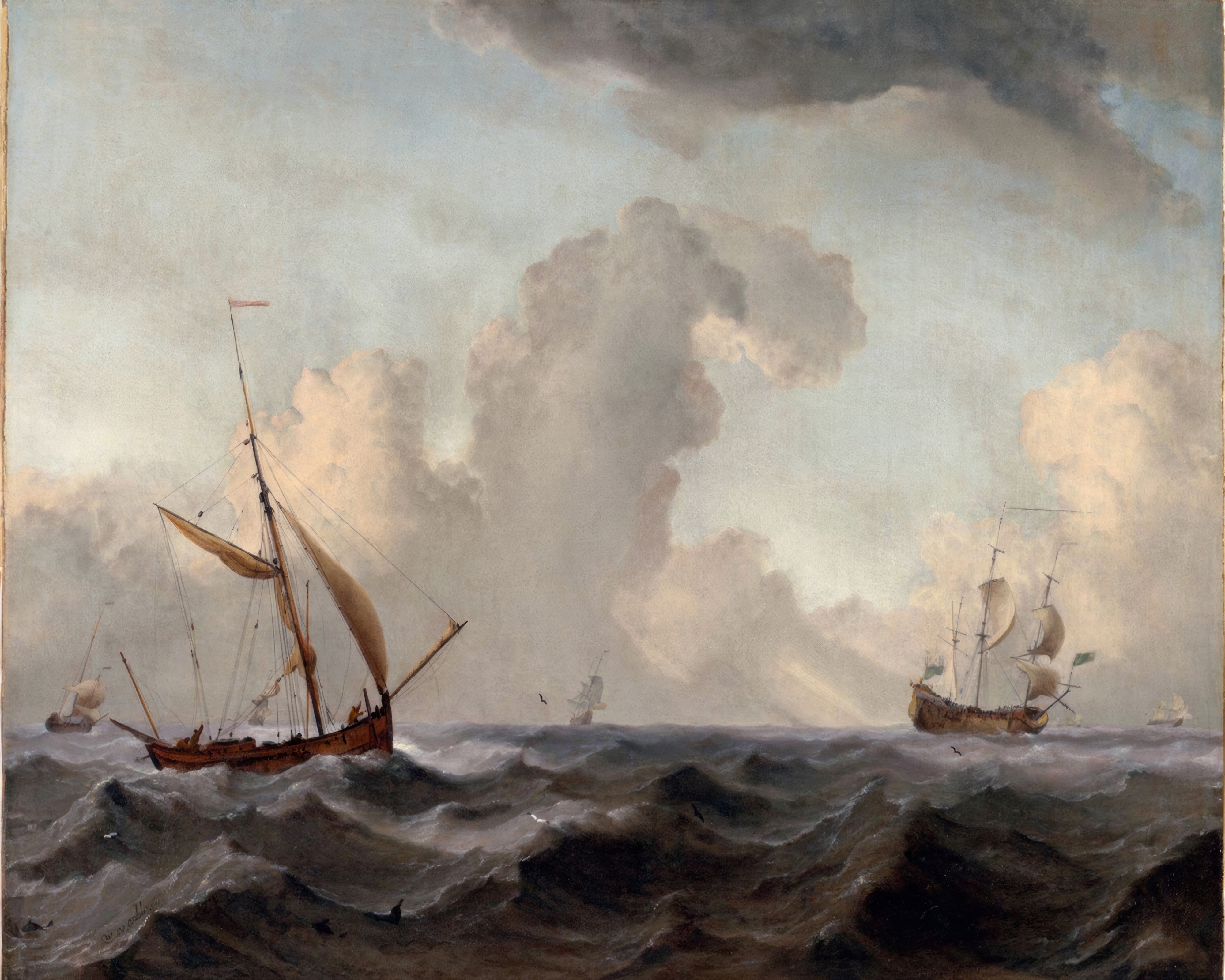
Willem van de Velde II, An English Galliot at Sea Running before a Strong Wind, c. 1690. Oil on canvas. Harvard Art Museums.
Willem van de Velde the Younger was the finest sea painter of his age, and he left Holland for London in the 1670s to work for Charles II. Here a small English galliot runs before a strong wind, and you can feel the weight of the water and the push of the air in its sails.
A fresh, airy seascape for a hallway, a bathroom or a house by the water.
13. The Piebald Horse
Paulus Potter, The Piebald Horse, c. 1650–1654. Oil on canvas. J. Paul Getty Museum, Los Angeles.
Paulus Potter died at twenty-eight, but he changed animal painting for good: he painted horses and cattle as the heroes of their own pictures. This piebald stallion stands side on against a low horizon, every patch of his coat carefully mapped. It is also the masterwork behind one of Fable’s pet portrait styles.
Ideal for a horse or a spotted dog: a side-on photo in good daylight works best in this style.
Create your portrait in this style
14. Still Life with Fruit, Glassware, and a Wanli Bowl
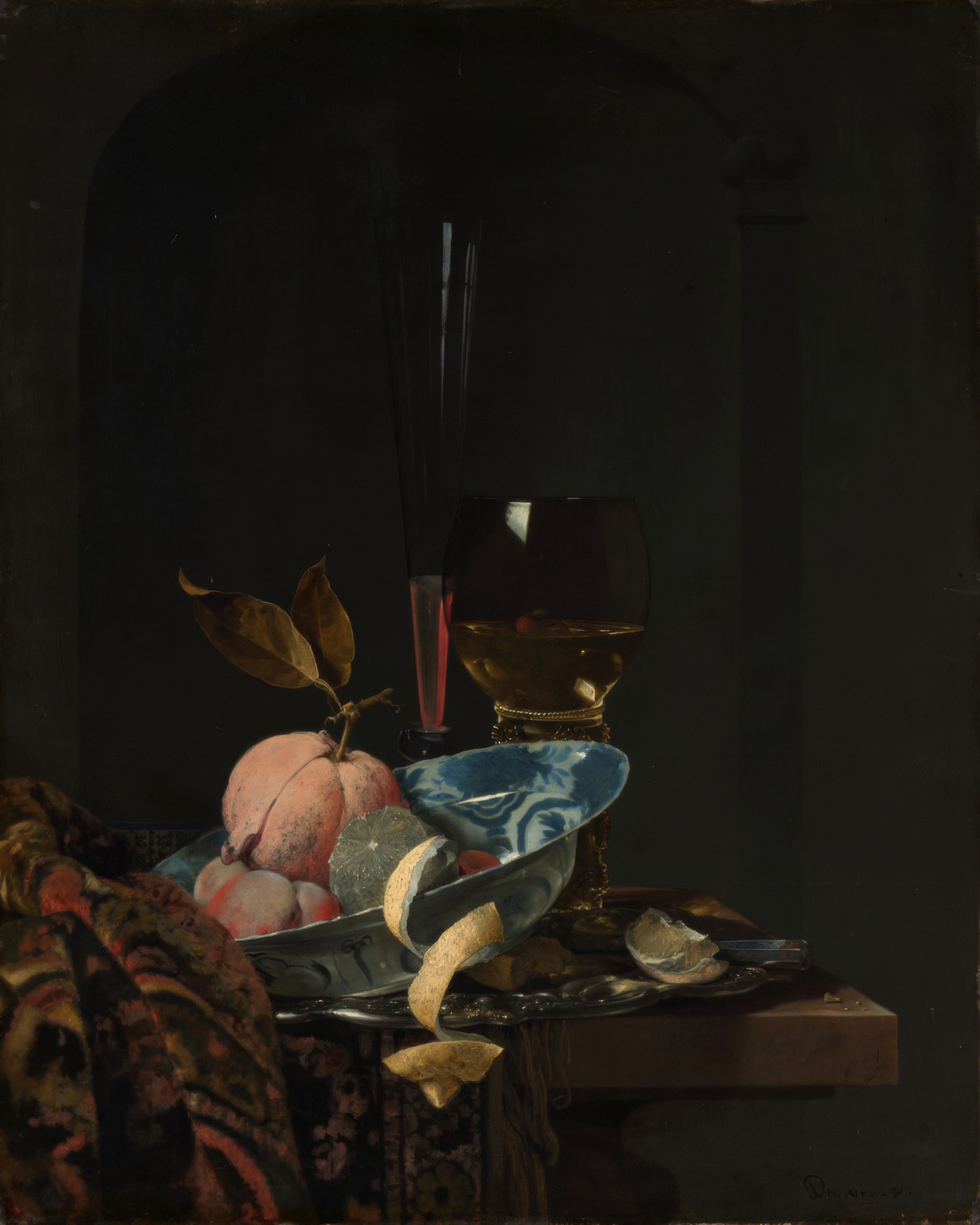
Willem Kalf, Still Life with Fruit, Glassware, and a Wanli Bowl, 1659. Oil on canvas. The Metropolitan Museum of Art, New York.
Willem Kalf painted the luxury goods of the Dutch trading empire: Chinese porcelain brought home by the East India Company, Venetian glass and lemons from the south. In this still life of 1659 they glow out of a deep black ground. It is the masterwork behind Fable’s Fruit and glassware style.
A deep, glowing still life for a dining room or a dark-walled kitchen.
Create your portrait in this style
15. Silver Wine Jug, Ham, and Fruit
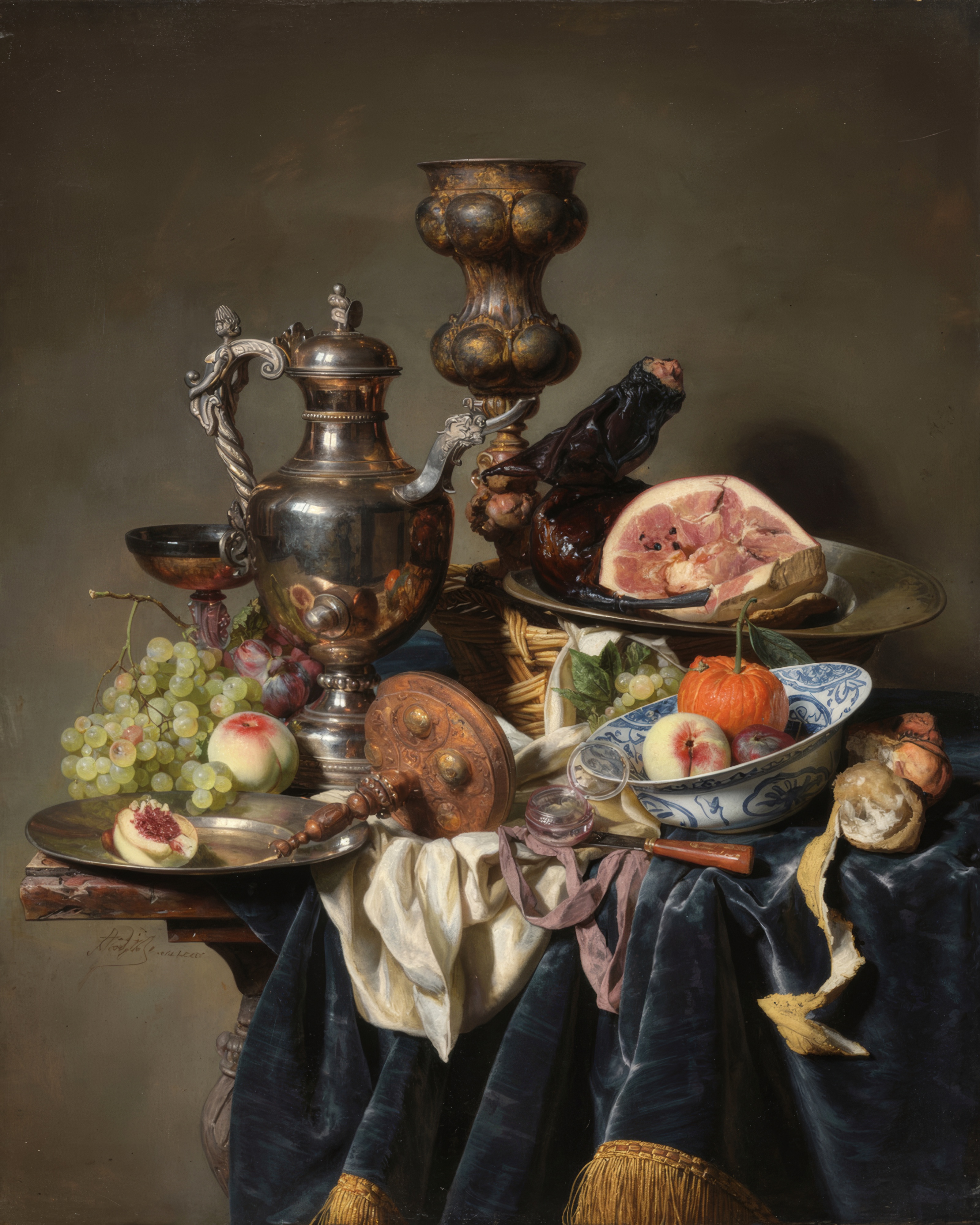
Abraham van Beyeren, Silver Wine Jug, Ham, and Fruit, c. 1660–66. Oil on canvas. Cleveland Museum of Art.
Abraham van Beyeren painted the end of a grand meal: the ham cut into, the silver jug catching the window, the fruit spilling across the cloth. These pictures showed off wealth, and quietly warned that all of it passes. The silver alone is a lesson in painting reflections.
A sumptuous still life that anchors a dining room or a wall above a sideboard.
Dutch Golden Age pictures were made for living rooms, which is why they still sit so easily in one. A dark still life or a Rembrandt portrait gives a dining room depth, while a pale Ruisdael sky or a van Goyen panorama opens up a hallway or a study. Every picture here comes from a museum scan and is printed whole, without cropping. For the century around it, read our guide to baroque art, and for the flowers that made Dutch painters famous, see famous flower paintings.
Questions
What is the Dutch Golden Age?
It is the period, roughly the 1600s, when the Dutch Republic was one of the richest trading nations in the world. Its wealth supported thousands of painters, who sold directly to middle-class buyers rather than to the church or the court.
Who are the most famous Dutch Golden Age painters?
Rembrandt, Johannes Vermeer and Frans Hals are the best known, followed by Jan Steen, Pieter de Hooch, Jacob van Ruisdael, Meindert Hobbema, Paulus Potter and Willem Kalf.
Are Rembrandt’s etchings as important as his paintings?
Yes. Rembrandt was one of the greatest printmakers who ever lived, and collectors across Europe bought his etchings in his lifetime. The Three Trees and The Windmill are among the most celebrated prints in Western art.
Can I get a portrait of my own in a Dutch Golden Age style?
Yes. Potter’s Piebald Horse and Kalf’s still life are each the source of a Fable style. Open the style under the picture, send a photo and you will see a free preview before you order.