Anne Boleyn portrait: a likeness and its later life
An Anne Boleyn portrait needs a date and an attribution. Explore Tudor likenesses with clearly identified contextual portraits.
An Anne Boleyn portrait is rarely a simple meeting with a face painted from life. The best-known surviving images belong to a complicated history of later copies, uncertain identifications and the desire to recover the appearance of a woman whose life ended in 1536. A familiar necklace or French hood can help explain why an image has become recognisable, but familiarity is not the same as a secure contemporary likeness.
The image shown here is Ormond, a 1797 print by Francesco Bartolozzi after Holbein. It is not Anne Boleyn, and its printing date is much later than the Tudor period. A Botticelli portrait below provides an explicitly Italian comparison from another courtly world. These contextual images let us discuss the construction and transmission of likeness without mislabelling another sitter as Anne.
Start with the object, not the resemblance
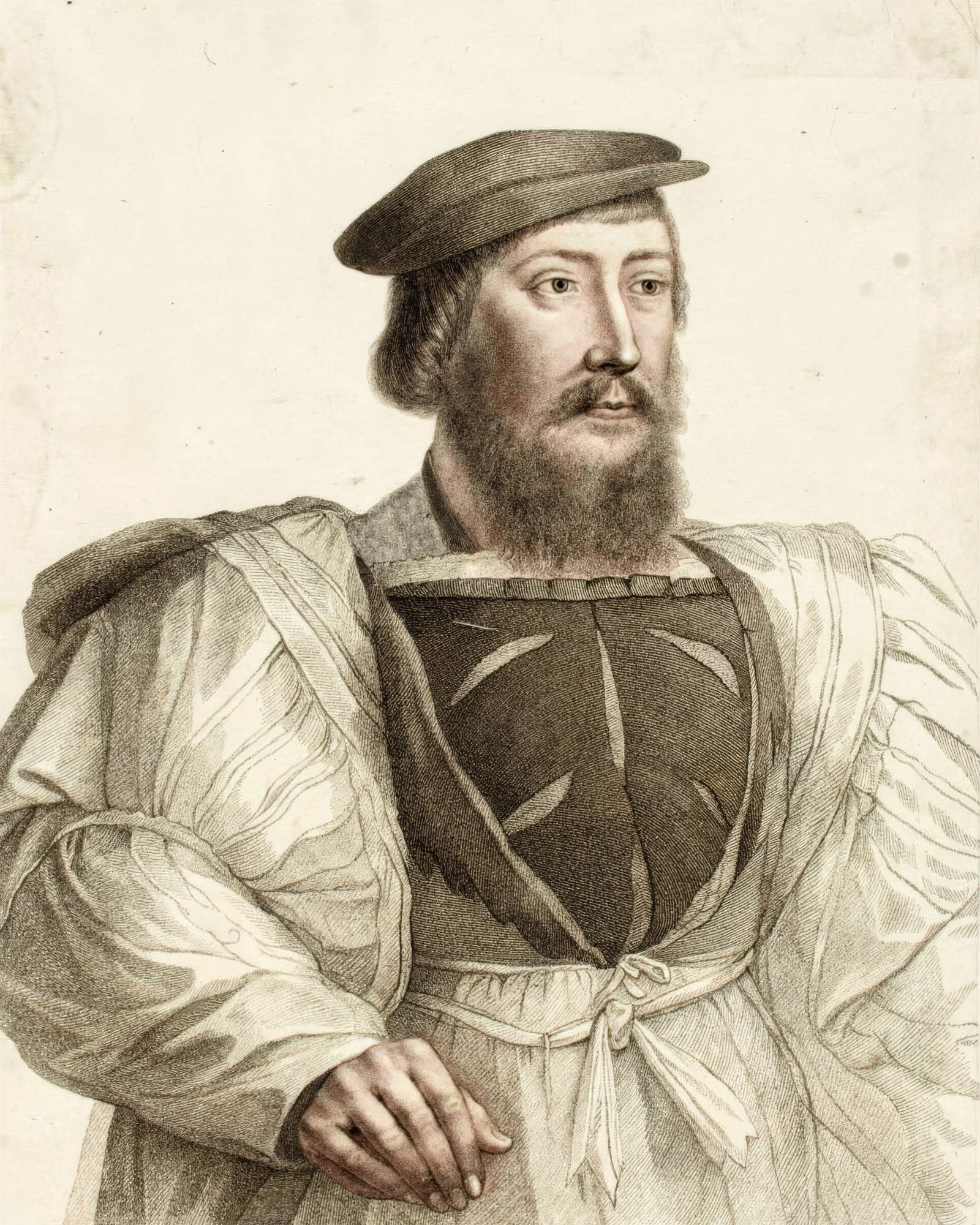
Ormond · Francesco Bartolozzi after Hans Holbein the Younger, July 14, 1797 · Art Institute of Chicago. Prepared for print by Surrealium at Vaxholm Fortress, Sweden. Contextual print after Holbein; not Anne Boleyn.
The National Portrait Gallery’s collection records distinguish between portraits of Anne Boleyn and works formerly identified as her. Its familiar panel portrait, NPG 668, is attributed to an unknown artist and dated to the late sixteenth century, after her death. That information does not make the object uninteresting. It changes the question from “what did an artist see in front of them?” to “how was Anne remembered and represented later?”
The print shown here needs the same discipline. Its title is Ormond, its maker is Bartolozzi, its model is associated with Holbein, and the print itself dates from 1797. Those facts describe different parts of the object’s history. A later print can transmit an earlier design, but it is still a later object with its own material and interpretive decisions. Looking at it as a Tudor-era sheet would collapse the history that makes it useful as a comparison. The date attached to a physical print should not silently become the date at which the original sitter was observed.
A necklace can identify an image tradition
The familiar image of Anne with a letter pendant has become a powerful visual shorthand. A recognisable attribute can help viewers connect one version to another, yet it cannot independently prove that a particular face was recorded from life. Copies can preserve an attribute while changing proportions, expression or costume details. A label must therefore rely on more than the fact that a picture looks like the version most often reproduced.
This is a useful distinction for any historic portrait. Ask whether the identification comes from an inscription, a documented history, comparison with another work or a later tradition. Those kinds of evidence have different strengths and limits. Our famous portrait paintings story offers a broader setting for the problem of likeness, while the royal portrait guide considers how recognisable signs of rank can coexist with an individual face. The symbols may be clear even when the precise history of a likeness remains uncertain. A careful label can preserve that uncertainty without preventing us from examining the painting’s visible choices.
An Italian comparison: a figure at a threshold
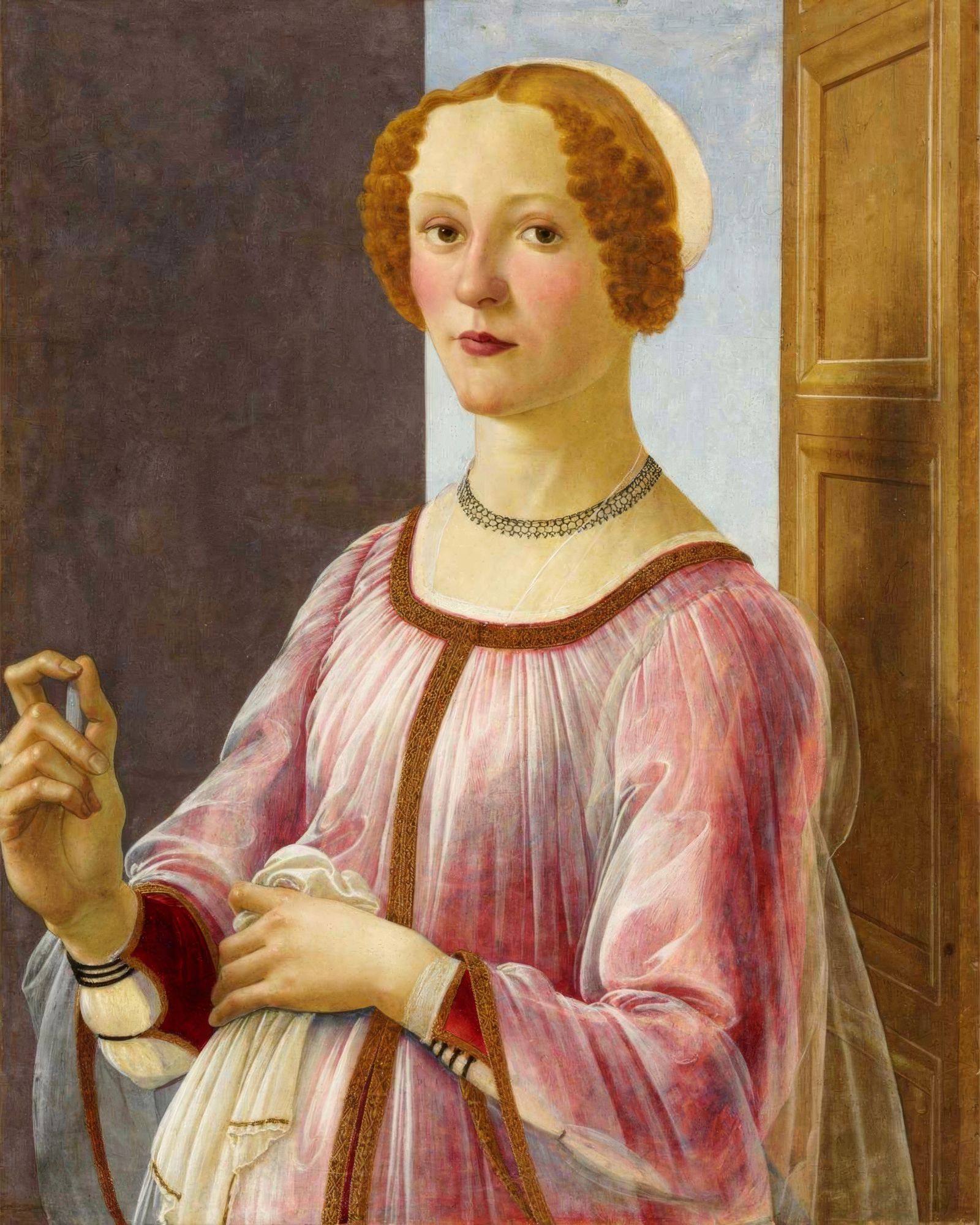
Portrait of a Lady known as Smeralda Bandinelli · Sandro Botticelli, 1470-1480 · Victoria and Albert Museum. Prepared for print by Surrealium at Vaxholm Fortress, Sweden.
Botticelli’s portrait conventionally known as Smeralda Bandinelli belongs to fifteenth-century Florence, not to the Tudor court. The title itself preserves a qualification: “known as” is not the same kind of claim as an unambiguous contemporary identification. The painting is included here for its arrangement of a woman within a frame and a space, not as evidence of Anne Boleyn’s appearance.
Look at the figure’s position and the way the architectural setting gives her a threshold to occupy. A portrait can make the viewer feel close to a person while keeping a formal boundary between them. That visual effect is worth describing without inventing private emotions for the sitter. Compare it with the more isolated presentation of the head and shoulders in the Ormond print. Different formats create different kinds of encounter, and neither format becomes more truthful merely because it seems more immediate to a modern viewer. The sensation of meeting a person belongs to our experience of the picture; establishing who that person was requires further evidence.
Henry VIII, Holbein and the authority of a model
Holbein’s name is closely associated with the visual culture of Henry VIII’s court. That association can become misleading when it encourages viewers to treat every later image in a Holbein-derived manner as an original portrait by the artist. A design, a workshop version, a copy and an engraving after a drawing are distinct objects. Each can be historically valuable, but the relationship between them should be stated.
The same care helps when comparing images of Henry VIII, Anne Boleyn and Elizabeth I. These were not three people photographed in one consistent studio system. Their surviving representations involve different artists, dates, purposes and later histories. A striking family resemblance in a modern collection of reproductions may owe something to selection and reproduction as well as to the original works. Begin with one securely catalogued object at a time. It is easier to understand a group after its members have been allowed to keep their individual histories, including the distance between an initial design and the version now in front of us.
A later print is an interpretation, too
Ormond · Francesco Bartolozzi after Hans Holbein the Younger, July 14, 1797 · Art Institute of Chicago. Prepared for print by Surrealium at Vaxholm Fortress, Sweden. Contextual print after Holbein; not Anne Boleyn.
Return to Bartolozzi’s Ormond and look at the marks that describe the face and clothing. An engraved or stippled image translates a model into a new system of marks, making choices about tone, edge and emphasis. Even when the aim is faithful transmission, the new medium affects how the likeness reaches us. A print is therefore more than a transparent window onto a vanished original.
This matters in the long afterlife of Tudor portraits, where reproductions often become more familiar than the objects from which they derive. A book illustration, a cropped website image and a museum photograph may each alter the scale and context of an encounter. Our Whistler’s Mother story considers another famous portrait whose popular name and repeated reproduction shape expectations. In both cases, returning to the complete object and its catalogue description helps restore details that a widely recognised image can lose through familiarity. The edges, the scale and the medium are parts of the work, not dispensable packaging around a face.
Making a new court-inspired portrait
If you are drawn to Tudor portraiture as a visual language, identify the qualities that appeal to you before choosing props. A clear silhouette, a controlled pose, a strong relation between face and clothing, or a dark field behind a light face may be enough to establish the mood. A contemporary portrait does not need to claim that its sitter has become Anne Boleyn or another historical person.
The guide to choosing a portrait photograph offers a practical starting point: preserve a clear likeness and an expression that belongs to the person. Then explore the available approaches in Styles. For historic pictures themselves, Masterworks keeps the attraction centred on the original work. Whichever route you choose, treat names and dates as part of the image’s interest. They prevent a costume from becoming a false identity and leave room for the contemporary sitter to remain recognisable within a historical visual reference. The aim is a thoughtful relationship with an older visual language, not an unsupported claim about ancestry or status.
The uncertainties around Anne’s appearance are not a reason to stop looking. They are a reason to look more precisely. A later portrait can tell us something about remembrance, a print can tell us about transmission, and an uncertain attribution can show how much a familiar face still asks us to investigate. Our custom portrait guide brings that attention back to a contemporary sitter.
- Is the familiar Anne Boleyn portrait contemporary with her?
- The National Portrait Gallery’s NPG 668 panel is dated to the late sixteenth century, after Anne’s death in 1536. Other images require their own separate assessment.
- Is Ormond an image of Anne Boleyn?
- No. It is a 1797 print by Bartolozzi after Holbein, used here to discuss the later transmission of court portrait designs.
- Does a costume or necklace prove a sitter’s identity?
- No. Attributes can support an identification, but the object’s date, attribution and documented history also matter. Familiarity with a reproduced image is not proof by itself.