Women reading paintings: books, letters and private worlds
Women reading paintings and prints, from a Chinese poetry scroll to Japanese letters and Larsson’s Lisbeth: ten pictures to look at closely.
Women reading paintings can suggest an uninterrupted private moment, yet a book or letter also connects the reader to someone outside the frame. The pages may carry a familiar story, new information or another person’s words. We can see the act of attention; we cannot necessarily know what the reader thinks.
This selection includes paintings, a hanging scroll and Japanese woodblock prints, with a final picture of writing to complete the exchange. The different media matter as much as the shared subject. The art books gift guide considers how a book can become a personal choice; these works ask what it looks like to be absorbed in one. Read them alongside our Japanese woodblock print story and Carl Larsson introduction, without treating every lowered gaze as the same emotion.
1. Toyonobu: a letter held close
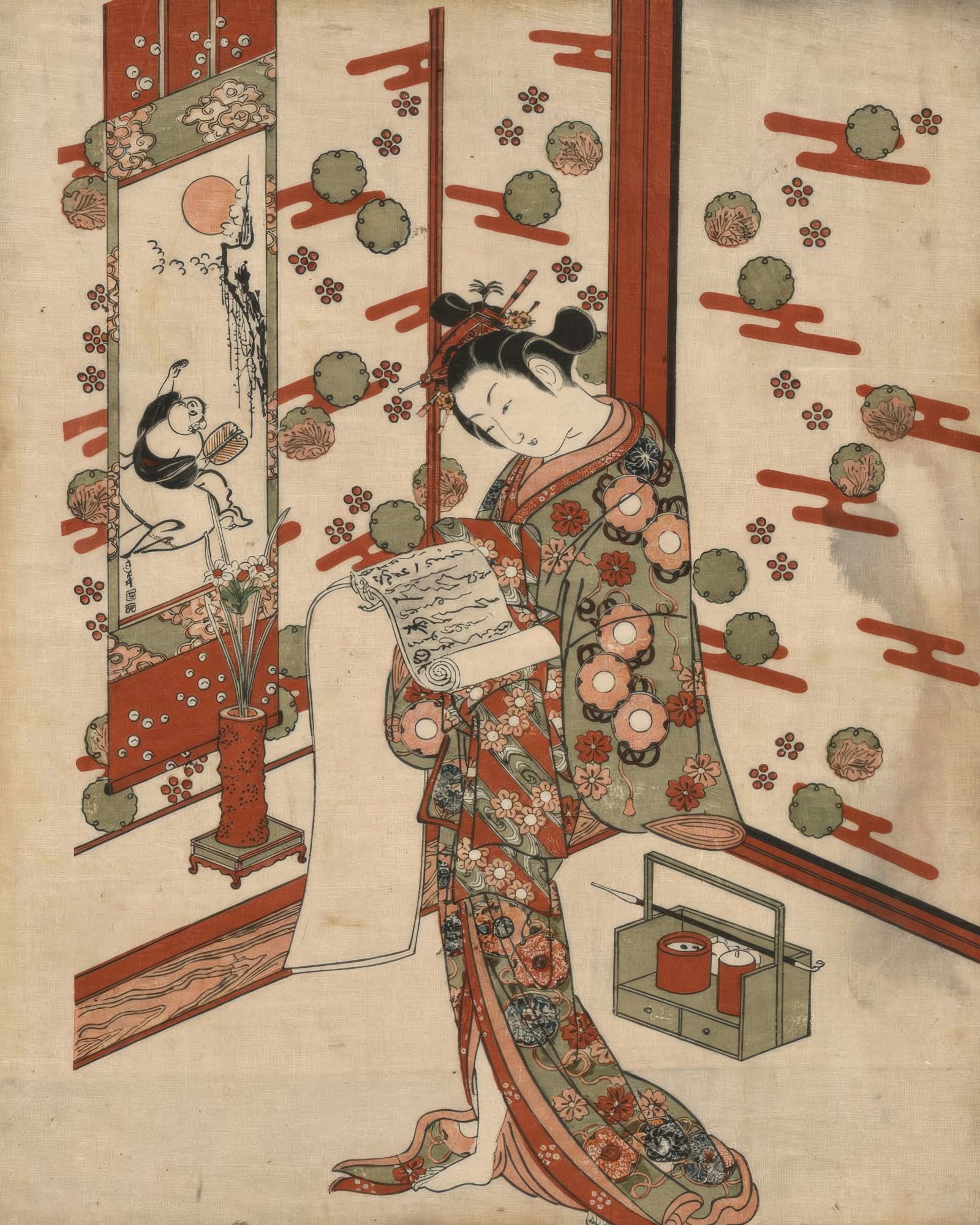
Beauty Reading a Letter — Ishikawa Toyonobu, c. 1758. Art Institute of Chicago. Restored by Surrealium at Vaxholm Fortress, Sweden.
The reader bends towards a narrow sheet while decorated screens establish the room around her. Her clothing supplies broad areas of pattern, but the small pale letter becomes the place where her attention gathers. Follow the angle of her head and hands before looking at the surrounding ornament; the composition makes reading visible through posture without needing to reveal a single sentence of the message.
2. D’Agesci: a pause over Heloise and Abelard

Lady Reading the Letters of Heloise and Abelard — Bernard d'Agesci, c. 1780. Art Institute of Chicago. Restored by Surrealium at Vaxholm Fortress, Sweden.
The woman has an open book at hand but turns her face away from its pages. The rich fabric, soft light and reclining pose make the pause as prominent as the act of reading. The title identifies the letters of Heloise and Abelard, yet the image still leaves room between a known literary subject and this particular reader’s response; we should not fill that space with an invented quotation or thought.
3. Hokusai: a book among patterned surfaces
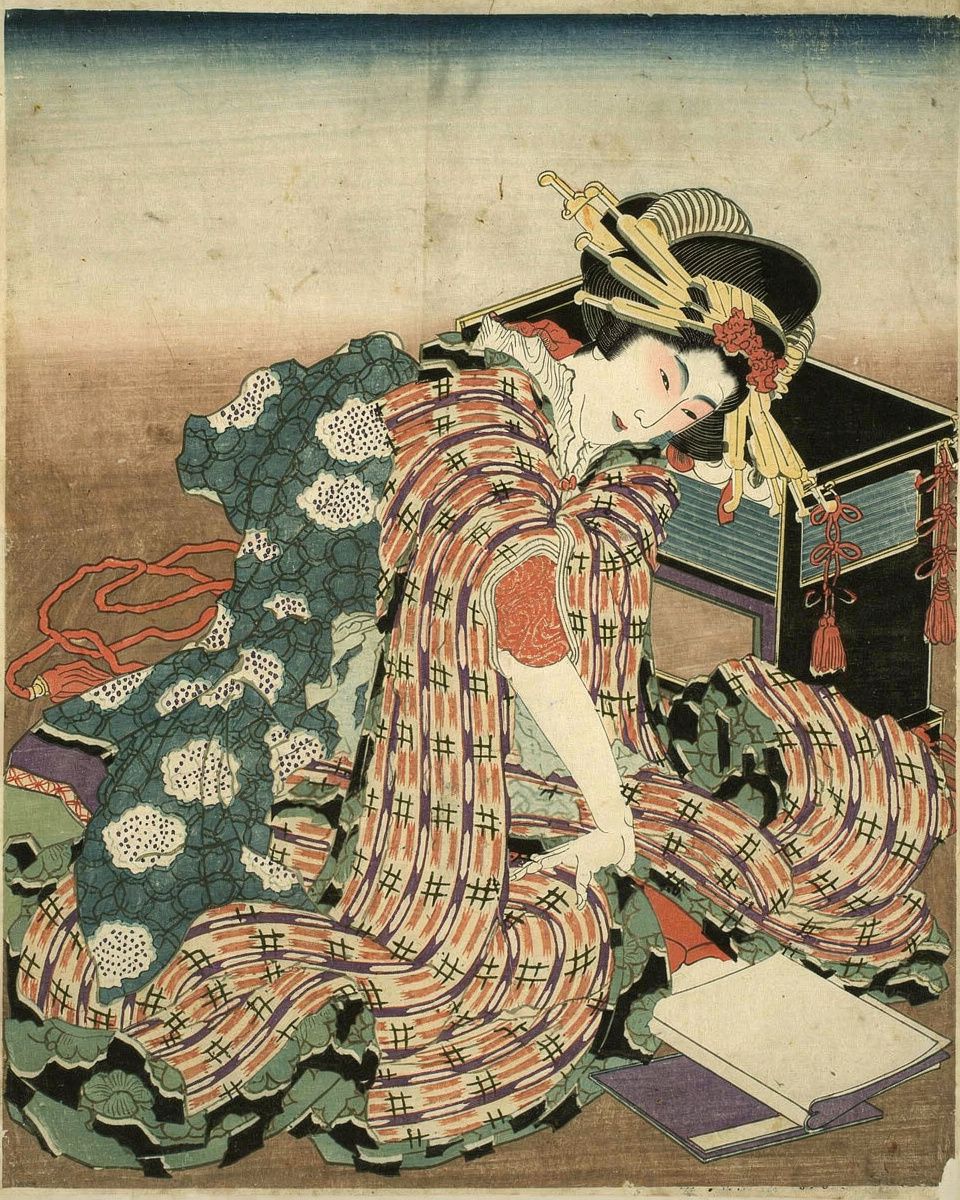
Young woman reading "The Pillow Book (makura no soshi)" — Katsushika Hokusai, 1822. Art Institute of Chicago. Restored by Surrealium at Vaxholm Fortress, Sweden.
Hokusai’s young reader leans over an open volume beside a low chest. Repeated patterns move across her robes and the objects around her, while the book creates a comparatively quiet shape among them. The title identifies The Pillow Book, inviting a connection with literature without requiring the viewer to reconstruct the exact passage; the visible pleasure is the concentration with which she occupies her small part of the room.
4. A poetry reader in a Chinese hanging scroll
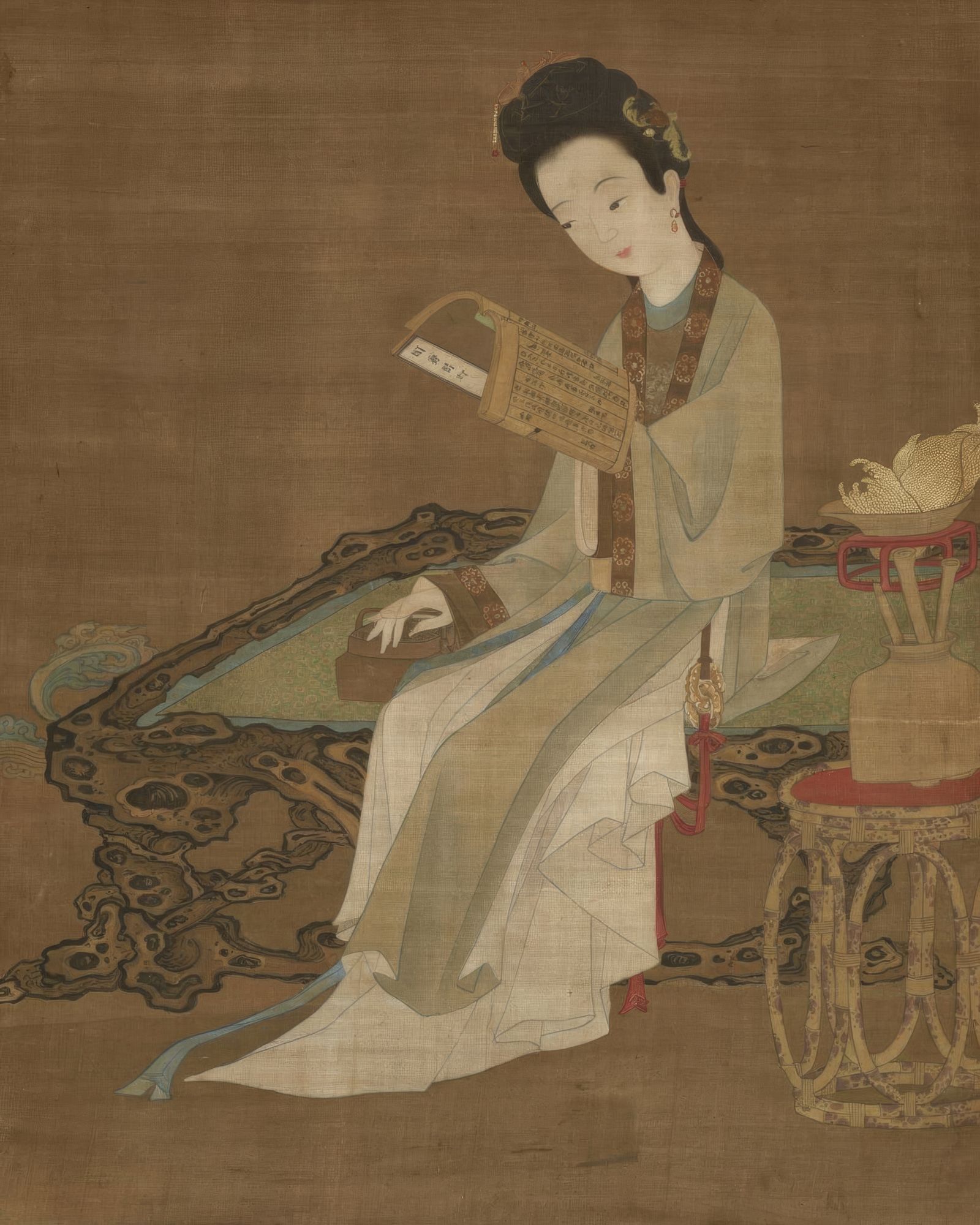
Young woman reading a book of poems — Traditionally attributed to Sheng Shiyan, 16th–17th century. Freer Gallery of Art, Smithsonian National Museum of Asian Art. Restored by Surrealium at Vaxholm Fortress, Sweden.
The figure sits beside a low table with her attention directed into a book. Sparse furnishings and the open space around her produce a different rhythm from the densely patterned Japanese interiors. The Smithsonian traditionally attributes this hanging scroll to Sheng Shiyan and dates it to the sixteenth or seventeenth century; that careful attribution belongs beside the image, rather than turning a collector’s name into the artist’s identity.
5. Harunobu: two readers sharing a room
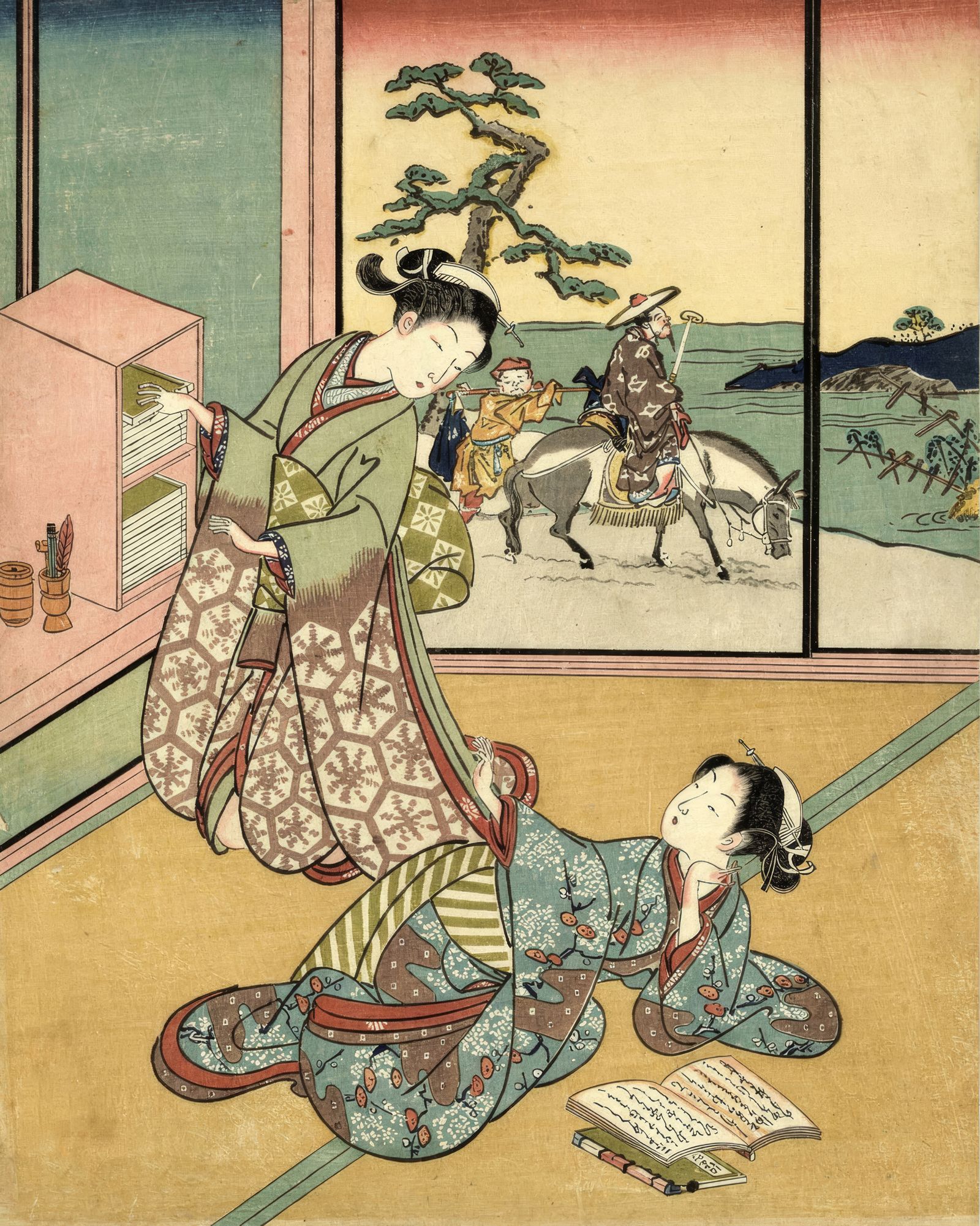
Two Young Women Reading Books — Suzuki Harunobu , c. 1767/68. Art Institute of Chicago. Restored by Surrealium at Vaxholm Fortress, Sweden.
Two women occupy an interior with open books and a screen behind them. Their separate postures allow us to consider reading as a shared setting even when attention remains individual. The scene does not require a conversation to link its figures: their proximity, the books and the surrounding architecture already establish a relationship, while leaving the precise nature of their companionship unspoken.
6. Toyonobu: a standing reader and a long letter
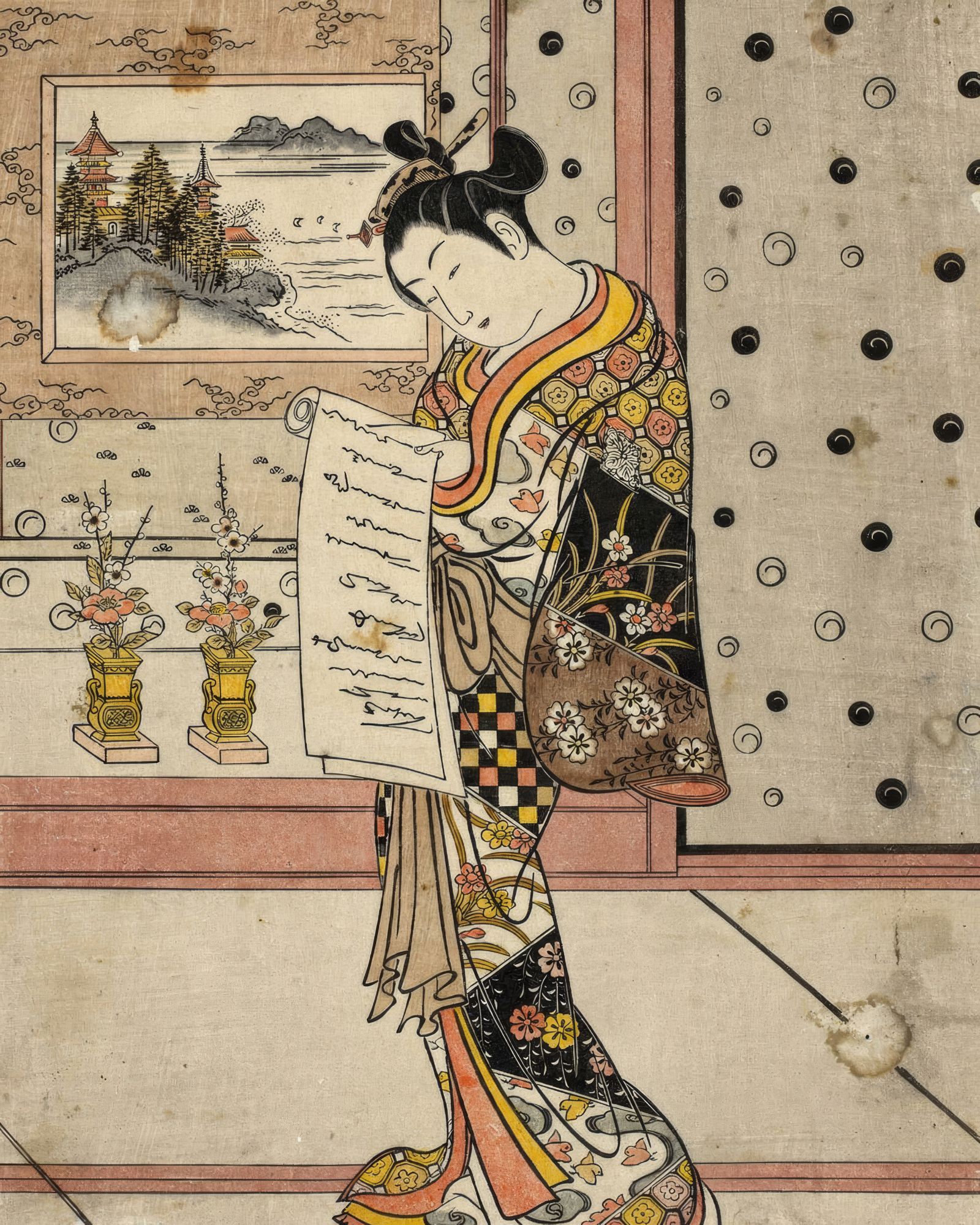
Courtesan Reading a Letter — Ishikawa Toyonobu, c. 1745. Art Institute of Chicago. Restored by Surrealium at Vaxholm Fortress, Sweden.
Here the letter unrolls in a standing figure’s hands, making its length part of the design. A hanging landscape behind her places another kind of image within the print, so the eye moves between a represented view and the narrow written surface. Compare this upright pose with the first Toyonobu reader: the subject remains close attention, but the body gives the act a different balance and scale.
7. Utamaro: a scroll across the floor
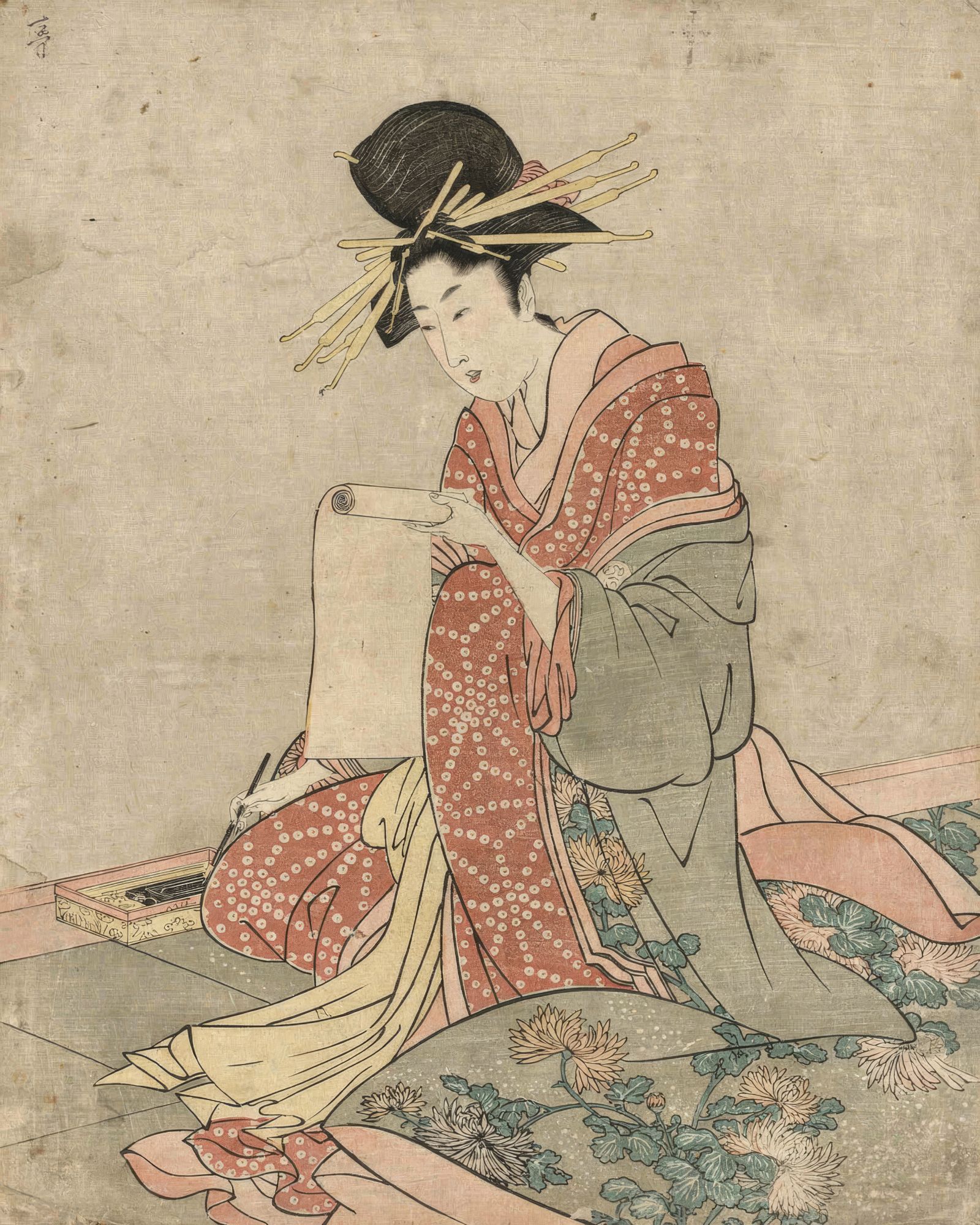
Woman of the Yoshiwara Reading Scroll — Kitagawa Utamaro, Undated, before 1806. Cleveland Museum of Art. Restored by Surrealium at Vaxholm Fortress, Sweden.
The woman leans forward over a scroll, her sleeves spreading around the gesture. Rather than holding a compact book near her face, she follows a longer surface in the space before her. That difference makes the material form of reading unusually clear: a scroll asks the body to move and organise its surroundings differently, even though we cannot recover this reader’s experience from the pose alone.
8. Larsson: Lisbeth behind the flowers
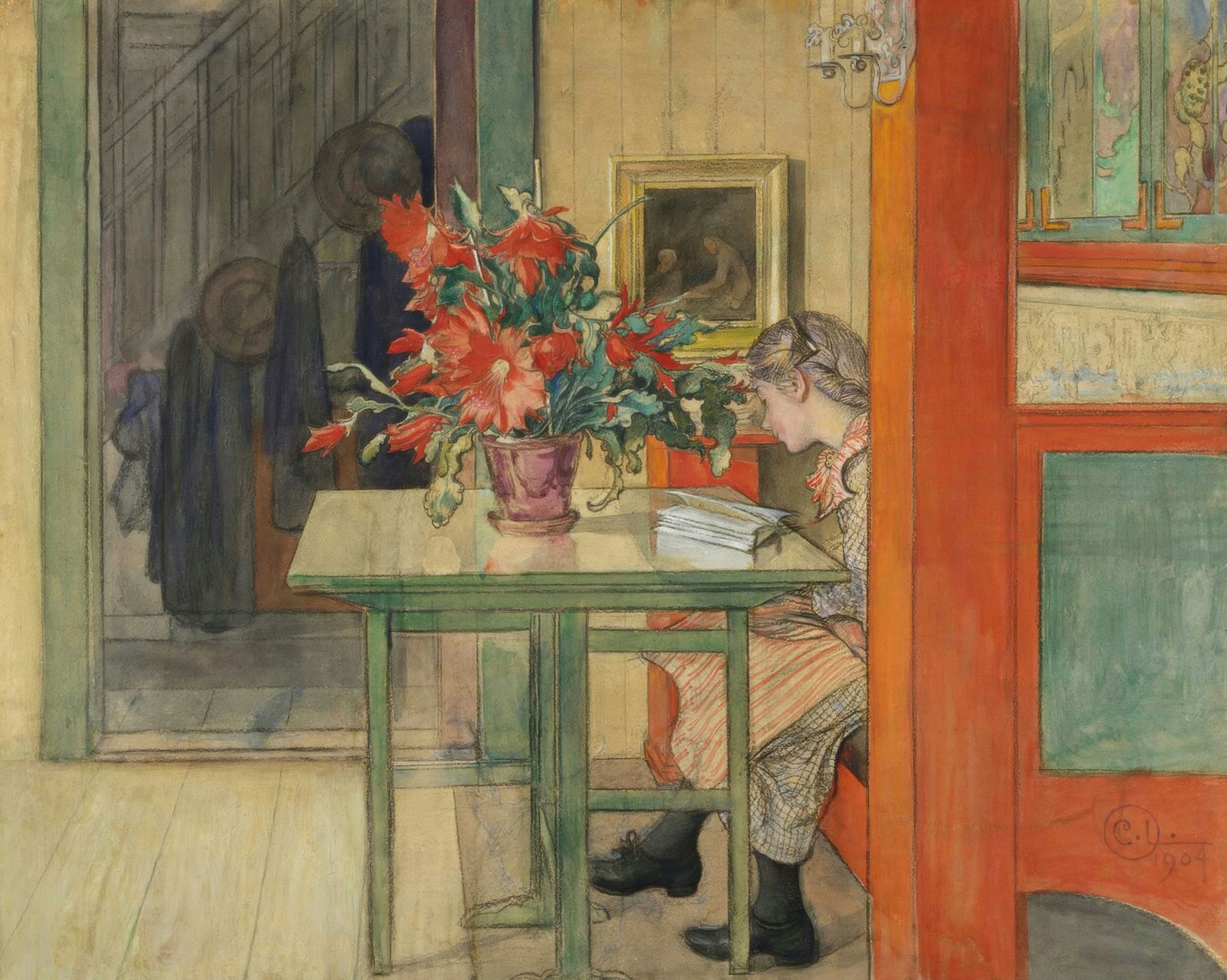
Lisbeth Reading — Carl Larsson, 1904. Nationalmuseum, Stockholm. Prepared for print by Surrealium at Vaxholm Fortress, Sweden.
Lisbeth reads at a green table, with red flowers occupying the near edge of the room. The plants do not erase her activity; they make us look past an ordinary domestic foreground towards it. Larsson’s 1904 watercolour offers a later example of the theme, where furniture, colour and a familiar interior surround the reader without turning the book into a ceremonial emblem of education or status.
9. Utamaro: a folded message and a fan
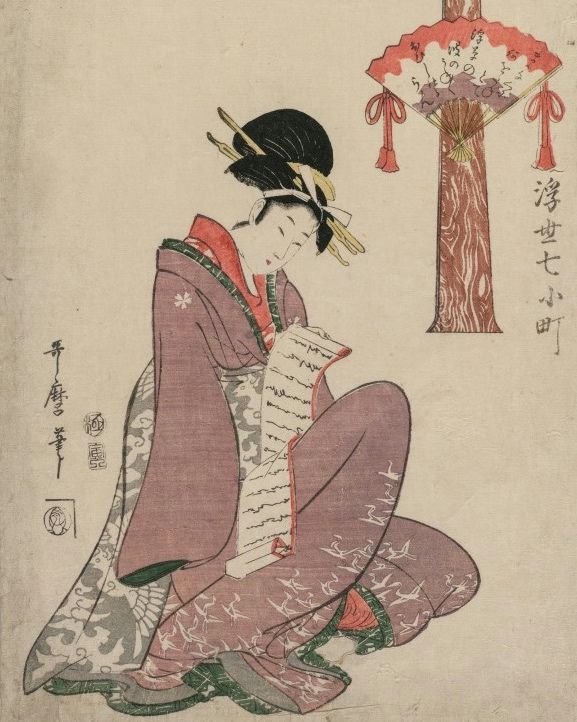
Woman Reading a Letter — Kitagawa Utamaro, 1806. Cleveland Museum of Art. Restored by Surrealium at Vaxholm Fortress, Sweden.
A seated woman studies a folded letter beneath a decorative fan. The small white paper interrupts the patterns of her clothing and becomes legible as the focus of the scene even at a distance. Compare it with the longer scroll: reading can be shown through a compact hand gesture as well as through a broad bodily movement, and the artist can make either feel visually complete.
10. Harunobu: the writer at the other end
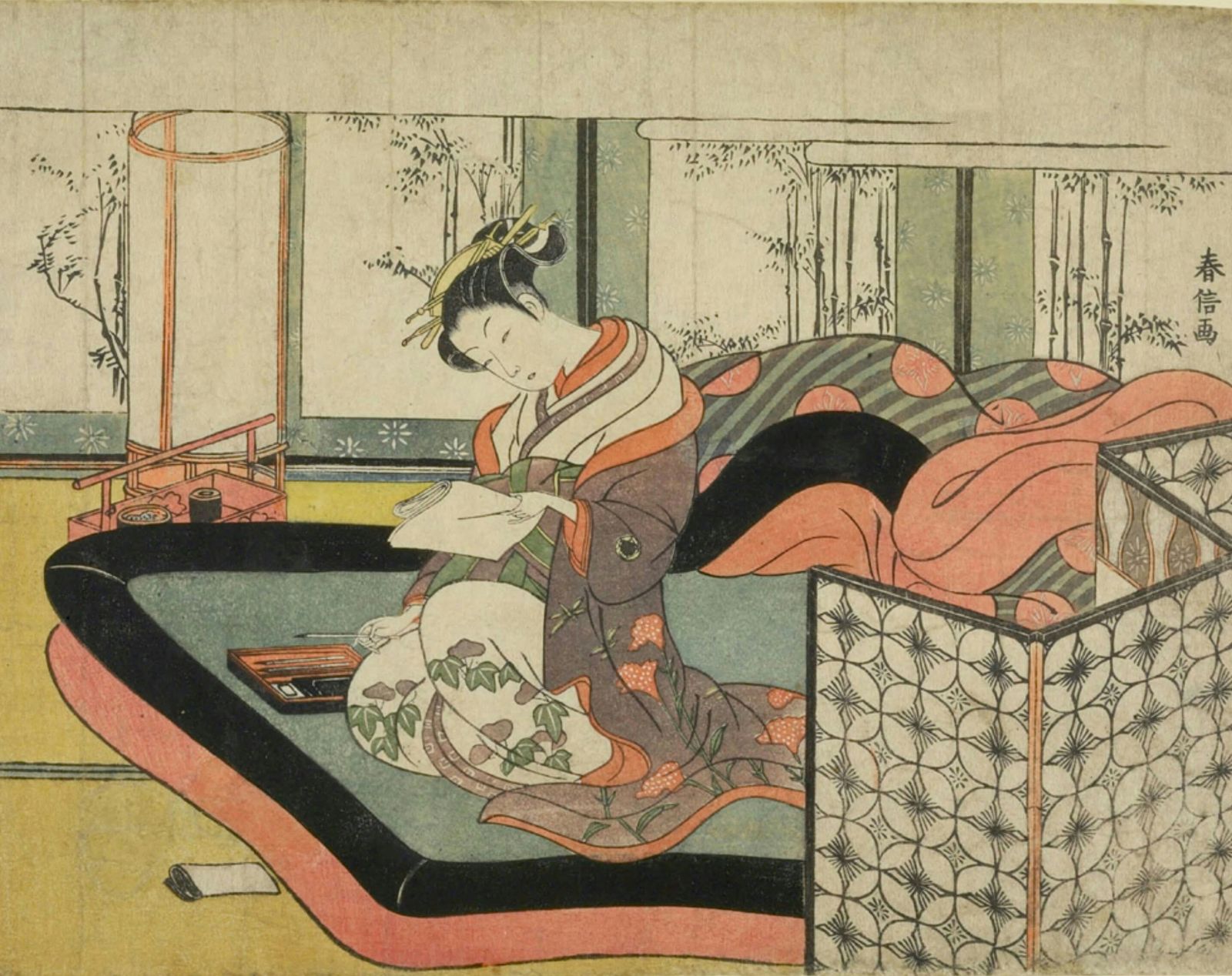
Writing a Love Letter in Bed — Suzuki Harunobu, Edo period, circa 1765-1770. Harvard Art Museums. Prepared for print by Surrealium at Vaxholm Fortress, Sweden.
The final print changes the action: a woman writes while reclining beneath a padded coverlet. It is a comparison with the readers above, not another example of someone looking into a book. The soft bedding and extended hand bring the preparation of a message into the same intimate territory, reminding us that a painted reader often holds the absent work of another person.
Consider whether they prefer shared reading, solitude, decorative interiors or the visual character of a printed line. Compare these with famous portrait paintings before choosing a picture simply because it contains a book.
Before choosing, compare the space each work gives its reader. D’Agesci surrounds a pause with luxurious fabric; the poetry scroll makes emptiness important; Larsson places reading among flowers and furniture. A picture for a book lover can acknowledge those preferences more precisely than a generic image of a stack of books. Follow the individual work into Masterworks to consider the whole composition, including the margins and surroundings that make the act of reading feel particular.
- Are all ten works paintings?
- No. Several are woodblock prints, and the final image shows writing rather than reading. Their inclusion makes the exchange between writer, text and reader visible across different artistic media.
- Can we identify what each woman is reading?
- Sometimes the title supplies a book, as with Hokusai’s reader of The Pillow Book. Elsewhere only the format is clear. A letter in a picture does not by itself tell us the sender, contents or reader’s feelings.
- How can I choose one for a book lover?
- Think about how the recipient likes to read: in company, alone, at a desk or outdoors. Then compare the atmosphere of the pictures, rather than choosing by the presence of a book alone.