Arcimboldo: five faces and five still-life comparisons
Arcimboldo turns fruit, flowers and books into people. Look at five composite heads, then five clearly labelled still-life comparisons.
Arcimboldo makes recognition change while you look. A face appears, then breaks into fruit, flowers, books or other objects; the parts do not stop being themselves when they become a person. Five composite heads below show that double reading. Five still lifes by other artists follow as comparisons, allowing us to see what changes when similar objects remain objects rather than becoming anatomy.
Giuseppe Arcimboldo, who lived from 1526 to 1593, worked for the Habsburg court and returned to Milan late in his career. His unusual heads belong to a world of courtly invention and display, not simply to a modern category of visual puzzles. Compare them with famous portrait paintings, or with the different forms of likeness in our royal portrait story. The complete works are available to explore in the Renaissance collection. Start far enough away to see the head, then move closer to inspect its ingredients.
1. The Jurist — an uncomfortable likeness
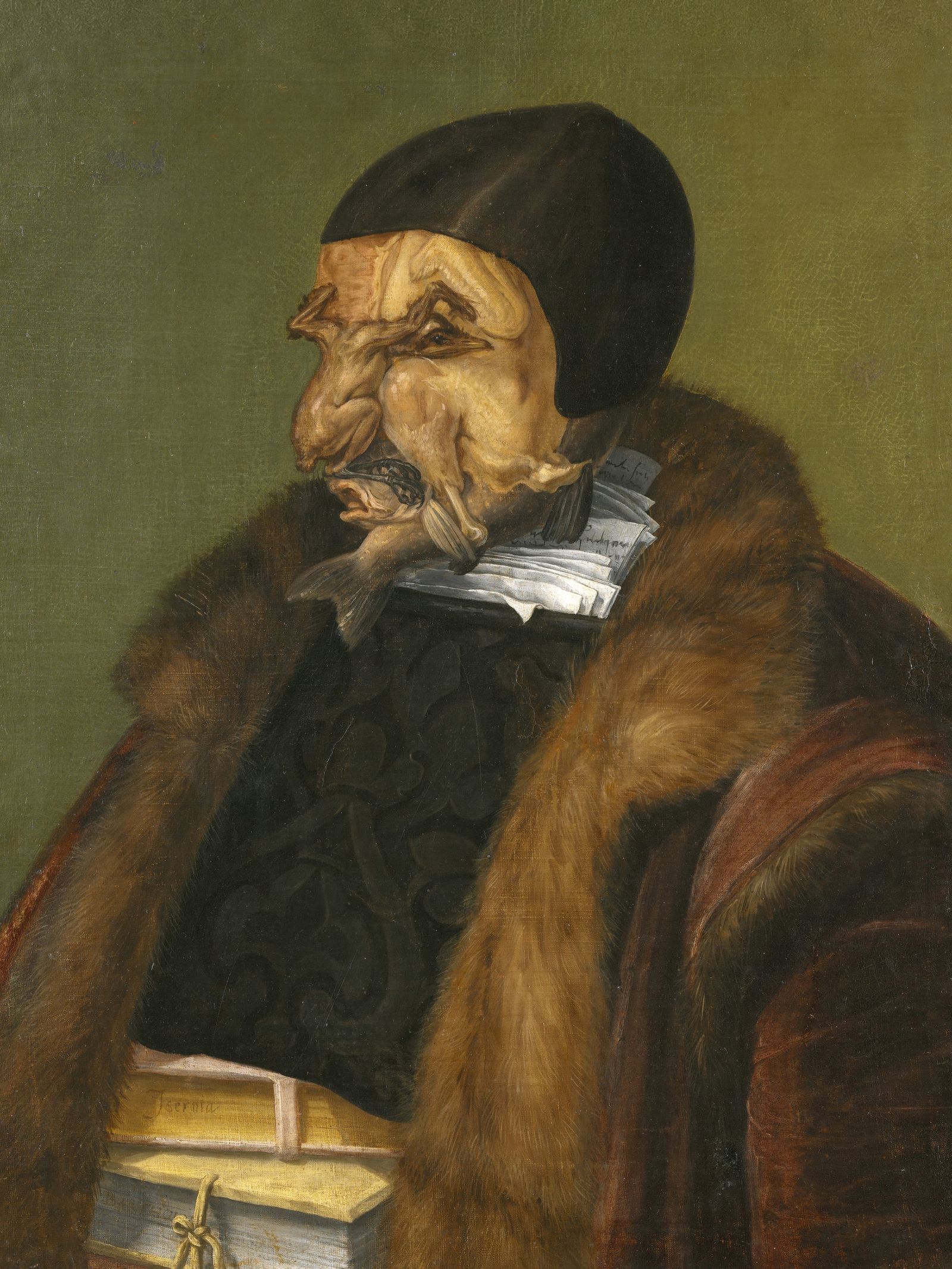
The Jurist · Giuseppe Arcimboldo, 1566 · Nationalmuseum, Stockholm. Prepared for print by Surrealium at Vaxholm Fortress, Sweden.
The Jurist assembles a figure from objects and bodily-looking materials that make the portrait deliberately disconcerting. Recognition does not settle into a flattering face: the viewer keeps noticing the individual components and their uneasy relation to the human shape. That discomfort is part of the work’s effect, so it is worth resisting the urge to describe every composite head as merely whimsical or cheerful. Look at the difference between the face and the clothing, and consider how the choice of ingredients changes the social character of the person we imagine.
2. Spring — a profile built from flowers
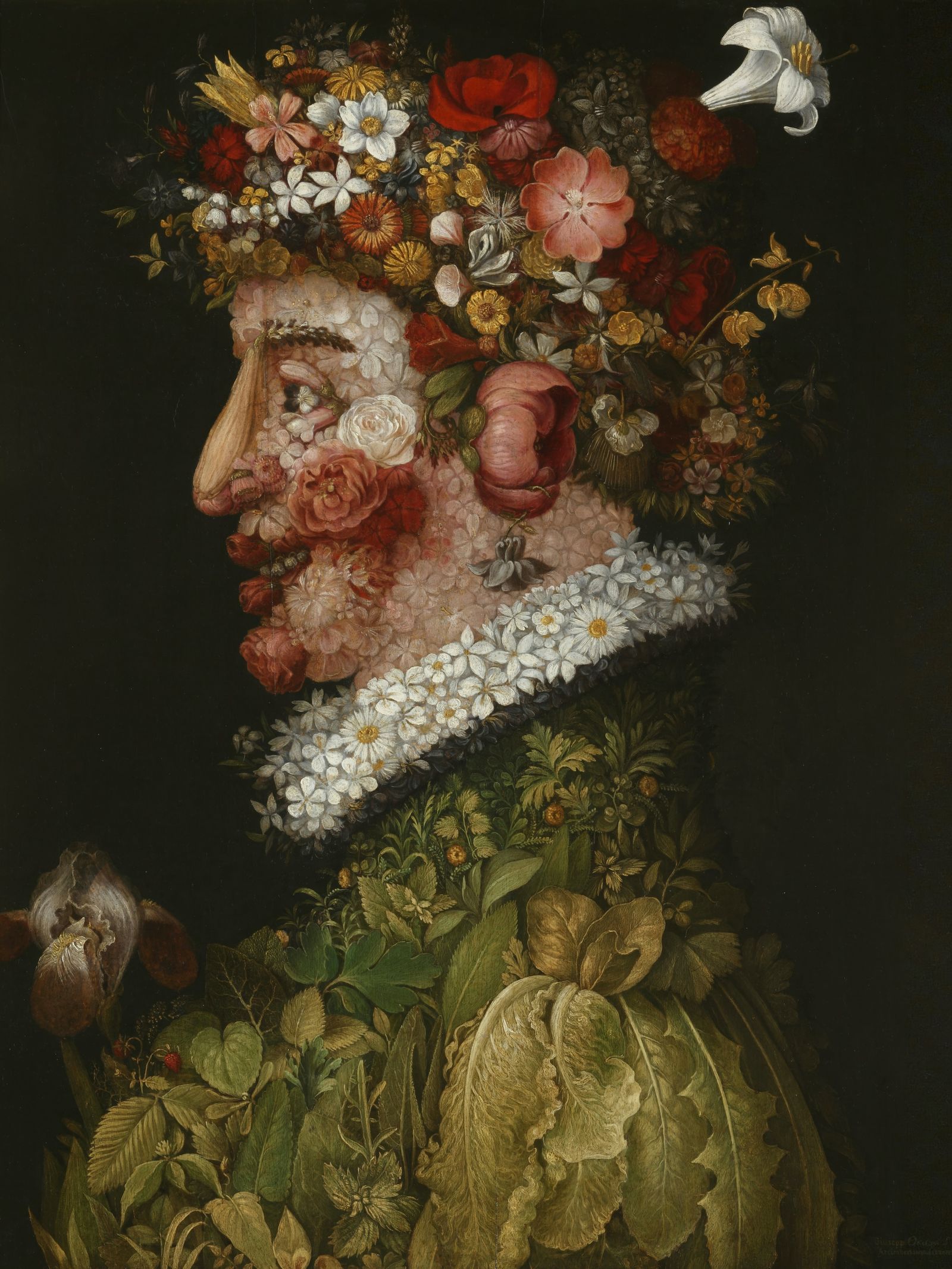
Spring · Giuseppe Arcimboldo, 1563 · Real Academia de Bellas Artes de San Fernando, Madrid. Prepared for print by Surrealium at Vaxholm Fortress, Sweden.
Flowers supply both colour and anatomy, accumulating into a profile that remains readable even as individual blooms attract attention. The result depends on arrangement as much as abundance: a mass of flowers would not become a face without a controlled outline and carefully placed features. Try tracing that outer contour before identifying any species, then return to the different scales of the blossoms within it. The painting offers a useful lesson in how a strong overall shape can organise an intricate surface without making every small element equally prominent.
3. The Librarian — knowledge becomes a body
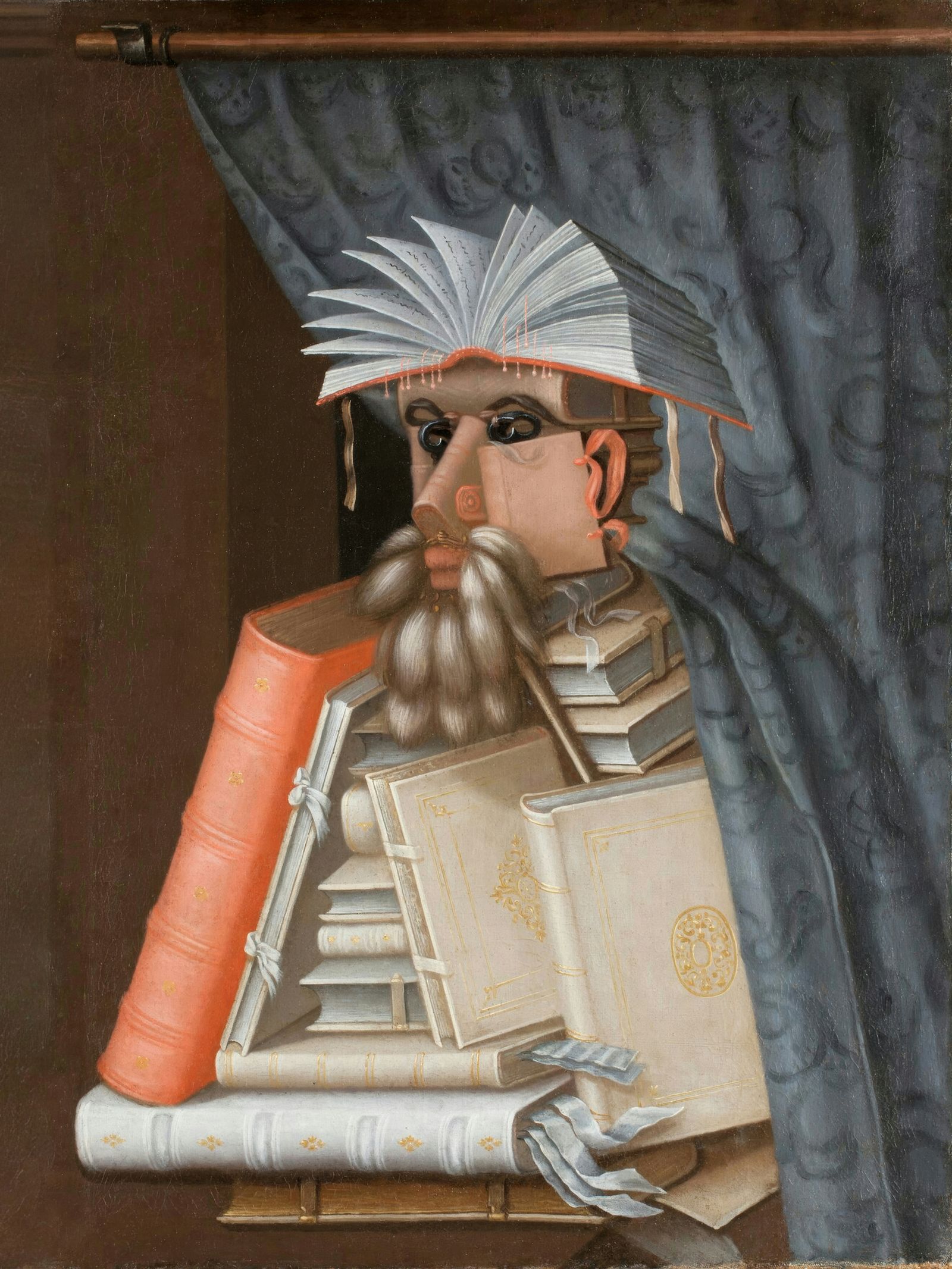
The Librarian · Giuseppe Arcimboldo, c. 1566 · Skokloster Castle. Prepared for print by Surrealium at Vaxholm Fortress, Sweden.
Books and associated objects take on the work of head, clothing and gesture, making a human figure out of the materials connected with a role. The joke depends on our ability to see both the person and the piled things at once, without resolving the image permanently into either reading. It also raises a sharper question about whether someone can become identified with possessions or a profession. The graduation gifts guide considers this picture from a different angle: as a possible gift for someone who enjoys its particular kind of bookish humour.
4. Vertumnus — Rudolf II as seasonal abundance
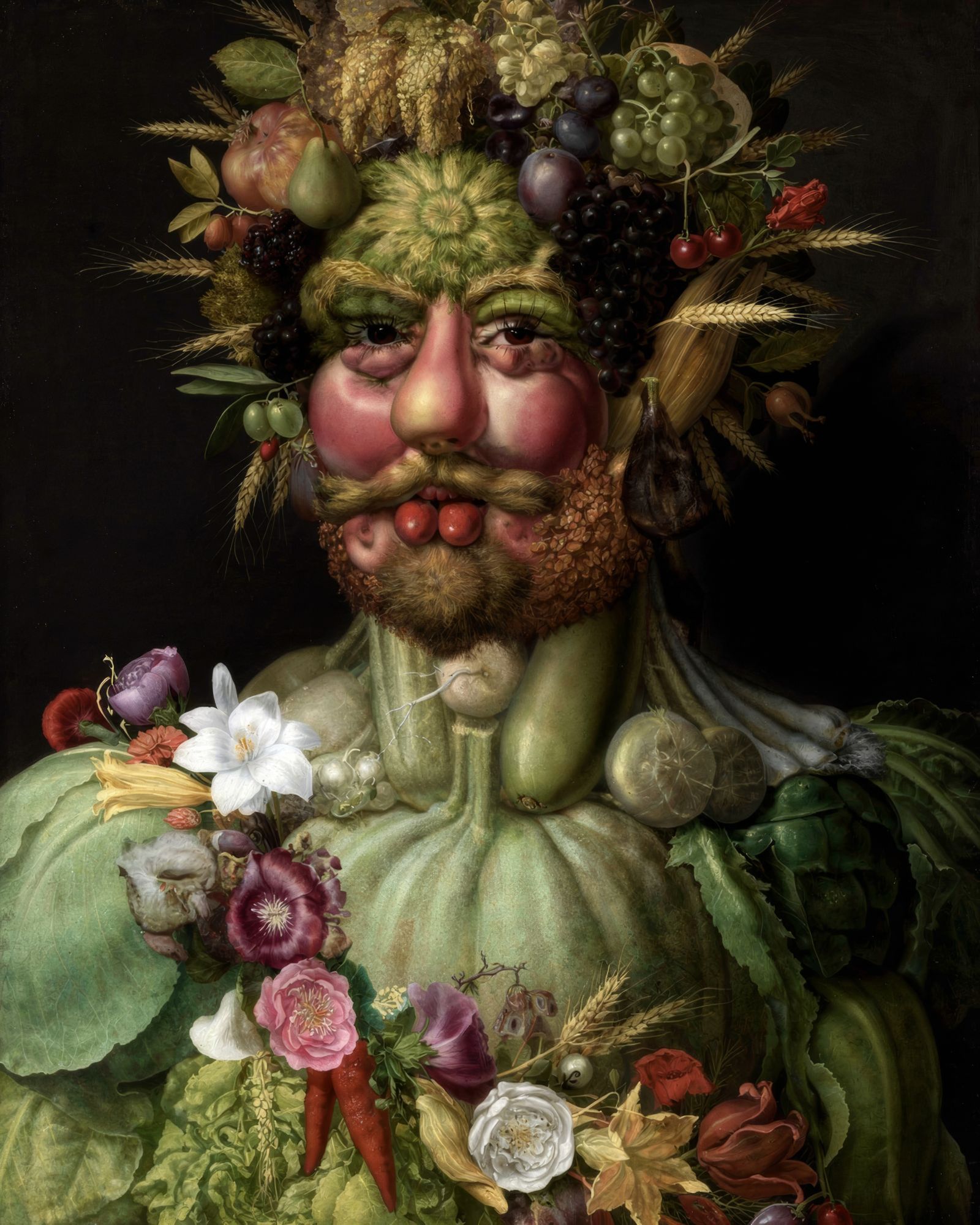
Vertumnus (Rudolf II) · Giuseppe Arcimboldo, 1591 · Skokloster Castle. Prepared for print by Surrealium at Vaxholm Fortress, Sweden.
Fruit, vegetables and flowers form the emperor Rudolf II in the guise of Vertumnus, the Roman deity associated with seasonal change. The portrait’s extraordinary abundance is therefore tied to a named ruler and a particular mythological presentation, not to an anonymous person made from whatever happened to be in a kitchen. Notice how the ingredients give volume to the face while retaining their separate textures and colours. The composition lets imperial display and visual invention reinforce one another, even as a modern viewer may first encounter it as an astonishing face made of produce.
5. Four Seasons in One Head — time gathered together
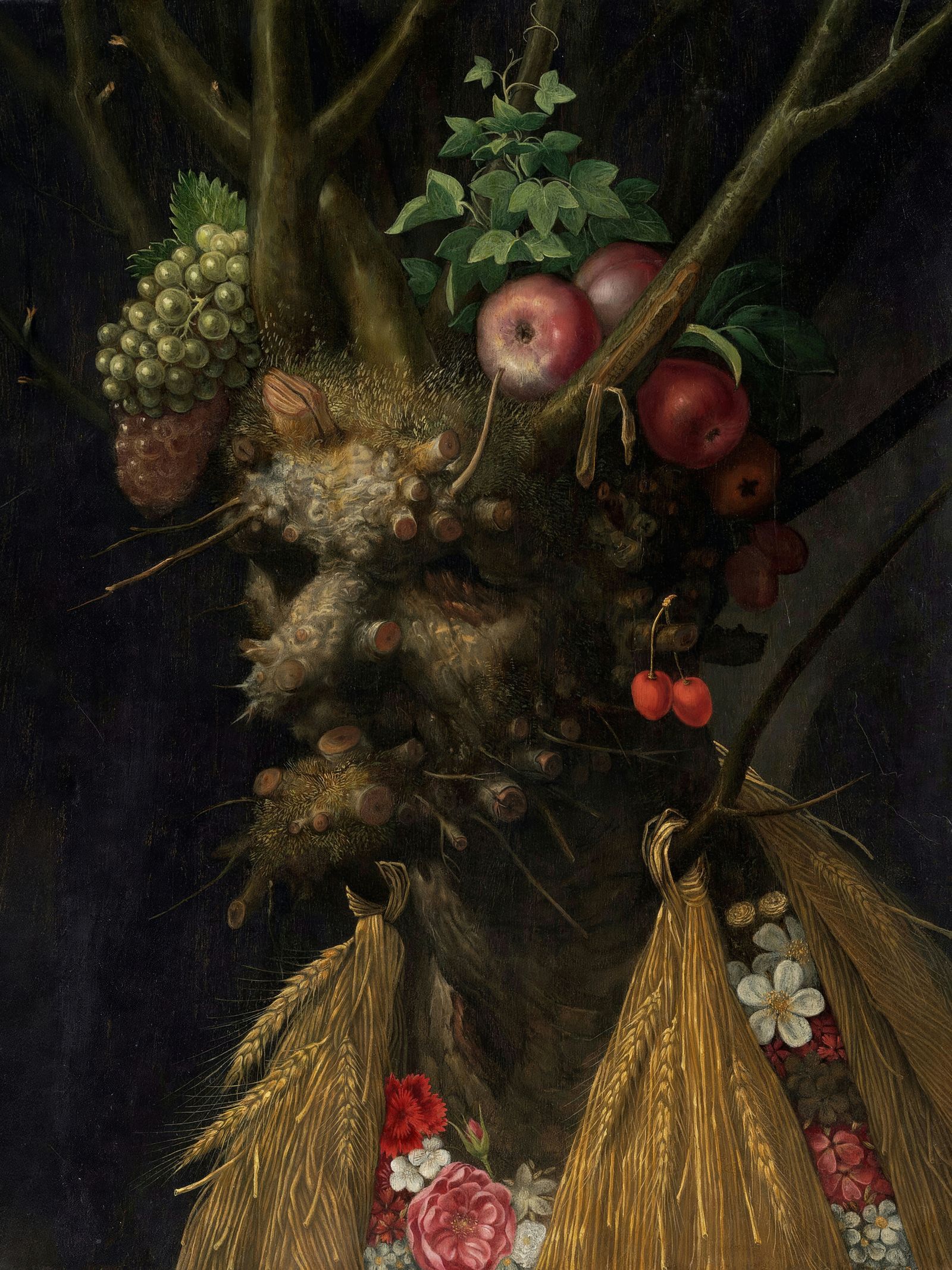
Four Seasons in One Head · Giuseppe Arcimboldo, c. 1590 · National Gallery of Art, Washington. Prepared for print by Surrealium at Vaxholm Fortress, Sweden.
An aged, tree-like head gathers signs of different seasons into a single figure, bringing change into a form that appears rooted and enduring. Its rougher surfaces create a different impression from the lush fullness of Vertumnus or the floral density of Spring. Compare the ways the eye, mouth and outline emerge from their materials, because the same basic trick can produce very different feelings. The title also encourages a reading across time: separate moments of growth and decline are held together instead of being presented as four independent pictures.
6. Comparison: flowers, a snail and insects — Joris Hoefnagel
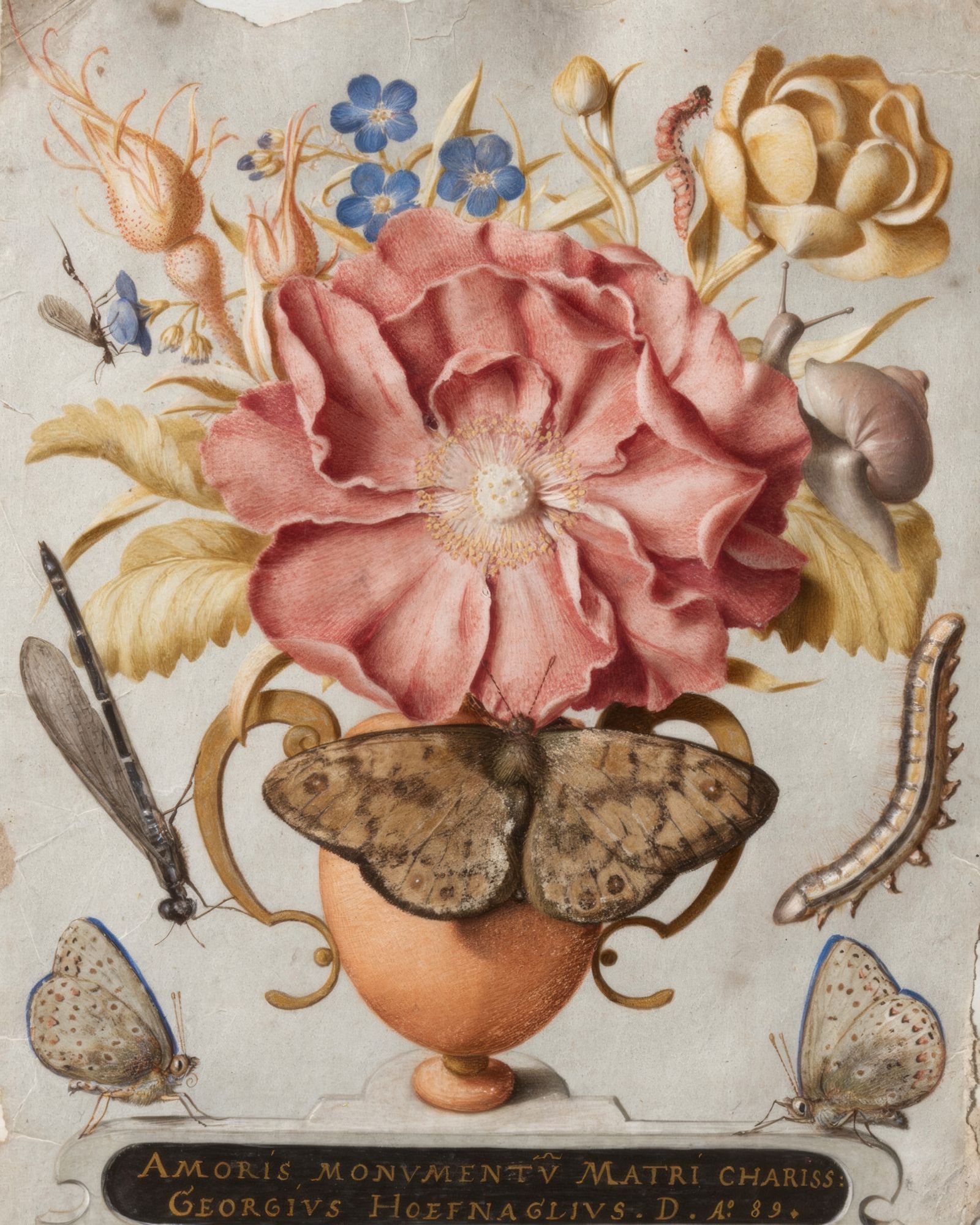
Still Life with Flowers, a Snail and Insects · Joris Hoefnagel, 1589 · The Metropolitan Museum of Art. Prepared for print by Surrealium at Vaxholm Fortress, Sweden.
Hoefnagel’s small natural forms remain flowers and creatures rather than assembling themselves into a human likeness. Their precision offers a useful counterpoint to Arcimboldo, whose components must serve two identities at once. Look at how an insect or a stem can attract attention without being required to stand for an eyebrow, a cheek or a mouth. The comparison helps explain why detailed observation alone does not create a composite portrait: Arcimboldo’s additional work lies in making a second coherent image emerge from the observed things.
7. Comparison: Fruit and Flowers — Orsola Maddalena Caccia
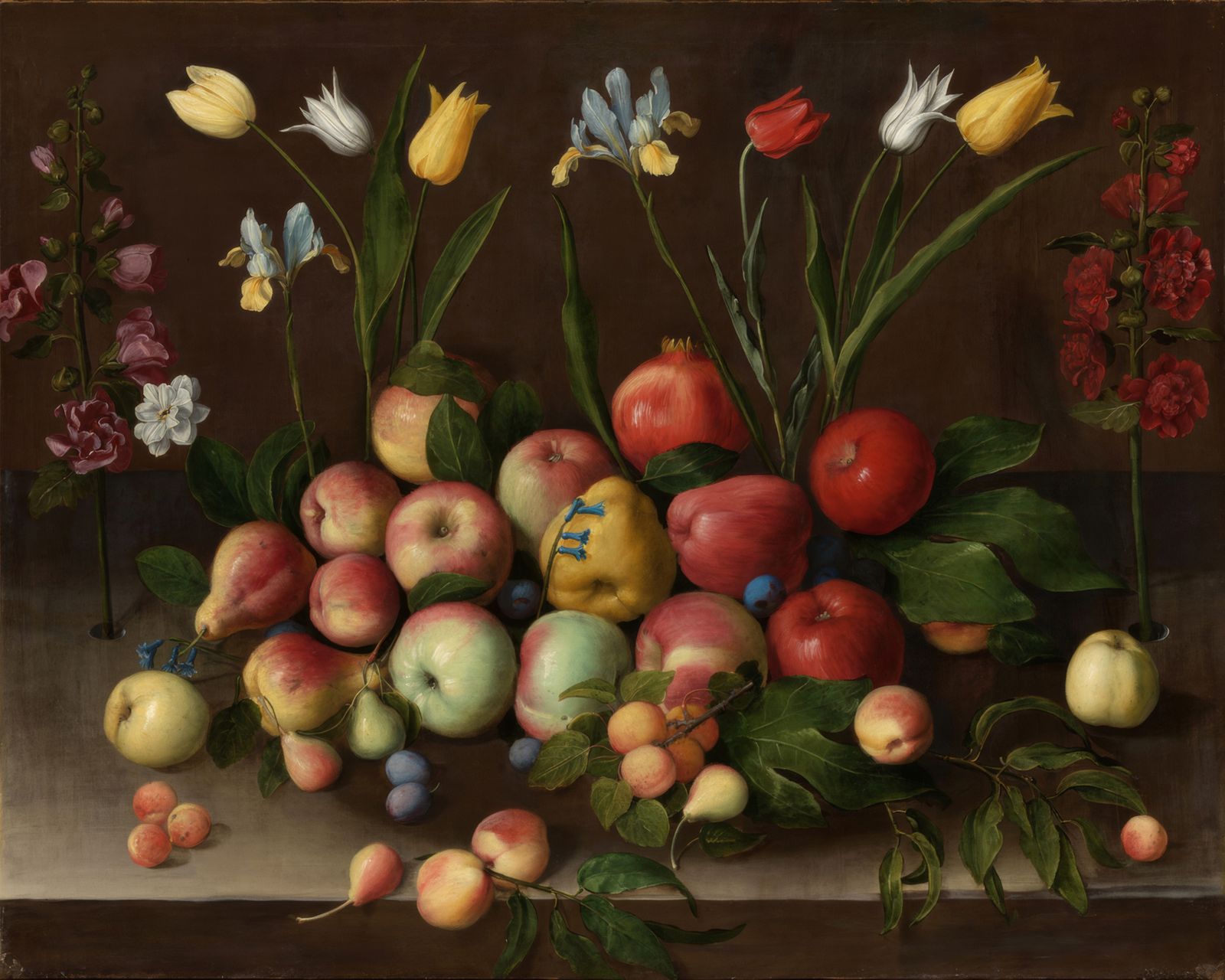
Fruit and Flowers · Orsola Maddalena Caccia, ca. 1630 · The Metropolitan Museum of Art. Prepared for print by Surrealium at Vaxholm Fortress, Sweden.
Caccia arranges fruit and flowers as a display with its own balance, allowing botanical forms to establish rhythm without turning into a person. The eye can move among separate clusters and stems rather than being pulled repeatedly back to a face. Beside Arcimboldo’s seasonal heads, this makes the difference between abundance as subject and abundance as anatomy especially clear. It is also a reminder that a still life can be inventive and highly organised while asking us to look at objects directly, without solving an additional visual riddle.
8. Comparison: a porcelain bowl — Juan de Zurbarán
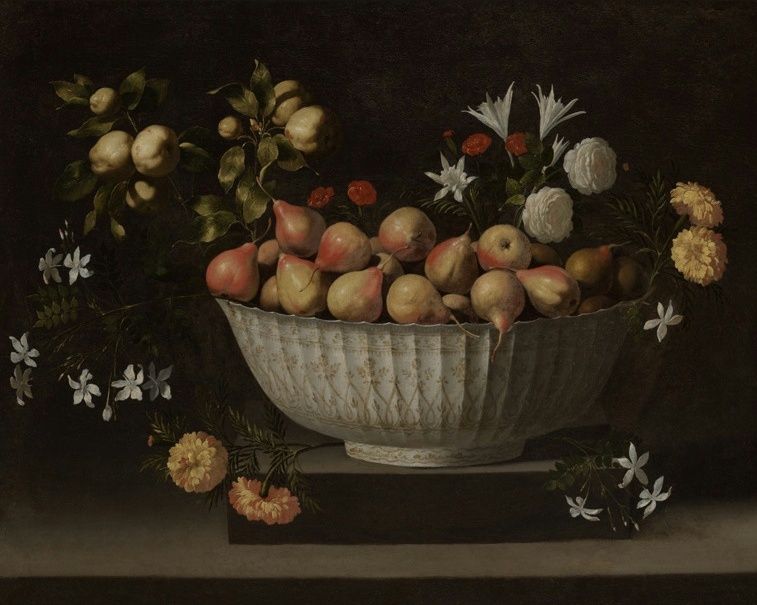
Flowers and Fruit in a Porcelain Bowl · Juan de Zurbarán, c. 1645 · Art Institute of Chicago. Prepared for print by Surrealium at Vaxholm Fortress, Sweden.
The bowl provides a stable centre for flowers and fruit, giving the arrangement a physical support that a composite face usually has to disguise. Differences between the vessel’s surface and the organic forms become part of the painting’s interest. Compare that straightforward relation between container and contents with the way Arcimboldo makes a pear or blossom occupy a place in an imagined body. Here the objects can retain their own scale and weight, allowing the viewer to enjoy a material arrangement without continually switching between two competing interpretations.
9. Comparison: fruit and asparagus — Louise Moillon
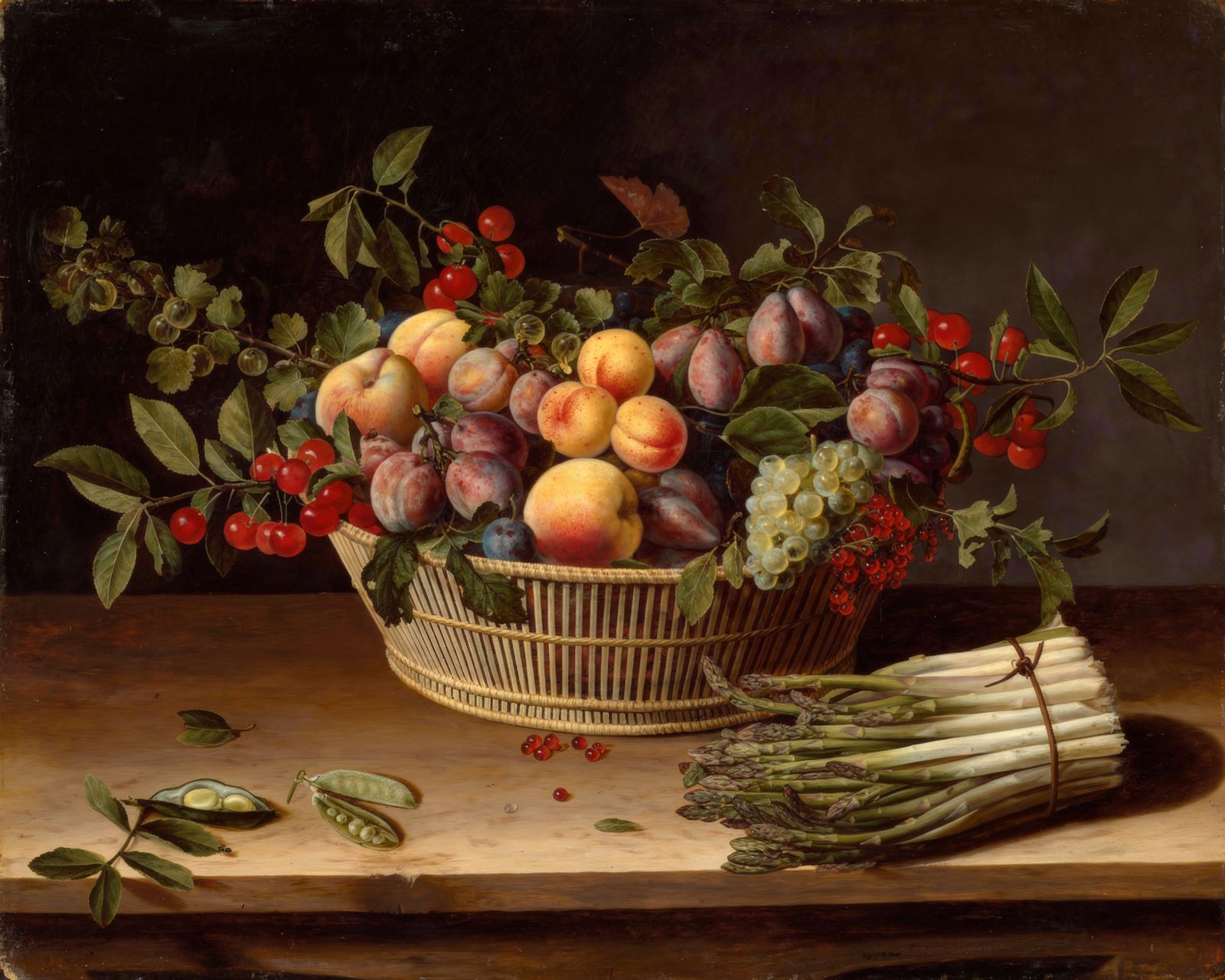
Still Life with Fruit and Asparagus · Louise Moillon, 1630 · Art Institute of Chicago. Prepared for print by Surrealium at Vaxholm Fortress, Sweden.
Moillon’s basket and asparagus give familiar produce a composed, substantial presence. The arrangement makes texture, ripeness and the meeting of surfaces worth attending to, rather than treating fruit as a vocabulary that must encode a human feature. Put it beside Vertumnus and notice how strongly the expectation of a face changes the way you read similar kinds of material. A round form that remains simply fruit in a still life can become a cheek elsewhere, but that change comes from the whole composition rather than from the object alone.
10. Comparison: a spray of flowers — Rachel Ruysch
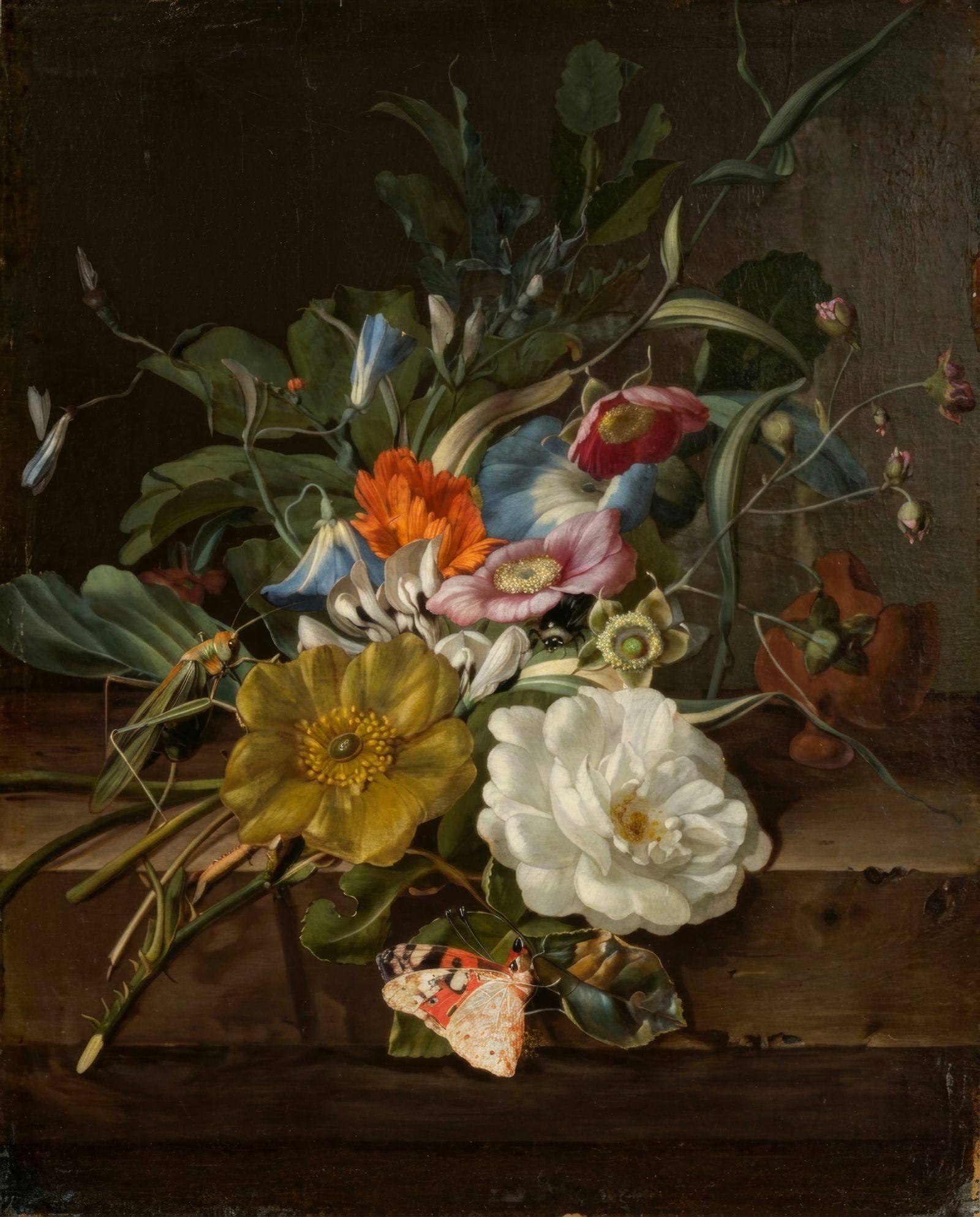
A still-life with a spray of flowers · Rachel Ruysch, ca. 1685-1700 · Victoria and Albert Museum. Prepared for print by Surrealium at Vaxholm Fortress, Sweden.
Ruysch gives flowers a structure of stems, openings and overlapping forms that directs attention through the arrangement. The work makes a useful final comparison with Spring because both paintings depend on many small botanical shapes, yet their larger organising forms differ. One asks flowers to become a profile; the other lets the bouquet develop its own movement and balance. If you prefer a picture whose detail unfolds without repeatedly returning to a human face, this comparison may help clarify why a still life appeals more strongly than a composite portrait.
Look at each head twice: once as a person, once as a collection of things. Then ask which details refuse to stay in only one reading. Compare that instability with the softened forms in George Inness’s landscapes or the measured colour in Whistler’s pictures. Each artist makes recognition depend on the whole arrangement. Explore the complete pictures in Masterworks.
- Are all ten works by Arcimboldo?
- No. Five composite heads are by Arcimboldo. The remaining five works are explicitly labelled still-life comparisons by other artists.
- Is Vertumnus a portrait of a real person?
- Yes. It represents Emperor Rudolf II through the figure of Vertumnus, using seasonal produce and flowers to construct the likeness.
- How should I begin looking at a composite head?
- Start with the whole silhouette and the position of the features. Then inspect the individual objects and watch how they continue to read as themselves within the face.