Christmas card photo ideas from four family paintings
Twelve simple photo ideas for your Christmas card, and four family paintings that show why a shared setting and clear faces work.
The best Christmas card photo ideas are simple: a familiar place, a small shared activity, soft window light and every face clearly visible. You do not need matching jumpers or a studio set. Here are twelve ideas to try, then four family paintings that show why they work.
12 Christmas card photo ideas
- Everyone on the sofa, close together, with the tree in soft focus behind.
- Decorating the tree, one person on tiptoe, someone handing up a bauble.
- On the doorstep in coats, as if just home from a winter walk.
- Around the table before a Christmas meal, faces turned to the window light.
- Reading together, a child on a lap and an open book between you.
- A walk in the snow or frost, photographed from the front so faces stay clear.
- The dog at your feet, sitting naturally, not dressed up. More in our dog Christmas cards guide.
- Three generations, grandparents seated, everyone else standing behind.
- Playing music or a game, as the de Hooch family below does.
- Christmas morning in pyjamas, by the tree in daylight, before the wrapping paper.
- The two of you at the window, for a couple's card.
- A garden or park you love, which matters more than any prop.
Whichever you choose, take a few photos in daylight, check the eyes are sharp, and keep the session short. Then paint the photo into a Christmas scene and see the card in a free preview.
The four works in this guide are not photography instructions from their artists or examples of customer results. They are visual references for making decisions about your own image. Choose the people and the intended card format first, allow enough light for recognisable faces and keep the session short enough that a real expression survives. The Christmas mood can come from the greeting as well as from the photograph.
For a related starting point, read choose a photo for your portrait, family portrait photo guide.
Use a familiar place
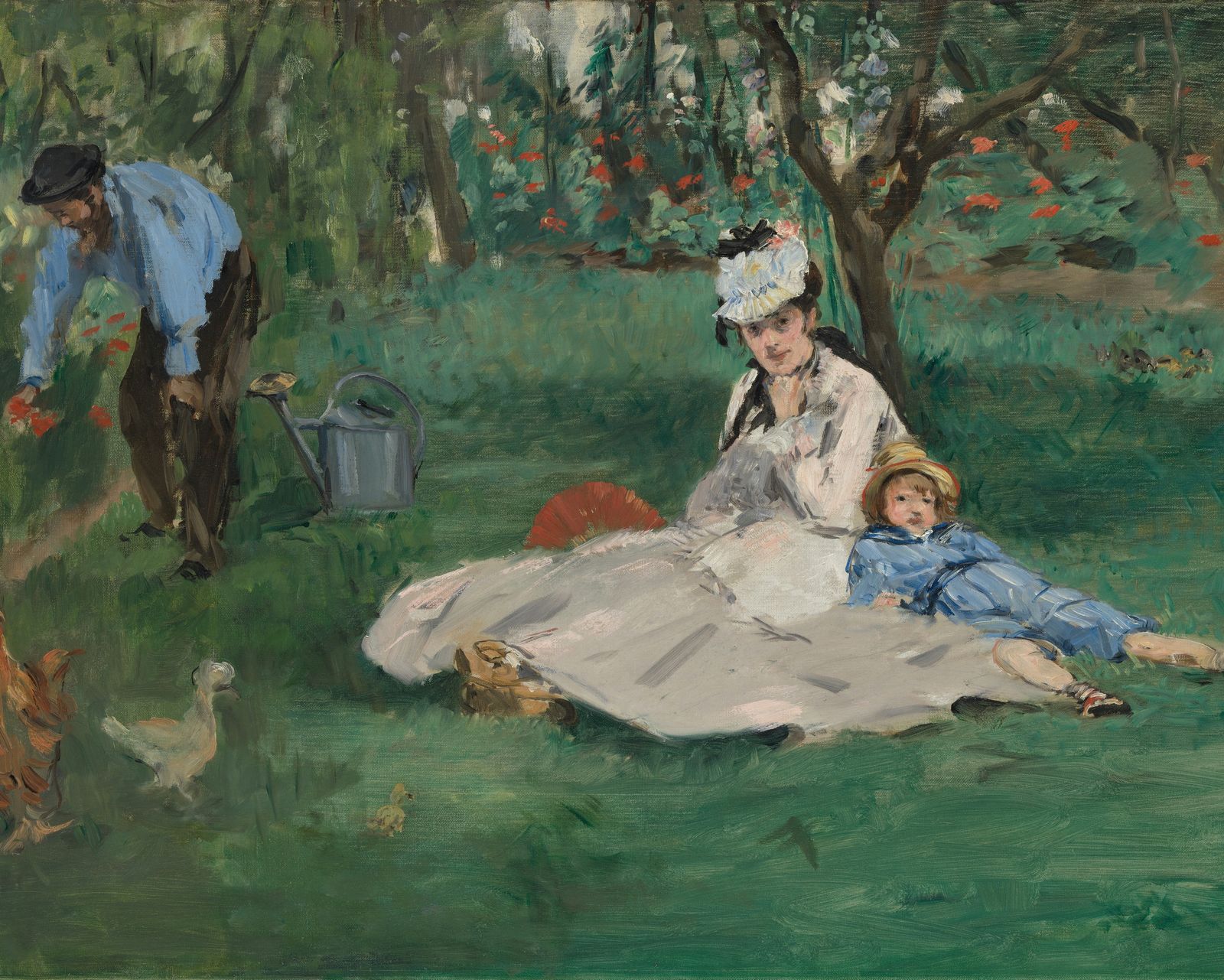
The Monet Family in Their Garden at Argenteuil — Edouard Manet, 1874. The Metropolitan Museum of Art, New York. Restored by Surrealium at Vaxholm Fortress, Sweden.
Manet’s Monet family belongs to the garden around them: the seated figures and the person working at the edge share a setting without facing the viewer in the same way. A familiar place can do similar work in a photograph. Choose a garden, doorstep or room where people are comfortable, rather than spending the whole session explaining how to behave in a decorative set.
Look at what will appear behind the group before everyone gathers. A bright window, a pole or a pile of unrelated objects can distract from the faces. Move the camera or the people a little if needed, but keep the location recognisable when that is part of the memory. The aim is not to remove every trace of life; it is to make the important relationships easy to see.
Give people something simple to do
A small shared action can be easier than an instruction to look happy. Sitting with a book, talking beside a tree or standing together before a walk can give hands and bodies a natural place. Choose an activity that is already comfortable for the group, and avoid props that cover faces or need constant correction.
Take several photographs while the arrangement remains relaxed, then stop and inspect them. Check the person at each edge as carefully as the one in the centre. A good family source is a complete image, not a collection of isolated good expressions you hope will later be assembled. If the group is becoming tired, return another time rather than treating a perfect photograph as the condition for enjoying the occasion.
Arrange around a shared interest
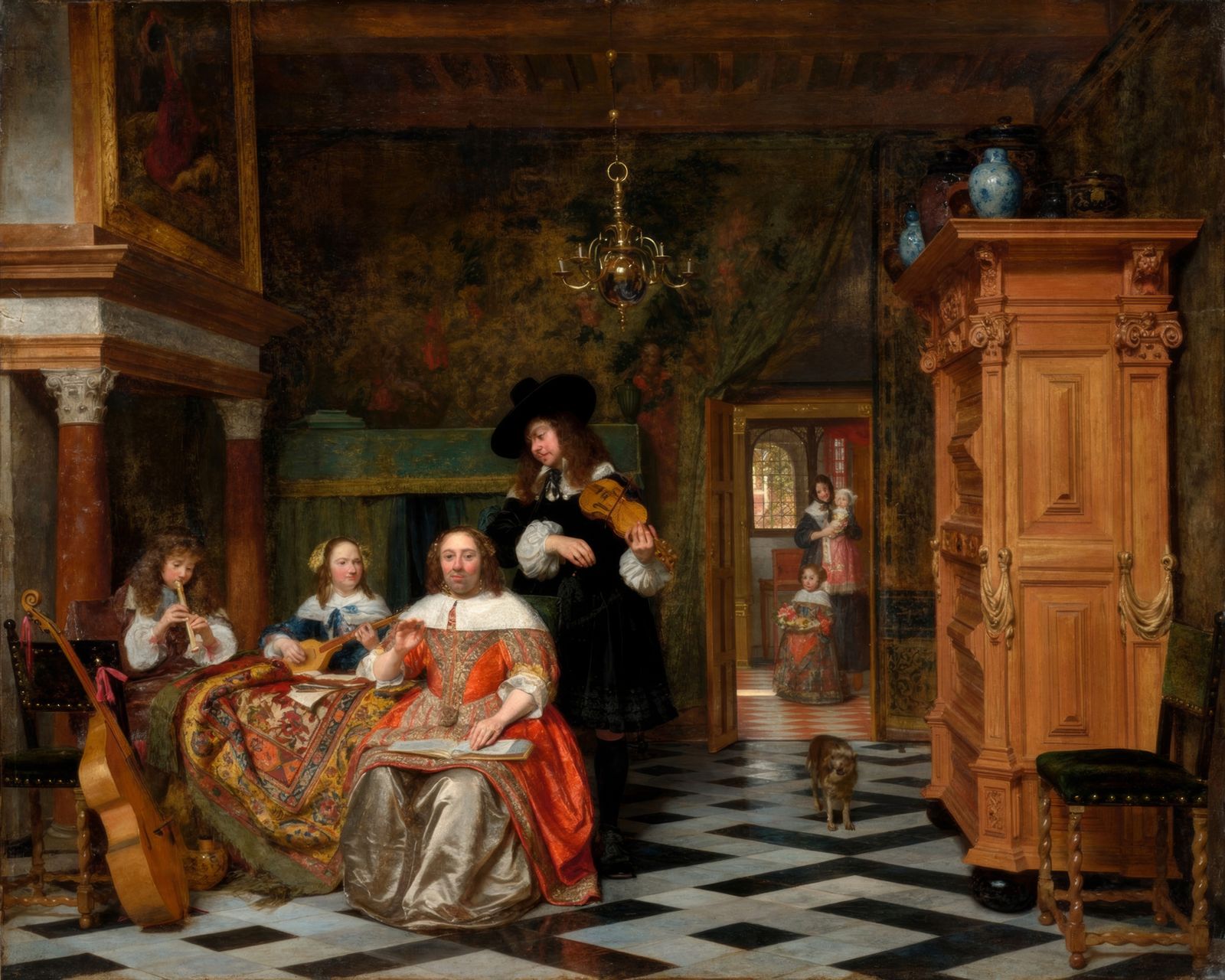
Portrait of a Family Playing Music — Pieter de Hooch, 1663. Cleveland Museum of Art. Restored by Surrealium at Vaxholm Fortress, Sweden.
De Hooch’s family playing music gives different people different positions, while the activity keeps the group coherent. For your photograph, a shared interest can provide a structure without requiring identical poses. A family that genuinely plays together might sit near instruments; another might gather at a table or around a familiar chair.
Keep the activity simple enough that faces remain visible. If hands or objects matter to the picture, include them clearly rather than cutting them at an awkward point. Do not assume a portrait treatment will correct a confusing hand position or reconstruct an instrument hidden behind a body. Historical art can encourage a more interesting arrangement, but the source photograph still has to contain useful information about the people in it. Compare the available portrait style with your own photograph.
Vary height without hiding anyone
A seated adult, a standing person and a child at a comfortable lower level can make a group feel connected. The important test is whether each person remains visible and the arrangement makes sense. Avoid making somebody lean sharply forward merely to fit into the frame, and do not place a small child in an uncomfortable or unstable position for the sake of a triangular composition.
Check the spacing between faces. Two heads that overlap in a small preview may be difficult to separate later, even if they seemed clear while you were taking the photograph. Leave enough room around the group for the intended layout, and inspect both a closer and a wider frame. The best choice is the one that preserves the people and their relationship, not simply the one that fills every corner.
Let ordinary light do the work
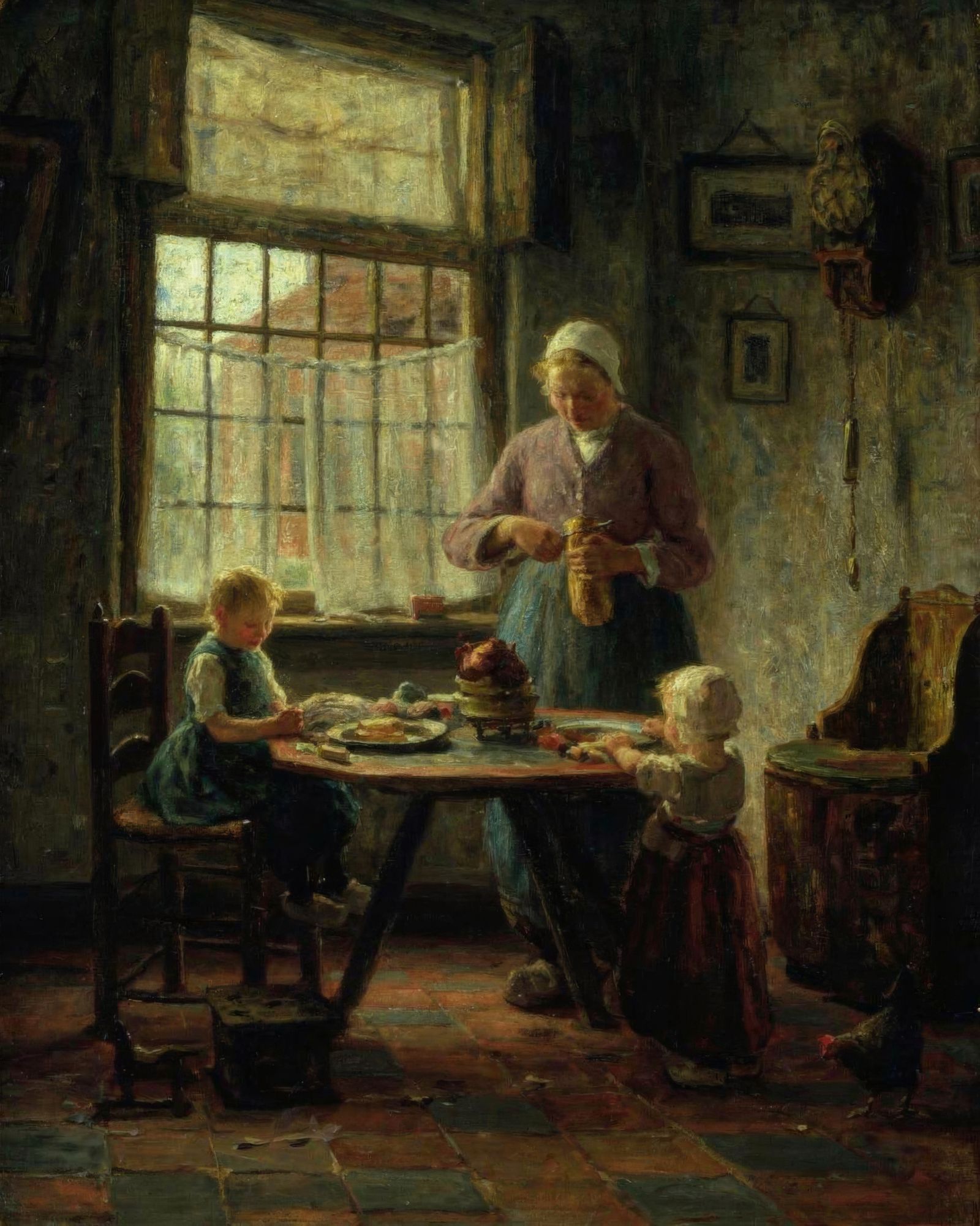
A Family Meal — Evert Pieters, 1890s (?). Art Institute of Chicago. Restored by Surrealium at Vaxholm Fortress, Sweden.
Pieters’s family meal is organised around the light entering the room, with the table and people placed where it can describe them. In a photograph, a window can provide a useful starting point when the faces are turned towards enough light. Check the actual result rather than assuming a bright room always produces a clear image.
Avoid putting the strongest light directly behind the group if it leaves the faces dark. If some people are in deep shadow while others are brightly lit, change the position before taking more photographs. You do not need to recreate the painting’s atmosphere exactly. A source that records the faces clearly is more useful for a portrait card than a dramatic image whose most important details have disappeared.
Photograph children and pets on their own terms
Keep the session close to a familiar routine and make room for a break. A child does not need to maintain an adult’s formal expression, and a pet does not need to perform a human role. For a dog or cat, choose a natural position and enough light to show the face and markings; avoid clothing or accessories that make the animal uncomfortable or hide the features you want to remember.
If a child and pet appear together, prioritise a calm, safe interaction over an elaborate pose. Take the photograph from a position that lets you see both clearly. A small movement or an off-camera glance can still be characteristic, provided the image is sharp enough and the relationship remains understandable. Stop when the participants have had enough; the card is not more important than the people and animals in it.
Keep the Christmas setting secondary
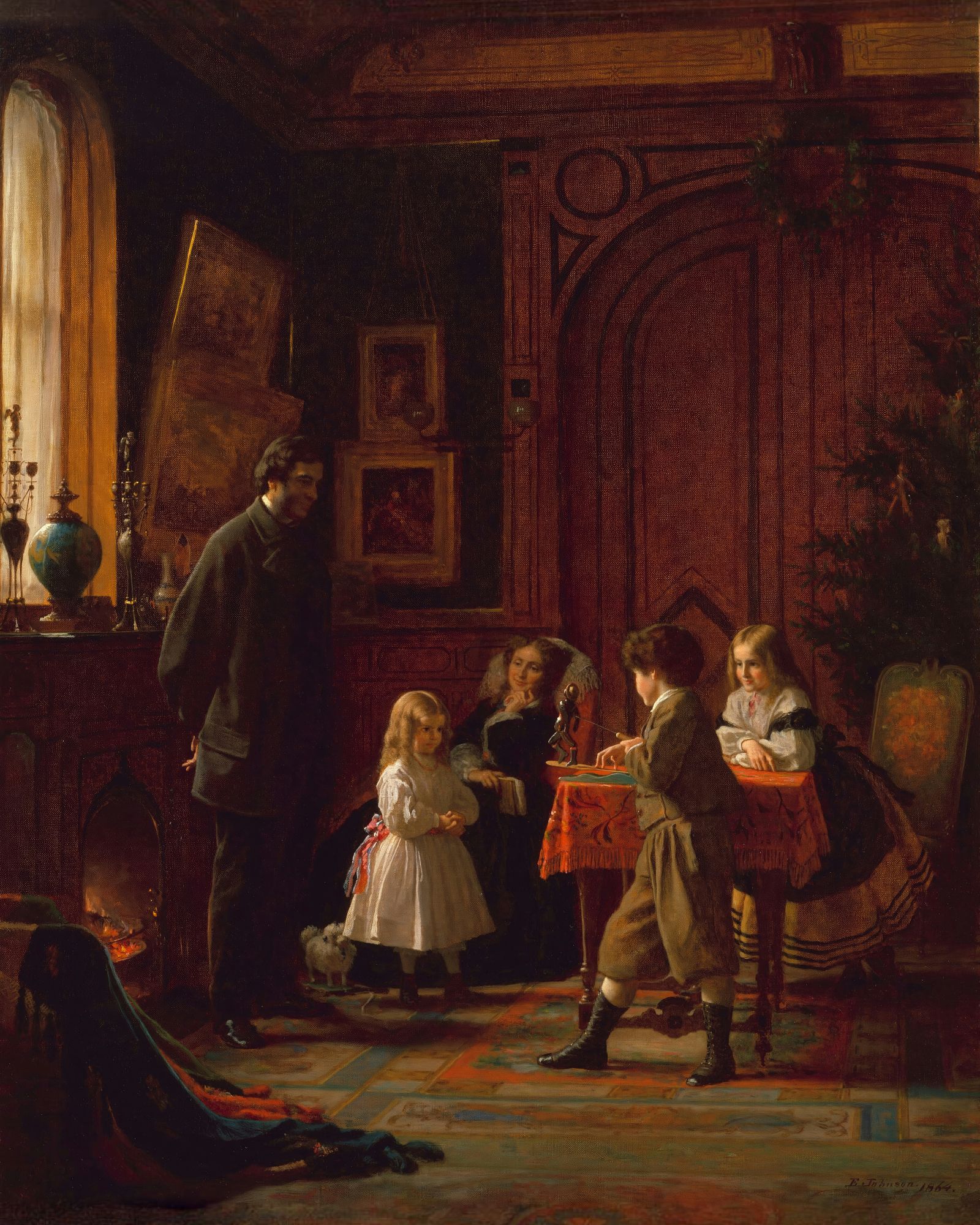
Christmas-Time, The Blodgett Family — Eastman Johnson, 1864. The Metropolitan Museum of Art. Prepared for print by Surrealium at Vaxholm Fortress, Sweden.
Johnson’s Blodgett family inhabits a richly described room, but the people remain distinct within it. That is a useful test for decorations in your own photograph. A tree, a wreath or a favourite chair can supply context, but it should not cover a face or become so dominant that the family looks like a small accessory in the corner.
Choose one or two meaningful elements rather than adding everything associated with Christmas. Familiar clothing is often easier to live with than outfits bought for a single photograph. If you want a portrait card that can also be enjoyed beyond the holiday, keep the source simple and let the card’s words carry the date and occasion. A clear family image does not become less festive because it avoids a crowded set.
Select the source with the final card in mind
Review the photographs at a useful size before choosing. Check the eyes, the edges of faces, hands that matter to the pose and any pet markings. Then view the whole image small, as someone might see it on a phone. The source should remain readable at both scales, with no one disappearing into a dark corner or being reduced to a tiny face behind another person.
Use the original file and keep it available while reviewing the portrait preview. A card made from a photo is a new image, so compare recognisability and arrangement rather than assuming every detail transfers unchanged. Read the final greeting separately, including names and the sign-off. Only choose the sharing or print format after the image and words work together in the actual preview.
The most useful photo idea is the one your family can carry out comfortably. A familiar setting, a shared activity, varied but clear positions and enough light will usually serve you better than a complicated theme. Keep a few strong candidates and choose together when possible. Once you have a clear source, the Christmas portrait card route lets you compare the available treatments and build the greeting around the people, rather than forcing the people into a card idea chosen before the photograph existed.
Continue with the Christmas card picture guide, planning a family Christmas portrait.
- What is an easy family Christmas photo idea?
- Gather in a familiar place around a simple activity, such as reading or preparing for a walk. Keep faces visible and use enough light. You do not need matching clothes or an elaborate set to make the image feel connected.
- How can I include a dog in a Christmas photo?
- Choose a comfortable natural position and a calm moment. Keep the dog’s face and markings visible, avoid human costumes, and stop if the animal is uncomfortable. A familiar expression matters more than a forced festive pose.
- Should everyone look directly at the camera?
- No. A shared activity or a glance between people can feel natural, provided the faces remain recognisable. Take several complete photographs and choose one that works for the whole group rather than only the central person.
- Can a portrait process fix a poor source photograph?
- Do not rely on it to recover hidden or blurred features. A clearer original image gives you a better basis for judging the result. Review the source first, then compare the new portrait carefully with the people you know.