Family Christmas portrait: choose a scene that feels familiar
Four historical family scenes help you plan the people, photograph and atmosphere of a Christmas portrait without staging a perfect household.
A family Christmas portrait can begin with the way people gather rather than the way they pose. Some families meet around a table; others remember the walk, the music or the moment everyone finally sits down. A useful portrait brings those relationships into view without asking the household to pretend it is more formal, harmonious or decorative than it feels.
These four works are historical references, not approved examples of portraits made from family photographs. They show different ways to organise people and a room. Use them to decide what matters in your own source photograph, then inspect the actual portrait result carefully. A beautiful reference cannot guarantee that every face, hand or small object will transfer as you expect.
For a related starting point, read Christmas portraits after the masters, Christmas portrait or Christmas card.
A group joined by one shared action
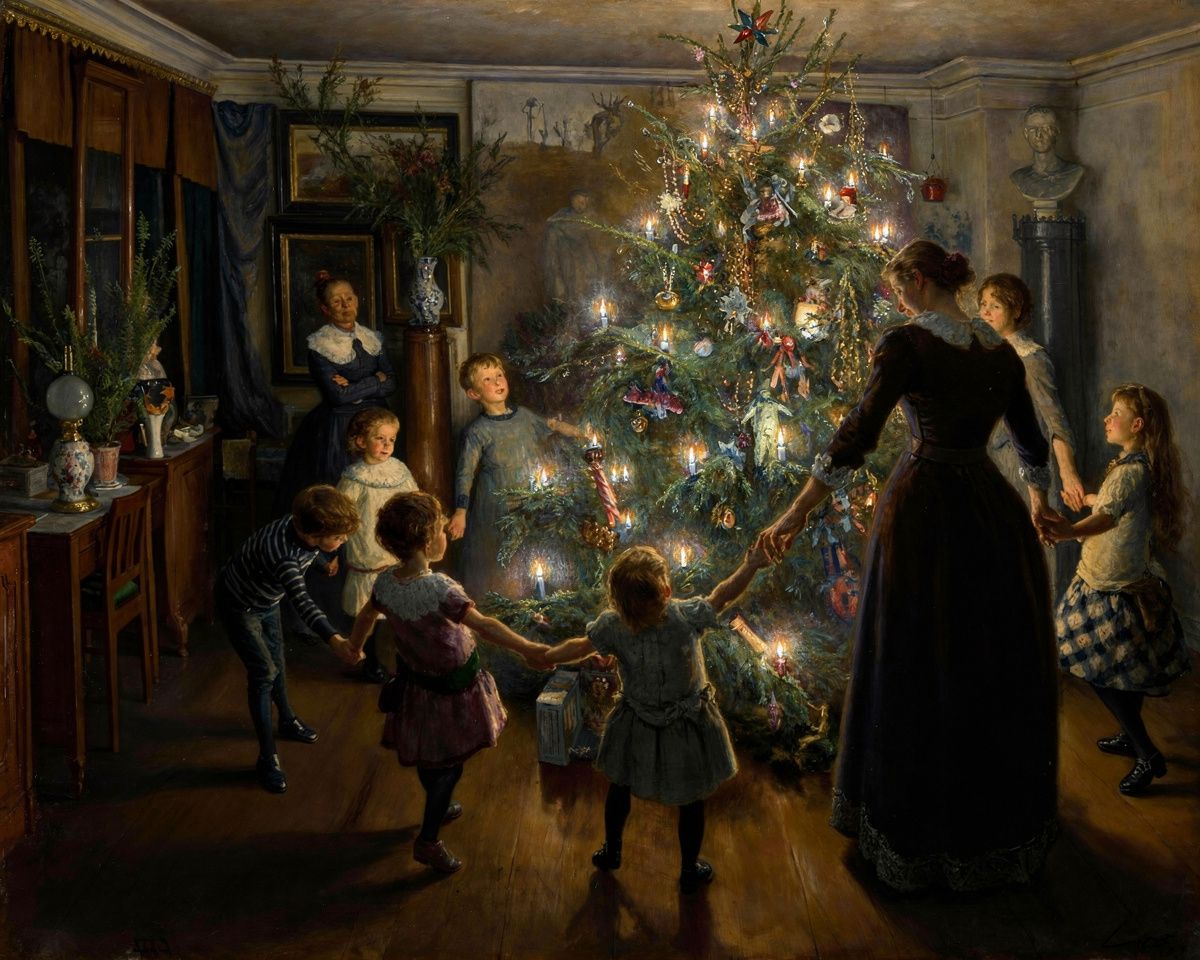
Glade jul (Happy Christmas) — Viggo Johansen, 1891. The Hirschsprung Collection, Copenhagen. Restored by Surrealium at Vaxholm Fortress, Sweden.
Viggo Johansen’s Merry Christmas gathers people around a lighted tree. The figures form a connected group without all presenting themselves in the same way. The tree helps organise the room, but the relationships between the people give the scene its interest: some faces turn towards others, while movement carries attention around the circle.
For your own photograph, choose a simple shared activity that everyone can perform comfortably. It might be looking at decorations or listening while someone reads. Keep faces visible and avoid asking a child to hold an awkward pose for the sake of an elaborate idea. The historical scene can suggest how a group fits together; it does not require you to reproduce a candlelit room or imitate the artist’s household exactly. Compare the available portrait style with your own photograph.
Decide who belongs in the picture
Make the list of people before taking the photograph. If the portrait is a gift, consider whether the recipient expects children, grandparents, partners or pets to be included. A small group may communicate a relationship more clearly than an ambitious assembly in which several people are hidden. There is no obligation to compress every branch of a family into one image.
Separate households or difficult relationships deserve practical care. Ask what arrangement feels comfortable rather than assuming a seasonal gift will resolve a disagreement. For children, check that the relevant adults are happy with the photograph’s use. If someone is missing, do not assume the portrait process can invent a convincing likeness from a name or a vague description. Begin with a source image that already contains the people and connection you want to preserve.
A Christmas portrait can be a small scene
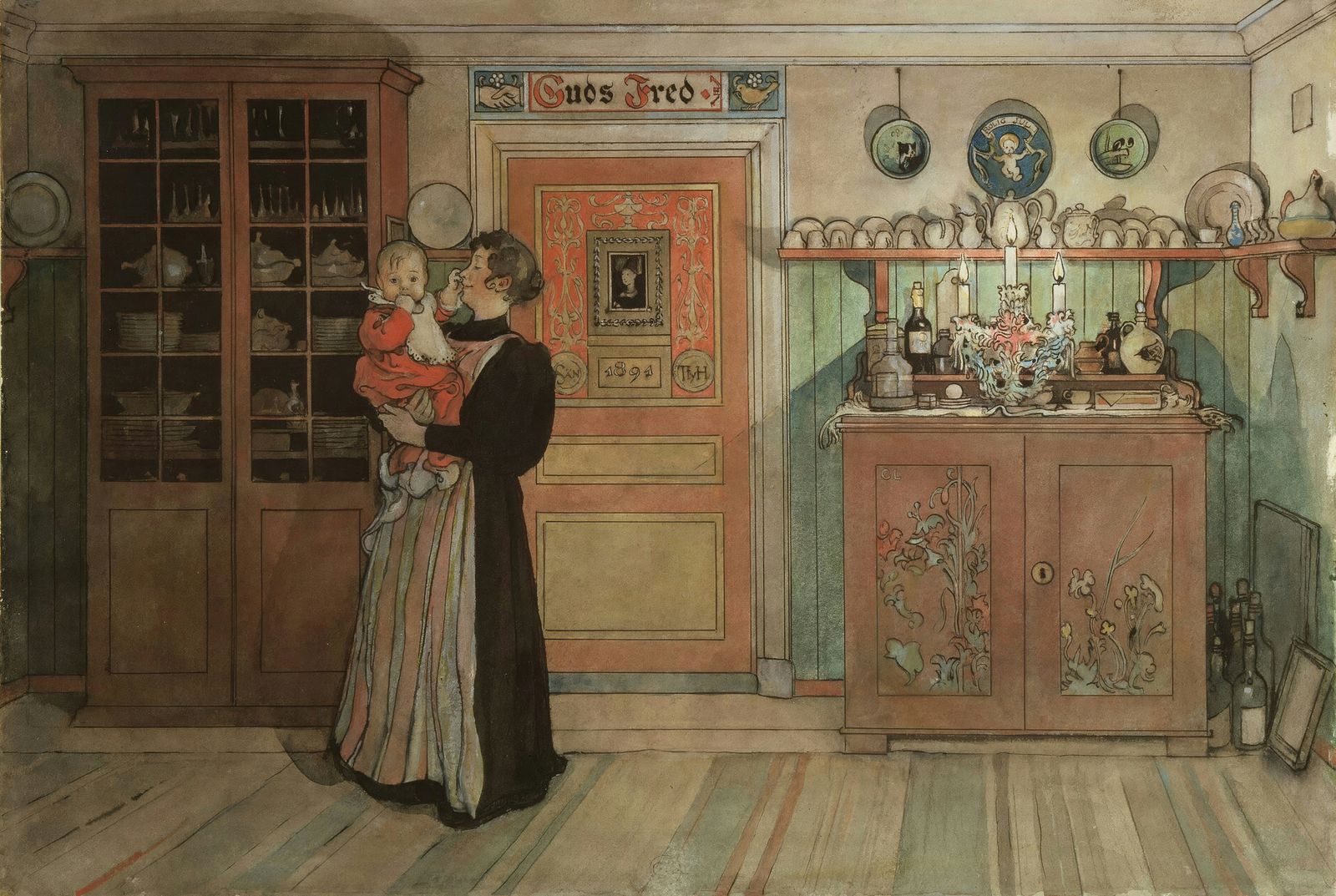
Between Christmas and New Year (A Home) — Carl Larsson, 1899. Nationalmuseum, Stockholm. Prepared for print by Surrealium at Vaxholm Fortress, Sweden.
Carl Larsson’s domestic scene near the stove concentrates on a close relationship within a furnished room. The warmth comes from proximity and familiar surroundings, not from assembling a large cast. It is a useful direction for a parent and child, two siblings or another small group whose everyday closeness is the subject of the gift.
Look at the balance between people and setting. A recognisable room can carry memory, but it should not overwhelm the faces. Choose one or two objects that matter, then keep the nearest clutter out of the photograph if it distracts. The aim is not to make a lived-in home look unused. It is to make the relationship easy to see, with enough of the surroundings left to explain why this moment belongs to this family.
Take a photograph the portrait can use
Use the clearest original file available. Good, even light and visible faces matter more than elaborate decorations. Check the photograph at a useful size before uploading it: a face that looks acceptable as a tiny thumbnail may be blurred when enlarged. Avoid starting with a screenshot of a compressed image from a long message thread when the original is available.
Take several frames while keeping the arrangement simple. Choose a complete photograph in which the people look comfortable rather than expecting the process to combine the best expression from each separate frame. Hands, glasses and overlapping arms deserve particular attention. If a pet is included, let the animal settle naturally beside the family. No costume or human pose is needed to show that it belongs in the household.
Let a room carry part of the story
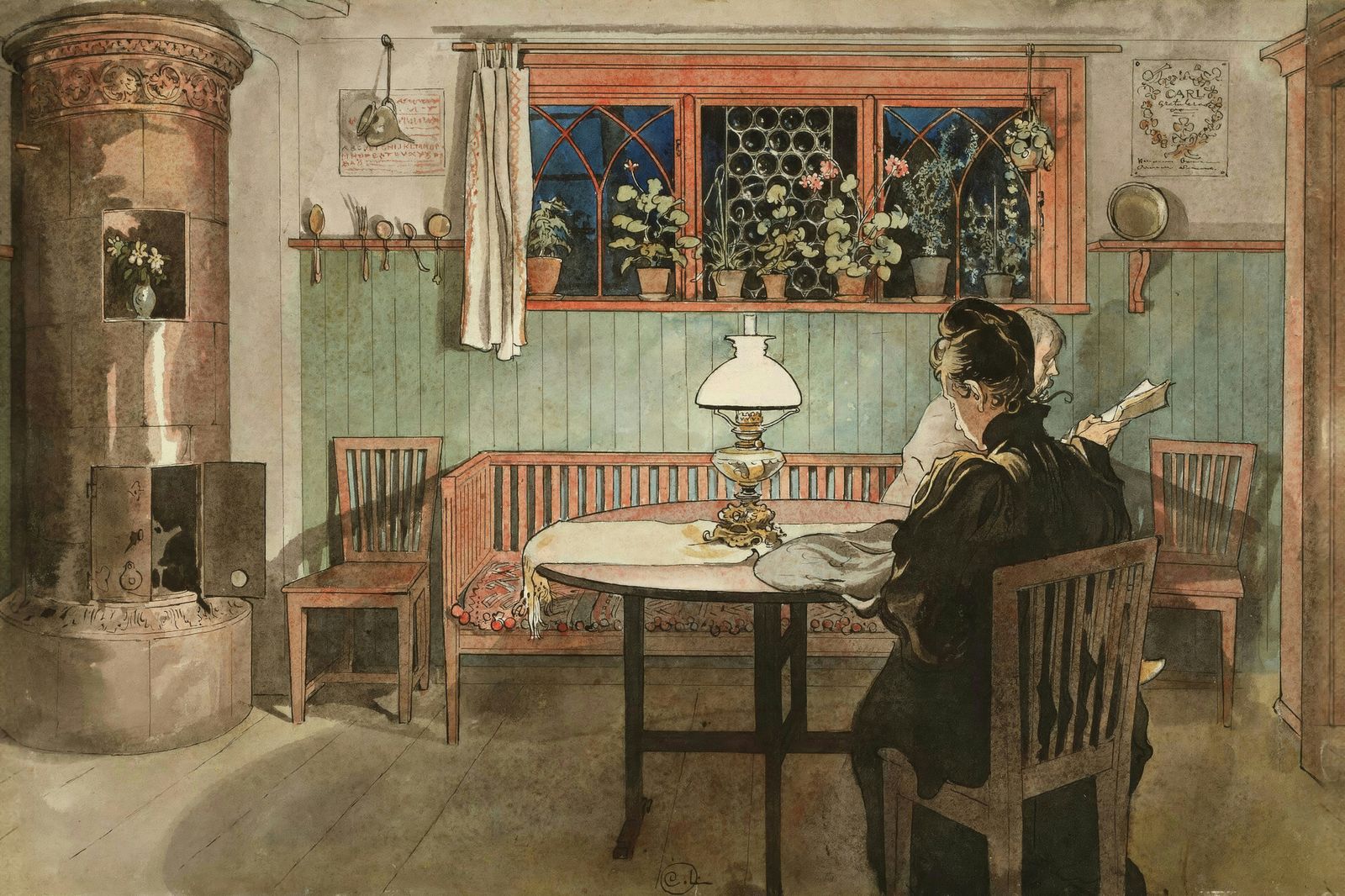
When the Children Have Gone to Bed. From A Home — Carl Larsson, 1899. Nationalmuseum, Stockholm. Prepared for print by Surrealium at Vaxholm Fortress, Sweden.
Larsson’s Between Christmas and New Year gives the table, lamp and plants a strong presence around the seated figure. It suggests a quieter kind of seasonal memory: the days after the gathering, when a familiar room settles back into ordinary use. A family portrait can draw on that feeling even when the source photograph includes more than one person.
Consider whether your family recognises itself in a kitchen, a window seat or a corner where people read. A place can be more meaningful than an added festive prop. Keep the distinction between inspiration and documentation clear: the historical room is Larsson’s subject, while your photograph belongs to your own household. Borrow the idea of domestic attention rather than claiming that an old-master reference records a universal or ideal family Christmas.
Choose atmosphere before ornamental detail
Compare available portrait styles through their own reference paintings. Look at the distance between people, the strength of the light and the amount of room visible around the group. Those choices affect the portrait more deeply than whether a reference contains a tree or a ribbon. A formal setting may suit one family and feel uncomfortable to another.
Choose a style that is actually available for the intended subject. A single-person demo does not prove that the same approach has been approved for a large family. If you cannot see a relevant family example, treat the historical work as a composition reference and judge your own result with care. Do not promise a specific outcome to the recipient before you have checked that the faces remain recognisable and the arrangement still makes sense.
A gathering can be remembered through preparation
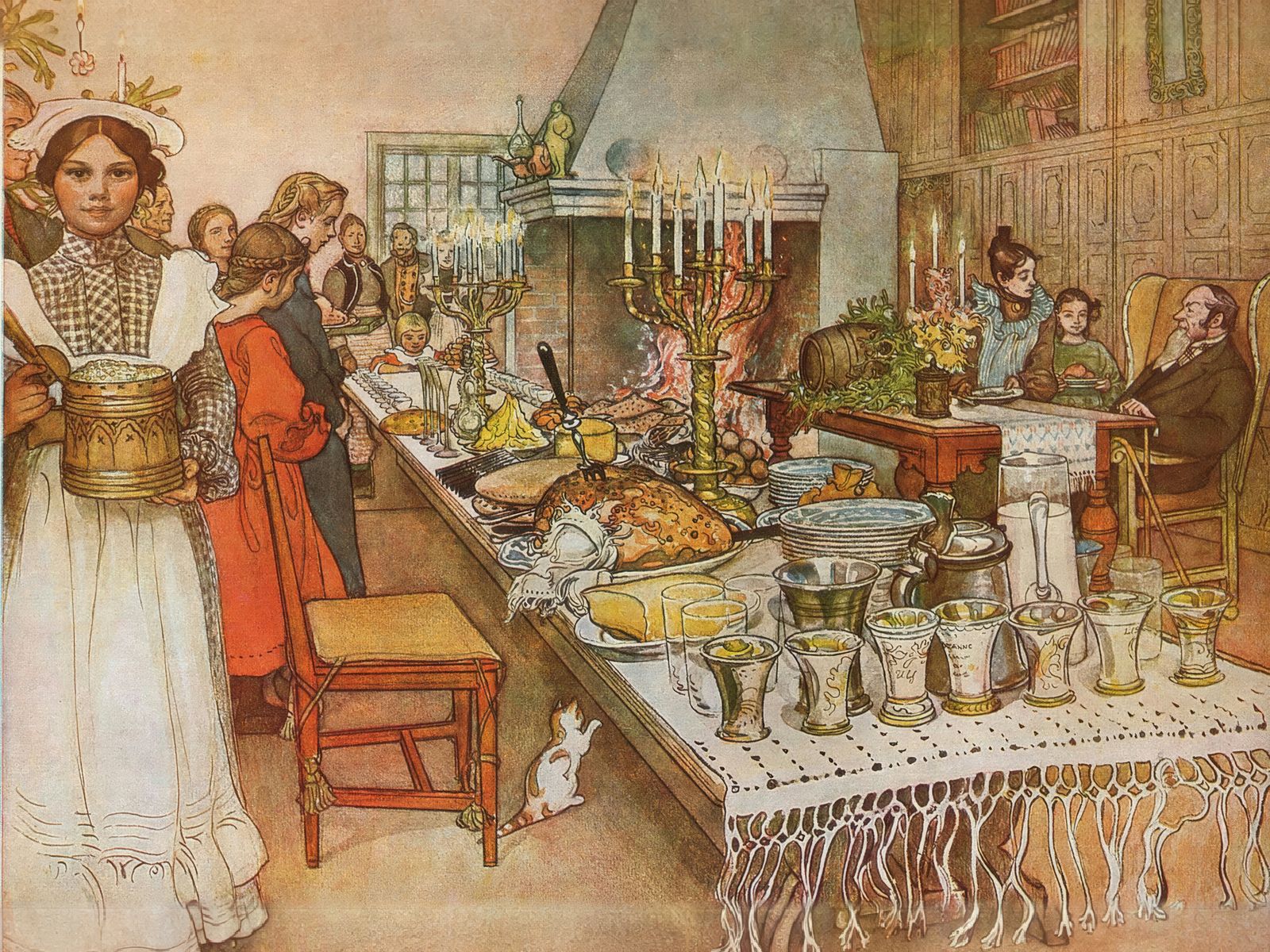
Christmas Eve — Carl Larsson, 1904. Bonnier Portrait Collection. Prepared for print by Surrealium at Vaxholm Fortress, Sweden.
Larsson’s Christmas Eve shows the table and the work of a household preparing for an occasion. It offers another way to think about a seasonal portrait: the people who make the gathering possible may be the real subject. A photograph taken before everyone arrives can sometimes hold more character than the formal group assembled later.
Use that idea kindly. Choose a moment the people pictured would welcome seeing again, rather than exposing someone’s exhaustion or an unflattering private instant. A portrait gift should not require the recipient to explain why they dislike the photograph. Ask about their preference when necessary. Surprise is less valuable than a result they recognise and want to keep, particularly when the image is intended for a shared room or a prominent place at home.
Review the finished portrait as a family image
Check each person separately, then look at the group as a whole. Are the faces recognisable? Do hands and arms connect sensibly? Has a meaningful object changed in a distracting way? Finally, step back and ask whether the result still feels like the relationship you wanted to remember. Technical neatness alone does not make an image personally convincing.
Decide on the next use only after that review. A portrait, a card and a physical product involve different choices, and an article’s reference painting is not proof of the result you will receive. Use the current Christmas portrait route to see the available process and options. Keep the original photograph and your preferred version together so you can compare them if you return to the project or discuss it with the recipient.
A family Christmas portrait does not need to contain every decoration or every relative. It needs a clear relationship, a usable photograph and an atmosphere the people recognise. Choose one gathering, one room or one shared action, then let the available portrait style support it. The paintings here offer ways of looking; the final test is whether your own family feels present in the result.
Continue with family gift choices, planning a seasonal photograph.
- What makes a good photograph for a family Christmas portrait?
- Choose an original file with clear faces, comfortable poses and even light. Keep the whole group visible and inspect details before uploading. A familiar setting is useful only if it does not hide the people.
- Does everyone have to look at the camera?
- No. A shared activity can connect people naturally. The important point is that faces remain usable and the arrangement is clear, rather than that everyone adopts an identical expression or pose.
- Can I include a pet in a family portrait?
- A pet can belong naturally in the photograph if it is comfortable and visible. Let the animal sit or stand as itself, without human clothes or an unnatural pose, and inspect the resulting likeness carefully.
- Are these paintings examples of Fable family portrait results?
- No. They are historical composition references. They are not customer work or approved family demo pairs. Use the available family portrait flow and judge your own result before choosing how to use it.