Ace of Cups: a vessel before a promise
Historic Cups aces look like elaborate vessels. Read their forms alongside later ideas of openness, feeling and creative beginnings.
The Ace of Cups is a beginning expressed as a vessel. In Payen’s Marseille deck, the cup is so elaborate that it can resemble a small building; in the older Cary-Yale card, a golden structure stands against a patterned ground. Neither image depicts a couple falling in love. Modern readings often connect this ace with emotional openness or a fresh creative impulse, but looking at the historic objects makes room for a more patient question: what are you able and willing to receive?
A cup that resembles architecture
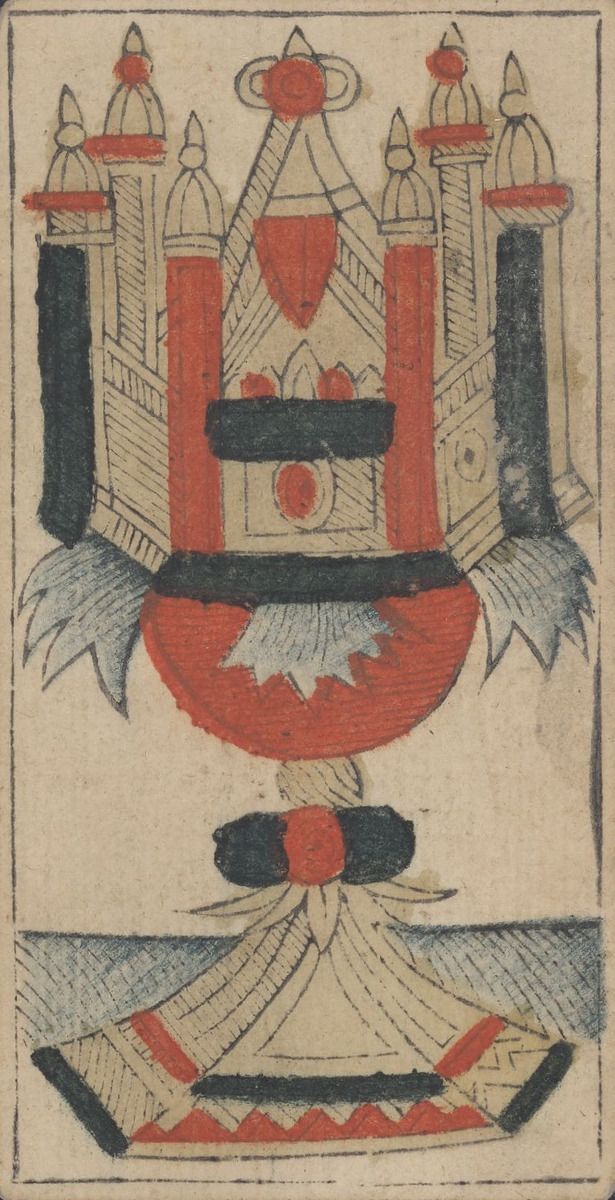
Ace of Cups · Jean-Pierre Payen, Blocks dated 1713 · Payen Marseille deck, FRA 166, Beinecke Rare Book and Manuscript Library, Yale University. Prepared for print by Surrealium at Vaxholm Fortress, Sweden.
The Payen ace has a broad foot, a swelling central form and a tall arrangement of pointed elements above it. Red and dark blue accents divide the pale ground into compartments. It is more elaborate than an ordinary drinking cup, and its upright symmetry gives the object a ceremonial presence. There is no hand carrying it and no landscape to supply a narrative.
Try following the outline from the base upwards. The narrow support holds a much wider upper structure, so the vessel feels both contained and expansive. That visual tension can be a useful starting point for reflection. Receptivity is not the same as having no edges: a container has a form that lets it hold something. This is an interpretation prompted by the drawing, not a claim about a secret message encoded by its maker.
Another age, another precious object
The Cary-Yale ace also presents one elaborate vessel, with a tall stem, decorated body and a richly worked surface around it. Its gold and blue details sit within the worn edges of a surviving fifteenth-century playing card. The material is part of its meaning as an object: this was a luxurious courtly pack, not a mass-produced modern oracle printed to illustrate a fixed list of emotional states.
The Cary-Yale story describes that setting. Comparing the two cards is more informative than pretending that all Cups aces have always looked alike. Later decks can introduce water, birds, hands and landscapes; those additions create new relationships between symbols. We can discuss their influence without projecting them onto a historic image that does not contain them. A picture deserves to be read before it is made to agree with a familiar explanation.
An ace belongs to a suit
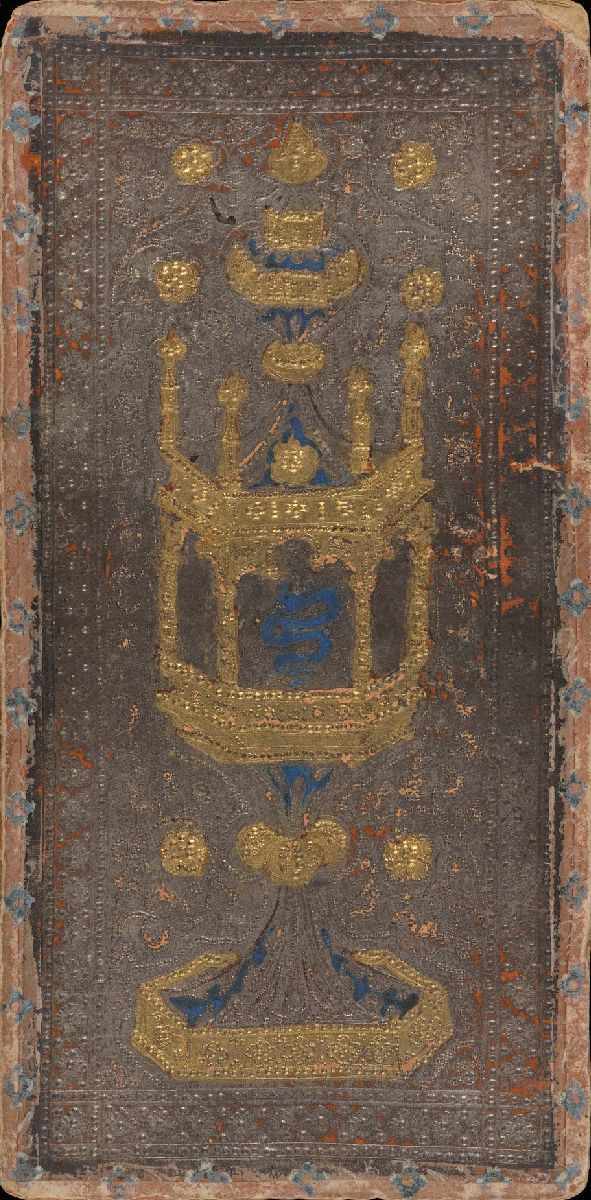
Ace of Cups · Unidentified Milanese workshop, c. 1442–1447 · Visconti di Modrone (Cary-Yale) deck, GEN 965, Beinecke Rare Book and Manuscript Library, Yale University. Prepared for print by Surrealium at Vaxholm Fortress, Sweden.
The Ace begins the numbered Cups in a conventional modern ordering. It is part of the minor arcana, not one of the major trumps. The Two follows it; if you arrange a whole suit as a loop, the King is the preceding court card. The Marseille deck guide supplies the broader context for those neighbours. Moving from one cup to two changes the balance of the design; moving from a numbered card to a court introduces a person with a particular rank.
Our major arcana guide helps distinguish those two parts of the pack. For a comparison within the suit, the Knight of Cups changes the emphasis from a vessel standing alone to one being carried towards someone. That shift can help you distinguish recognising a feeling from deciding how to express it. Neither stage guarantees what another person will feel in return.
Upright: make room to notice
Modern upright readings often associate the Ace with affection, receptivity and creative possibility. As a reflective practice, begin with noticing rather than announcing a new era of your life. Something may interest or move you before you know what you want to do with it. You can allow that first response to exist without immediately converting it into a commitment.
Ask what conditions help you pay attention. A quiet walk, a conversation without distractions or time spent making something can reveal a feeling that was difficult to hear amid obligations. The card does not establish that a new relationship is coming, or that a creative idea will succeed. Its usefulness lies in giving you a form for considering capacity: what is already occupying you, what deserves more attention and what you might choose to welcome if there were room.
Reversed: a boundary can be useful
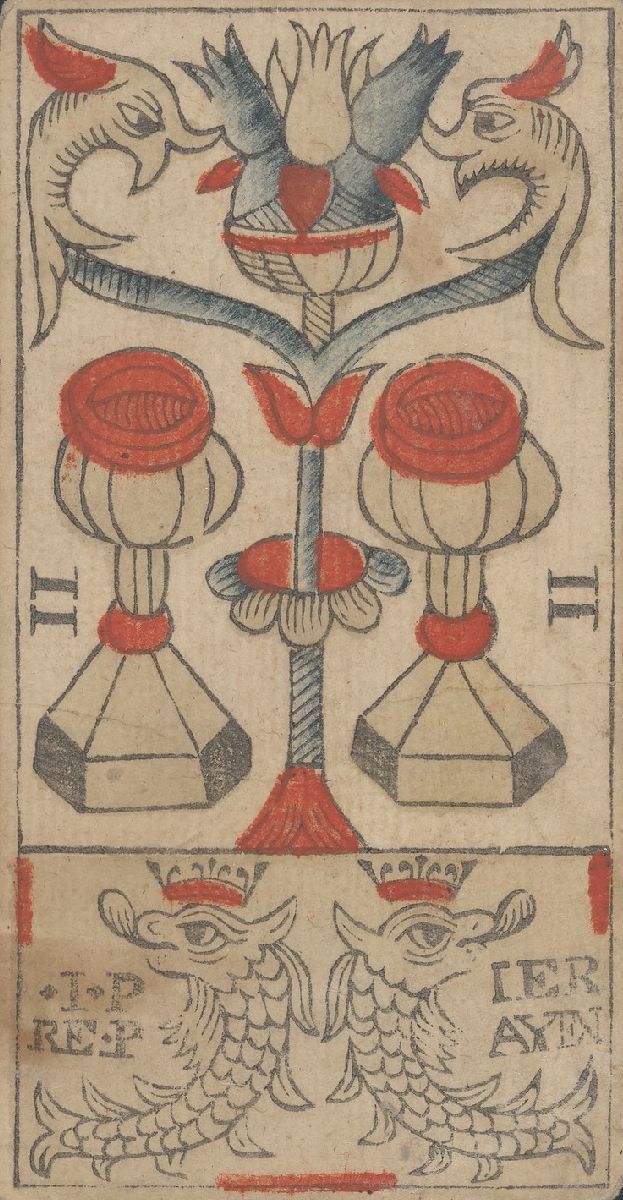
Two of Cups · Jean-Pierre Payen, Blocks dated 1713 · Payen Marseille deck, FRA 166, Beinecke Rare Book and Manuscript Library, Yale University. Prepared for print by Surrealium at Vaxholm Fortress, Sweden.
A reversed Ace is often read through withheld feeling, depletion or difficulty receiving care. Those possibilities should remain questions. A person may need privacy, rest or a boundary for reasons that have nothing to do with emotional failure. Refusing an invitation is not evidence of being closed-hearted, and an upside-down card does not establish a hidden psychological condition.
The Two of Cups shown here offers a formal comparison: the single ceremonial object has become a paired arrangement surrounded by ornament. It is tempting to turn that pairing straight into a romance. Instead, consider the conditions of exchange. Can something be offered without obligation, and received without pressure? If you are exhausted, a useful response may be to reduce demands rather than to force yourself into greater openness. Let what you know about the situation guide the interpretation.
A reflection on capacity
Draw a simple outline of a cup and write inside it three things currently taking your attention. Outside the outline, write one thing you would like to give space to. You do not have to remove everything already inside. Consider one adjustment small enough to make this week, and be clear about what you would give up to make it possible.
Then look again at the historic ace. Its decorative structure has weight and limits; it does not dissolve into an unlimited promise. You can carry that observation into the reading desk with a question such as “What needs room in my life?” Keep the answer provisional and connected to choices you can make. A symbolic image can help you recognise a priority, but it cannot supply consent, certainty or a future on someone else’s behalf.
- Does the Ace of Cups predict new love?
- No. New affection is a common interpretive association, but the card cannot establish that a relationship will begin or be reciprocated.
- Why does the old card look like a building?
- Payen’s cup has an elaborate, nearly architectural structure. It is a stylised ceremonial vessel, rather than the naturalistic scene familiar from later tarot.
- Is the Ace of Cups a major arcana card?
- No. It belongs to the suit of Cups in the minor arcana. The distinction affects how readers place it within the whole pack.