Cartomancy: playing cards, tarot and reflective reading
Cartomancy through historic playing cards and tarot: how decks differ, where later meanings enter, and a short exercise without prediction.
Cartomancy is the practice of reading cards, often for divination. Its tools can be ordinary playing cards or a tarot pack, but the practice is not the same thing as the history of those objects. A card made for a game does not arrive with one timeless set of meanings attached.
The historic cards here let us look at that distinction directly. Two come from the Cloisters playing-card pack, one from Payen’s 1713 Marseille tarot and one from the fifteenth-century Visconti di Modrone deck. They support a comparison of pictures and structures. For the exercise below, reading means symbolic reflection rather than a way to establish hidden facts or predict the future.
A playing card before it becomes a reading
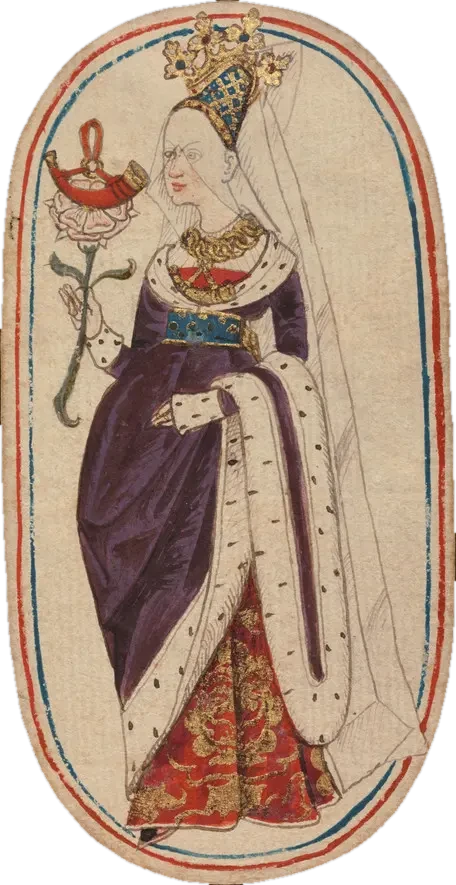
Queen of Horns — Unknown South Netherlandish artist, c. 1475–1480. The Metropolitan Museum of Art, The Cloisters. Prepared for print by Surrealium at Vaxholm Fortress, Sweden.
The Queen of Horns from the Cloisters pack wears an elaborate costume within a rounded card. Her hunting-horn suit belongs to a set whose other suits also concern hunting equipment. The Metropolitan Museum dates the pack to about 1475–1480 and identifies it as South Netherlandish. It is an extraordinary surviving playing-card object, not evidence that this queen originally carried a modern divinatory meaning.
Look at the long outline of the body and the way the costume fills the card. A present-day viewer may associate the figure with confidence, ceremony or display. Those responses can begin a reflection, but they remain responses. The historical task is to identify the object and its setting; the reflective task is to notice what it prompts in you. Keeping those tasks distinct allows both to remain useful.
Cartomancy is a practice, not one fixed deck
Cartomancy means reading or divining with cards. The term can include ordinary playing-card packs as well as tarot, though everyday usage often contrasts a standard pack with tarot’s additional trumps. The distinction concerns both the objects and the conventions a reader chooses to use. It does not establish that one pack has greater access to the future.
A modern French-suited pack has hearts, diamonds, clubs and spades. Historic European packs used other suit systems, including the hunting emblems shown here. Tarot commonly has four suits plus a separate sequence of trumps and the Fool. Our history of tarot follows that development more closely. The variety matters because a rule written for one system cannot be assumed to belong to every other pack simply because they all consist of small rectangular pictures.
A king in the same material world
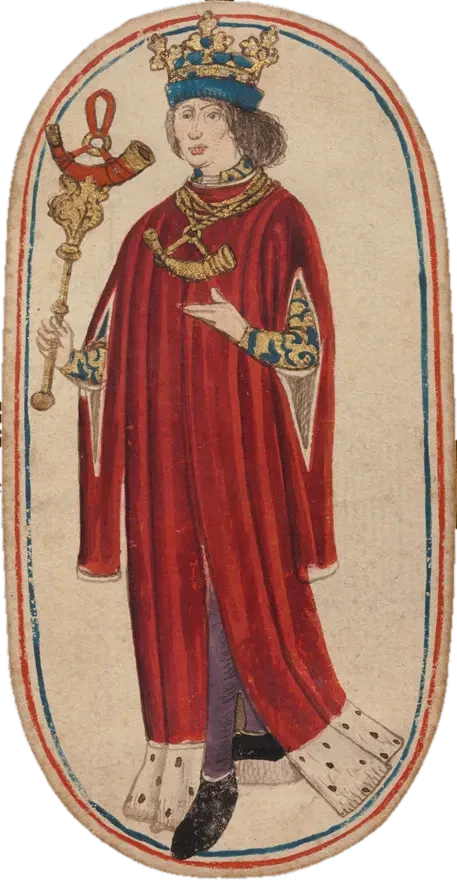
King of Horns — Unknown South Netherlandish artist, c. 1475–1480. The Metropolitan Museum of Art, The Cloisters. Prepared for print by Surrealium at Vaxholm Fortress, Sweden.
The King of Horns belongs to the same Cloisters pack as the queen. His rank and suit create a relationship within a playing-card structure, while his costume and rounded format connect him visually to the other cards. Those connections can be described before importing a meaning such as a powerful man, a partner or an event.
A contemporary reflective exercise might compare the two figures as different presentations of authority. That is an optional question, not a claim that a king drawn from a shuffled pack identifies someone in your life. Court cards need not be assigned to a person’s gender, appearance or supposed character. They can instead help you ask about a role: who is responsible for a decision, who has agreed to help, or what kind of leadership a situation actually needs.
Playing and divination have different histories
Tarot developed as a card game before its later association with organised occult interpretation. The V&A describes the growth of fortune-telling uses in the late eighteenth century and their further elaboration in the nineteenth. That chronology is enough to challenge a common shortcut: an old image does not prove that today’s reading instructions are equally old.
Nor does a claim of ancient Egyptian origin become established history through repetition. Writers have proposed such origins, but the museum treats them as unproven. A reading can be meaningful as a present-day activity without needing a mythical pedigree. When a guide claims that every card has always meant the same thing, ask which deck, which text and which period it is discussing. The major arcana guide separates the visible sequence from later ways of arranging its meanings.
Four cups without a scene of refusal
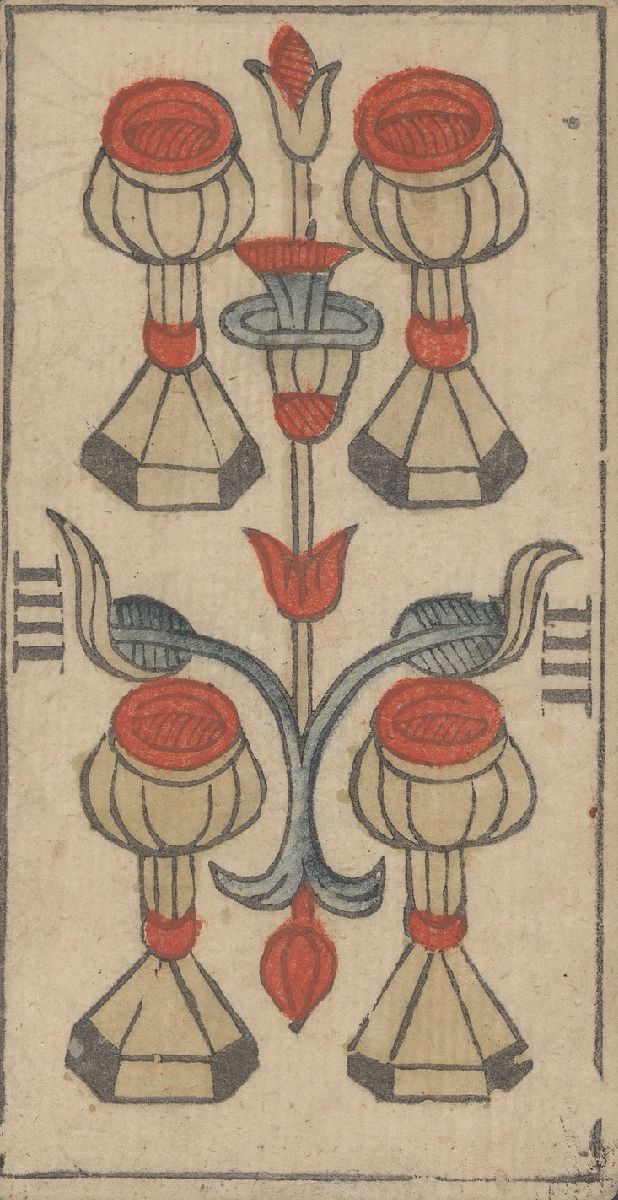
Cups Four — Jean-Pierre Payen, 1713. Beinecke Rare Book and Manuscript Library, Yale University. Prepared for print by Surrealium at Vaxholm Fortress, Sweden.
Payen’s Four of Cups arranges vessels around an ornamental centre. It does not contain the seated figure and offered cup familiar from the later Rider–Waite–Smith design. If you describe boredom or refusal while looking at this historic card, you are using a later convention or a personal association, not reporting an action that appears in the woodcut.
Begin instead with repetition, spacing and symmetry. Four similar forms can suggest a stable arrangement, a pattern that needs variation or simply the pleasure of balance. Choose a question that fits the actual situation rather than pretending the number supplies a factual answer. The Marseille deck story gives these pip cards their own context, preserving the difference between an arrangement of suit signs and a fully illustrated narrative scene.
A small vocabulary can remain provisional
If you want to experiment with ordinary playing cards, decide on a few associations before drawing. You might use hearts to prompt questions about relationships, diamonds about resources, clubs about effort and spades about decisions. These are example conventions for this exercise, not a universal historical key. You can write different associations if they are more useful, provided you are honest about choosing them.
Then ask an open question: what part of this situation have I not considered? Avoid questions that ask the cards to establish another person’s private thoughts or predict an outcome. Turn one card and describe its visible features before consulting your chosen words. Write both observations down separately. The separation makes it easier to notice when a broad association feels relevant because you supplied the connection, rather than because the card contains hidden information.
An ace from a different pack
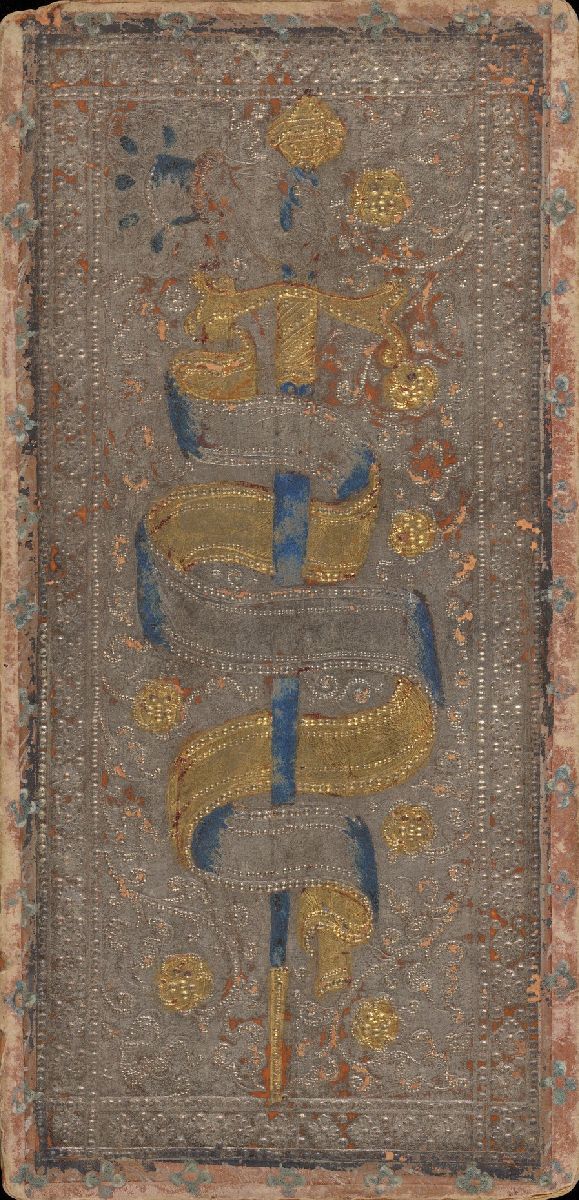
Swords Ace — Unknown Milanese workshop, Visconti di Modrone deck, c. 1440–1445. Beinecke Rare Book and Manuscript Library, Yale University. Prepared for print by Surrealium at Vaxholm Fortress, Sweden.
The Ace of Swords in the Visconti di Modrone deck gives a single suit sign a richly decorated setting. Yale’s current research places this surviving painted pack around 1440–1445. The card is shown as a historic object from that deck, not as the missing ancestor of every modern sword interpretation.
Compare its concentrated emblem with Payen’s four repeated cups. One card offers a dominant form; the other distributes attention across a pattern. That visible contrast is enough to begin a reflection about focus and repetition without claiming that either image predicts an event. It also shows why an old deck deserves to be looked at directly. Gilding, paint, stencil colour and printed line are material choices, and they can be lost when every card is reduced to a single keyword.
End with a question you can act on
A useful session can finish with three sentences: what I noticed, what I associated with it and what I will check in the real situation. The last sentence matters. If the reflection concerns a conversation, you may need to ask the person involved; if it concerns a plan, you may need information about time, cost or consent. A card does not remove that work.
You can also decide that the exercise has offered nothing useful and stop. There is no requirement to keep drawing until an answer feels certain. The Celtic Cross guide explores a larger arrangement, but a larger spread is not automatically a clearer one. Begin with a small question, retain your own judgement and let any practical next step be supported by the facts outside the cards.
A historic card gives you something definite to look at; a thoughtful question gives that looking a purpose. Keep observation, interpretation and practical evidence separate as you begin.
- Can ordinary playing cards be used for cartomancy?
- Yes, people use standard packs with chosen interpretive conventions. Those conventions vary. A reflective exercise should make its associations explicit rather than present them as information about the future.
- Is tarot the same as a standard 52-card pack?
- No. A common tarot pack has 78 cards, including trumps and the Fool, while a standard French-suited playing pack has 52 before jokers. Historic packs can differ from both patterns.
- Do I need to read reversed cards?
- No. Reversals are an interpretive choice, not a requirement imposed by the physical object. If you use them, decide what the change of orientation means in your exercise before treating it as an answer.