Wheel of Fortune card: change without a timetable
Read the Wheel of Fortune card through Payen’s historic image, with reflective meanings for change, repetition and limited control.
The Wheel of Fortune card shows figures placed around a turning structure, with one above and others at its sides. The arrangement makes changing position visible: what is high, low, rising or descending depends on the wheel. Later reading traditions use that image to consider change, chance and the limits of control. It is not a timetable for good luck or bad luck.
This page shows Jean-Pierre Payen’s Tarot de Marseille from Yale’s Cary Collection, printed from blocks dated 1713. The card is X in its sequence. Start with the major arcana guide for the surrounding cards, or Tarot de Marseille for the visual tradition behind this particular object.
Look at the wheel as a physical structure
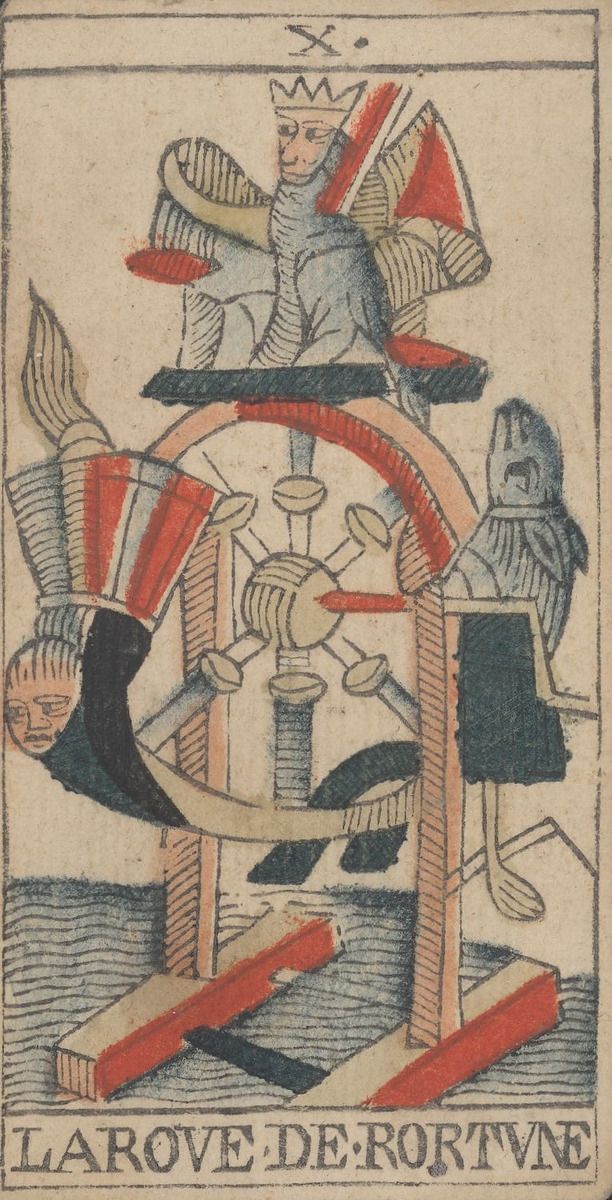
Wheel of Fortune · Jean-Pierre Payen, blocks dated 1713 · Cary Collection of Playing Cards (FRA166), Beinecke Rare Book and Manuscript Library, Yale University. Prepared for print by Surrealium at Vaxholm Fortress, Sweden.
The wheel stands on a support, with spokes meeting near its centre and animal-like figures occupying different positions around it. A crowned figure sits above, while the figures at the sides relate differently to the rim. The base gives the fantastic scene a surprisingly practical structure: this is a wheel that has been made to stand somewhere.
Describe those positions before adding a modern symbolic system. Payen’s image does not display the same letters and corner figures found in the Rider–Waite–Smith Wheel. The earlier card offers its own visual problem of movement and balance. Its meaning should not be discussed as though the details of every later version were already present.
Upright: recognise a change in conditions
Upright readings often associate the Wheel with change, cycles and an unexpected turn. In reflective use, that can become a question about what has changed around you and what remains within your ability to influence. The card does not establish that an improvement is imminent or that a setback was destined.
Name a concrete change before interpreting it. A routine may have ended, a team may have altered or a familiar plan may no longer fit. Then separate the event from your response. You may not control the change itself, but you can examine the information you need, the people you should speak with and the next decision that belongs to you.
The Hermit before the Wheel
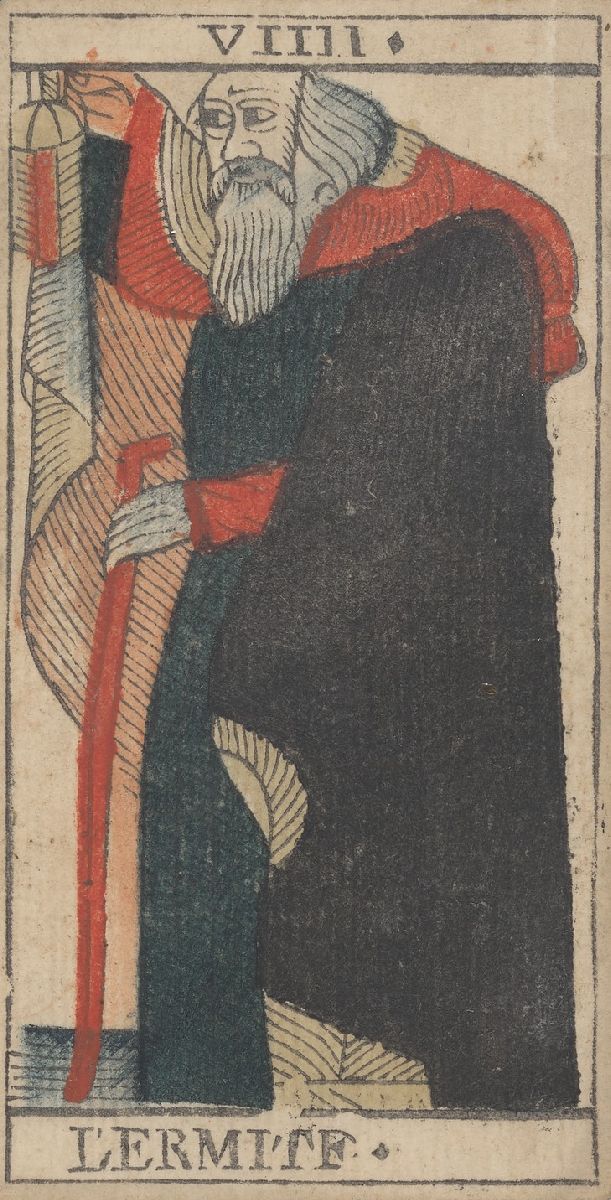
The Hermit · Jean-Pierre Payen, blocks dated 1713 · Cary Collection of Playing Cards (FRA166), Beinecke Rare Book and Manuscript Library, Yale University. Prepared for print by Surrealium at Vaxholm Fortress, Sweden.
The Hermit precedes the Wheel in the Marseille sequence. His staff and small light suggest a different kind of arrangement: one figure attending to a limited area rather than several figures carried around a turning mechanism. The contrast can prompt a useful shift from individual attention to changing circumstances.
That does not mean introspection causes the next event, or that the deck predicts a sequence of experiences. It is a way to compare images. Ask whether you are still treating a changed situation as though nothing has moved around you. The Hermit’s careful attention may remain useful, but the question it serves may need to be updated.
Reversed: examine repetition without blaming yourself
Reversed Wheel readings commonly consider resistance to change, recurring patterns or a feeling of limited control. Those associations should not become a claim that every difficulty is a lesson you caused or failed to learn. Circumstances can be difficult for reasons that a card cannot identify.
A practical reflection is to ask whether a repeated response is still serving its purpose. Perhaps a useful habit now prevents a necessary adjustment, or perhaps the same problem returns because its material conditions have not changed. Look for evidence before assigning a moral explanation. The reversed image can organise the enquiry, but it should not turn uncertainty into blame or treat chance as a verdict on someone’s character.
Strength after the Wheel
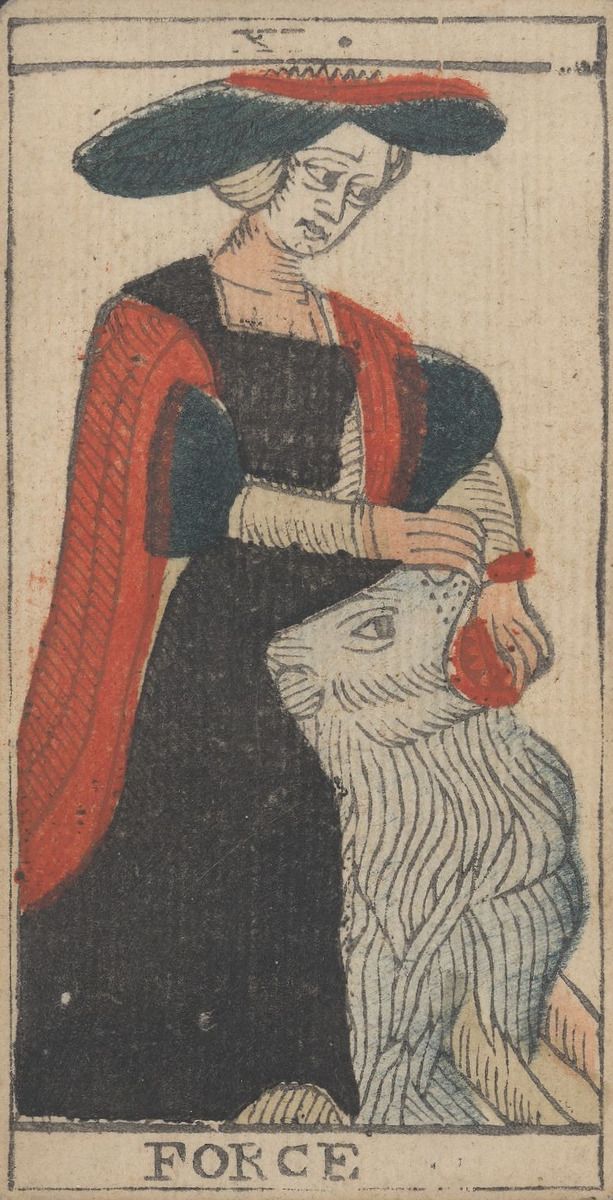
Strength · Jean-Pierre Payen, blocks dated 1713 · Cary Collection of Playing Cards (FRA166), Beinecke Rare Book and Manuscript Library, Yale University. Prepared for print by Surrealium at Vaxholm Fortress, Sweden.
Strength follows the Wheel in Marseille order. Its woman and lion bring the attention back to a close encounter and the way effort is exercised. Read together as a reflection, the cards can distinguish changing conditions from the quality of a response to them.
The distinction is useful because accepting limited control does not require complete passivity. You can recognise that a situation has changed while still choosing how to meet it. Equally, effort does not guarantee mastery of everything outside you. Keep both limits in view. The sequence can help frame a balanced question without promising that enough courage will make every turn of the wheel favourable.
Compare the World’s enclosure
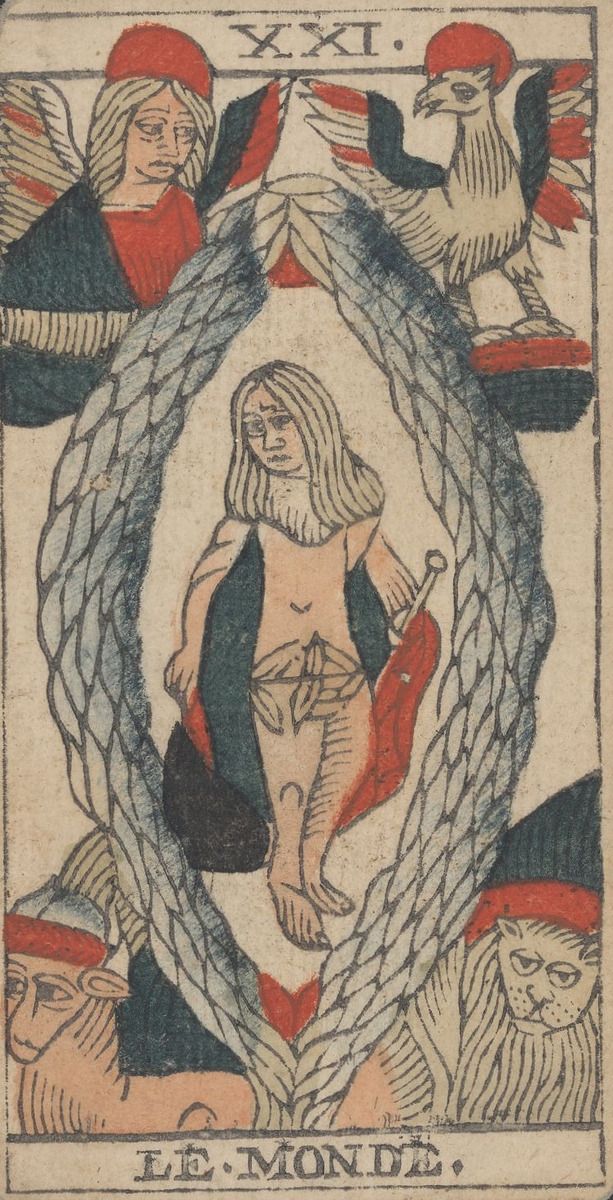
The World · Jean-Pierre Payen, blocks dated 1713 · Cary Collection of Playing Cards (FRA166), Beinecke Rare Book and Manuscript Library, Yale University. Prepared for print by Surrealium at Vaxholm Fortress, Sweden.
The World places a central figure within a surrounding form, with other figures occupying the corners of the card. Its enclosure looks different from the Wheel’s mechanism and the figures carried around its rim. The comparison can help separate an image of changing position from an image often read through wholeness or completion.
Do not force the two cards into a single story of guaranteed progress. A cycle does not always end neatly, and a feeling of completion may be partial or temporary. The World card guide develops that neighbouring theme. Here the comparison is useful because the shapes themselves differ: one turns through positions, while the other gathers figures around a centre.
Make a map of what can be changed
Divide a page into three areas: what has changed, what you can influence and what you need to understand better. Write a few concrete points in each area. If a point feels like a prediction rather than an observation, mark it as an uncertainty instead of treating it as a fact.
Choose one proportionate next step from the second or third area. It might be asking a question, revising a plan or allowing time before deciding. The exercise gives the Wheel’s broad theme a practical boundary. You are not trying to discover when fortune will turn in your favour; you are clarifying how to respond to the conditions you can actually identify.
- Does the Wheel of Fortune predict good luck?
- No. This guide uses it as a symbol for reflecting on change and limited control. It cannot establish when an outcome will occur or whether it will be favourable.
- What number is the Wheel in Marseille?
- It is X, following the Hermit and preceding Strength in the sequence used here.
- Does a reversed Wheel mean I caused a setback?
- No. Reversal can prompt questions about repetition or resistance, but it is not evidence of blame, destiny or the cause of a real event.