The High Priestess: the book in the old card
The High Priestess began as La Papesse in Marseille packs. Look at her book, her setting and the meanings later readers brought to her.
The High Priestess is often associated with intuition, attention and knowledge that is not immediately available. Those ideas are most useful when they encourage patience and careful listening. A card does not reveal a hidden fact or make a feeling automatically correct.
The figure in Payen’s 1713 pack is called La Papesse. She sits with an open book and a tall, tiered headdress. This is not the same image as the veiled, moon-associated figure of the later Rider–Waite–Smith deck. Starting with the historic card makes room for a less hurried reading of both the picture and its traditions. The major arcana guide places her near the beginning of the sequence.
The open book deserves attention
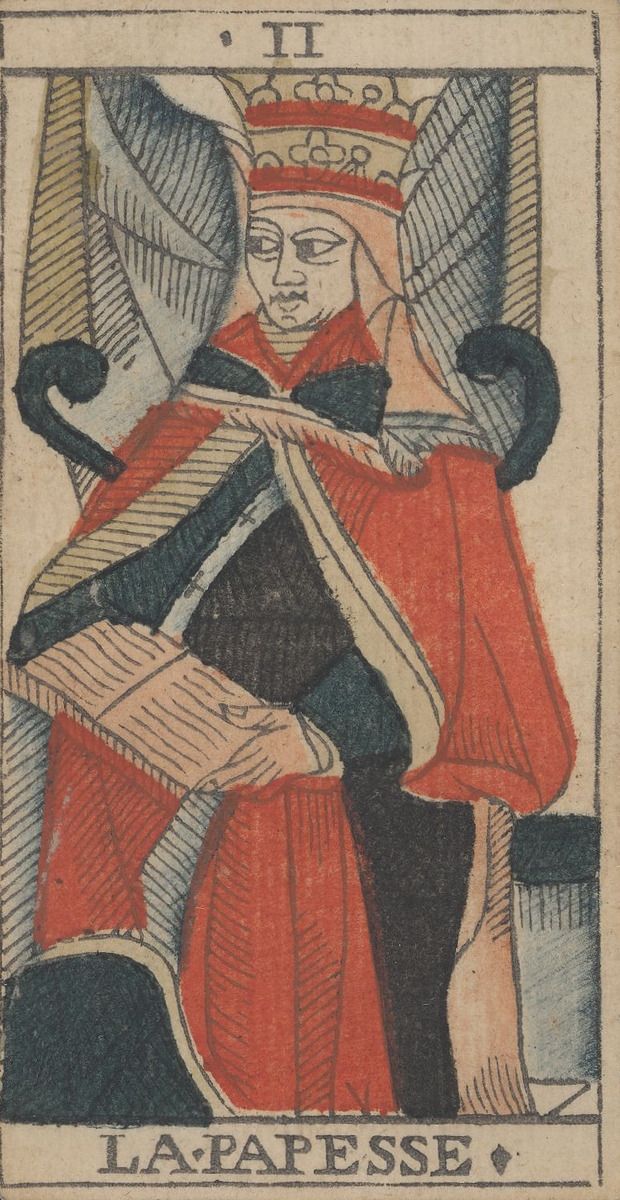
La Papesse (the High Priestess) — Jean-Pierre Payen, 1713. Beinecke Rare Book and Manuscript Library, Yale University. Prepared for print by Surrealium at Vaxholm Fortress, Sweden.
Payen’s seated figure fills nearly the entire rectangle. Red and blue robes fall around an open volume held low across the body. The headdress rises into the narrow space beneath the number II. Behind the head, pale patterned forms create a kind of enclosure without turning the card into a detailed architectural interior.
The book is visible, but its contents are not available to us. That is a useful distinction: the image presents learning without handing over a legible lesson. It can encourage a question about how knowledge is held, studied or withheld. It does not prove that the figure represents one named historical woman. The Marseille art story treats her as part of a printed visual tradition, whose meanings have accumulated over time.
Upright: listen, then check
An upright High Priestess reflection can begin with something you have noticed but not yet understood. Perhaps a conversation left you uncertain, or an apparently simple choice keeps returning to mind. Describe the observation before explaining it. “I hesitated when that option was mentioned” is a sounder starting point than “My intuition knows the answer”.
Then ask what information would help. Quiet attention and investigation can work together. You might reread a message, ask a direct question or allow yourself a day before replying. The card need not oppose thought to feeling. A useful interpretation lets each contribute without granting either absolute authority. This is particularly helpful when a confident first impression could otherwise turn into an unsupported judgement about another person’s motives.
A queen is not a replacement priestess
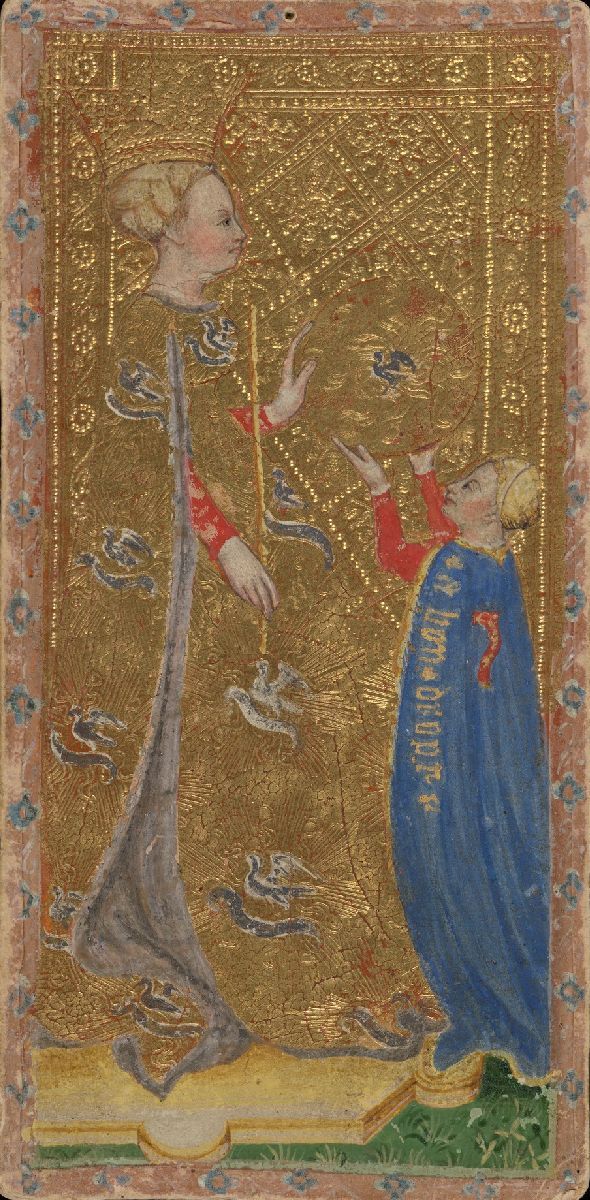
Coins Queen — Unknown Milanese workshop, Visconti di Modrone deck, c. 1440–1445. Beinecke Rare Book and Manuscript Library, Yale University. Prepared for print by Surrealium at Vaxholm Fortress, Sweden.
The Visconti di Modrone Queen of Coins is a surviving court card: a richly dressed woman with attendants against a worked gold field. She is shown here as a comparison in the depiction of female authority, not as an early High Priestess. The named trump does not survive in that pack among the source images used for this story.
This restraint keeps a gap in the record visible. A reconstruction might make a deck feel complete, but it cannot supply historical evidence of a missing design. Compare what actually survives instead: the queen’s elaborate clothing and entourage, Payen’s book and enclosed seat. Each picture uses a different set of attributes to make a woman’s position legible. Neither can be reduced to a universal personality type.
Reversed: distinguish privacy from avoidance
Reversed readings of the High Priestess often concern ignored impressions, confusion or something left unspoken. Those possibilities are not interchangeable. Keeping a private matter private can be healthy; avoiding information you need may be unhelpful. The card cannot decide which is happening without reference to your situation.
Choose a question that can be answered through ordinary means. What have you actually been told? What have you assumed? What is someone entitled to keep to themselves? Writing those categories separately can prevent a reading from becoming a search for secrets. If a subject concerns another person, their privacy remains real even when a symbolic image makes mystery feel compelling. Curiosity is useful when it is accompanied by boundaries and a willingness to accept uncertainty.
A vessel with an architectural silhouette
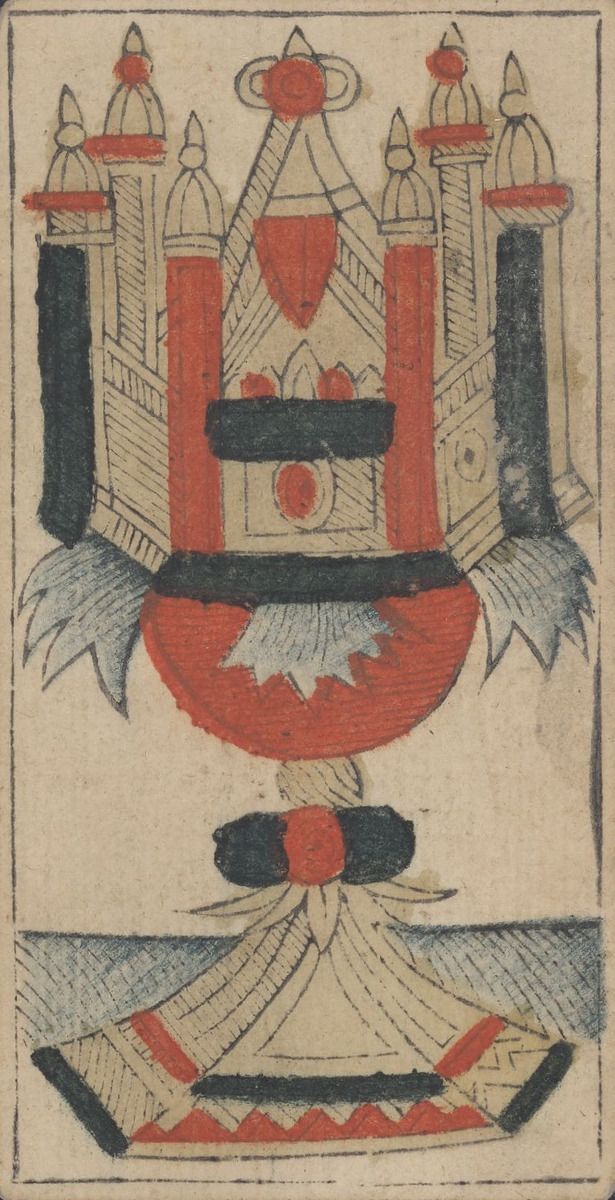
Cups Ace — Jean-Pierre Payen, 1713. Beinecke Rare Book and Manuscript Library, Yale University. Prepared for print by Surrealium at Vaxholm Fortress, Sweden.
Payen’s Ace of Cups is unusually elaborate: the vessel rises into a form that can look architectural, with repeated upright elements and a central red area. It has no seated reader and no open book. Its value beside La Papesse is visual rather than genealogical: both images arrange attention around something contained.
The High Priestess is II in the usual sequence, after the Magician and before the Empress. A modern reflection might move from making or demonstrating towards listening, then towards tending or provision. That progression is optional. It should not be confused with proof that the numbered cards were originally designed as a single course of spiritual instruction. The actual images remain more varied than such a scheme.
An observation and an unanswered question
Sit with the image for a short time and write down three details: one about the book, one about the hands and one about the surrounding shapes. Then write a question you are content to leave unanswered for now. The exercise is about sustained attention, not obtaining a message from a hidden source.
If you are considering a decision, finish by naming the next piece of information you need and where you might obtain it. A conversation, a document or a practical trial can follow the reading. You do not have to turn uncertainty into confidence in order to make progress. Sometimes the most useful outcome is a more exact statement of what you know, what you feel and what still needs to be checked.
- What does the High Priestess mean?
- Common modern readings connect her with intuition, attention and concealed or developing knowledge. Here those themes encourage observation and inquiry rather than a claim to hidden certainty.
- Is La Papesse the same card?
- La Papesse is the French title in the Marseille pattern. It occupies position II, corresponding to the card usually called the High Priestess in English, while its imagery differs from later designs.
- Does the card reveal secrets?
- No. It cannot establish a hidden fact or another person’s thoughts. A reflective reading can help you distinguish observations, assumptions and questions that need ordinary evidence.