The Moon card: look carefully at what is uncertain
Read the Moon card through Payen’s historic Marseille image, with upright and reversed meanings that separate impressions from evidence.
The Moon card places a face in the sky above two towers, two animals and a small creature in water. The scene is familiar enough to recognise and strange enough to resist an immediate explanation. Later reading traditions often associate it with uncertainty, dreams and the difficulty of distinguishing an impression from what is actually known.
The image shown here is Payen’s Tarot de Marseille Moon, from Yale’s Cary Collection and blocks dated 1713. It is XVIII in the major arcana. Begin with the major arcana guide for the larger sequence and Tarot de Marseille for the historic deck. This page uses the card for reflection; it does not reveal secrets, diagnose a condition or predict deception.
Read the scene from water to sky
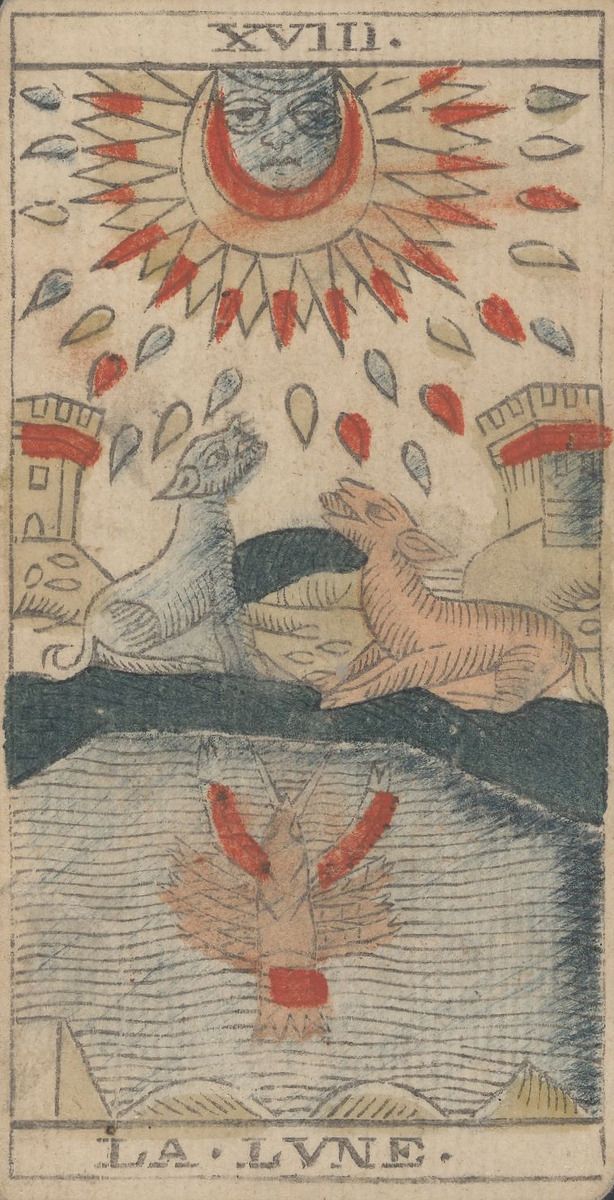
The Moon · Jean-Pierre Payen, blocks dated 1713 · Cary Collection of Playing Cards (FRA166), Beinecke Rare Book and Manuscript Library, Yale University. Prepared for print by Surrealium at Vaxholm Fortress, Sweden.
A red crustacean-like creature occupies the water near the lower edge, while two canine forms face upwards between the towers. Above them, the moon’s face sits within radiating shapes and descending drops. The image divides attention between several levels without showing a human observer who can explain the whole scene to us.
Describe those levels before deciding what they stand for. Water, ground, architecture and sky have different visual roles, and the animals connect the middle part of the card to the light above. The arrangement can support a reflection on partial understanding, but it does not prove that something threatening is hidden in a real situation you are asking about.
Upright: give uncertainty an accurate name
Upright Moon readings often consider intuition, ambiguity, dreams or misleading appearances. A useful reflective approach begins by asking which parts of your situation are observations and which are interpretations. An uneasy feeling is real as a feeling, but it is not automatically evidence that your explanation for it is correct.
Write down what you actually know in plain terms. Then list the questions that remain open. The card can help you tolerate that separation instead of rushing to a dramatic answer. If another person is involved, consider what could be clarified through a direct, proportionate conversation. A symbolic image should not replace the ordinary work of asking, listening and checking what can be checked.
The Star before the Moon
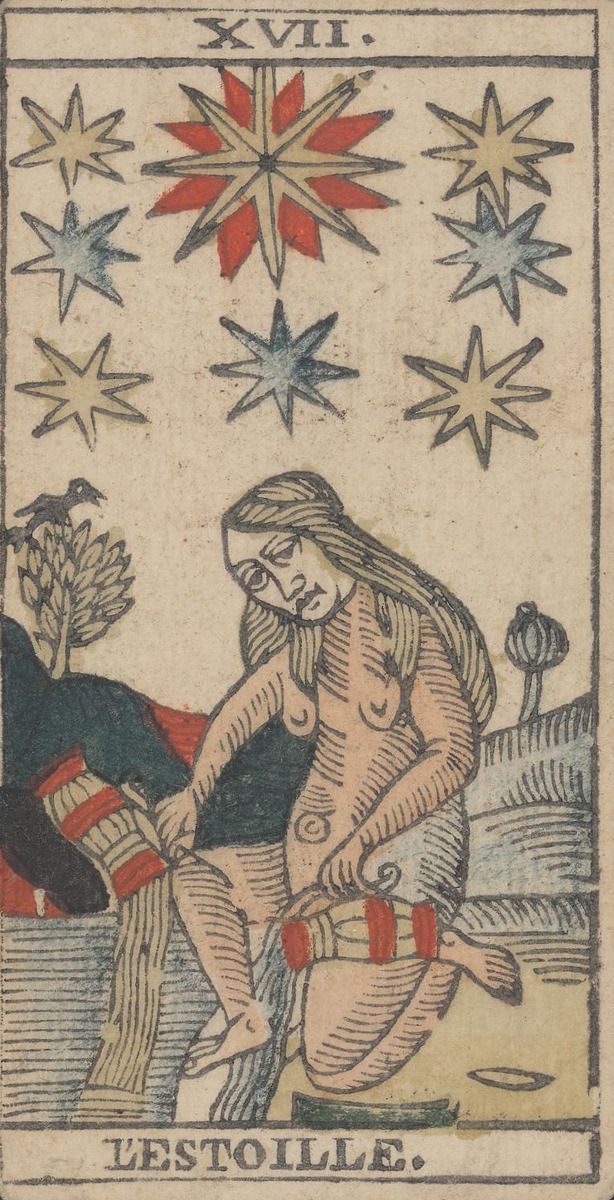
The Star · Jean-Pierre Payen, Tarot de Marseille, blocks dated 1713 · Cary Collection of Playing Cards (FRA166), Beinecke Rare Book and Manuscript Library, Yale University. Prepared for print by Surrealium at Vaxholm Fortress, Sweden.
The Star precedes the Moon in Marseille order. Its kneeling figure and open sky offer a different arrangement from the Moon’s separated towers and animals. The comparison can help distinguish an intention to remain hopeful from a need to establish what is clear.
Those needs can coexist. Hope does not require pretending that every impression is reliable, and uncertainty does not require abandoning all possibility. A reflective reading can ask what deserves care while also asking what needs verification. The sequence supplies a way to organise those questions, not a story in which one emotional state must always replace another on the way to a predetermined result.
Reversed: clarity is a process, not a revelation
Reversed Moon readings sometimes concern confusion beginning to lift, or a reluctance to examine an assumption. Neither interpretation establishes that a hidden truth has suddenly been exposed. A card’s orientation cannot authenticate a suspicion or tell you that another person has been dishonest.
If you use the reversed image as a prompt, ask what would make the situation clearer in a practical sense. More information, a calmer conversation or a written account of the question may help. You can also notice when repeated interpretation is making the uncertainty feel larger. The aim is to identify a useful next step, not to force a symbolic answer to settle something the available evidence has not settled.
The Sun after the Moon
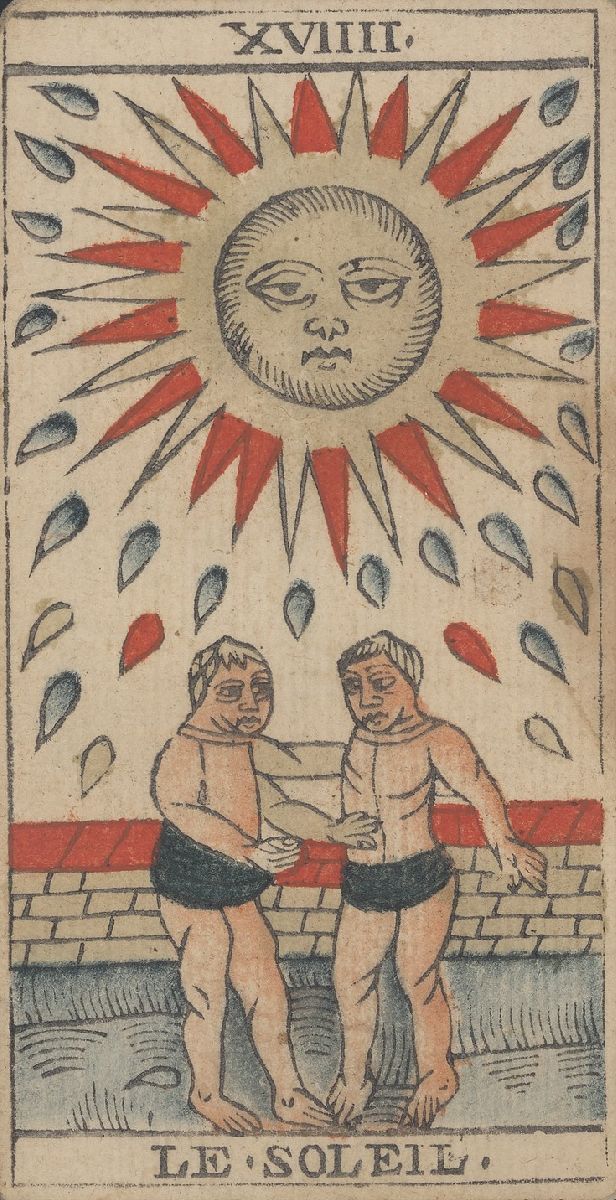
The Sun · Jean-Pierre Payen, blocks dated 1713 · Cary Collection of Playing Cards (FRA166), Beinecke Rare Book and Manuscript Library, Yale University. Prepared for print by Surrealium at Vaxholm Fortress, Sweden.
The next card is the Sun, whose large radiating face appears above two figures and a wall. Compared with the Moon’s divided landscape, the scene can suggest a more direct kind of visibility and contact. That difference is visible in the images before a reading tradition supplies its meanings.
It does not follow that every unclear situation will soon become simple or favourable. Use the comparison to ask what greater clarity would actually look like. Would you understand a decision, know which facts remain uncertain or have agreed on a next step with someone? A specific answer is more useful than waiting for a general promise that the fog will disappear.
The Hermit offers a smaller light
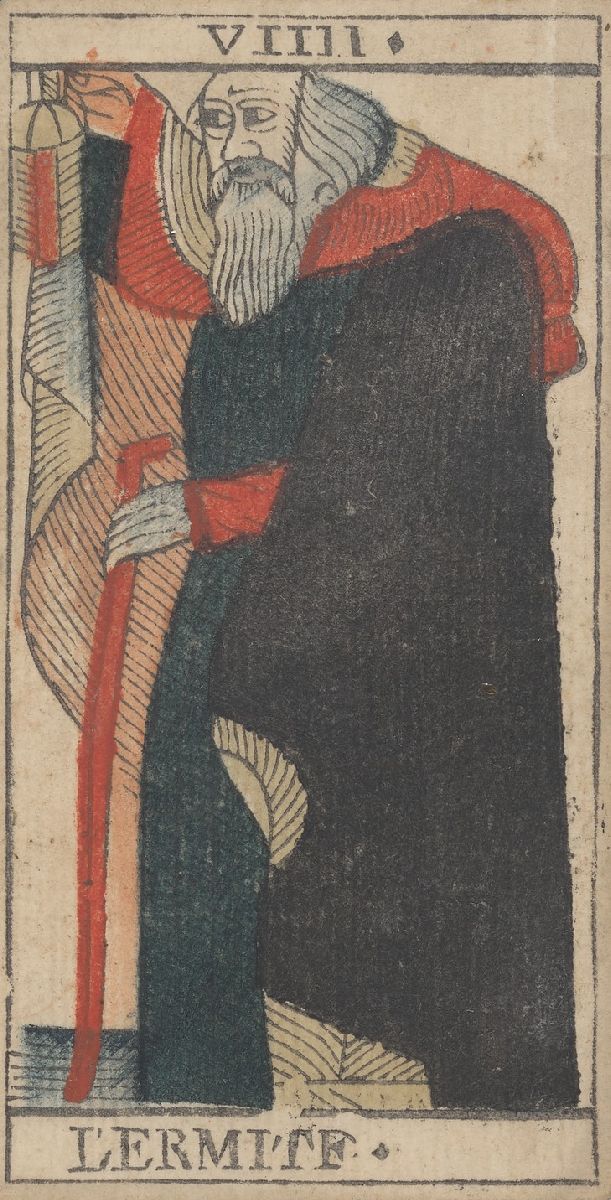
The Hermit · Jean-Pierre Payen, blocks dated 1713 · Cary Collection of Playing Cards (FRA166), Beinecke Rare Book and Manuscript Library, Yale University. Prepared for print by Surrealium at Vaxholm Fortress, Sweden.
The Hermit carries a small light close to the body rather than illuminating an entire landscape. Beside the Moon, that image can prompt a modest approach to an uncertain question: look carefully at the part you can examine instead of demanding a complete view all at once.
This is a contemporary reflective comparison, not a claim that the cards provide factual guidance beyond the evidence you already have. The Hermit card guide develops the theme of limited attention. Here the useful distinction is between wanting certainty about everything and finding one question that can be answered. A smaller, well-defined enquiry may reduce confusion more effectively than another broad interpretation.
Try a three-column reflection
Divide a page into “observed”, “inferred” and “unknown”. Put each part of the situation into the column that fits it best. If you cannot explain how an item was observed, it may belong among the inferences. An unknown can remain unknown without becoming proof of the most worrying possibility.
Choose one question that could move from the third column to the first through a practical action. Then stop the exercise. The Moon’s symbolic value here is the invitation to recognise partial knowledge and respond carefully to it. It is not a test of whether you possess a special intuition, and it should not be used to read another person’s private thoughts.
- Does the Moon card mean someone is lying?
- No. It can prompt reflection on uncertainty or assumptions, but it is not evidence of deception and cannot reveal another person’s private intentions.
- What does a reversed Moon mean in this guide?
- It raises questions about how clarity might develop or which assumptions need examination. It does not authenticate a sudden revelation or guarantee that confusion will end.
- Where is the Moon in the Marseille sequence?
- It is XVIII, following the Star and preceding the Sun. The page shows Payen’s historic Marseille image rather than the later Rider–Waite–Smith card.