The Star card: hope as an act of attention
Explore the Star card in Payen’s Marseille deck, with upright and reversed meanings framed as reflection rather than prediction.
The Star card shows a figure kneeling beneath a large star and several smaller ones, with vessels held towards the ground and water. Its open setting differs from the enclosed buildings and forceful figures elsewhere in the major arcana. Later readers often associate the image with hope, renewal and the possibility of returning attention to something beyond immediate strain.
The picture here is Jean-Pierre Payen’s Marseille Star, from Yale’s Cary Collection and blocks dated 1713. Its number is XVII. The major arcana guide explains its wider place, while Tarot de Marseille introduces the historic deck. The meanings below are reflective traditions, not promises that help or good fortune will arrive.
Start with the figure’s two vessels
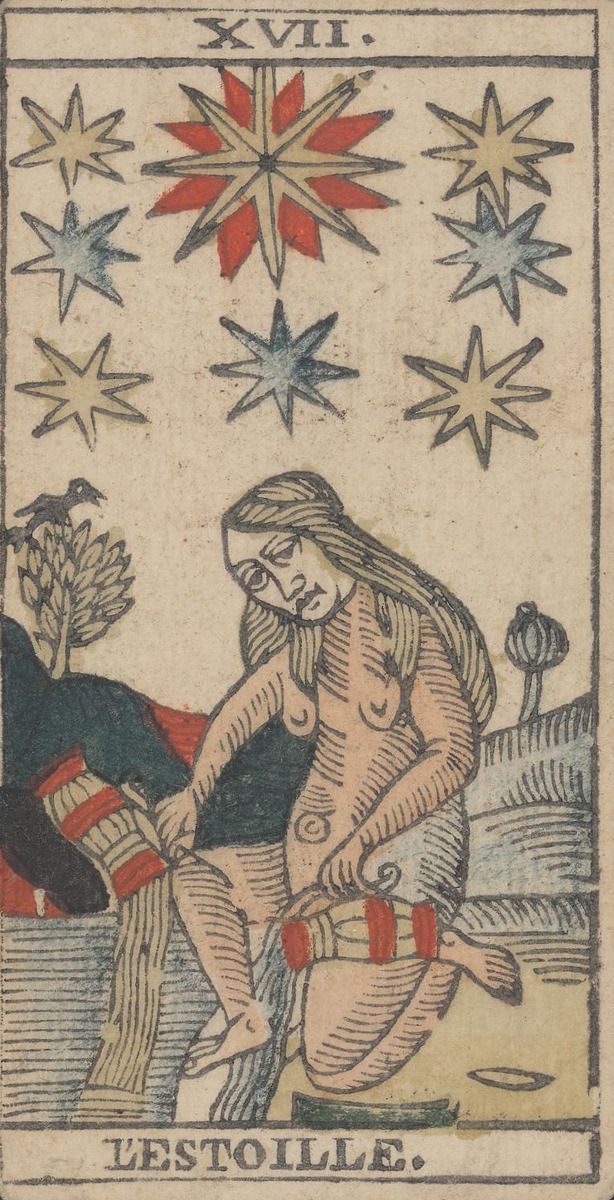
The Star · Jean-Pierre Payen, Tarot de Marseille, blocks dated 1713 · Cary Collection of Playing Cards (FRA166), Beinecke Rare Book and Manuscript Library, Yale University. Prepared for print by Surrealium at Vaxholm Fortress, Sweden.
The kneeling figure holds a vessel in each hand, with the arms reaching in different directions. The body occupies the lower part of the card, while the stars claim much of the space above. A small tree and bird-like shape appear to one side, adding another scale of life within the scene.
Look at the relationship between the large upper star and the practical activity below it. The image connects a broad sky with a small bodily action. That visible contrast supports a reading in which hope is not only a distant idea but also something expressed through attention and care. It does not tell us whose future will improve or when.
Upright: make hope specific enough to use
Upright Star readings commonly emphasise hope, openness and renewal. For reflection, ask what those words would mean in the circumstances you actually know. A hopeful action might be modest: returning to a neglected activity, making time for a conversation or noticing one thing that remains possible after a disappointment.
The card does not require forced optimism. You can acknowledge difficulty while identifying a small source of continuity or support. Avoid treating a hopeful interpretation as evidence that practical obstacles have disappeared. The useful shift is in attention: what can you see, receive or contribute now that was obscured by a more immediate concern? A clear answer can remain limited and still be worthwhile.
The Tower before the Star
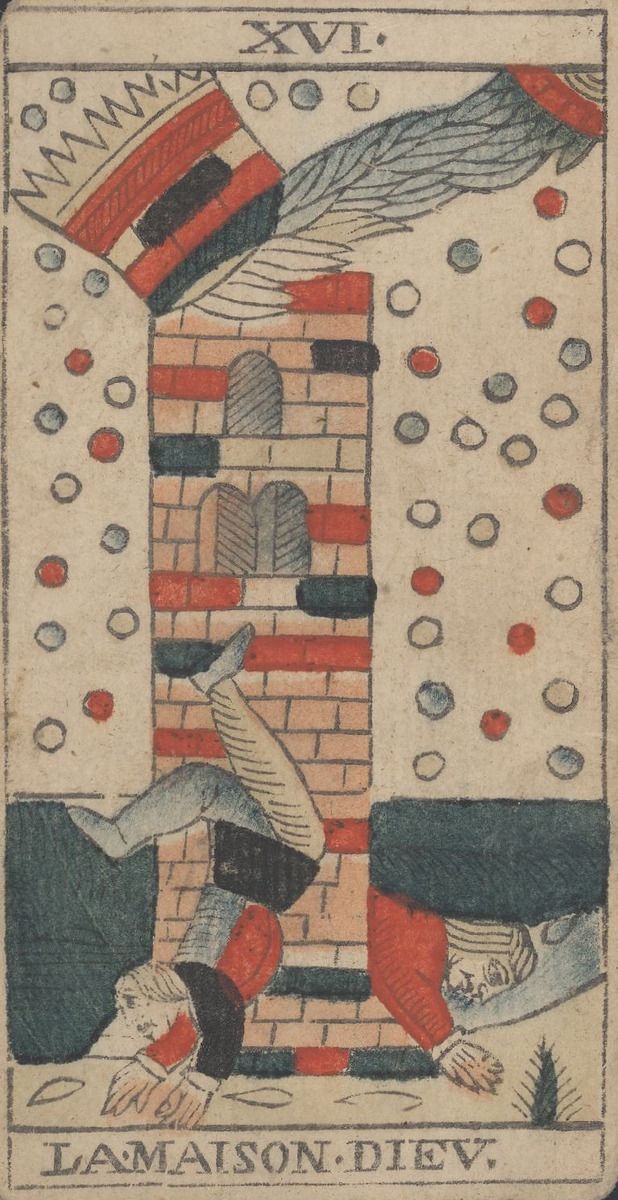
The Tower · Jean-Pierre Payen, Tarot de Marseille, blocks dated 1713 · Cary Collection of Playing Cards (FRA166), Beinecke Rare Book and Manuscript Library, Yale University. Prepared for print by Surrealium at Vaxholm Fortress, Sweden.
The Tower precedes the Star in the Marseille sequence. Its building, falling figures and forceful upper movement offer a strong visual contrast with the Star’s open ground and kneeling body. The difference makes it easy to read the sequence as a movement from disruption towards a quieter kind of attention.
Keep that reading symbolic. It is not a promise that every difficult event will be followed immediately by relief, or that distress is necessary in order to deserve renewal. The comparison can instead help name a change in the question you are asking: after attending to what has been unsettled, what needs care in the space that remains?
Reversed: notice the pressure to feel hopeful
Reversed Star readings often consider discouragement, distance from a source of inspiration or difficulty trusting a hopeful possibility. Those associations are prompts, not an assessment of someone’s mental health or a judgement that they are failing to think positively. A card cannot measure the seriousness of a person’s circumstances.
Ask whether the idea of hope has become another demand. You may be expecting yourself to feel certain before taking a small useful step, or comparing your response with someone else’s account of recovery. The reflective task is to reduce the demand to something observable. What would count as care today, even if a larger sense of confidence has not yet returned?
The Moon changes the light
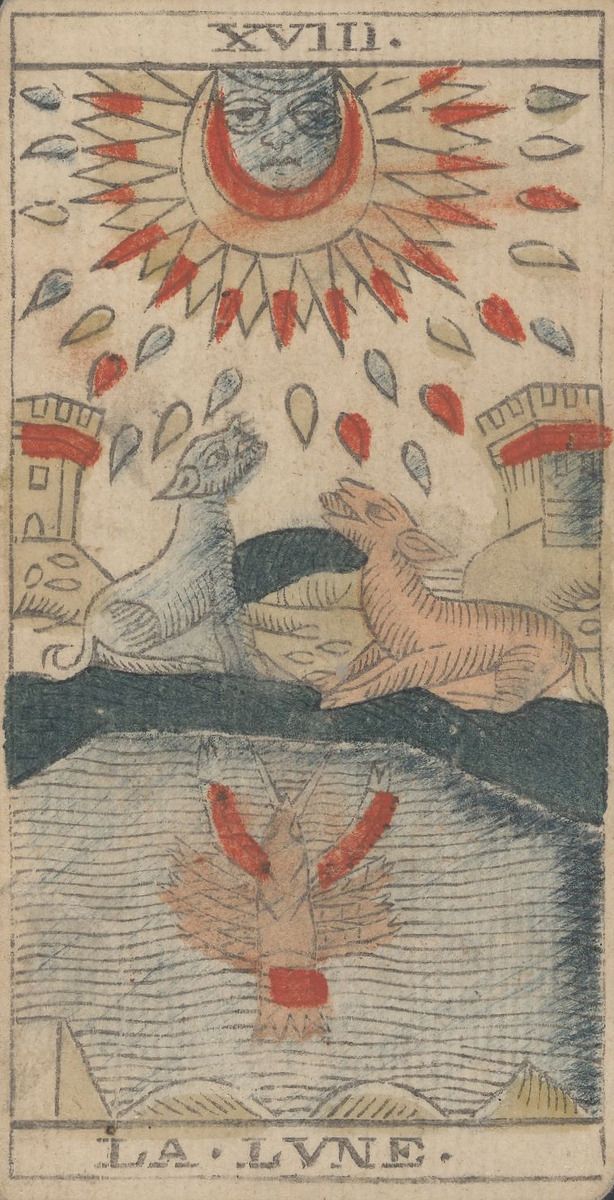
The Moon · Jean-Pierre Payen, blocks dated 1713 · Cary Collection of Playing Cards (FRA166), Beinecke Rare Book and Manuscript Library, Yale University. Prepared for print by Surrealium at Vaxholm Fortress, Sweden.
The next card is the Moon, with its face above towers, animals and a body of water. The landscape is more divided and its relationships less immediately open than the Star’s kneeling scene. The comparison can prompt questions about how hope and uncertainty coexist rather than treating them as mutually exclusive states.
A hopeful intention does not make every impression reliable. You may still need to ask questions, check assumptions and allow a situation to remain unresolved. In a reflective reading, the sequence can hold both possibilities: something invites renewed attention, while other things remain unclear. The cards do not reveal hidden facts; they offer different images through which to examine your own response.
Compare the Sun without promising a happy ending
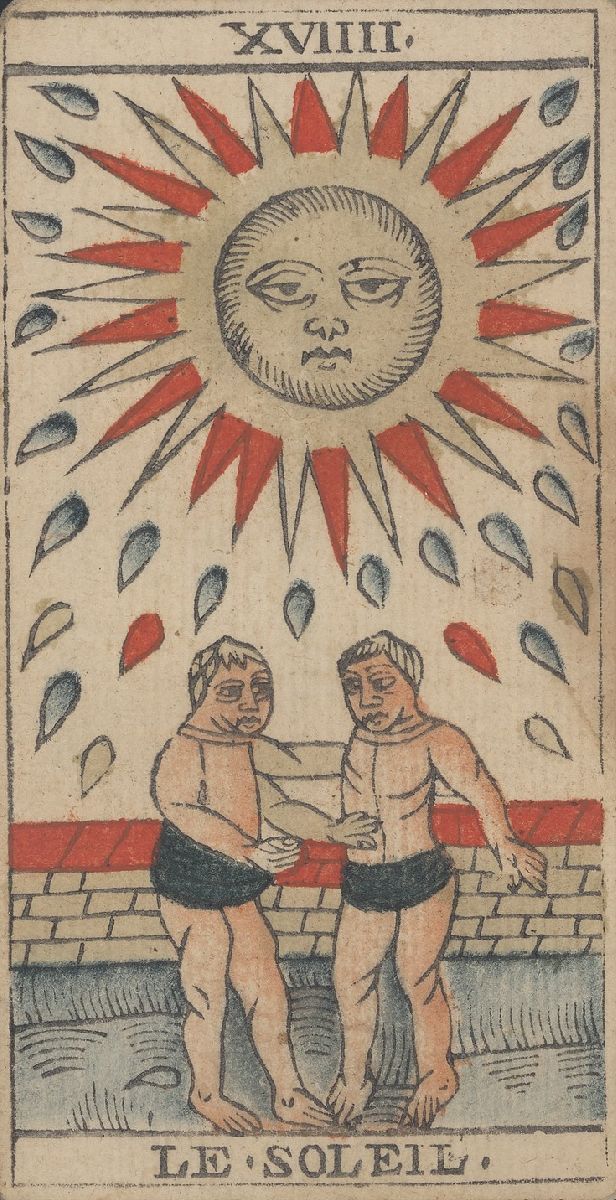
The Sun · Jean-Pierre Payen, blocks dated 1713 · Cary Collection of Playing Cards (FRA166), Beinecke Rare Book and Manuscript Library, Yale University. Prepared for print by Surrealium at Vaxholm Fortress, Sweden.
Payen’s Sun places two figures beneath a large radiating face, with a low wall behind them. Its strongly defined central image offers another kind of openness, different from the small stars spread above the solitary kneeling figure. Comparing the cards can help distinguish quiet replenishment from a more outward, shared scene.
The Sun card guide continues that comparison, but the sequence should not become a forecast that every uncertainty will resolve favourably. Look at the arrangements rather than imposing a timetable. One card may help you reflect on a private act of care; another on connection or visibility. Both remain ways of asking questions about life, not evidence of what life will deliver.
Write a reflection that allows uncertainty
Complete two sentences: “Something I can still care for is…” and “One small action that supports it is…”. Keep the answers specific enough to recognise in an ordinary day. If your first response becomes a promise about another person or a future event, rewrite it as an action or observation that belongs to you.
Then allow the reflection to end. You do not need to repeat the reading until it supplies certainty. The Star can serve as a reminder to notice a possible source of continuity without denying what remains difficult. A small, honest statement of attention is more useful than an elaborate prediction dressed in the language of hope.
- What does the Star mean upright?
- It is commonly associated with hope, renewal and openness. Here those themes become questions about attention and care, not predictions of a favourable outcome.
- Is the Star a guarantee that things will get better?
- No. The image can support a hopeful reflection, but it does not remove practical obstacles or establish what will happen next.
- What comes before and after the Star in Marseille?
- The Tower precedes it and the Moon follows it. The Star is XVII in the sequence shown here.