The Tower card: upheaval without a prophecy
The Tower card’s falling figures and open crown, with historic comparisons and upright and reversed meanings as reflective questions.
The Tower card is commonly associated with disruption, exposure and a structure that no longer holds. It does not predict a disaster. A reflective reading can use its dramatic image to ask what has already changed, which assumption needs checking, or where a plan has proved less solid than it looked.
Payen’s card is titled La Maison Dieu. Its coloured shapes, falling figures and displaced top create an event without providing a narrative explanation. Begin there. The more frightening a card appears, the more useful it is to distinguish the visible picture from a claim about your future. The major arcana guide locates it among the other trumps.
A building, two bodies and scattered colour
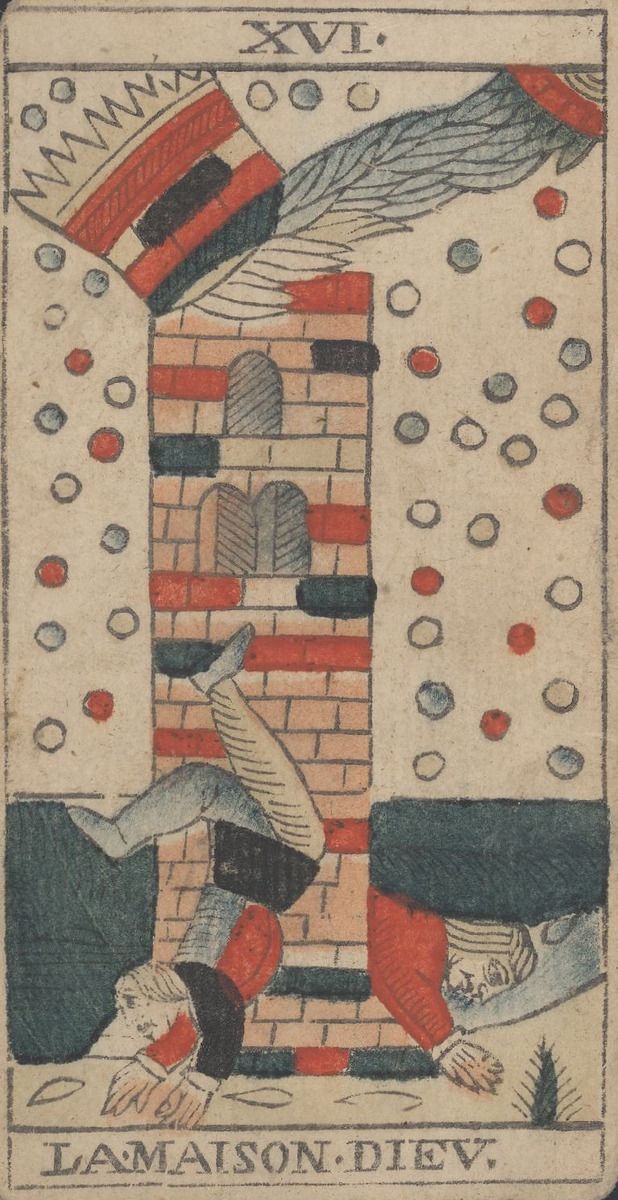
Tower — Jean-Pierre Payen, 1713. Beinecke Rare Book and Manuscript Library, Yale University. Prepared for print by Surrealium at Vaxholm Fortress, Sweden.
The tower rises almost to the top of the card. Its crown-like upper part tilts away, while two figures appear low beside the building. Small coloured circles fill much of the surrounding space. A broad shape crosses the sky towards the opened top, but the drawing does not supply a caption explaining every detail.
A modern viewer may immediately name lightning, punishment or collapse. Those associations belong to the act of reading, and they should not replace description. Notice the bands of brickwork, the position of the hands and the space around the figures. The whole composition is stranger than a generic illustration of a ruined house. In the Marseille tradition, a forceful printed outline can carry ambiguity as well as drama.
Upright: begin with what has actually happened
For an upright Tower reflection, start with a change you already know about. Perhaps a plan was cancelled, an explanation proved incomplete, or a process failed under ordinary pressure. Naming the event prevents the card from encouraging a search for disasters that have not occurred.
Next separate the event from the story you immediately told about it. “The venue is unavailable” differs from “Nothing ever works for me”. The first statement can be checked and acted on; the second is a broad conclusion that the picture cannot support. A symbolic reading may help expose that difference. It should not demand that you call an unwanted change a gift, or insist that everything broken needed to be broken. Disruption can simply be difficult.
Five coins are a different kind of pattern
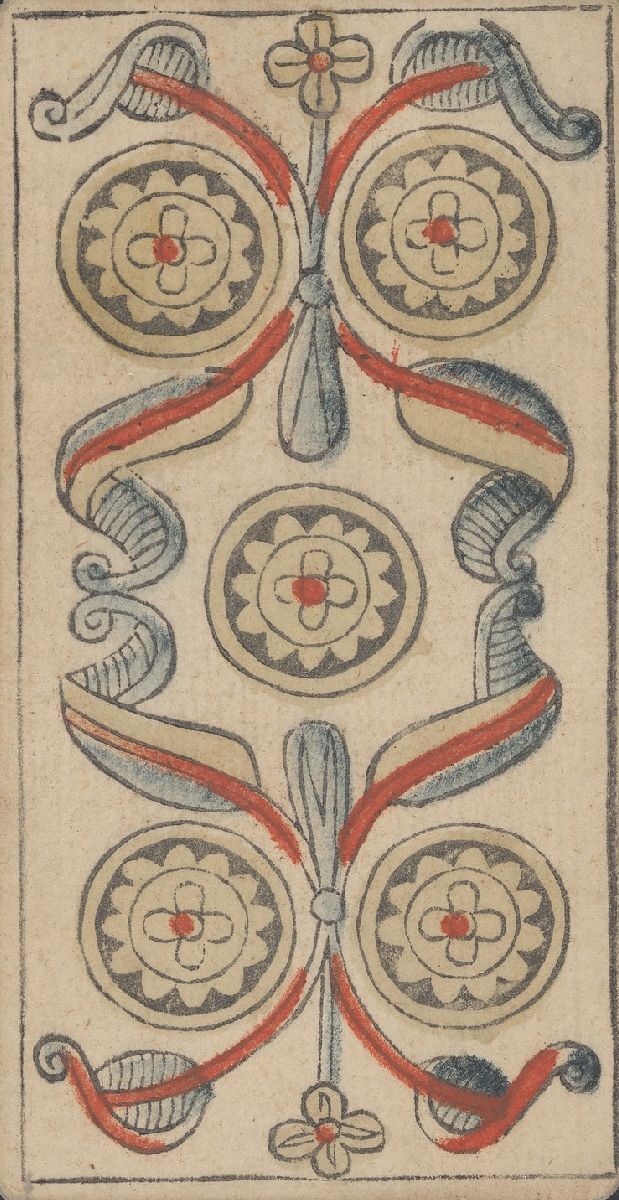
Coins Five — Jean-Pierre Payen, 1713. Beinecke Rare Book and Manuscript Library, Yale University. Prepared for print by Surrealium at Vaxholm Fortress, Sweden.
Payen’s Five of Coins arranges five circular emblems among curling stems. Nothing in the image depicts a falling building. Its inclusion here offers a quieter comparison: a pattern can remain readable even when its symmetry is more complex than a pair or a square. Count the emblems and follow the lines between them.
Modern readers sometimes connect this suit card with material difficulty, but those associations do not turn the old ornament into a picture of poverty. Let the comparison stay modest. After the Tower’s spectacular scene, a patterned pip card can redirect attention towards what can be counted, described and organised. It offers a different visual tempo, not a second prediction or a secret explanation of the event in the trump.
Reversed: resistance, aftermath or a smaller revision
Reversed Tower interpretations vary. Some readers consider resistance to change; others attend to an internal shift or the aftermath of a disruption. Rather than selecting the most alarming option, ask which question matches something observable. You may be revising a belief quietly without any public upheaval at all.
Try identifying one assumption that your plan relies on. Is it still true? If you do not know, find a way to check. A reversed card is not proof that you are repressing a terrible truth, nor does it certify that a crisis has been avoided. It can simply make room for reconsideration. The useful result is a clearer question and a proportionate next step, not a dramatic story that outruns the facts.
Nenbroto belongs to another sequence
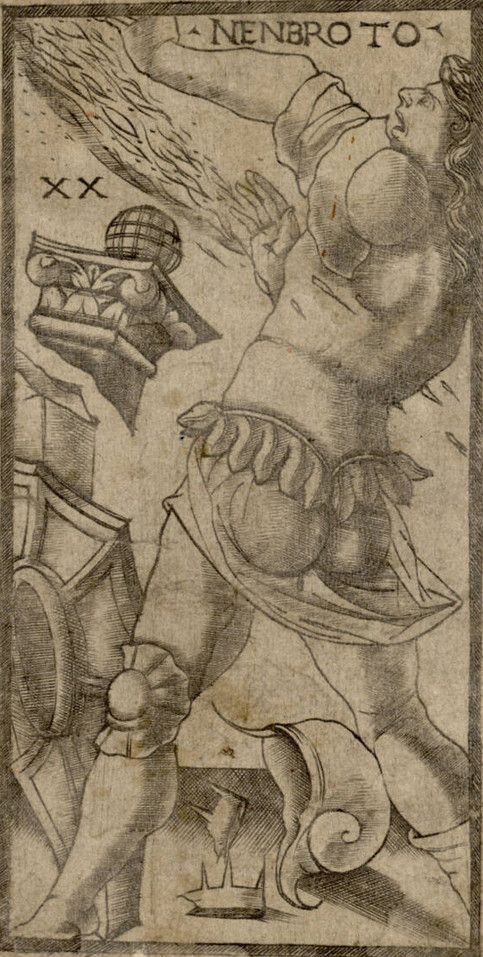
20 Nenbroto — Unknown engraver, Sola Busca deck, c. 1490. ALBERTINA, Vienna. Prepared for print by Surrealium at Vaxholm Fortress, Sweden.
The Sola Busca engraving Nenbroto shows an armoured figure and a forceful sweep of flame or light. Its name and number XX belong to that deck’s own sequence. It is not a surviving medieval Tower card, even if its dramatic energy invites comparison. Preserving its label is part of looking honestly at it.
Payen’s Tower is XVI, between the Devil and the Star. A contemporary reader may connect those neighbours with constraint, disruption and renewed orientation. That is a possible arrangement of themes, not a promise that events will occur in that order. The historical difference between packs is useful precisely because it stops one familiar interpretation from becoming the only story the images are allowed to tell.
Separate the rubble from the next task
Make two short lists. On the first, put the things you know have changed. On the second, put the things that remain available: people you can contact, records you can check, tasks that still have a purpose. Keep both lists factual and small enough to read at a glance.
Choose one action from the second list. It might be a conversation, a correction or a pause while information arrives. Then return to the card and notice whether the picture feels different after that practical inventory. There is no required emotional result. You need not become grateful for difficulty or interpret discomfort as a lesson. A useful reading leaves you with more clarity about the present, rather than more certainty about an unknowable future.
- Does the Tower card mean disaster?
- No. The card cannot predict a disaster. Its imagery can prompt reflection on a known disruption, an exposed assumption or a structure that needs revision.
- Is the Tower reversed better?
- There is no objective better or worse orientation. Reversed readings vary and may focus on resistance, quieter change or aftermath; choose questions that fit observable circumstances.
- Why is the old card called La Maison Dieu?
- That is the French title on the Marseille pattern shown here. It belongs to the card’s historical vocabulary; the dramatic picture should not be reduced to a single modern keyword.