The Devil card: looking at bonds and choices
The Devil card’s historic image, upright and reversed traditions, and a practical way to reflect without blame or prediction.
The Devil card can be unsettling, but drawing it is not evidence of evil, danger or a curse. In modern symbolic readings it often brings attention to attachment, pressure and choices that feel difficult to make. Those are subjects for careful reflection, not a reason to label yourself or somebody else.
Payen’s historic image is crowded with hybrid bodies and unfamiliar faces. Its strangeness deserves a close look before a modern keyword is attached. Other early packs used entirely different trump subjects, so a matching number alone cannot identify an older “Devil”. The major arcana guide helps keep the present card within its own sequence.
An image designed to disturb ordinary categories
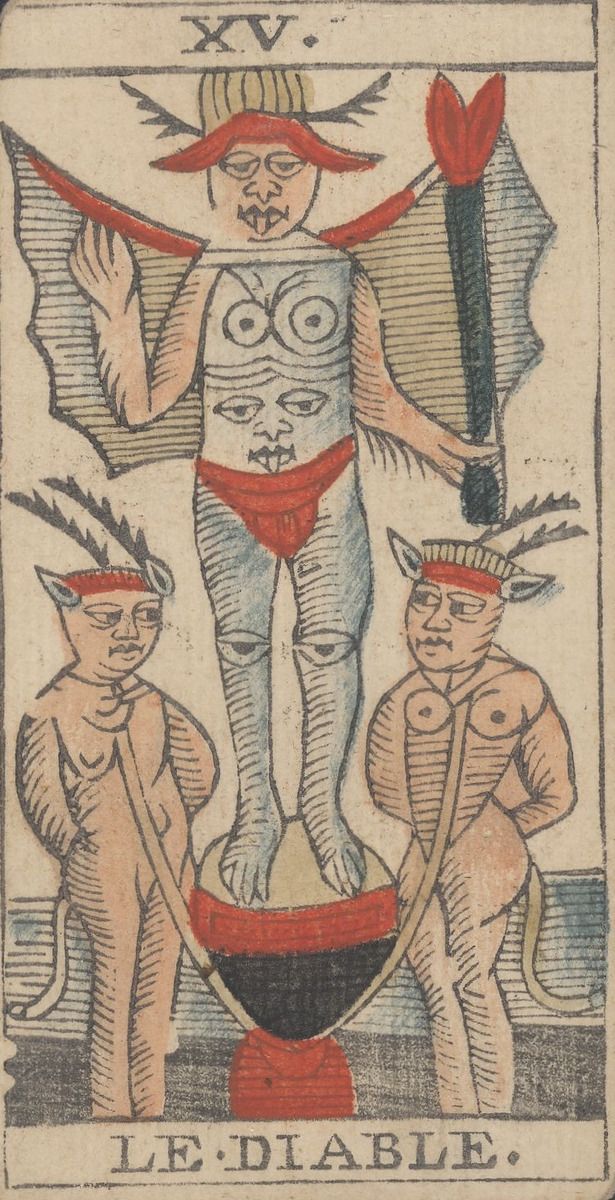
Devil — Jean-Pierre Payen, 1713. Beinecke Rare Book and Manuscript Library, Yale University. Prepared for print by Surrealium at Vaxholm Fortress, Sweden.
The central creature in Payen’s card combines horns, wings, claws and several face-like features. Two smaller figures stand below, linked to the raised platform. The large body occupies the middle, while the smaller pair make its scale more emphatic. Red and blue divide parts of the figure that ordinary anatomy would keep together.
Describe those features without making them stand for particular people. The picture is a printed fantasy of a devil, not a portrait or a diagnostic chart. Its theatrical body makes boundaries between human and animal unstable. That can encourage questions about what feels unfamiliar or difficult to name, but the image does not tell you why you feel it. The Marseille deck story provides its material and visual context.
Upright: name a pattern without blaming yourself
An upright Devil interpretation often examines a bond or habit that has become costly. Begin with an observable pattern: staying longer than you intended, agreeing before you have considered a request, or returning to an activity that leaves you dissatisfied. The purpose is to describe the pattern accurately, rather than calling it a personal defect.
There may be practical constraints behind the feeling of being stuck. Time, money, employment, care responsibilities and another person’s behaviour can limit your options. The card does not prove that those limits are imaginary. Separate one thing you can change from one thing that needs help, negotiation or more information. This keeps the reflection grounded and prevents the old image’s chains from becoming a glib instruction simply to walk away.
Eight swords without a captive
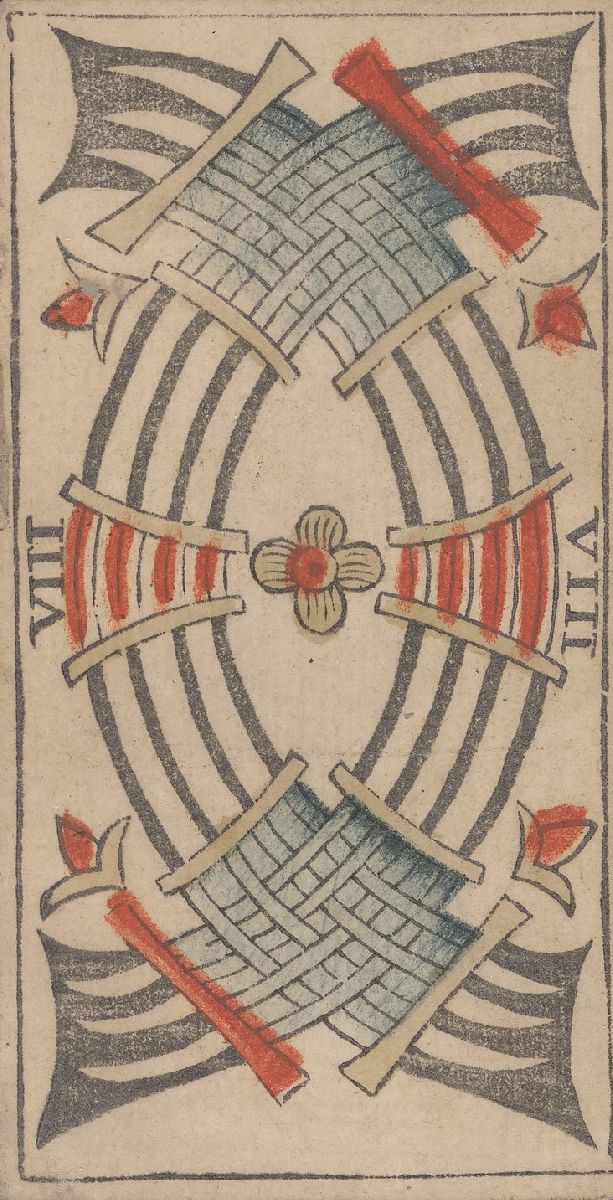
Swords Eight — Jean-Pierre Payen, 1713. Beinecke Rare Book and Manuscript Library, Yale University. Prepared for print by Surrealium at Vaxholm Fortress, Sweden.
Payen’s Eight of Swords is an arrangement of curved blades around a central ornament. It contains no blindfolded person. That difference matters because later illustrated tarot packs often attach a human scene to the suit number, and readers can accidentally import it into an older card where it is absent.
Here the comparison is formal: curved lines create an enclosure, while the central flower remains clearly visible. You may find that arrangement suggestive of limits, protection or repetition. Those are your responses to a design, not a recovered instruction from the printer. Keeping observation and interpretation separate gives the exercise more room. It also prevents a modern story about helplessness from swallowing the actual historic picture in front of you.
Reversed: a small opening is still specific
A reversed Devil is sometimes read as loosening a bond, recognising a pattern or reconsidering a dependency. It can also describe an incomplete attempt to change something. Choose whichever question fits the facts; the reversed orientation does not confirm that a difficult situation is over.
What would a small opening look like in practice? It might be delaying an automatic answer, asking a trusted person to help with a plan, or removing one unnecessary obligation. Keep the step proportionate to your circumstances. Do not use the card to decide whether someone is safe, whether a treatment is needed or whether a serious risk has disappeared. The reflective part is the naming of a choice; real decisions need information and support appropriate to the situation.
Olivo is not an early Devil
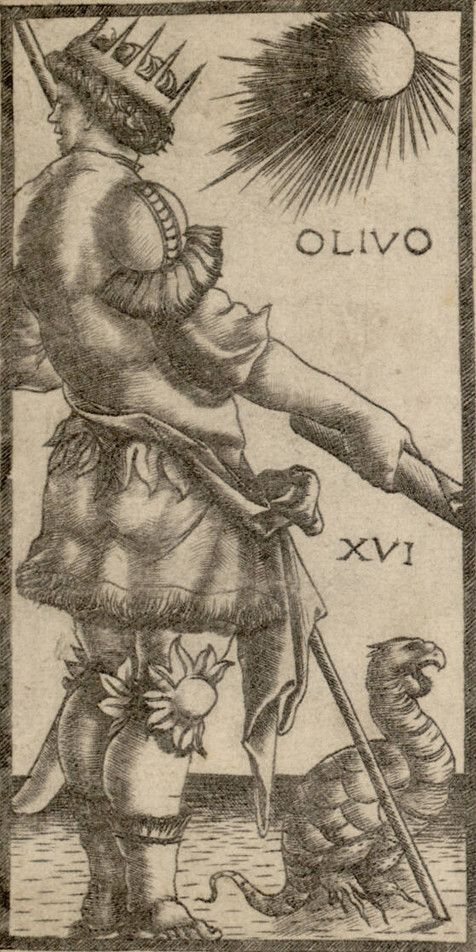
16 Olivo — Unknown engraver, Sola Busca deck, c. 1490. ALBERTINA, Vienna. Prepared for print by Surrealium at Vaxholm Fortress, Sweden.
The uncoloured Sola Busca engraving labelled Olivo shows an armoured figure with a torch-like object, a shield and military equipment. Its number is XVI. It is included to show how different an early trump sequence could be, not as a hidden form of Payen’s Devil. A number and an imposing figure do not make two cards equivalent.
In Payen’s sequence the Devil is XV, after Temperance and before the Tower. A modern reflection might compare moderation, constraint and disruption. That is one possible sequence of questions, not evidence of an ancient universal system. Historical packs retain their own names and structures, and a useful reading should not have to erase those differences to make sense.
A reflection with an exit
Write down one repeated situation you would like to understand. Under it, list the immediate reward, the later cost and the support that could make a different response easier. Do not assume that all three are obvious. A pattern can persist because it meets a real need, even when its consequences are unwelcome.
Then choose whether to continue the exercise. An unsettling image does not demand your attention, and leaving a reading is a valid choice. If you continue, end with a concrete observation rather than a label: “I agree before checking my calendar” is more useful than “I am weak”. The first sentence can lead to an experiment. The second closes down the curiosity that brought you to the card.
- Is the Devil card a bad omen?
- No. Drawing a card supplies no evidence of a curse, approaching harm or moral failure. Its imagery can be considered symbolically, or set aside if it is unhelpful.
- Does the Devil mean addiction?
- Some traditions connect it with dependency, but a card cannot diagnose addiction or another condition. Use ordinary evidence and appropriate professional support for health concerns.
- What can the reversed Devil mean?
- It can frame questions about loosening a pattern, recognising constraints or attempting change. It does not guarantee release, and it should not make real limitations seem like personal failings.