The Emperor card: authority in the old decks
The Emperor card, from a gilded Milanese throne to Payen’s woodcut: upright and reversed meanings as prompts for reflection.
The Emperor card gives authority a visible shape: a crown, a seat, an emblem and a body that seems difficult to move. In modern tarot interpretation it often concerns structure, responsibility and boundaries. Those themes can be useful questions; a card cannot tell you who should command your life or guarantee that a plan will succeed.
Begin with the pictures. Jean-Pierre Payen’s 1713 Emperor and the much earlier Visconti di Modrone Emperor both occupy positions of power, but their surroundings differ sharply. Reading those differences is more rewarding than treating every sceptre as a universal code. Our guide to the major arcana places the figure within the larger sequence.
A ruler made from a few strong lines
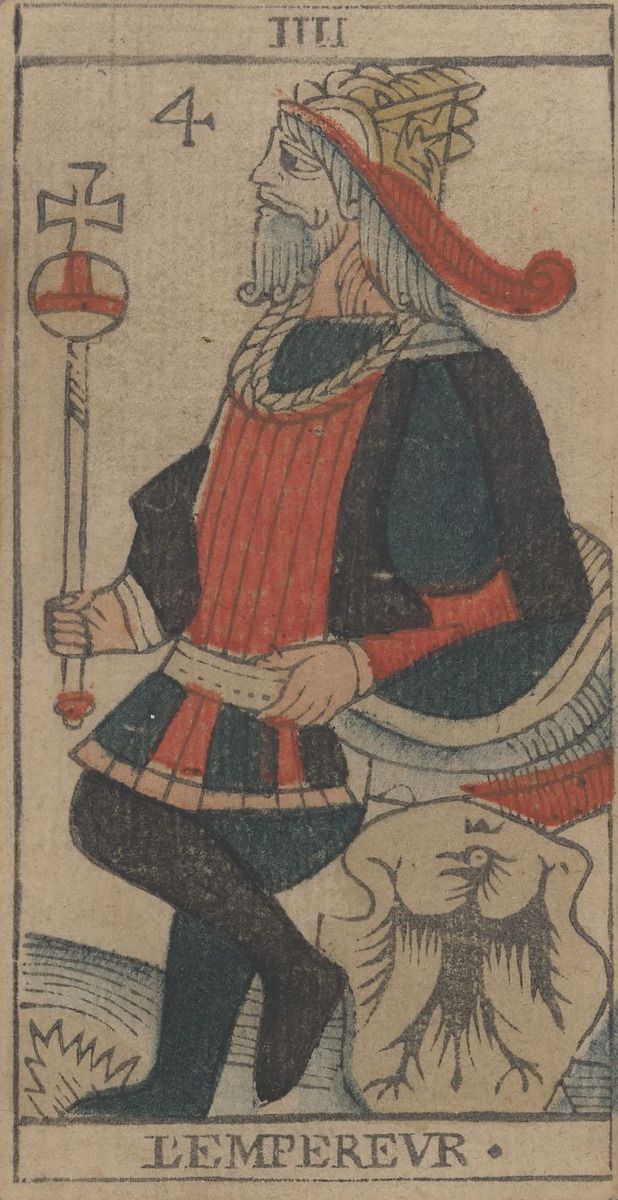
Emperor — Jean-Pierre Payen, 1713. Beinecke Rare Book and Manuscript Library, Yale University. Prepared for print by Surrealium at Vaxholm Fortress, Sweden.
Payen’s Emperor turns in profile. His legs cross; one hand holds a sceptre while an eagle occupies the shield below. Red and blue divide the costume into large, readable areas. The crown, beard and emblem supply the vocabulary of rulership without requiring a detailed palace behind him. Even on a small card, the picture declares a rank.
Notice the difference between that declaration and the sitter’s mood. A profile can appear watchful, remote or merely conventional; the image does not tell us which. Start by naming what is present before assigning a temperament. The crossed legs are a visible arrangement, not proof that this historical printer meant stubbornness. Payen worked within an established card pattern, one discussed in the Marseille deck’s art story.
Upright: make responsibility specific
An upright Emperor can be read as an invitation to give a responsibility a workable form. That might mean setting a meeting time, agreeing who will make a decision, or writing down a boundary that has remained vague. The useful question is what a structure makes possible for the people inside it.
A household plan offers an ordinary example. Saying that somebody should take charge leaves the difficult details untouched. Agreeing who will collect the keys, who will pay a shared bill and when the arrangement will be reviewed creates something testable. This interpretation concerns your own choices and agreements. It does not establish that the loudest person is the natural leader, or that someone else’s control deserves your obedience. Authority can be shared and checked.
The earlier throne has an audience
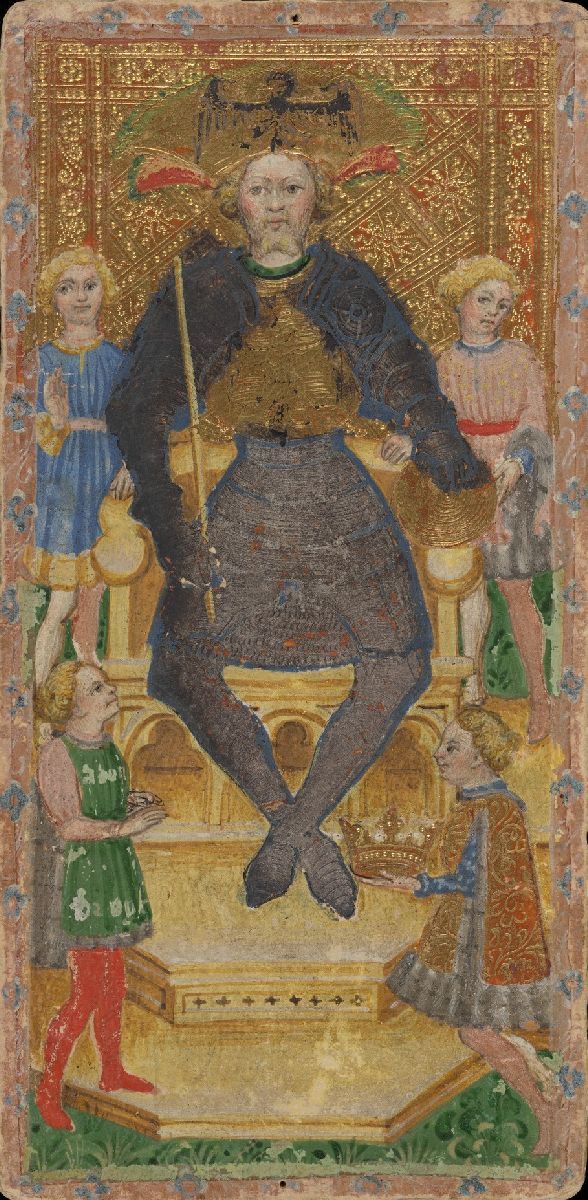
Emperor — Unknown Milanese workshop, Visconti di Modrone deck, c. 1440–1445. Beinecke Rare Book and Manuscript Library, Yale University. Prepared for print by Surrealium at Vaxholm Fortress, Sweden.
The Visconti di Modrone card, preserved at Yale, surrounds its enthroned Emperor with attendants and a patterned gold field. The frontal arrangement makes a public display of his position. Compare the many small bodies here with Payen’s isolated profile: one image presents a court around a ruler, while the other compresses rulership into a few attributes.
These are different historical objects, not successive drafts of a single psychological diagram. The painted Milanese pack belongs to a fifteenth-century courtly setting; Payen’s card is a later printed woodcut with stencil colour. Their material differences matter. Gilding announces expense and brilliance, whereas a repeatable outline can travel across many packs. Both can prompt reflection now without implying that their makers used today’s upright and reversed meanings.
Reversed: ask whom the rules serve
Reversed readings often turn the Emperor’s structure towards rigidity, excessive control or a lack of dependable boundaries. Those are alternatives to examine, not a verdict on a person. A rule can be too strict in one respect and too vague in another. Ask for an example before deciding which description fits.
If a process keeps failing, write down what actually happens: a deadline changes without notice, a task has two owners, or nobody can explain who may approve it. Then consider one adjustment that can be discussed openly. Do not use the card to diagnose a parent, partner or manager, and do not read it as an instruction to endure mistreatment. A symbolic exercise has value only while it leaves room for evidence, consent and your own judgement.
A king is a comparison, not a duplicate
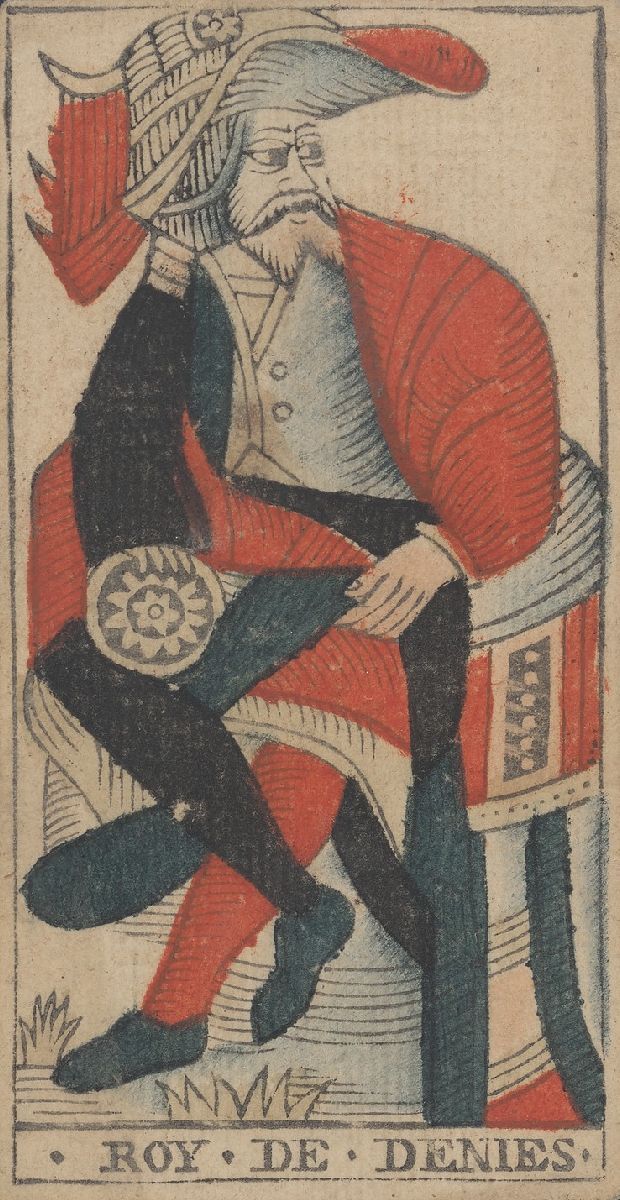
Coins King — Jean-Pierre Payen, 1713. Beinecke Rare Book and Manuscript Library, Yale University. Prepared for print by Surrealium at Vaxholm Fortress, Sweden.
Payen’s King of Coins also sits with crossed legs and a large emblem in his hand. Set the two pictures beside each other and the visual family resemblance becomes clear. The Emperor belongs to the trump sequence; the King belongs to a suit. Similar poses do not make them interchangeable cards.
In the usual Marseille order the Emperor is IV, after the Empress and before the Hierophant. One possible modern reading moves from provision to civic structure and then to shared teaching or institutions. That is a way of arranging a reflection, not a recovered medieval lesson. You can compare the actual neighbouring images without assuming that every historical player understood the sequence as a spiritual journey.
A short exercise with a review date
Choose one area where you want more order. Divide a page into three parts: the responsibility, the person who has agreed to hold it, and the point at which the arrangement will be reconsidered. Leave blank anything you do not yet know. A blank is often more informative than an impressive but untested plan.
Look back at the Emperor’s shield. What protects the people affected by your arrangement? A useful boundary may protect time, privacy, money or the ability to say no. Finish with one conversation you can actually have, rather than a forecast about how others will respond. If the card brings up a complicated relationship with authority, it is also reasonable to stop the exercise and choose another image.
- What does the Emperor card mean?
- In common modern readings it concerns authority, boundaries and practical structure. Here those ideas are questions about responsibilities you can identify and discuss, rather than predictions about power or success.
- Does the Emperor always represent a man?
- No. The historic image depicts a male ruler, but a reflective reading need not assign the card to a particular gender, parent or partner. It can concern an agreement, institution or role.
- Is the Emperor reversed a bad sign?
- It is not evidence that something bad will happen. It can prompt you to examine rigidity, confusion about responsibility or a boundary that needs attention, using the facts of your situation.