The Hierophant: the picture behind the teacher
Payen’s Pope shows religious authority and an audience. Explore the later Hierophant name, tradition and independent judgement.
The Hierophant is called the Pope in the historic Marseille card shown here. That name matters: the triple crown, staff and raised hand belong to a specific image of religious authority, not an abstract modern life coach. Later readers expanded the figure into a symbol of teaching, tradition and institutions. A thoughtful reading can hold both layers at once, asking what a tradition gives you and how you decide whether its authority deserves your trust.
A blessing with an audience
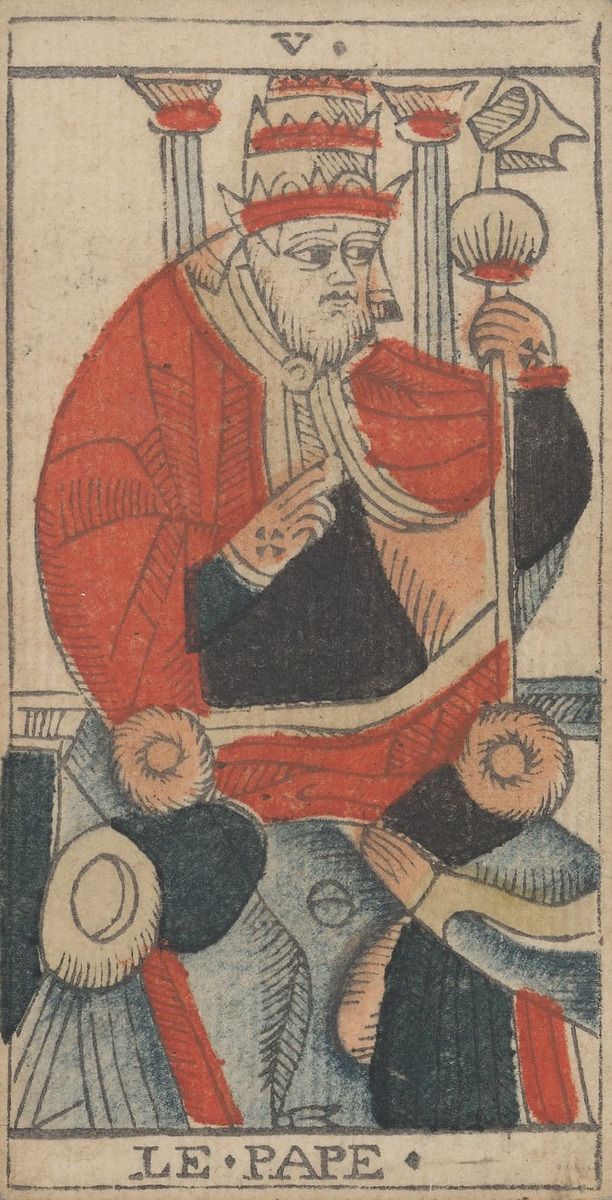
The Pope · Jean-Pierre Payen, Blocks dated 1713 · Payen Marseille deck, FRA 166, Beinecke Rare Book and Manuscript Library, Yale University. Prepared for print by Surrealium at Vaxholm Fortress, Sweden.
Payen’s seated figure wears a tall, tiered crown and holds a staff with a cross at its upper end. One hand is raised. In the foreground, two smaller heads turn towards him. The arrangement immediately establishes a relationship: one person occupies a central elevated position, while others attend from below. Costume and composition tell us about rank before any interpretive vocabulary is added.
The two foreground figures are especially useful to notice. Without them, we might read the image solely as a portrait of power; with them, it becomes a scene of authority being received. What makes the listeners willing to attend? The picture does not answer. A modern reflection can therefore examine both sides of a teaching relationship: the responsibility of the person speaking and the judgement of the person who listens. Neither side disappears simply because the setting is ceremonial.
Why the name changed
Hierophant is a later name familiar from modern occult tarot. It broadens the association towards a religious teacher or revealer of sacred things. The historic label LE PAPE remains plainly visible on Payen’s card, and should not be erased by applying the newer name retrospectively to its printed surface. A reading tradition may rename an image without changing where that image came from.
The history of tarot follows the distance between playing cards and later interpretive systems. Our Marseille art story keeps attention on the actual pack. These contexts are useful if you have no religious affiliation, or have complicated feelings about institutions. You can consider the figure critically. Understanding its imagery does not require accepting its authority, sharing its beliefs or treating a historic social hierarchy as a model to reproduce.
Between a ruler and a choice
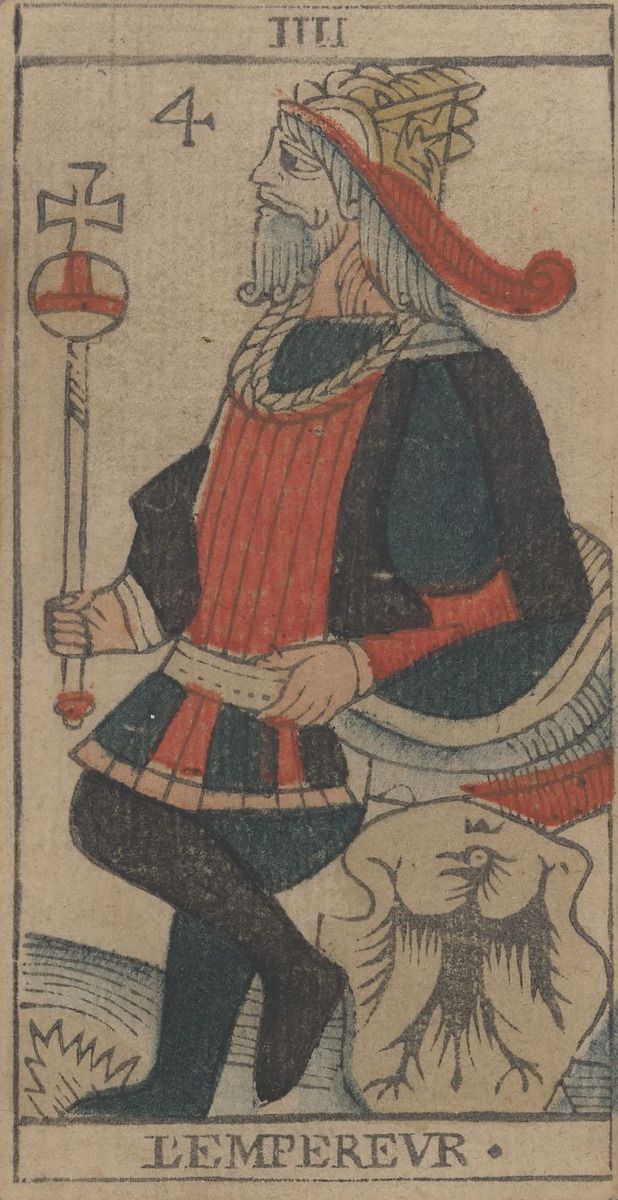
The Emperor · Jean-Pierre Payen, Blocks dated 1713 · Payen Marseille deck, FRA 166, Beinecke Rare Book and Manuscript Library, Yale University. Prepared for print by Surrealium at Vaxholm Fortress, Sweden.
The Pope is numbered V in this deck. He follows the Emperor and precedes the Lovers. Placing the cards together lets you compare different kinds of authority: the Emperor’s political regalia, the Pope’s religious office and the interpersonal scene that follows. This is a way to read the sequence visually, not proof that its first makers intended a modern psychological lesson.
The Emperor shown here turns his body while retaining a sceptre and eagle shield. The Pope faces an audience more directly. Those compositional differences can suggest questions about command, explanation and participation. In the major arcana guide, the figures sit among virtues and other public images. They come from a shared cultural repertoire; reducing each one to a private personality type loses some of that breadth.
Upright: learn from something that lasts
An upright Hierophant is often interpreted through established teaching, shared practice or belonging to a community. For reflection, ask what knowledge you can learn from a reliable source rather than improvising alone. A craft tradition, a professional method or a regular gathering can give useful structure. Repetition can make attention easier, especially when a task feels too large to begin from nothing.
The value of a tradition is not that it has never changed. It may be valuable because people have tested, corrected and transmitted it over time. Look for the places where a teacher explains the reasons behind a practice and welcomes a reasonable question. Those are observable features you can assess. The card cannot certify someone’s wisdom, and a ceremonial title does not remove the need to check what they say against evidence and your own considered values.
Reversed: distinguish dissent from reflex
The Pope · Jean-Pierre Payen, Blocks dated 1713 · Payen Marseille deck, FRA 166, Beinecke Rare Book and Manuscript Library, Yale University. Prepared for print by Surrealium at Vaxholm Fortress, Sweden.
A reversed interpretation often asks about rigid rules, conformity or a tradition that no longer fits. It can also raise the question of rejecting every structure simply because it comes from someone else. Those are different situations. The useful work is to identify a specific rule, its purpose and its effect, rather than deciding that all tradition is either shelter or constraint.
Write the rule in plain language. Then ask who benefits from it, who carries its cost and what would happen if it changed. You may find a sensible practice with an outdated explanation, or an impressive explanation attached to an unhelpful practice. A symbolic reading is most useful when it makes such distinctions possible. It becomes less useful when it supplies a heroic story in which any disagreement automatically proves that you alone have seen the truth.
A question to take to a teacher
Think of one subject on which you would welcome guidance. Write a question precise enough that an experienced person could answer it, then write what would help you assess the answer. It might be an example, a source, a demonstration or an explanation of the limits. Asking well is part of learning; it is not a failure of independence.
Return to the two listeners in the card. Imagine one question they might ask that would make the exchange more substantial. Keep it respectful if that serves the situation, but do not make it empty. The exercise turns the Hierophant from an instruction to obey into an image of a relationship you can examine. At the reading desk, bring the real question underneath the symbolism: what do you need to learn, from whom, and on what grounds will you decide to trust it?
- Is the Hierophant the same as the Pope?
- The modern Hierophant occupies the corresponding place in many tarot decks. Payen’s historic card is explicitly labelled the Pope; the later name changes the interpretive emphasis.
- Does this card mean marriage?
- Commitment and institutions are common associations, but a card cannot predict a wedding or determine what another person wants.
- Must I be religious to reflect on this card?
- No. You can examine teaching, community, authority and tradition while recognising the specifically Christian imagery of the historic object.