The Lovers card: choice, company and the picture
The Lovers card shows different kinds of company in historic decks. Explore its imagery and symbolic upright and reversed meanings.
The Lovers card is often read through affection, choice and the alignment of values. It cannot identify a destined partner or reveal another person’s private feelings. Its pictures offer something more tangible: people standing together, hands moving between them, and a figure above who changes the mood of the scene.
The contrast between Payen’s printed card and the gilded Visconti di Modrone card is especially useful. One gathers three people beneath an archer; the other places a couple beneath an elaborate canopy. Neither is the garden scene familiar from the later Rider–Waite–Smith deck. The major arcana guide gives the wider setting for these differences.
Three people beneath an arrow
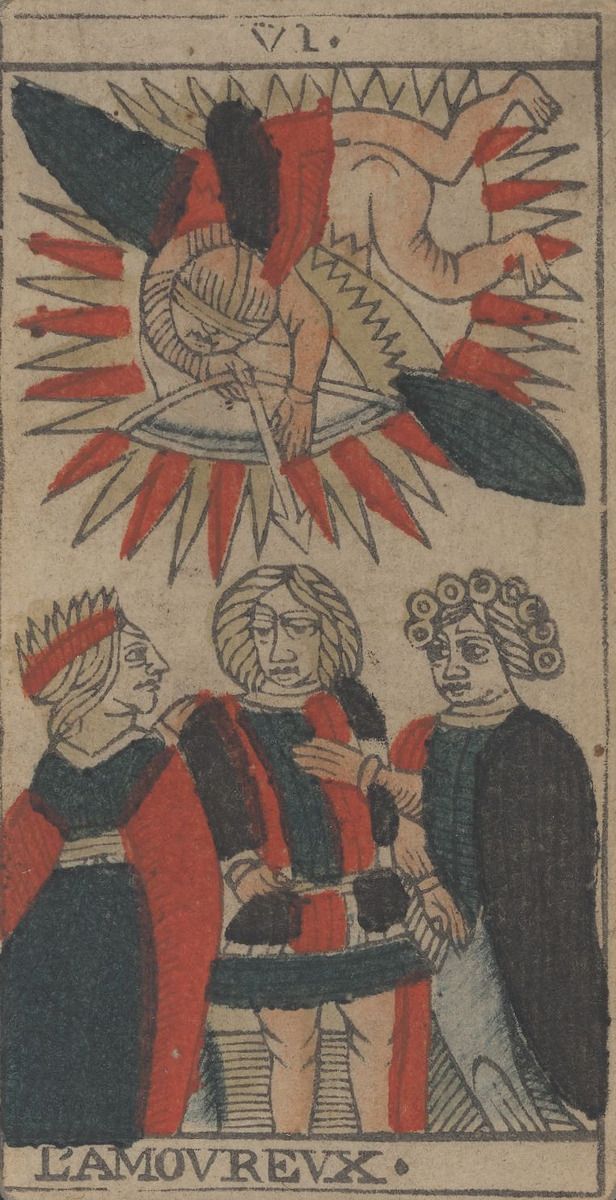
Lovers — Jean-Pierre Payen, 1713. Beinecke Rare Book and Manuscript Library, Yale University. Prepared for print by Surrealium at Vaxholm Fortress, Sweden.
On Payen’s card, a central figure stands between two companions. Their hands and faces point in different directions. Above them a small winged figure draws a bow inside a radiant shape. The eye moves up to the arrow, then back to the uncertain traffic of gestures below.
This arrangement invites a question about choice, but it does not label the alternatives. It is tempting to give the companions fixed identities, such as virtue and vice, without checking the particular deck’s history. The safer beginning is visual: who looks towards whom, where do the hands meet, and what remains undecided? The singular French title, L’Amoureux, also differs from the familiar English plural. For the printing tradition around this example, see Tarot de Marseille.
Upright: bring values into the conversation
An upright Lovers reading can concern agreement between what matters to you and what you are choosing. In a relationship, that may mean talking about the actual shape of a shared life rather than relying on a feeling of inevitability. Outside romance, it might concern collaboration, friendship or a commitment to a piece of work.
Choose a real decision and name the values in tension. You may want closeness and privacy, excitement and steadiness, or loyalty and honesty. Those pairs do not always cancel each other out. A useful next step is to ask what each value would require in practice. The card does not settle the balance for you. It gives you a reason to make the conversation clearer and to listen to the other person’s answer.
A canopy changes the setting
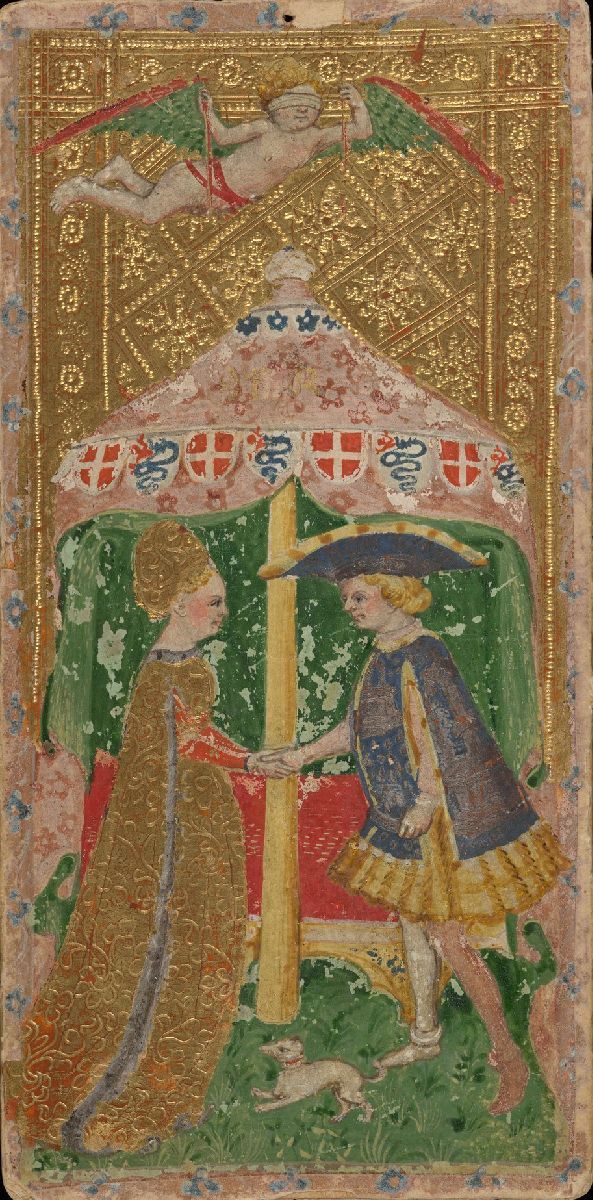
Lovers — Unknown Milanese workshop, Visconti di Modrone deck, c. 1440–1445. Beinecke Rare Book and Manuscript Library, Yale University. Prepared for print by Surrealium at Vaxholm Fortress, Sweden.
In the Visconti di Modrone card, the couple meet beneath a highly ornamented canopy. The gold ground and ceremonial clothing establish a courtly atmosphere. A winged figure still appears above, but the arrangement below is more openly paired than Payen’s three-person scene. Compare the hands before trying to compare the meanings.
The surviving image belongs to a particular luxury pack made in fifteenth-century Milan. It should not be treated as a photograph of all medieval marriage customs, nor as proof that love meant the same thing to every viewer. Its usefulness here is more precise: it shows that the visual form of this trump was never limited to the design most people now recognise. Material splendour, public ceremony and personal attachment can occupy the same small rectangle.
Reversed: locate the disagreement
A reversed Lovers interpretation often asks about mismatch, divided loyalties or an agreement made without enough thought. Try to locate the actual disagreement. Are you choosing something you do not want, avoiding an honest conversation, or assuming that another person shares a value they have never stated?
The answer may be quite small. Two friends planning a trip might want different amounts of time alone; two collaborators might have different ideas about credit. Naming that difference offers more than calling the whole relationship incompatible. A card cannot establish infidelity, prove dishonesty or tell you what a silent person secretly thinks. When somebody’s words and actions are unclear, the appropriate source of information is a respectful conversation and the evidence available to you.
Two cups, and a place in the sequence
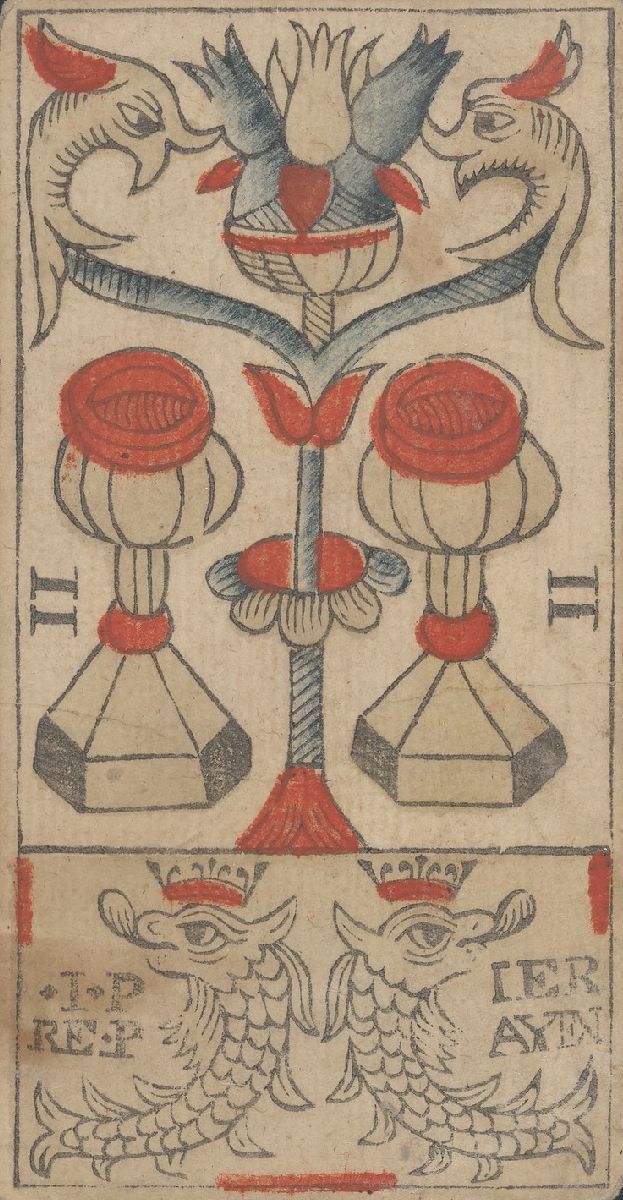
Cups Two — Jean-Pierre Payen, 1713. Beinecke Rare Book and Manuscript Library, Yale University. Prepared for print by Surrealium at Vaxholm Fortress, Sweden.
Payen’s Two of Cups makes a second kind of pair: two vessels separated and connected by a central ornament. There is no depicted conversation and no promise attached to the symmetry. It is a useful comparison because pairing can be built with objects as well as bodies. The repeated shape creates relation before any story is supplied.
The Lovers is VI in the Marseille order, between the Hierophant and the Chariot. A modern reader might connect those positions with inherited values, a personal choice and the effort of carrying that choice forward. Keep that sequence provisional. It is an interpretive exercise rather than a historical account of what every cardmaker intended, and another deck may invite a different emphasis.
Write a choice without a prediction
Put one decision into a sentence beginning with “I can choose”. Avoid sentences that require control over somebody else’s feelings. Then write what you would need to know before choosing, and who could provide that information. An unresolved question is a good outcome if it makes your next conversation more honest.
Return to the three figures on Payen’s card. Which gesture first caught your attention? Describe it without making it stand for a real person. This separates the imaginative work of looking from the practical work of deciding. If the reading concerns a relationship, leave room for both people to answer differently. The value of the image is the attention it encourages, not an authority to declare a union right or wrong.
- Does the Lovers card always mean romance?
- No. Romance is a common association, but the card can also frame questions about values, partnership and choice in friendship or work.
- Does it mean someone loves me?
- A card cannot reveal another person’s feelings. Use the image to clarify your own hopes and questions, then rely on communication and observed behaviour.
- Why are there three people on the old card?
- The Marseille pattern differs from the later Rider–Waite–Smith design. Payen’s card shows a central figure between two companions beneath an archer; interpretations of their roles vary.