The Chariot card: direction before speed
The Chariot card in Payen and the Visconti deck: two vehicles, different riders, and meanings grounded in purposeful reflection.
The Chariot card is commonly associated with direction, determination and the effort of coordinating different forces. A useful reading asks how you intend to move, and what needs to move with you. It does not promise victory or tell you to force a difficult situation into submission.
Historic images make the question more interesting. Payen presents an armoured figure beneath a canopy, above two horses. The earlier Visconti di Modrone card gives the vehicle another rider and another ceremonial setting. Looking at both slows down a familiar keyword such as “success” until it becomes a set of visible choices. The major arcana guide supplies the larger sequence.
A vehicle held within a small frame
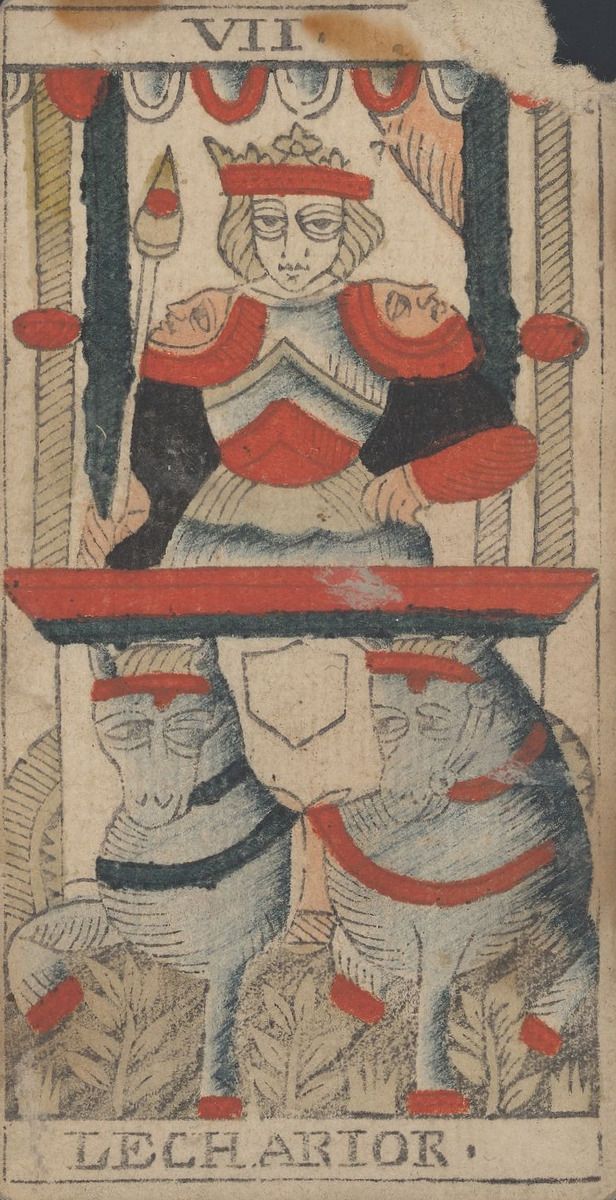
Chariot — Jean-Pierre Payen, 1713. Beinecke Rare Book and Manuscript Library, Yale University. Prepared for print by Surrealium at Vaxholm Fortress, Sweden.
Payen’s charioteer occupies a canopy supported by upright posts. The figure’s costume is boldly divided into red and blue, while the horses fill the lower part of the card. They do not read like a naturalistic team galloping through an open landscape. The picture is more like a compact emblem of movement and rank.
Look closely at the upper right corner: the surviving card is damaged there. That loss belongs to the object’s history; it is not part of a symbolic sky. Keeping the whole card visible lets you distinguish physical condition from design. The Marseille art story explains the repeatable woodcut and stencil tradition behind these strong contours. Start with that printed object before borrowing details from a later deck.
Upright: choose a direction you can describe
In an upright reading, determination becomes useful when attached to a specific course of action. “Move forward” is too vague if you do not know what forward means. A clearer question might be which task deserves your next hour, what information is missing, or which competing commitment must be renegotiated.
Imagine a project with an appealing destination and several people doing different things. The problem may be coordination rather than insufficient enthusiasm. Write down the destination in ordinary words, then name the next action that belongs to you. Other people retain their own choices. The Chariot can be a prompt to organise effort without becoming an excuse to override a collaborator or ignore a practical limit that has already been explained.
The earlier rider is not the same figure
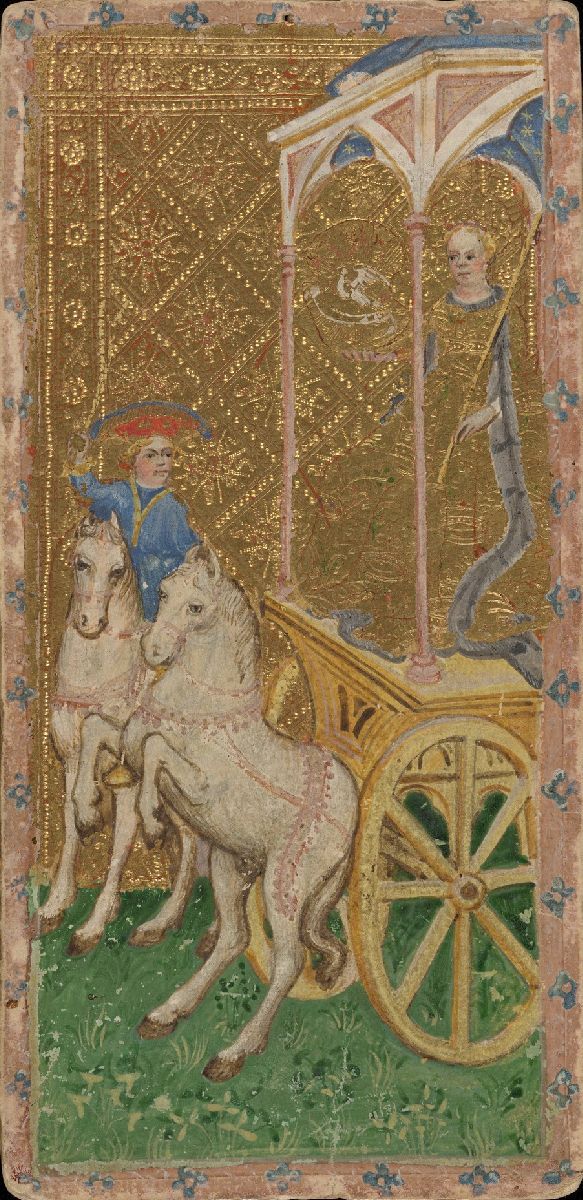
Chariot — Unknown Milanese workshop, Visconti di Modrone deck, c. 1440–1445. Beinecke Rare Book and Manuscript Library, Yale University. Prepared for print by Surrealium at Vaxholm Fortress, Sweden.
The Visconti di Modrone Chariot shows a crowned woman in a richly ornamented vehicle drawn by pale horses. The gold surface and elaborate canopy make its ceremonial character unmistakable. Payen’s card compresses the equipment into a plainer printed arrangement. The shared vehicle does not erase the differences in costume, gender or setting.
The Yale card is a surviving painted object, rather than a reconstruction of a missing card. That distinction matters when comparing old packs. It gives us a particular image to inspect, not permission to imagine that every Renaissance Chariot looked alike. In the later Rider–Waite–Smith design, sphinxes replace the horses; those familiar creatures should not be read back into the two historic pictures displayed here. A deck’s details belong to that deck.
Reversed: check the load and the route
A reversed Chariot reading can explore scattered effort, an unsuitable pace or an attempt to control too much. These possibilities call for different responses. Scattered effort may need a shorter list; an unsuitable route may need new information; exhaustion may require less activity rather than a stronger push.
Describe one recent moment when your effort did not produce the result you expected. What was within your control, and what depended on weather, timing, resources or another person? The distinction prevents a motivational symbol from turning into self-blame. No amount of determination makes every obstacle personal. Use the card to examine a method, not to decide that you deserve success or failure. A change of direction can be a considered decision rather than a defeat.
A mounted court card offers a different pace
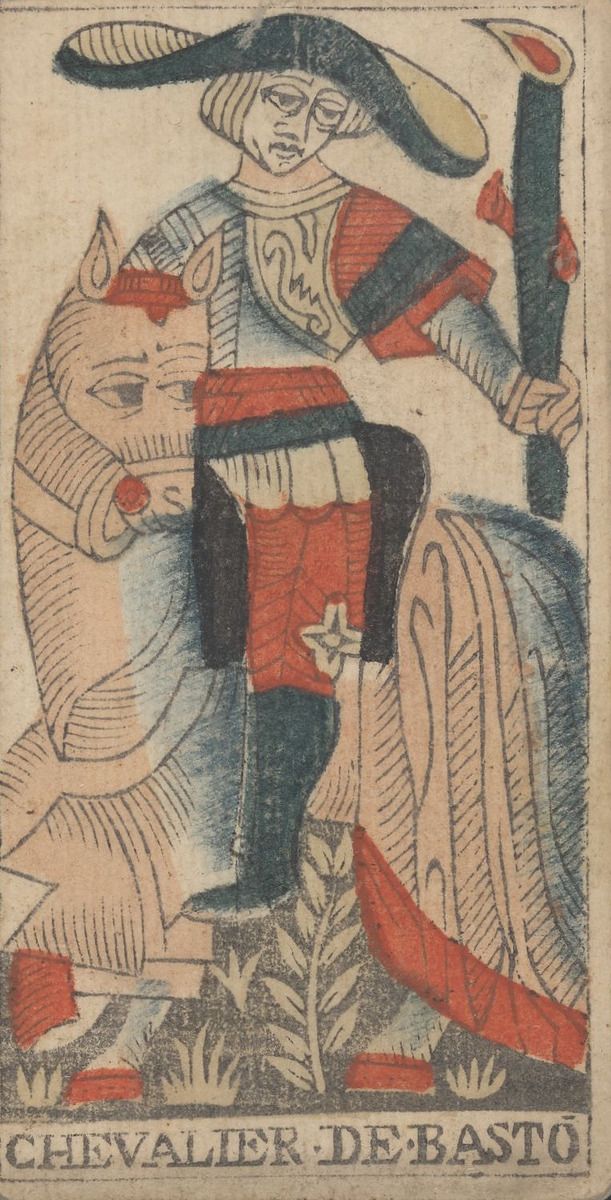
Batons Knight — Jean-Pierre Payen, 1713. Beinecke Rare Book and Manuscript Library, Yale University. Prepared for print by Surrealium at Vaxholm Fortress, Sweden.
Payen’s Knight of Batons also brings a person and a horse together, but without the Chariot’s enclosed vehicle. The long staff, broad hat and horse’s head occupy different directions. It is a suit court card, not another version of trump VII. Comparing their silhouettes shows how a deck can represent several kinds of active presence.
In the Marseille sequence the Chariot follows the Lovers and precedes Justice. The move from choice to action to accountability is one possible contemporary reflection on that order. It should remain a reading of the sequence, not a claim that a historical card game taught a fixed programme of personal development. You can keep the relationship useful while acknowledging that limit.
A route with room to stop
Draw three small boxes on paper: destination, next step and stopping point. Fill the last box first. What would tell you that the plan needs a pause or a revision? This gives determination a boundary and makes the exercise more realistic than a command to keep going regardless.
Then choose one step small enough to review after doing it. Ask whether it depends on consent or information you have yet to obtain. If so, the next step may be to ask or investigate. Return to the horses in the picture and notice how much coordination the image implies without explaining its mechanics. A reflection can work the same way: it can reveal a question that a practical plan must subsequently answer.
- What does the Chariot card mean upright?
- It commonly frames direction, determination and coordinated effort. A reflective reading turns those themes into a specific action and a way to review it.
- Does the Chariot predict a win?
- No. A symbolic reading cannot establish the outcome of a competition, journey or project. It can help you examine preparation and choices.
- Why do some Chariot cards have sphinxes?
- The familiar Rider–Waite–Smith design uses sphinxes. Payen’s 1713 card and the Visconti di Modrone example shown here use horses; the differences should remain visible.