Queen of Swords: clear sight without cruelty
Compare two historic queens and their swords, then explore judgement, boundaries and careful speech as reflective themes.
The Queen of Swords is often described as severe before anyone looks closely at her picture. Payen’s historic queen sits with a long upright sword, while the Cary-Yale queen stands in an ornate gown with a small attendant nearby. These are images of rank and an attribute, not diagnoses of a woman’s character. Modern readers commonly connect the card with discernment and direct speech. The useful question is how to be clear without turning clarity into a licence to wound.
The sword beside the seated figure
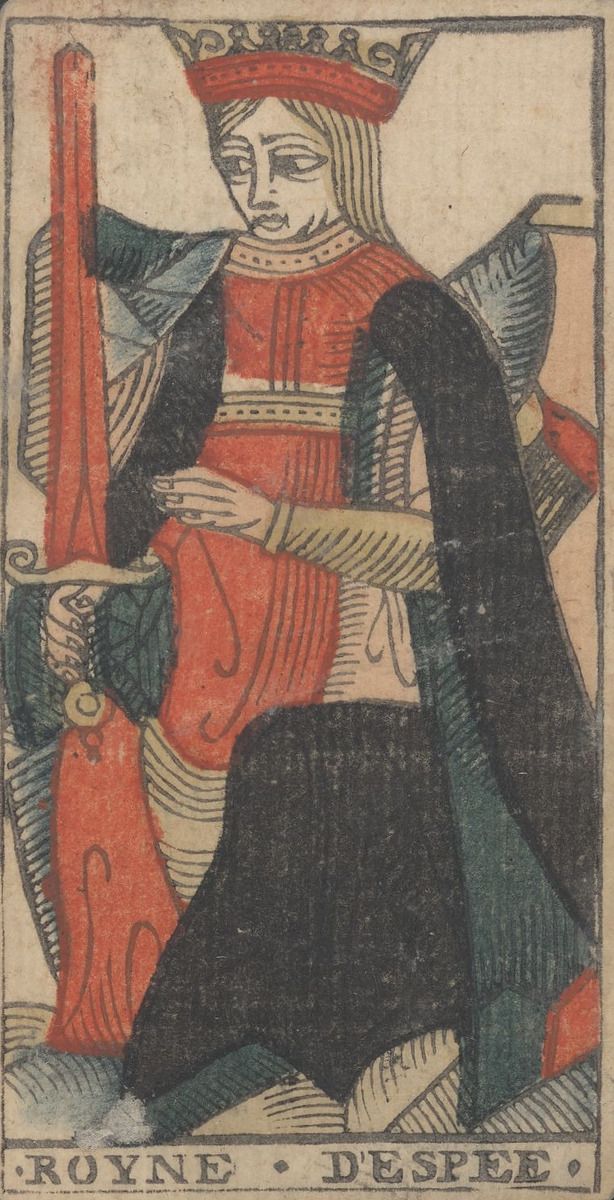
Queen of Swords · Jean-Pierre Payen, Blocks dated 1713 · Payen Marseille deck, FRA 166, Beinecke Rare Book and Manuscript Library, Yale University. Prepared for print by Surrealium at Vaxholm Fortress, Sweden.
Payen places the sword along one side of the card, its long red form almost parallel to the edge. The queen’s crowned head turns across the narrow space. Her clothing is divided into strong areas of colour, and one hand rests near her middle while the other supports the weapon. The figure is contained and composed; the card does not show her striking anyone.
That difference between holding and using an object is worth keeping. A sword can suggest judgement, defence or the power to act, but the image does not tell us which action has occurred. Describe the gesture before assigning a temperament. If the card prompts a question about your own speech, ask what you need to say and what purpose saying it will serve. There is a difference between a necessary boundary and an unnecessary final word.
A queen with an attendant
In the older Cary-Yale example, patterned fabric and gold ground make a sumptuous surface. The queen’s long sword rises beside her, while a smaller figure stands close to the edge of her gown. The contrast of scale is a reminder that court cards picture social positions as well as individual bodies. Their original audience lived among recognisable forms of rank, service and display.
The Cary-Yale deck story explains the surviving originals used here. Both queens can invite modern reflection, but they should not be merged into a single imaginary picture. One is a compact printed seated figure, the other a richly painted standing figure with an attendant. Their shared suit does not cancel their differences. Nor should their historic dress be used to prescribe how a modern woman, or anyone else, ought to behave.
Where the queen belongs

Queen of Swords · Unidentified Milanese workshop, c. 1442–1447 · Visconti di Modrone (Cary-Yale) deck, GEN 965, Beinecke Rare Book and Manuscript Library, Yale University. Prepared for print by Surrealium at Vaxholm Fortress, Sweden.
This is a court card in the minor arcana. In the usual four-rank Swords sequence, the Knight comes before the Queen and the King follows. The Marseille deck guide introduces the wider court, where a shared suit can include a mounted figure and seated rulers with different kinds of presence. The major arcana guide explains the separate group of trumps, so the Queen should not be assigned a major-arcana number.
For another view of the suit, the Three of Swords replaces a person holding a weapon with an arrangement of blades. That contrast helps keep interpretation flexible. A court card may suggest a role or a manner of responding rather than a particular person. You need not search your acquaintances for a woman who matches a stock description, and the picture offers no evidence about anyone’s concealed motives.
Upright: separate an observation from a conclusion
An upright Queen of Swords is often read through judgement, independence and forthright communication. A practical way to explore those themes is to separate three statements: what happened, what you think it means and what you need now. The first should be observable. The second should acknowledge that it is an interpretation. The third should be a request or boundary you can state clearly.
For example, a delayed reply is an event; deciding that someone does not care is an inference. You may still need a timely answer to make a plan. Keeping those layers separate lets you communicate the need without claiming access to another person’s mind. The queen’s upright sword can become a reminder of precision. Precision is not the same as emotional distance: it can protect both the speaker and the listener from accusations built on information neither has.
Reversed: question the certainty of your judgement
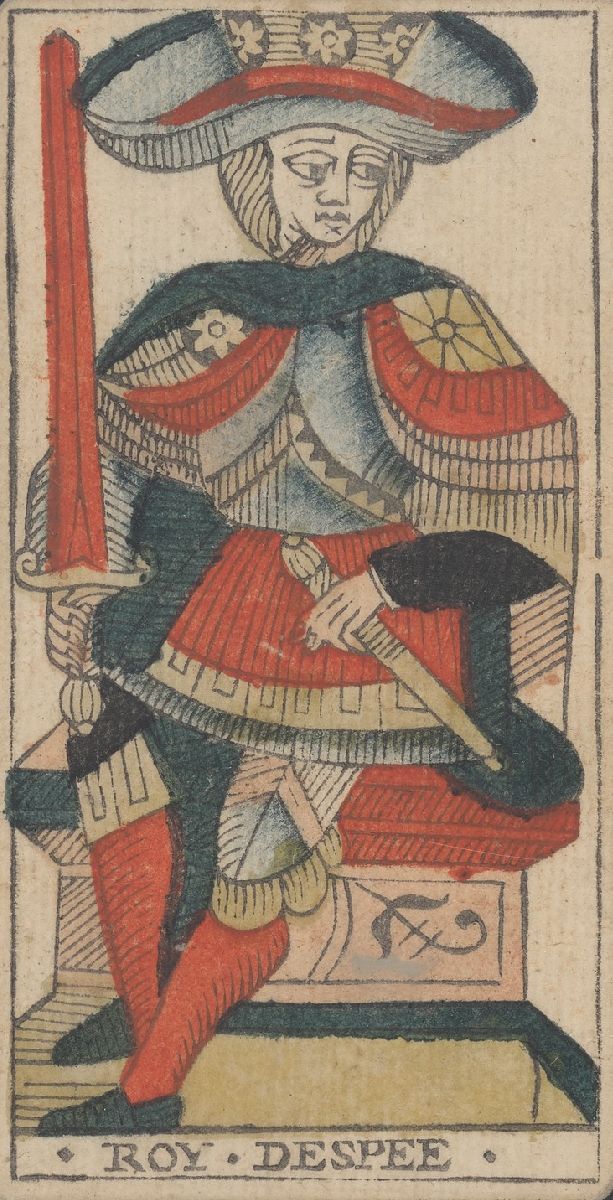
King of Swords · Jean-Pierre Payen, Blocks dated 1713 · Payen Marseille deck, FRA 166, Beinecke Rare Book and Manuscript Library, Yale University. Prepared for print by Surrealium at Vaxholm Fortress, Sweden.
Reversed readings often explore harshness, defensiveness or a judgement formed too quickly. Use those themes to examine a specific exchange rather than to condemn a personality. Ask which fact might change your view and whether you have made it possible for the other person to supply it. If nothing could change your view, consider whether you are describing a conclusion reached through evidence or a position you feel obliged to defend.
The King shown alongside this section offers another presentation of the suit’s authority. Comparing him with the Queen can expose how readily viewers call similar gestures firm in one figure and cold in another. A reflective reading need not repeat that double standard. Clarity can coexist with uncertainty, and a boundary can remain valid even when expressed kindly. Reversal does not require making yourself smaller or surrendering a reasonable limit.
Practise a sentence you can stand behind
Write a difficult sentence you need to say. Remove any claim about what the other person always does, secretly wants or truly is. Replace it with the event you can describe and the response you are asking for. Read the sentence aloud once. It should sound like something a person could answer, not a verdict with no possible reply.
Now return to the whole card and notice the space around the blade. The object is powerful partly because it remains distinct. Let that be the final visual prompt: what needs a clear edge, and what can remain open? The question belongs with your knowledge of the situation. At the reading desk, bring the subject you want to think through without demanding that the card identify a villain or certify you as the only reasonable person in the room.
- Does the Queen of Swords represent an older woman?
- Some reading systems use court cards that way, but it is not necessary. The card can represent a role, a quality of attention or the reader’s approach to a situation.
- Is the reversed Queen a bad person?
- No. A reversal is an interpretive device. It cannot establish character, intentions or a psychological condition.
- What is the difference between the Queen and the Three?
- The Queen is a court figure holding a sword; the Three is a numbered arrangement in the same suit. Their visual forms offer different starting points for reflection.