Three of Swords: before the pierced heart
The historic cards show blades and ornament, not a pierced heart. Explore how the image and its later readings diverge.
The Three of Swords is famous for a heart pierced by blades, but that is not what the historic cards here show. Payen’s Marseille Three places a straight sword inside a framework of curved blades and ornament. The Cary-Yale version arranges weapons across a patterned ground. Later readers often connect the card with sorrow, separation or a difficult truth. Understanding that later association is useful; mistaking it for an event the card predicts is not.
Count the weapons, then follow their lines
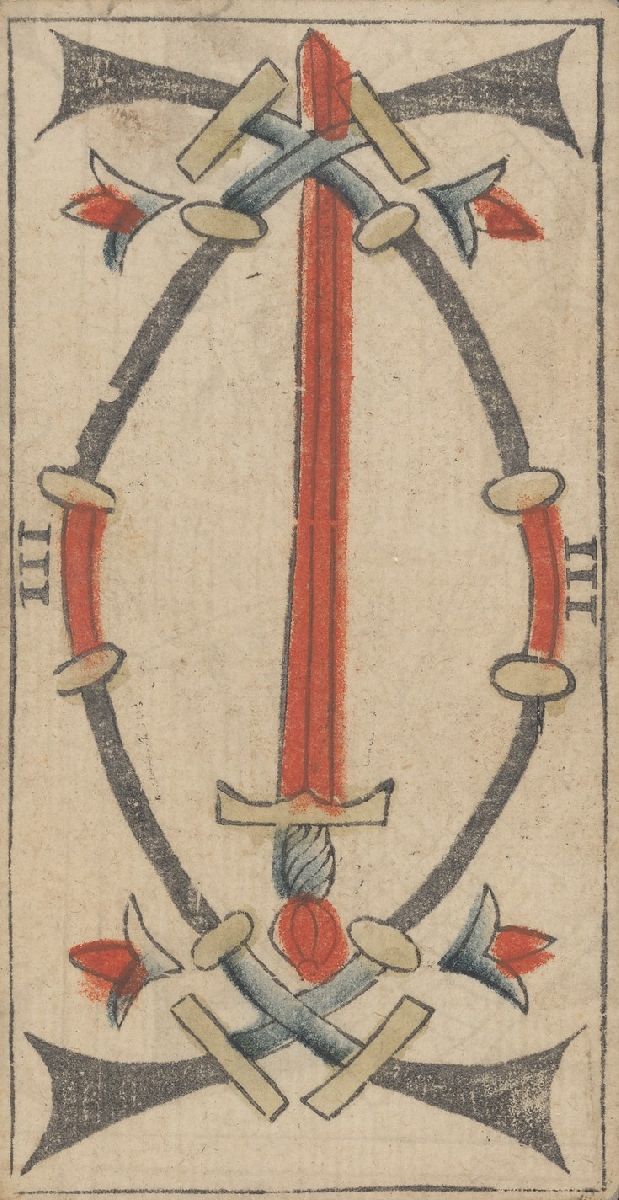
Three of Swords · Jean-Pierre Payen, Blocks dated 1713 · Payen Marseille deck, FRA 166, Beinecke Rare Book and Manuscript Library, Yale University. Prepared for print by Surrealium at Vaxholm Fortress, Sweden.
A red straight sword runs through the centre of Payen’s card. Curving blades create an oval framework around it, with their hilts and points arranged towards the corners. Small floral forms occupy the remaining spaces. The picture is organised, symmetrical and decorative. There is no injured body, no weather and no face whose expression tells us how to feel.
That absence is not a puzzle you need to solve by importing a later image. Begin with the relationship between the central line and the surrounding curves. You might find tension, containment or a division of space. These are possibilities suggested by the composition. They do not prove that the maker intended a modern emotional reading, and they do not provide evidence that something distressing is about to happen to the person who draws the card.
An older arrangement of swords
The Cary-Yale card belongs to a fifteenth-century courtly pack. Its blades cross on a rich patterned surface, with gold details and visibly aged edges. The objects retain the identity of the suit while their arrangement differs from the repeated curved framework in the later Marseille print. Seeing both makes the card’s history less like a single fixed code and more like a succession of visual decisions.
The Cary-Yale introduction describes the surviving pack, and the Marseille deck story gives the printed context. In each case, the card is a physical object with a date and a maker or workshop. Those facts remain useful even if you approach tarot primarily through reflection. They stop a familiar interpretation from swallowing the evidence of what is actually in front of you.
The later heart image changes the story
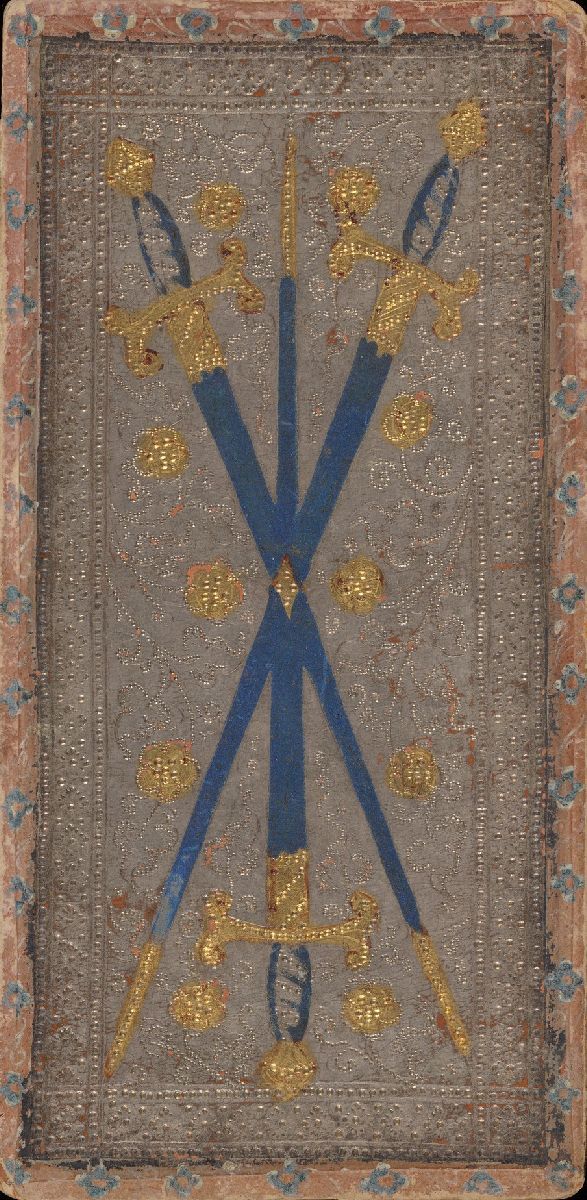
Three of Swords · Unidentified Milanese workshop, c. 1442–1447 · Visconti di Modrone (Cary-Yale) deck, GEN 965, Beinecke Rare Book and Manuscript Library, Yale University. Prepared for print by Surrealium at Vaxholm Fortress, Sweden.
Pamela Colman Smith’s 1909 card, made for the Waite deck, gives the blades an immediate emotional setting through a pierced heart and stormy sky. That later image is discussed here but not reproduced. Its influence explains why many contemporary meaning pages begin with heartbreak rather than with the structure of a numbered suit. The interpretation has a visual history; it is not written into every earlier Three of Swords.
A reader may still use sorrow as a reflective theme with a Marseille pack, provided that the distinction remains clear. The image and the reading are two different layers. You can acknowledge a feeling you already have without claiming that the card discovered it independently. You can also decide that a particular interpretation does not fit your situation. A symbolic practice does not become more thoughtful by refusing to accept a mismatch.
Its place in the suit
The Three follows the Two of Swords and precedes the Four. The adjacent cards in Payen’s pack vary the number and arrangement of blades within related ornamental structures. Compare that repeated ornamental vocabulary with the individually named trumps in the major arcana overview. Number and arrangement become especially important when a card does not show a narrative scene. The Three itself belongs to the minor arcana, not the major sequence.
For a contrast within the available stories, the Queen of Swords gives the suit a human figure. She holds an attribute that the numbered card arranges as a pattern. Moving between those forms can help you ask different questions: how a situation is structured, and how you might respond within it. Neither form can identify a person who has betrayed you or establish another person’s unspoken thoughts.
Upright and reversed without forecasting pain
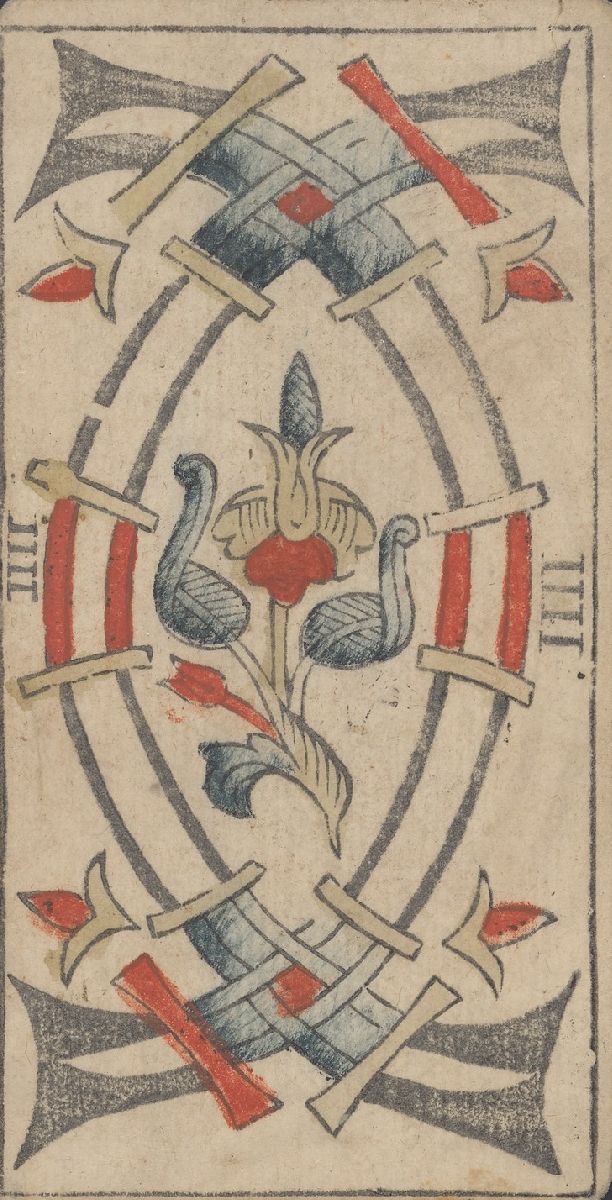
Four of Swords · Jean-Pierre Payen, Blocks dated 1713 · Payen Marseille deck, FRA 166, Beinecke Rare Book and Manuscript Library, Yale University. Prepared for print by Surrealium at Vaxholm Fortress, Sweden.
Modern upright readings often address sadness, disappointment or a truth that is difficult to accept. If that theme fits something you already know, use it to name the experience precisely. A disagreement, an ending and an unanswered question are not interchangeable. Naming what actually happened can be more useful than letting a dramatic image expand it into a complete account of your life.
Reversed readings often turn towards release, recovery or difficulty expressing hurt. Again, these are possible questions rather than promised stages. You do not owe the card a rapid reconciliation, a declaration of forgiveness or a performance of optimism. The neighbouring Four shown here changes the visual balance by changing the number of weapons; it does not prescribe a timetable for feeling better. Let ordinary support, conversation and your own circumstances determine what would help next.
A reflection that leaves room for care
Make three short notes: what you know, what you are imagining and what would support you today. Keep the first note factual and the third practical. If the second is much longer than the others, that is useful to notice without judging yourself. The exercise is not a cure; it is a way of keeping an uncertain situation from becoming more certain in your mind than the evidence allows.
Finally, look at the ornament between the blades. The whole picture contains more than its sharpest objects. You need not turn that observation into a cheerful moral, but you can allow it to complicate the first impression. At the reading desk, a question about understanding a situation is more workable than a demand to know whether something bad will happen. The card can accompany reflection without being given authority over the future.
- Does the Three of Swords always mean a breakup?
- No. Separation is one later association, not a prediction. A card cannot establish that a relationship will end.
- Why is there no heart in the old card?
- The Marseille and Cary-Yale examples use arrangements of suit symbols. The famous pierced-heart scene belongs to a later illustrated tradition.
- Is a reversed Three a promise of healing?
- No. It may prompt reflection on release or unspoken hurt, but it does not set a timetable or guarantee an emotional outcome.