The Magician card: begin with what is on the table
Explore the Magician card in Payen’s Marseille deck, with upright and reversed meanings grounded in skill, attention and honest reflection.
The Magician card brings a figure, a wand-like object and a small table of things into a compact scene. In Payen’s Tarot de Marseille, the printed name is Le Bateleur, a title associated with a performer or conjurer. That older image is not identical to the ceremonial figure familiar from the later Rider–Waite–Smith deck.
The card can prompt reflection on skill, attention and the relationship between an intention and an action. It does not guarantee that an idea will succeed or that desire alone can make an outcome happen. The major arcana guide gives the larger sequence, and Tarot de Marseille introduces the historic deck whose cards are shown here.
Describe the table before supplying a system
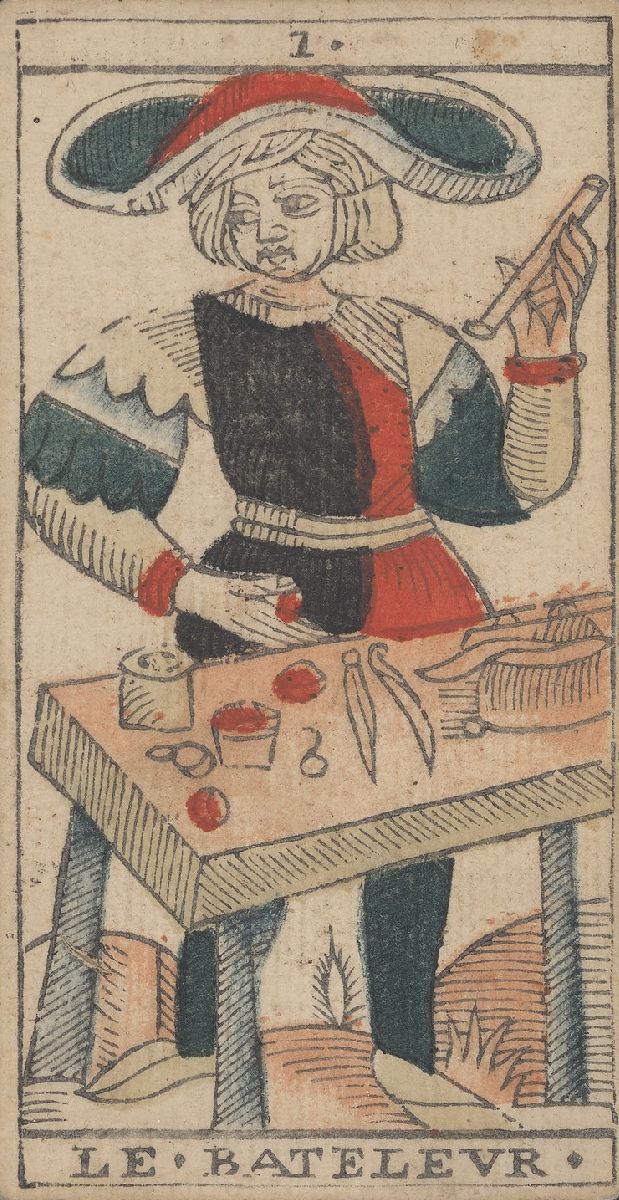
The Magician · Jean-Pierre Payen, Tarot de Marseille, blocks dated 1713 · Cary Collection of Playing Cards (FRA166), Beinecke Rare Book and Manuscript Library, Yale University. Prepared for print by Surrealium at Vaxholm Fortress, Sweden.
Payen’s figure stands behind a table, holding a slim object in one raised hand while the other remains lower near the tabletop. Small cups, round objects and other implements occupy the surface. The broad hat and alternating colours of the clothing give the person a lively outline within the narrow card.
Do not automatically label every item as one of the four suits simply because another deck arranges those symbols explicitly. The table here is particular to this image. Begin with the visible objects and the performer’s stance, then consider what the arrangement suggests about handling materials, directing attention or making something happen in front of an audience.
Upright: turn an intention into a specific action
Upright readings commonly associate the Magician with skill, resourcefulness and focused action. As a reflective prompt, that can become a practical question: what is the smallest useful thing you can do with the resources already available? The question is more testable than a broad promise of manifestation.
Name the task and the material conditions. A conversation requires another person’s participation; a craft requires tools and practice; a plan may need time or information you do not yet have. The card can help you distinguish what is ready to use from what remains missing. Confidence becomes more useful when it is attached to a clear next step and a realistic account of the work.
The Fool and the first numbered trump
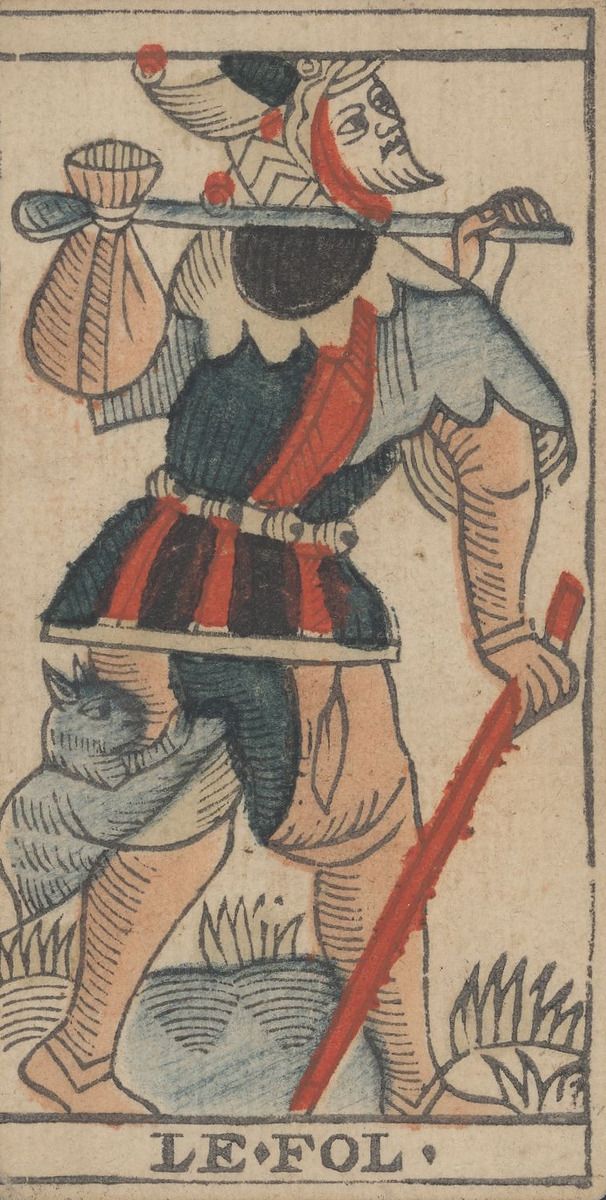
The Fool · Jean-Pierre Payen, blocks dated 1713 · Cary Collection of Playing Cards (FRA166), Beinecke Rare Book and Manuscript Library, Yale University. Prepared for print by Surrealium at Vaxholm Fortress, Sweden.
The Magician is I in the Marseille sequence. The unnumbered Fool offers a useful preceding comparison, moving with a bundle and staff rather than standing at a table. One image suggests motion through a world; the other gathers attention around an immediate activity.
The Fool card guide develops the first image, but the comparison need not become a compulsory story about everyone’s spiritual development. You can simply ask what changes when an open intention meets a practical task. A person setting out may carry possibilities; a person at a table must decide what to handle first. The distinction is useful without claiming that the cards describe a fixed life sequence.
Reversed: examine the use of attention
Reversed Magician readings often raise questions about scattered effort, unused ability or manipulation. Treat those as possibilities to investigate, not as proof that another person is deceiving you. A card cannot establish someone’s intentions, and an attractive symbolic story should not replace an actual conversation or observable evidence.
For self-reflection, ask where the performance of competence has begun to replace the work itself. Are you collecting tools without using them, or promising more than the available time allows? The point is not to accuse yourself. It is to make the gap between intention and action visible enough that one small change becomes possible.
The Priestess changes the pace
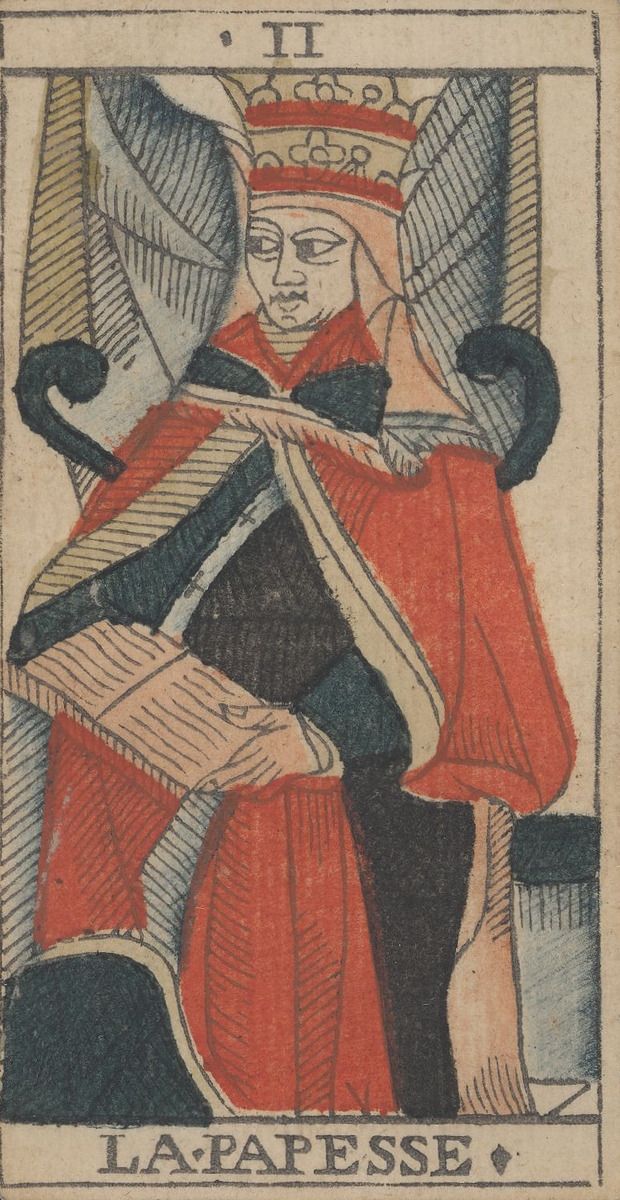
The Popess · Jean-Pierre Payen, Tarot de Marseille, blocks dated 1713 · Cary Collection of Playing Cards (FRA166), Beinecke Rare Book and Manuscript Library, Yale University. Prepared for print by Surrealium at Vaxholm Fortress, Sweden.
The next numbered card is the High Priestess, called La Papesse in this Marseille image. She sits with an open book, creating a different arrangement of body and object from the Magician’s standing figure and crowded table. Reading and attending become useful visual comparisons with performing and handling.
A reflective reading can hold both activities without deciding that one is superior. Some situations need a first attempt; others need more study before an attempt is useful. Compare the two images and ask which kind of attention the actual task requires. Their sequence offers a way to organise the question, not a command to ignore the evidence of the situation in front of you.
The Ace of Cups is a comparison, not a hidden label
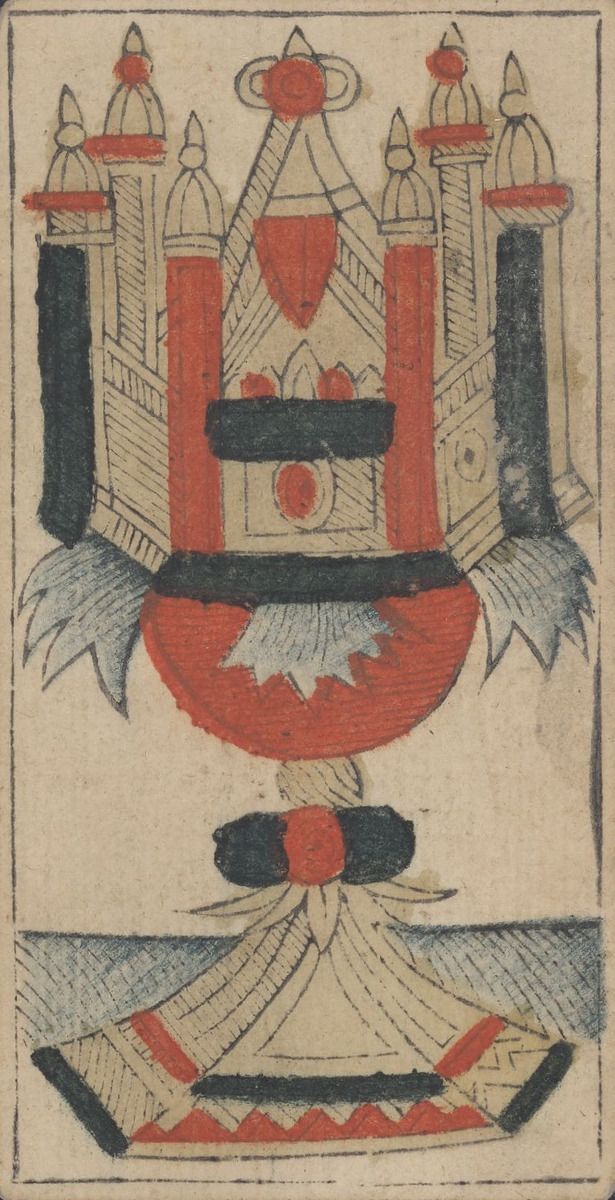
The Ace of Cups · Jean-Pierre Payen, blocks dated 1713 · Cary Collection of Playing Cards (FRA166), Beinecke Rare Book and Manuscript Library, Yale University. Prepared for print by Surrealium at Vaxholm Fortress, Sweden.
The Ace of Cups in Payen’s deck shows a large ornate vessel that occupies most of the card. Its concentrated form is quite different from the smaller objects distributed across the Magician’s table. Seeing the two together helps prevent the table from being reduced to a familiar modern diagram without looking at its actual details.
The cup can also prompt a different question: what is being received or held, rather than made or demonstrated? That is a contemporary reflective comparison. It does not establish that Payen intended the exact psychological meanings used by later readers. Keep the historic object and the present exercise distinct, so neither has to pretend to authenticate the other.
Make one small experiment
Choose an unfinished task and list the things already on your metaphorical table: time, materials, information and help. Then write down one missing requirement. Decide whether the next step is to act with what you have or to obtain what is genuinely necessary before acting.
Keep the experiment small enough to review. After trying it, compare the result with your original expectation and note what you learned. This gives the Magician’s themes of skill and attention a practical form without turning the card into a promise of success. The useful outcome is a clearer understanding of your choices, not proof that the symbol controlled what happened.
- Why is the Marseille Magician called Le Bateleur?
- The printed French title refers to a performer or conjurer. It helps distinguish this historic figure from the more ceremonial presentation in some later decks.
- Does the Magician guarantee success?
- No. It can prompt reflection on resources, focus and action, but a project’s outcome depends on real conditions and the work involved.
- What does the reversed card mean here?
- It raises questions about scattered effort, unused ability or how attention is being used. It does not prove deception or reveal another person’s motives.