The Fool card: a traveller before the numbered road
Read the Fool through Payen’s historic card: a bundle, an animal and a journey, followed by upright and reversed reflection.
The Fool card begins with a person already walking. In Jean-Pierre Payen’s historic Marseille deck, a traveller carries a bundle and turns his face away from the animal at his legs. There is movement, but no map. The card can invite reflection on beginnings, freedom and preparation without promising that a leap will work out. Looking at this early picture also clears up a common confusion: the cliff, white rose and bright mountain landscape familiar from later tarot are not the scene shown here.
Look at the traveller first
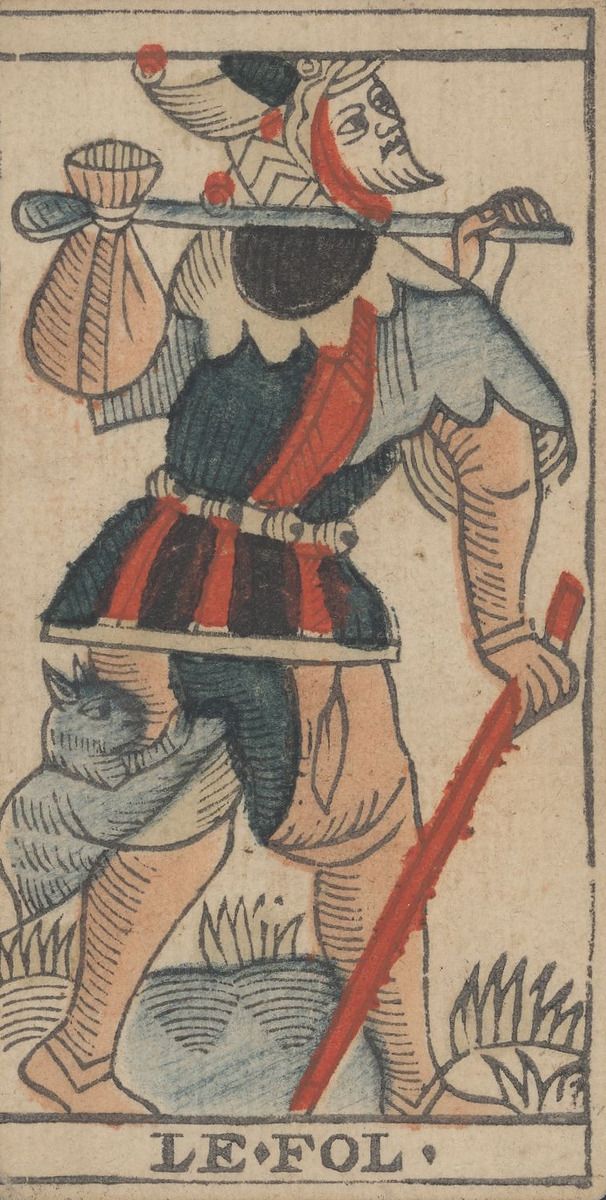
The Fool · Jean-Pierre Payen, Blocks dated 1713 · Payen Marseille deck, FRA 166, Beinecke Rare Book and Manuscript Library, Yale University. Prepared for print by Surrealium at Vaxholm Fortress, Sweden.
The pack hangs from a stick over one shoulder, while another staff reaches towards the ground. The traveller wears sharply divided colours and a cap with projecting points. At the back of his clothes, an animal reaches up towards him. The drawing compresses the encounter into a narrow strip: there is very little landscape to tell us where this person came from or where he intends to go.
Notice the direction of attention. His head and stride do not form a simple, settled forward march. You can read that tension as distraction, openness or a person caught between departure and what follows him. Those are interpretations of a gesture, not facts about the card’s first owner. Before attaching a meaning, try describing the picture in ordinary language. A bundle, a walking stick and an interruption give you more to work with than a single keyword such as freedom.
Why this Fool has no zero
Payen’s card is labelled LE FOL and carries no Roman numeral. The other trumps belong to a numbered sequence, but the Fool has a different position in the visual vocabulary of the pack. The familiar zero is a convention of many later decks, not a number you should search for on this particular object. Likewise, a modern story about a soul progressing through every trump is a way of reading the sequence, not a documented instruction printed on this eighteenth-century card.
Our visual guide to the major arcana gives the broader sequence. For a circular reading, the richly enclosed figure of the World can precede the traveller; the Magician follows him as the first numbered figure. Treat that arrangement as an editorial route through the cards, rather than proof that every historic game put the Fool in the same place.
From wandering to working
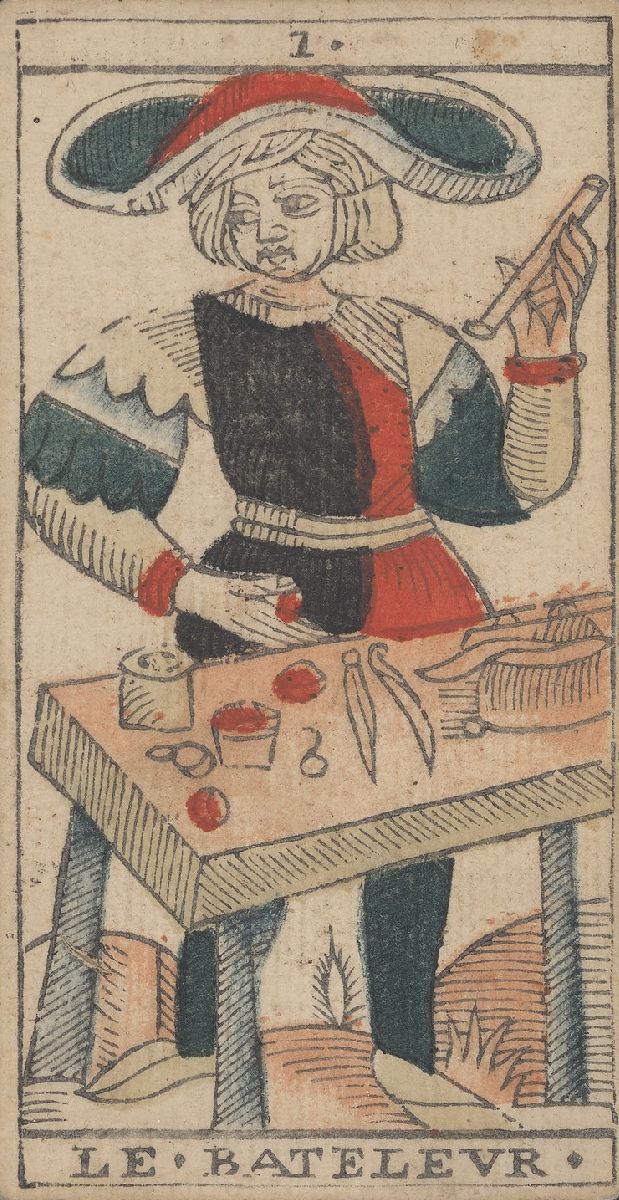
The Juggler · Jean-Pierre Payen, Blocks dated 1713 · Payen Marseille deck, FRA 166, Beinecke Rare Book and Manuscript Library, Yale University. Prepared for print by Surrealium at Vaxholm Fortress, Sweden.
The Juggler, often called the Magician in modern decks, stands at a table covered with objects. Beside the Fool’s portable bundle, that table offers a useful comparison: belongings have become things that can be handled, counted or practised with. One figure moves through open ground; the other occupies a small working space. Neither picture supplies a guarantee of success.
This comparison changes a vague question about destiny into a manageable question about starting. What do you already have? What needs to be unpacked before you can use it? A notebook, an hour of concentration or a conversation with someone experienced may matter more than an impressive declaration. If you are interested in the printed details themselves, the Marseille deck story explains why those plain outlines and repeated colours are part of a coherent visual language.
An upright reading: permission to begin
Modern readers commonly associate the upright Fool with a beginning, curiosity and willingness to encounter something unfamiliar. As a reflection, that need not mean abandoning judgement. A beginning can be small enough to revise: attend one class, make one drawing, visit a place in daylight or ask a question before making a commitment. The value lies in becoming available to experience.
It is also possible to begin while frightened. The image does not require a perfectly confident traveller, and the pack suggests that leaving does not mean having nothing. List the useful things you are carrying, including skills that do not look impressive on paper. Then distinguish them from assumptions you have never tested. Read the card as a prompt to investigate the road rather than an instruction to believe that it has already been made safe for you.
A reversed reading: notice what pulls at you
The Fool · Jean-Pierre Payen, Blocks dated 1713 · Payen Marseille deck, FRA 166, Beinecke Rare Book and Manuscript Library, Yale University. Prepared for print by Surrealium at Vaxholm Fortress, Sweden.
A reversed Fool is often read through hesitation, carelessness or a beginning postponed indefinitely. These possibilities point in different directions, so the surrounding question matters. Someone avoiding every modest experiment needs a different reflection from someone making commitments without checking their consequences. Turning a picture upside down cannot decide which situation applies.
Return to the animal at the traveller’s legs. In your own reading it might stand for an interruption worth heeding, or simply for the awkwardness that accompanies movement. Do not turn it into a secret warning about a particular person. Ask what information you have overlooked and what would make your next step easier to reverse. Preparation can protect curiosity. It does not have to extinguish it, and a delay made for a clear reason is different from a habit of never starting.
A short exercise before the reading
Write two sentences without using the words fate, meant or should. Begin the first with “I would like to try…” and the second with “Before I do, I need to find out…”. Make the second sentence answerable through an ordinary action. That keeps the picture connected to your life while leaving decisions with you.
Then look once more at the whole card. Choose one detail that was absent from your first description. It might be the angle of a stick, the turn of the head or the animal’s position. Let that detail complicate your initial interpretation. Tarot is more interesting when a picture can resist a ready-made answer. The history of tarot offers another useful pause: these images had lives as playing cards before later readers developed the symbolic systems now attached to them.
- Does the Fool mean I should take a risk?
- It can prompt you to consider a beginning, but it does not assess the consequences of a decision. Check the circumstances and choose a proportionate next step.
- Is the Fool always numbered zero?
- No. Payen’s surviving Marseille Fool shown here is unnumbered. Zero is familiar from many later decks.
- Is the animal definitely a friendly dog?
- The animal reaches at the traveller’s clothing. Its exact role is open to interpretation; the picture does not tell us that it guarantees protection.