Strength card: courage without force
Read the Strength card through Payen’s historic Marseille image, with upright and reversed meanings as prompts for reflection.
The Strength card places a woman beside a lion, with her hands close to its mouth. The encounter is physical, but the figure does not carry a visible weapon. In later reading traditions, that arrangement often becomes a way to think about courage, patience and the difference between power and coercion. It is a symbolic prompt, not a prediction about what will happen.
The image here comes from Jean-Pierre Payen’s Tarot de Marseille in Yale’s Cary Collection, printed from blocks dated 1713. Its place in the Marseille sequence is XI, unlike the VIII position familiar from many Rider–Waite–Smith decks. The major arcana guide provides the larger sequence, while Tarot de Marseille introduces this historic visual tradition.
Look at the hands before naming a meaning
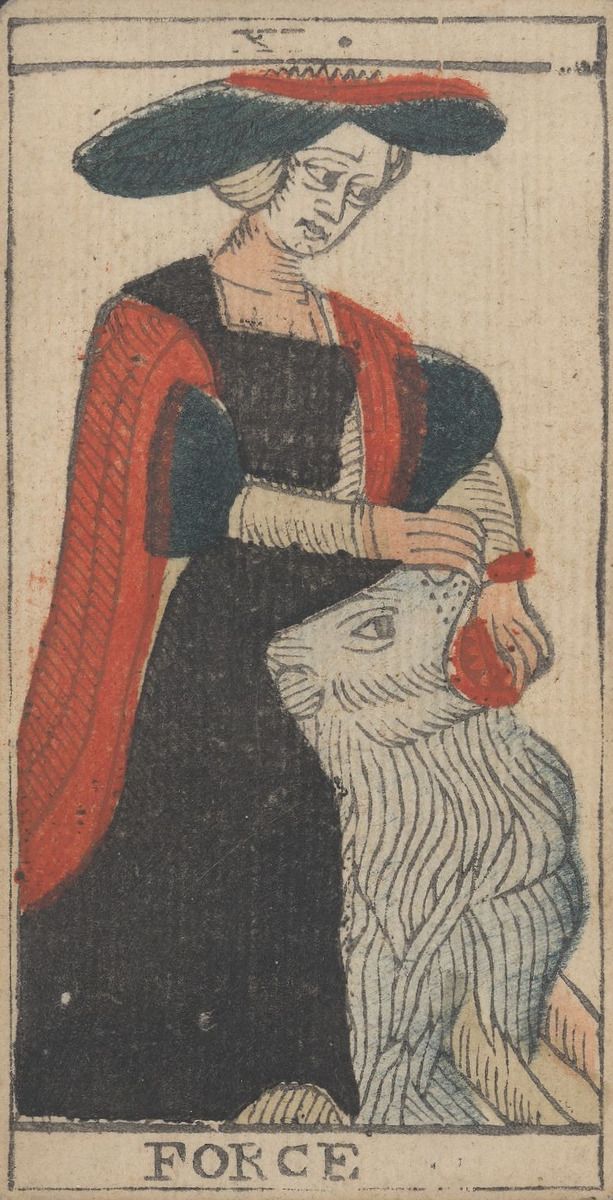
Strength · Jean-Pierre Payen, blocks dated 1713 · Cary Collection of Playing Cards (FRA166), Beinecke Rare Book and Manuscript Library, Yale University. Prepared for print by Surrealium at Vaxholm Fortress, Sweden.
The woman’s hands meet the lion’s muzzle, while the animal’s body extends down the side of the narrow card. Her broad hat and long clothing create a firm upright shape above it. The image gives us a close encounter between two bodies, but it does not supply a written account of the woman’s feelings or the animal’s intentions.
Begin by describing that visible relationship. The contrast between the human figure’s composed posture and the lion’s physical presence supports a reading about measured effort. It does not require the conclusion that the animal is evil or that all difficulty must be defeated through domination. Looking first leaves room for a more precise interpretation.
Upright: the quality of your response
Upright Strength is commonly read through courage, steadiness and self-command. In a reflective practice, those associations can turn attention towards how you respond to a situation rather than towards a promised outcome. The useful question may be whether you can remain clear and patient while something feels demanding.
Choose an ordinary example. Perhaps a conversation becomes tense, or a task seems larger than expected. The card can prompt you to distinguish firmness from escalation and endurance from refusing all help. It does not prove that you should stay in every difficult situation. A symbol of strength can include the decision to pause, ask for support or change the conditions under which you are working.
Compare Strength with Justice
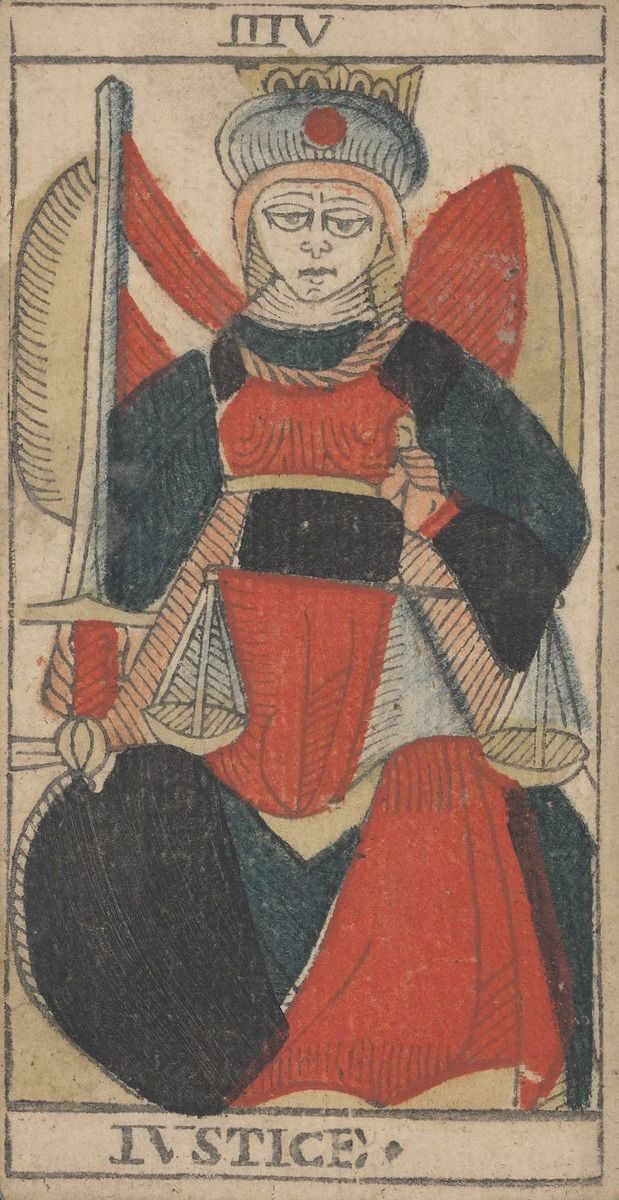
Justice · Jean-Pierre Payen, blocks dated 1713 · Cary Collection of Playing Cards (FRA166), Beinecke Rare Book and Manuscript Library, Yale University. Prepared for print by Surrealium at Vaxholm Fortress, Sweden.
Justice sits with a sword and scales in Payen’s deck. Those objects give its symbolic language a different emphasis from the hands and lion of Strength. One image can prompt questions about judgement and proportion; the other about the way effort is exercised in an encounter.
The comparison is useful because neighbouring ideas need not collapse into one general message about doing the right thing. If your question concerns a decision, ask what evidence and balance require. If it concerns a response, ask how to act without unnecessary force. The Justice card guide develops the first of those questions while preserving the distinction between symbolic reflection and a factual verdict.
Reversed: notice strain rather than assign blame
Reversed Strength is often associated with self-doubt, depleted confidence or the misuse of force. Read those possibilities as questions to consider, not as a diagnosis of your character or another person’s motives. A reversed card does not establish that you are weak, and it cannot tell you why someone else behaved as they did.
A practical reflection is to ask where effort has become unsustainable. Are you trying to control every part of a situation? Are you mistaking silence for patience when something needs to be said? The image can help frame the enquiry, but the answer should come from the actual circumstances and the people involved, not from the orientation of a printed card alone.
The Hermit offers a different kind of steadiness
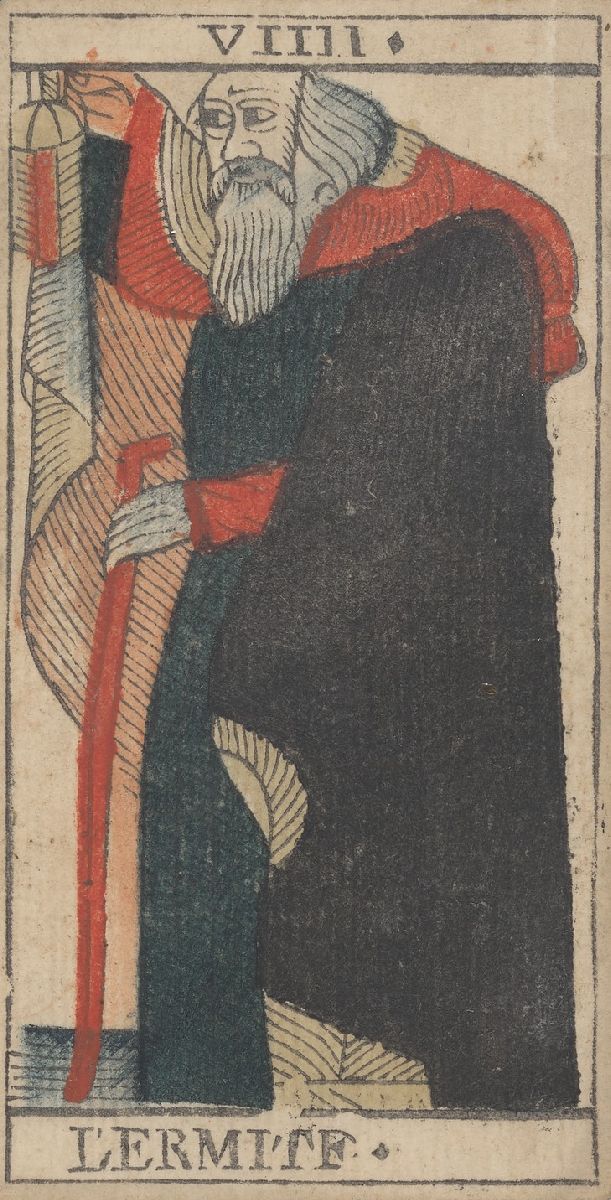
The Hermit · Jean-Pierre Payen, blocks dated 1713 · Cary Collection of Playing Cards (FRA166), Beinecke Rare Book and Manuscript Library, Yale University. Prepared for print by Surrealium at Vaxholm Fortress, Sweden.
Payen’s Hermit carries a staff and a small light, with a cloak gathering around the body. Its quieter arrangement offers a useful comparison to the close physical encounter in Strength. Steadiness can involve sustained attention as well as direct engagement.
If the lion image makes you imagine immediate action, the Hermit can prompt a pause to understand what the action is for. That is a comparison between symbols, not a rule that one card cancels another. A reflective reading can hold both questions: what requires courage, and what requires more time to see clearly? The answer may be modest, such as preparing for a conversation before attempting to resolve it.
Keep its place in the Marseille sequence clear
In Marseille order, Strength follows the Wheel of Fortune and precedes the Hanged Man. The positions offer one way to compare changing circumstances, deliberate effort and a suspended or altered viewpoint. They do not establish a timetable through which every life must pass.
Many modern readers know Strength as VIII from the Rider–Waite–Smith arrangement. Neither number should be silently substituted into a description of the other deck. Identify the deck you are using, then read the image and sequence that actually belong to it. This page shows the earlier Payen card, not the 1909 Rider–Waite–Smith illustration.
A small reflection with the Fool nearby
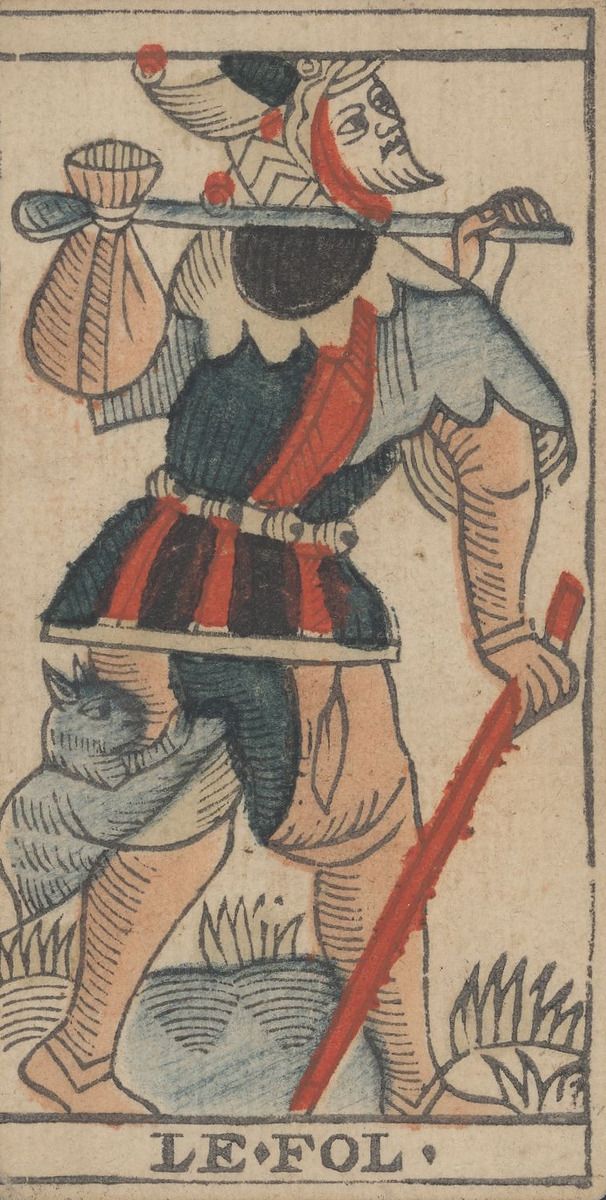
The Fool · Jean-Pierre Payen, blocks dated 1713 · Cary Collection of Playing Cards (FRA166), Beinecke Rare Book and Manuscript Library, Yale University. Prepared for print by Surrealium at Vaxholm Fortress, Sweden.
The Fool moves with a staff and bundle while an animal reaches towards the lower part of his clothing. Beside Strength, that image can prompt a comparison between setting out and learning how to meet what interrupts you. It is not evidence that a particular journey or challenge is about to arrive.
Write down one situation in which you want to respond with greater steadiness. Then name one action within your control and one thing you cannot control. Keep the distinction visible. The exercise turns a broad symbolic theme into a limited, practical reflection rather than a demand to become endlessly resilient in every part of life.
- Is Strength VIII or XI?
- In the Marseille sequence used here it is XI. Many Rider–Waite–Smith decks place it at VIII. Name the deck before assigning the number.
- Does reversed Strength mean weakness?
- It can be used to reflect on strain, self-doubt or the use of force, but it is not a diagnosis or judgement of a person’s worth.
- Can the Strength card predict that a problem will be overcome?
- No. This guide uses the image for reflection on how to respond. Outcomes depend on real circumstances and actions, not on the card.