The Hanged Man: a changed point of view
The Hanged Man in Payen’s deck, its symbolic meanings and the difference between choosing a pause and having no choice.
The Hanged Man is often interpreted through suspension, a changed perspective and the willingness to pause. That reading should never turn a difficult or coercive situation into a demand for grateful surrender. A card cannot tell you that suffering is necessary or that another person has the right to keep you powerless.
Payen’s figure hangs upside down within a simple wooden structure. The image is strange enough to reward looking before explanation. Its physical arrangement can prompt a question about perspective without supplying a moral lesson. The major arcana guide shows where this arrested movement falls among the more active scenes around it.
An inverted body in a firm frame
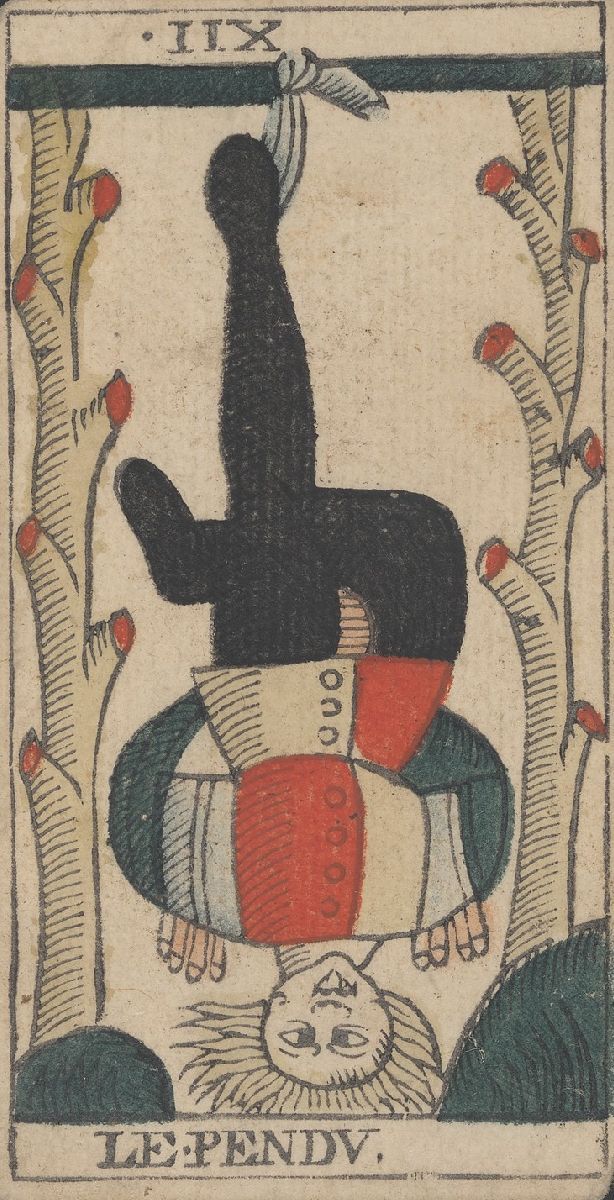
Le Pendu (the Hanged Man) — Jean-Pierre Payen, 1713. Beinecke Rare Book and Manuscript Library, Yale University. Prepared for print by Surrealium at Vaxholm Fortress, Sweden.
A horizontal beam spans two cut tree-like supports. The figure hangs from one ankle, while the other leg bends across it. The hands are held behind the body, leaving the front of the costume unusually clear. Red, blue and dark areas divide the inverted silhouette into large shapes.
Look at the contrast between the rigid frame and the unsettled body. The picture creates tension without showing a crowded scene or a naturalistic landscape. Its old lettering and number belong to the printed card, whose worn surface remains visible. The Marseille tradition gives the image a material history. Modern ideas about voluntary surrender are later readings; they should not be assumed from the pose alone, which does not show us how the figure arrived there.
Upright: a pause needs a purpose
For a modern upright interpretation, a pause can be useful when more effort is repeating the same mistake. Rather than pressing for an immediate answer, you might change the question, ask someone to explain an unfamiliar perspective, or allow time for information to arrive. The purpose of waiting should be describable.
Consider a disagreement in which both people keep restating their positions. A changed viewpoint might begin with each explaining what the other is asking for, without agreeing to it yet. That is different from giving up your own needs. The Hanged Man can frame a temporary experiment in attention, provided the people involved can choose it freely. A pause with a purpose and a review point is more useful than an indefinite command to endure.
Carbone does not hang from a beam
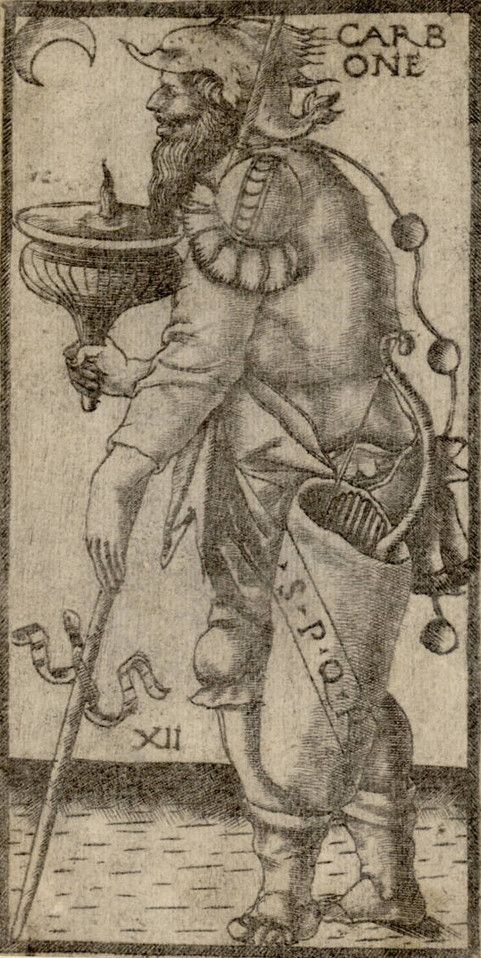
12 Carbone — Unknown engraver, Sola Busca deck, c. 1490. ALBERTINA, Vienna. Prepared for print by Surrealium at Vaxholm Fortress, Sweden.
The Sola Busca trump XII is named Carbone. Its engraved figure carries a large vessel and has equipment arranged around the body. Whatever associations a reader brings to that image, it is not a depiction of Payen’s suspended figure. The shared number is a reason to compare the packs, not to rename the older card.
This difference matters because the phrase “the oldest Hanged Man” can hide several distinct claims. A surviving card, a numbered position and a modern interpretive role are not the same thing. Here we show an actual Sola Busca impression held by the ALBERTINA and preserve its own label. Its inclusion demonstrates how much variety existed in early tarot imagery, rather than pretending that the history develops in one straight line.
Reversed: identify what is keeping you still
A reversed Hanged Man reflection can ask about delay, resistance or a sacrifice that no longer makes sense. Begin by identifying what is keeping you still. A missing answer, limited resources, fear of a conversation and a deliberate rest are different circumstances. They should not receive the same advice because one card has appeared.
If you have chosen to wait, decide what would allow you to reconsider. If the wait is imposed on you, acknowledge that limitation instead of blaming yourself for insufficient insight. The card cannot establish that you caused the problem or that passivity will solve it. A useful question may concern what support you can seek while the larger situation remains unresolved. Reflection is allowed to produce a practical request for help.
Four coins hold a different kind of stillness
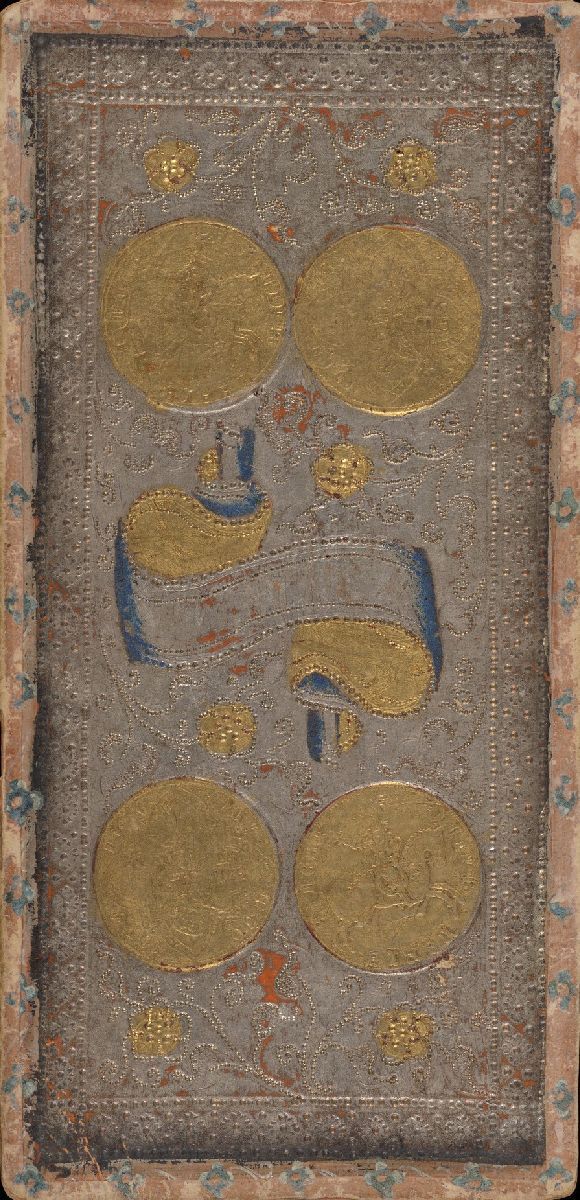
Coins Four — Unknown Milanese workshop, Visconti di Modrone deck, c. 1440–1445. Beinecke Rare Book and Manuscript Library, Yale University. Prepared for print by Surrealium at Vaxholm Fortress, Sweden.
The Visconti di Modrone Four of Coins sets four round gold emblems around a curling ribbon on a worked ground. Its geometry is steady and decorative. There is no suspended body and no implied distress. Comparing it with the Hanged Man separates the visual idea of balance from the story of a person being held.
In the Marseille order, XII follows Strength and precedes Death. A modern reader might consider effort, suspension and change as a sequence of questions. Other traditions number Strength differently, so name the deck when discussing the order. The relationship can support reflection without becoming a rule about the stages that every person or project must pass through.
Turn the question, not your life upside down
Write a question you have been asking repeatedly. Then rewrite it from another practical angle. “Why has nothing happened?” might become “What information is still missing?” or “Who can tell me when the next decision will be made?” Choose a version that makes an investigation possible.
Look at the card again and notice one detail you missed on the first viewing. That small act is enough to demonstrate a changed viewpoint; you need not derive a revelation from it. Finish by choosing whether to wait, ask or act, with the reasons written beside the choice. The image can interrupt an automatic response while leaving the decision with you and the evidence you have, rather than with the inverted figure.
- What does the Hanged Man mean upright?
- Many modern readers use it for a pause, a changed perspective or reconsideration. A useful pause has a purpose and preserves your ability to choose what happens next.
- Does it tell me to sacrifice myself?
- No. A reflective reading should not pressure you to tolerate harm or abandon your needs. The card is not an authority over your boundaries.
- Is the card numbered twelve in every deck?
- XII is the position in the Marseille pattern shown here. Early packs vary in subject and structure, and a matching number does not make Sola Busca’s Carbone the same image.