The World card: completion without a final verdict
Study the historic Marseille World and reflect on what it means to finish one task while leaving room for another.
The World card gathers a central figure inside an enclosing form, with four creatures around the edges. In a symbolic reading it often invites reflection on completion, connection and the relation between a part and a whole. It does not promise success, a perfect relationship or a life in which every loose end has disappeared.
The image shown here is the World from Jean-Pierre Payen’s historical Marseille deck in Yale’s Cary Collection. Its line, colour and arrangement differ from later versions, so the picture deserves to be looked at before a familiar description is applied. The major arcana visual guide provides the wider sequence, and the Marseille tarot art story introduces the deck. Begin with the enclosed figure’s movement and the surrounding forms. The card can help you ask what is sufficiently complete without deciding the answer on your behalf.
An enclosed figure can still be in motion
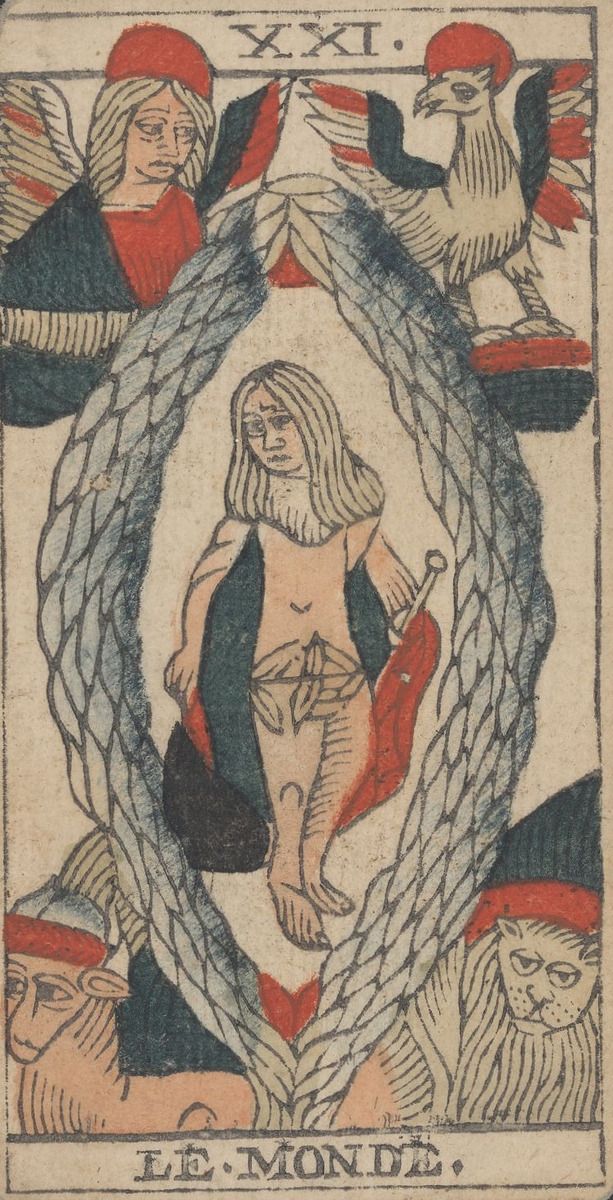
The World · Jean-Pierre Payen, blocks dated 1713 · Cary Collection of Playing Cards (FRA166), Beinecke Rare Book and Manuscript Library, Yale University. Prepared for print by Surrealium at Vaxholm Fortress, Sweden.
The central figure bends within the surrounding oval, while the corner creatures give the card a structure beyond that centre. The image contains both movement and enclosure. That tension is more interesting than treating the border as a simple sign that everything has stopped. A finished arrangement can still hold energy, just as a completed piece of work can remain something you revisit.
Look at the limbs, the cloth and the spaces around the body. Then move outward to the corners and back again. The card encourages that exchange between a central action and a larger frame. You do not need to identify every theological or later esoteric association to begin the visual comparison. Keep interpretations attributed to their traditions, and let the visible image supply a more modest starting point: what belongs within the task you are considering, and what lies outside the boundary you have chosen for it?
Upright: recognise a real stopping point
An upright reading can prompt you to recognise completion at a useful scale. A project may be ready to share even though you can imagine further improvements. A conversation may have reached a clear agreement without resolving every difference between the people involved. The card can help you ask whether the present task has met the purpose you actually set for it.
Write that purpose in one sentence, then compare the result with it. If the task was to make a first draft, do not judge it as though you had promised a final edition. If it was to answer a practical question, check whether the answer is now available. This approach gives completion an observable basis instead of making it depend on a perfect feeling. A symbolic prompt is useful when it brings you back to that concrete comparison. It should not persuade you to declare success where important work or evidence is still missing.
Judgement comes before the World
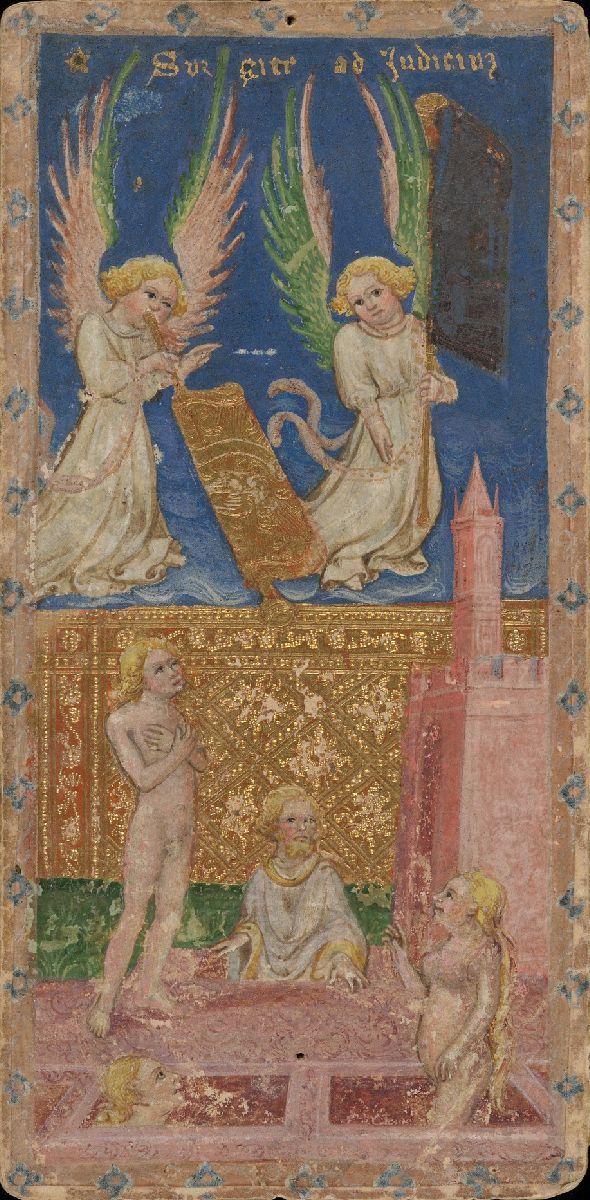
Judgement · Unidentified Milanese workshop, 1442–1447 · Cary Collection of Playing Cards, Beinecke Rare Book and Manuscript Library, Yale University. Prepared for print by Surrealium at Vaxholm Fortress, Sweden.
The familiar modern major arcana sequence places Judgement before the World. The Cary-Yale Judgement pictured here is from a different historical deck and is identified separately. Its figures responding to trumpets create an upward movement that contrasts with the World’s enclosed centre. Together, the images suggest a distinction between recognising a call to act and seeing how the response fits into a larger arrangement.
The Judgement card story explores the first image in more detail. This comparison does not imply that every situation passes through a fixed spiritual sequence. It offers two questions you can use or leave aside: what needs a response, and what would count as completing that response? Historical tarot packs have their own forms and contexts. Keeping the deck names visible prevents a modern sequence comparison from masquerading as one matching set of original cards, while allowing the visual conversation between them to remain useful.
Reversed: identify the unfinished part
A reversed World interpretation can ask what remains unfinished or why a task is difficult to release. The answer might be a genuinely missing step, an unclear standard or a reluctance to let someone else see the result. These possibilities should be tested against the situation, not treated as truths revealed by a reversed picture.
Make a short list of what is still required, then distinguish requirements from optional improvements. If one necessary step remains, name it precisely. If the requirements are met but you continue adding new ones, ask whether the scope has changed and whether that change serves the original purpose. It is also possible that the task should remain unfinished for now. A card does not require you to force an ending. Reflection can clarify the choice without making closure a moral duty or presenting uncertainty as a personal failure that must be overcome through another reading.
The Fool offers a beginning after the ending
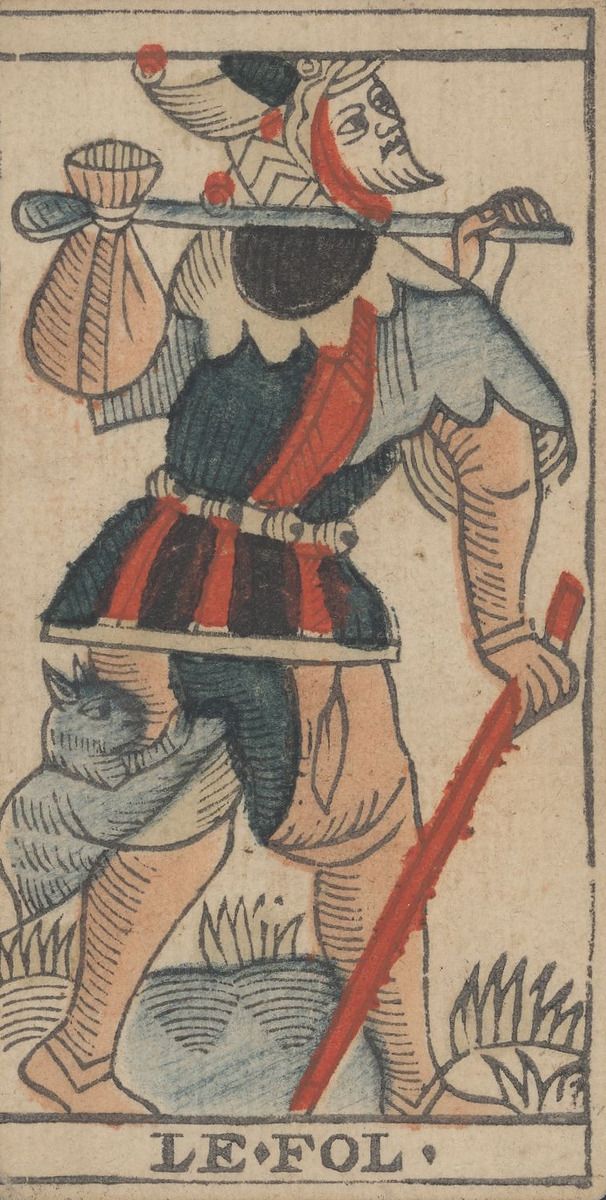
The Fool · Jean-Pierre Payen, blocks dated 1713 · Cary Collection of Playing Cards (FRA166), Beinecke Rare Book and Manuscript Library, Yale University. Prepared for print by Surrealium at Vaxholm Fortress, Sweden.
The World closes the familiar numbered major arcana sequence. There is no next numbered trump beyond it. In a cyclical reading, the Fool can offer a return to beginning, but that is an interpretive convention rather than a missing twenty-second numbered card. The Marseille Fool shown here moves with a staff and bundle, quite differently from the figure enclosed within the World.
Compare what each body appears prepared to do. One belongs to a completed arrangement; the other carries what it needs into a less enclosed space. You might use the pair to ask what experience to take forward and what belongs to the task you have finished. Browse Masterworks if you want to study the historical images outside a spread, or read the history of tarot for their changing uses. A new beginning does not erase the previous work, and an ending does not require a promise that the next stage will be easier.
A short reflection on enough
Name one thing you have finished recently, however small. Write what made it complete, what you learned and one element you would handle differently next time. Keep those statements separate: learning from a result does not mean the result was never finished.
Then choose whether to rest, share it or begin something else. The World can prompt that decision without dictating it. If you find yourself using the card to demand a perfect conclusion, return to the visible movement inside the frame. Completion can be a useful boundary around one piece of work, leaving the person who made it free to continue changing.
Let the whole card remain in view: an active centre held within a larger arrangement. Ask what belongs to the task you can finish now and what can wait for another beginning.
- What does the World card mean upright?
- It is often used as a symbolic prompt about completion and connection. It does not guarantee success; compare the actual result with the purpose of the task you set.
- Does reversed World mean failure?
- No. It can prompt a question about unfinished work, unclear standards or difficulty letting go. Test those possibilities against the situation instead of accepting them as a verdict.
- What card comes after the World?
- The World closes the familiar numbered major arcana sequence. A cyclical reading may return to the Fool as a new beginning, but that is an interpretive convention, not another numbered trump after twenty-one.