Judgement card: a call to look again
Explore a historical Judgement image and its upright and reversed meanings as symbolic prompts for reflection.
The Judgement card brings an image of a summons: trumpets above, figures below, and a moment in which remaining still no longer seems possible. In a symbolic tarot reading, it can prompt reflection on recognition, review and response. It does not announce a future event or establish that someone has been judged by an external authority.
The historical image shown here belongs to the Cary-Yale cards, preserved in Yale’s Beinecke Library. Its Christian resurrection imagery is part of the object’s context. Modern reflective meanings are a later way of using the card, not a replacement for that history. The major arcana visual guide places Judgement within the wider sequence. Here, begin with what the old image shows, then consider how a metaphor of awakening might help you examine a decision that remains yours to make.
What the historical card shows
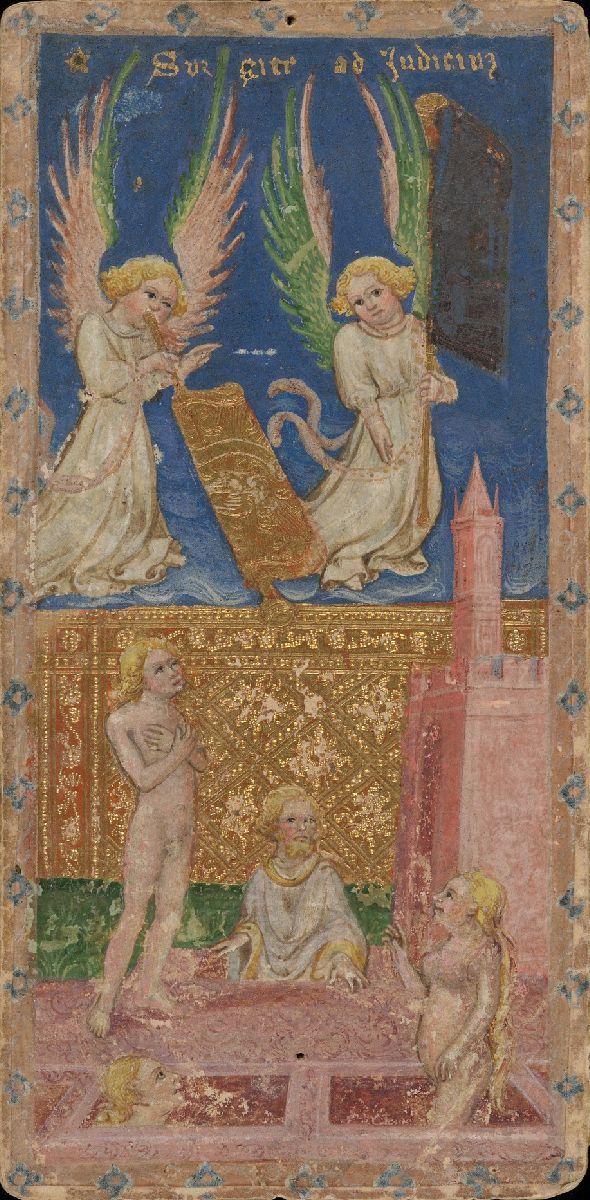
Judgement · Unidentified Milanese workshop, 1442–1447 · Cary Collection of Playing Cards, Beinecke Rare Book and Manuscript Library, Yale University. Prepared for print by Surrealium at Vaxholm Fortress, Sweden.
The Cary-Yale image sets trumpet-bearing figures above people rising from open graves. The vertical arrangement makes the relation between the call and the response immediately visible. Raised heads and bodies direct attention upward, while the lower structures establish the scene’s Christian resurrection subject. This is a specific historical image, not a neutral diagram of personal improvement.
Look at the whole card before isolating a face or gesture. Its upper and lower zones depend on one another, and the decorated surface remains part of the object’s presence. A modern reader can find a metaphor of recognition here while acknowledging that the makers and early viewers encountered a religious subject. Keeping both layers visible allows the card to be studied as art and used for reflection without pretending that its historical meaning was identical to a present-day account of personal growth.
Upright: recognising what needs a response
An upright reading can use Judgement as a prompt to review something honestly and decide whether a response is needed. The emphasis is on recognising what is already available to you, not receiving secret information. You might notice a pattern in your own work, an unfinished conversation or a decision you have postponed despite having enough ordinary evidence to begin.
Ask what has become clearer, what still needs checking and what action would be proportionate. The card does not require a dramatic reinvention. A small response can be enough: revising a plan, acknowledging an error or asking a direct question. Avoid using the image to pronounce a verdict on another person. The reflection is more useful when it concerns your own responsibility and leaves other people free to describe their experience. Recognition should make the next step clearer, not make the reader more certain about facts the card cannot establish.
The Sun comes before Judgement
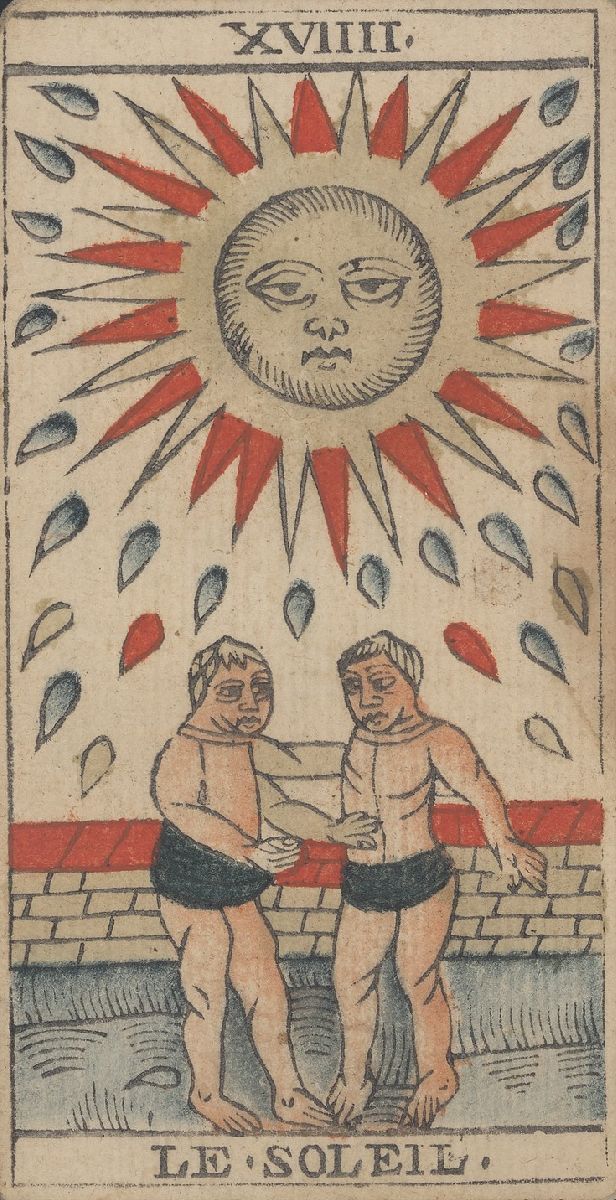
The Sun · Jean-Pierre Payen, blocks dated 1713 · Cary Collection of Playing Cards (FRA166), Beinecke Rare Book and Manuscript Library, Yale University. Prepared for print by Surrealium at Vaxholm Fortress, Sweden.
In the familiar modern major arcana order, the Sun precedes Judgement. The Marseille Sun pictured here offers a bright disc above two figures, making a different visual relationship from the trumpets and rising bodies of the Cary-Yale card. These images come from different historical decks and are placed together as a sequence comparison, not presented as matching cards from one original pack.
The Sun card story allows a closer look at that neighbouring image. As a reflective comparison, you might distinguish seeing something clearly from deciding how to respond to it. That distinction is useful without turning the deck order into a fixed account of everyone’s life. Historical packs and later numbering conventions differ, so the sequence is a reading framework here, not a claim that every early card carried the same number or occupied an identical position.
Reversed: make room for hesitation
A reversed interpretation can ask whether hesitation, harsh self-criticism or a reluctance to revisit a decision is making a response difficult. These are possible prompts within a symbolic practice, not a diagnosis. A card turned upside down does not prove that something is wrong with you or that an opportunity has been lost.
Try distinguishing a useful pause from avoidance. A useful pause has a reason: you need a conversation, another document or time to rest before deciding. Avoidance may feel less specific, but the answer is still to identify a manageable step rather than punish yourself with the image. You can also choose to read without reversals if that makes the practice clearer. State the approach before a spread and keep it consistent. The Celtic Cross guide shows how a card’s position can provide another source of nuance without making every reversed image a warning.
The World follows, without promising completion
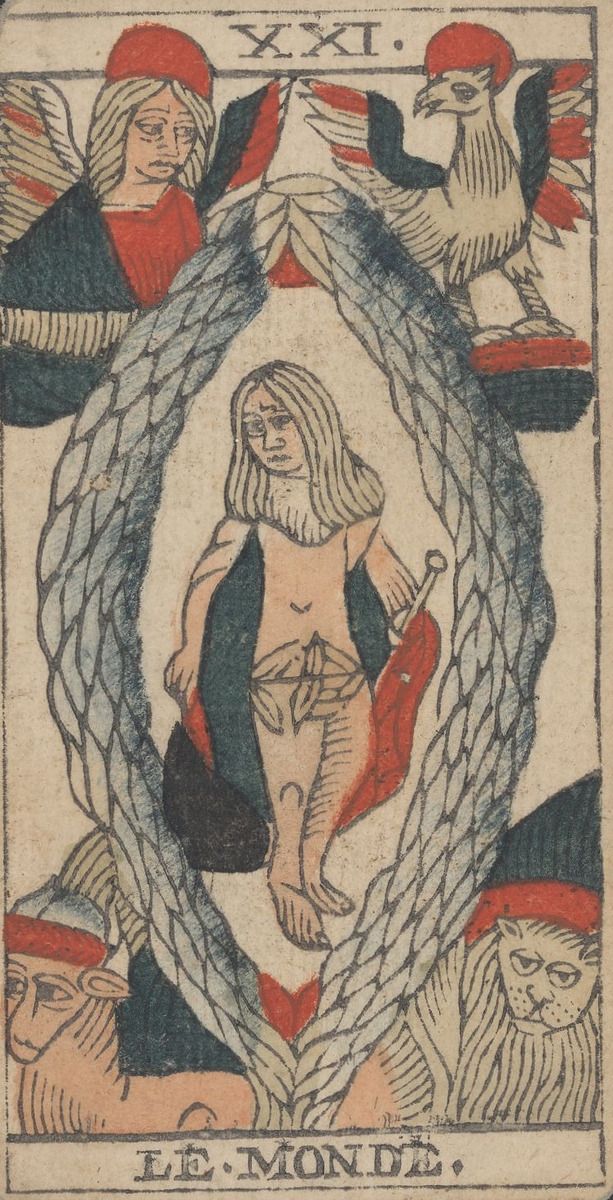
The World · Jean-Pierre Payen, blocks dated 1713 · Cary Collection of Playing Cards (FRA166), Beinecke Rare Book and Manuscript Library, Yale University. Prepared for print by Surrealium at Vaxholm Fortress, Sweden.
The World follows Judgement in the familiar modern sequence. The Marseille card gathers its central figure within an enclosing form, offering a visual contrast with the open vertical movement of the resurrection scene. As a pair, the images can prompt a question about the difference between responding to a call and seeing how a piece of work fits into a larger whole.
Read the World card story for that neighbouring subject. The sequence does not guarantee that an unfinished situation will resolve neatly after a moment of insight. It can simply help organise reflection: what have you recognised, what response is possible, and how will you know when the present task is sufficiently complete? Historical tarot images available in Masterworks can be studied beyond any one reading. Their visual detail remains interesting even when a particular symbolic interpretation does not fit your circumstances.
A short reflection to take away
Write down one thing you have recently understood more clearly. Separate what you know from what you suspect, then name a response that is small enough to carry out. You might correct a piece of work, ask for clarification or set a time to revisit the question. Leave room for the possibility that new evidence will change your view.
Judgement is useful here as an image of attention becoming response. It does not need to supply a verdict, a prediction or a permanent story about who you are. If the image feels too severe for the question, choose a gentler prompt or stop the exercise. A reflective practice should help you look, not compel you to accept its authority.
The Marseille tarot art story gives the neighbouring Sun and World cards their own historical context.
Return to the historical card once more: a call above, bodies responding below. Let that visible relationship support one honest question about your next step. The answer belongs to your circumstances and choices.
- What does the Judgement card mean upright?
- In a symbolic reading it can suggest review, recognition and a proportionate response. It does not establish hidden facts or guarantee a future event.
- Is reversed Judgement a bad omen?
- No. It can be used as a prompt about hesitation or self-criticism, but it is not a diagnosis or a prediction. You may also choose a consistent reading practice without reversals.
- Which cards come before and after Judgement?
- The Sun comes before and the World after in the familiar modern major arcana order. The historical examples shown come from different decks, so they are identified individually rather than presented as one original pack.