The Sun card: light, company and what is visible
The Sun card in Payen’s historic deck: two figures, a low wall and a bright image for grounded upright and reversed reflection.
The Sun card is often associated with clarity, warmth and enjoyment. Those themes can direct attention towards what is working in the present. They do not guarantee success, recovery or an uncomplicated future, and they should never become a demand to feel cheerful when you do not.
Payen’s 1713 card shows two lightly clothed figures beneath a large sun with a face. The pair differs from the child on a white horse in the later Rider–Waite–Smith design. Looking at the older image makes companionship, exposure and shared space available alongside the familiar keyword “happiness”. The major arcana guide places this bright scene near the end of the sequence.
Two figures under the same light
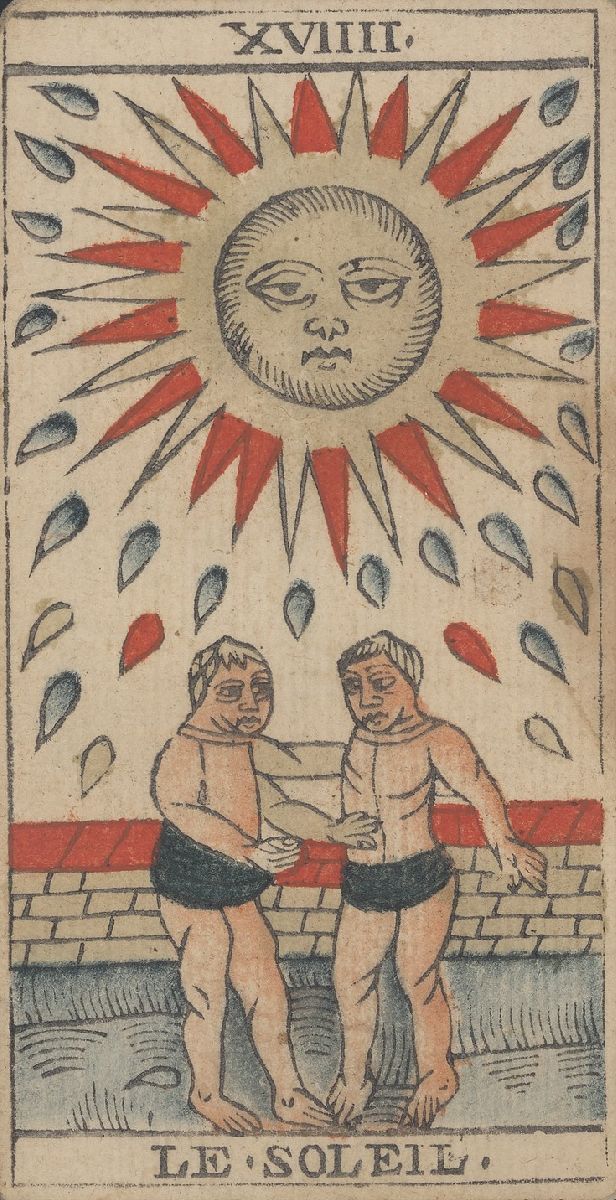
Le Soleil (the Sun) — Jean-Pierre Payen, 1713. Beinecke Rare Book and Manuscript Library, Yale University. Prepared for print by Surrealium at Vaxholm Fortress, Sweden.
The sun fills much of the upper half of Payen’s card. Straight and curved rays radiate from its face, while coloured drops or small flame-like shapes occupy the space below. Two figures stand near a low wall, their arms reaching towards one another. The image gives equal prominence to the source of light and the people beneath it.
Describe the gestures before assigning a relationship. The card does not name the pair or provide a story of their meeting. Their shared ground is visible; their feelings remain interpretation. The Marseille art story explains the printed pattern around this example. It helps us keep the particular two-person composition distinct from later decks rather than treating every Sun card as the same picture in different colours.
Upright: acknowledge something specific
An upright Sun reflection can ask what is presently clear, enjoyable or worth sharing. Make the answer concrete. A finished task, an honest conversation or an afternoon spent well gives you more to consider than an instruction to be positive. The point is attention, not a test of whether you are grateful enough.
You might also ask who helped make that good thing possible. The two figures in the card allow enjoyment to be social rather than solitary achievement. Thanking a collaborator or telling a friend what you appreciated can be an appropriate next step. None of this requires a prediction that the good feeling will last. Something can deserve acknowledgement even when it is brief, incomplete or accompanied by other difficulties.
The maker’s name belongs to the daylight too
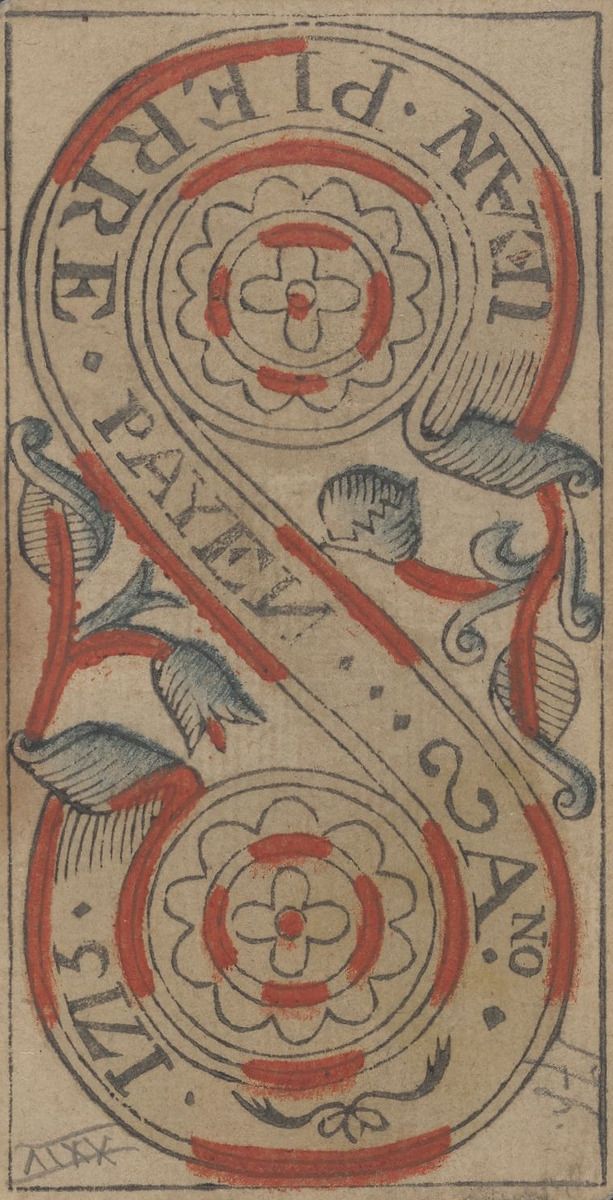
Coins Two — Jean-Pierre Payen, 1713. Beinecke Rare Book and Manuscript Library, Yale University. Prepared for print by Surrealium at Vaxholm Fortress, Sweden.
Payen’s Two of Coins carries a flowing band around its two large emblems. This is the card associated with the maker’s signed and dated information in the pack. It reminds us that a tarot deck is also a made object: printed, coloured, handled and preserved. Looking at the source can be as revealing as looking for a symbol.
The comparison with the Sun is deliberately modest. Both pictures arrange paired forms around a strong central axis, but the Two of Coins is a suit card, not a smaller version of the trump. Its ornamental clarity can invite close attention to lettering and repeated shapes. It does not prove that two people will be reunited or that a financial plan will succeed. The actual marks are enough to begin with.
Reversed: allow mixed weather
A reversed Sun interpretation sometimes concerns muted enjoyment, overexposure or a confidence that needs adjusting. It can also prompt a question about pressure to perform happiness. These are different possibilities, and no orientation of a card can diagnose the cause of a person’s mood.
Ask whether you have room to describe your experience honestly. You may be pleased about one thing and worried about another. You may want to celebrate quietly, or prefer to keep a success private. The card should not turn those choices into failures to accept joy. If confidence has run ahead of evidence, checking a fact or inviting another view may help. If the issue is fatigue or difficulty, a demand for more brightness is unlikely to be a useful response.
The World offers another wide view
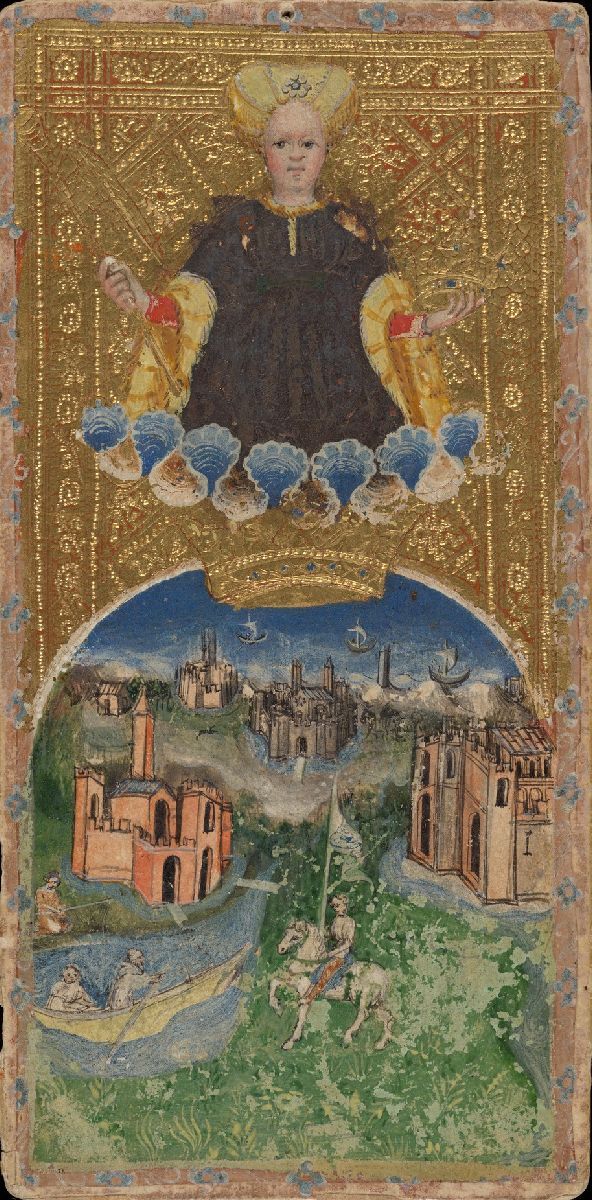
World — Unknown Milanese workshop, Visconti di Modrone deck, c. 1440–1445. Beinecke Rare Book and Manuscript Library, Yale University. Prepared for print by Surrealium at Vaxholm Fortress, Sweden.
The surviving Visconti di Modrone World card places a female figure above a circular view of buildings and landscape. Its gold ground and carefully arranged lower scene differ from Payen’s open sun and low wall. It is shown as another image that gives the viewer a broad field to contemplate, not as an earlier Sun card.
In the Marseille sequence the Sun is XIX, after the Moon and before Judgement. A modern reader may use the sequence to compare uncertainty, visibility and response. That is a way to organise thought rather than a prediction that uncertainty will inevitably be followed by good news. The visible picture can support a conversation without requiring life to follow the order of a shuffled pack.
Notice, share or simply leave it there
Write one sentence about something you can see more clearly now than you could a week ago. Then write one sentence about something you enjoyed. They do not have to concern the same subject, and neither needs to be impressive. Small observations are less likely to become slogans than broad declarations about your life.
Decide whether either sentence belongs in a conversation with someone else. If it does, share it without asking the person to confirm a prediction. If it does not, keep it as a private note. Return to the two figures beneath the sun and notice how the image holds company without explaining everything about it. A good reading can leave some things open while still making the present easier to describe.
- Is the Sun card always positive?
- It often carries positive associations, but it is not a promise of a particular outcome. A reflective reading can acknowledge enjoyment while making room for mixed feelings.
- Does the Sun predict pregnancy or recovery?
- No. A card cannot establish pregnancy, diagnose health or predict recovery. Those questions require appropriate evidence and care.
- Why does the old Sun card show two people?
- That is the composition of the Marseille pattern used by Payen. The later Rider–Waite–Smith card has a child on a horse; the two designs should be described separately.