Celtic Cross: ten positions, one useful question
A clear modern layout and worked reflection show how to read a Celtic Cross without treating its outcome as a prediction.
The Celtic Cross is a ten-card tarot layout that gives different parts of a question separate places on the table. Its value as a reflective exercise comes from making you look at the same concern from several angles: the immediate situation, what complicates it, what you bring to it and what you might do next. The final card is not proof of a fixed future.
A. E. Waite described a version in The Pictorial Key to the Tarot in 1910. His title called the method ancient and Celtic, but that label is not evidence of an ancient origin. The layout below is a clearly stated modern adaptation, using a fixed left-to-right arrangement and contemporary prompts. The historical Marseille cards shown are examples for looking, not a claim that this spread originated with their maker. For the card vocabulary, begin with the major arcana visual guide.
Set one question before placing the cards
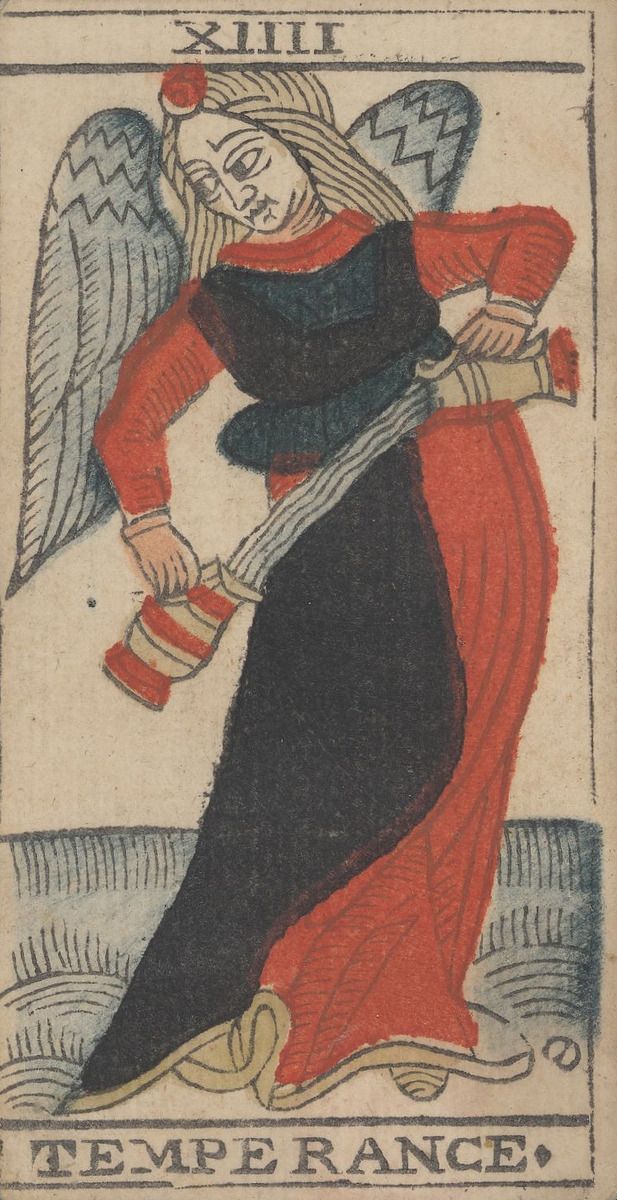
Temperance · Jean-Pierre Payen, blocks dated 1713 · Cary Collection of Playing Cards (FRA166), Beinecke Rare Book and Manuscript Library, Yale University. Prepared for print by Surrealium at Vaxholm Fortress, Sweden.
Choose a question that concerns something you can examine or influence. How can I approach a difficult conversation more clearly is a better starting point than asking the cards to reveal another person’s private thoughts. Write the question in one sentence and leave it visible. If several unrelated concerns appear, choose one rather than asking ten cards to settle an entire life at once.
Temperance, shown here in the Marseille tradition, offers a useful image for this preparation. The figure transfers liquid between vessels, giving attention to relationship and proportion. You need not draw this card to borrow a practical question from the image: what needs to be brought into a workable balance before I begin? Keep the exercise bounded. A notebook, a consistent position list and enough quiet to look carefully are more useful than an elaborate atmosphere that makes the result feel impossible to question. Decide in advance whether you will use reversals, and keep that choice consistent through the reading.
Use one numbered layout consistently
For this adaptation, place card 1 at the centre and card 2 sideways across it. Put 3 above, 4 below, 5 to the left and 6 to the right. Make a separate column on the right with 7 at the bottom, then 8, 9 and 10 rising above it. The sideways card marks a crossing influence; its position alone does not decide whether it is read as reversed.
Use these prompts: 1, the present situation; 2, the complication; 3, the aim; 4, the foundation; 5, a recent influence; 6, a possible next development; 7, your stance; 8, the surrounding circumstances; 9, hopes and fears; 10, a possible direction to examine. This fixed arrangement is a working convention, not the only authentic numbering. Waite’s treatment of the past and future sides depended on the facing of a chosen significator. Here no extra significator is required. If you follow another book, use its whole scheme rather than combining two sets of positions halfway through the exercise.
Read the centre as a relationship
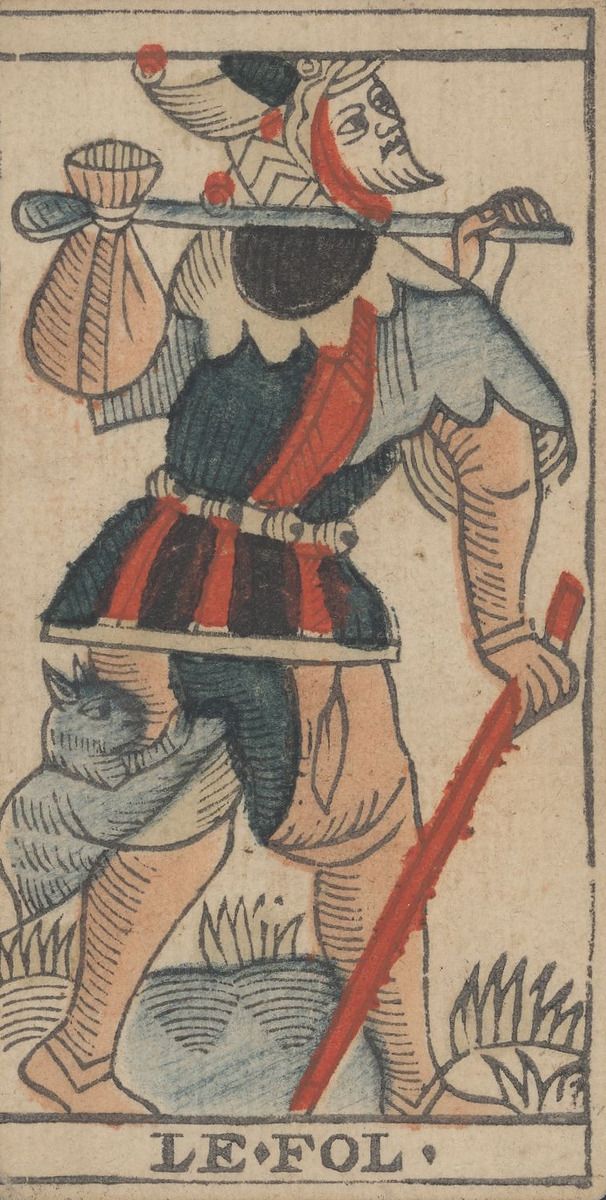
The Fool · Jean-Pierre Payen, blocks dated 1713 · Cary Collection of Playing Cards (FRA166), Beinecke Rare Book and Manuscript Library, Yale University. Prepared for print by Surrealium at Vaxholm Fortress, Sweden.
Consider a worked example about beginning a small creative project. Suppose the Fool appears at the centre and Temperance crosses it. A possible reflection is that enthusiasm is available, while the pace or combination of resources needs attention. That is an interpretation offered for practice, not a claim that these two cards always describe the same situation.
Look at the pictures before deciding the sentence. The Marseille Fool moves with a bundle and a staff; Temperance attends to a transfer between vessels. Their contrasting actions can help you ask whether starting and coordinating need different kinds of effort. Write an ordinary next step, such as choosing a manageable first session and identifying the materials already available. The Fool card guide gives the image a wider setting. A good reading of the centre should make the question more precise. If it merely tells you that everything is possible or everything is blocked, return to the visible details and ask for a more useful distinction.
Compare the cross before reading the final card
Now imagine the aim concerns making something shareable, while the foundation concerns an unfinished earlier attempt. The recent influence might bring encouragement, and the possible next development might suggest a choice about scope. The point of these positions is not to create a secret biography. It is to hold several aspects of the same question apart long enough to compare them.
Ask whether the aim is supported by the foundation, whether the recent influence is still relevant and whether the possible development requires a decision you can actually make. Contradictions are useful if you leave them visible. Wanting a polished result while having very little time is not an omen; it is a practical tension to address. Resist the temptation to make every card agree with the first interpretation. The birth-card guide offers a different exercise in comparing symbolic images, but a spread is especially suited to this kind of situational relationship. Its positions give you a structure for thinking, not independent witnesses confirming a hidden truth.
Let an unillustrated suit card remain itself
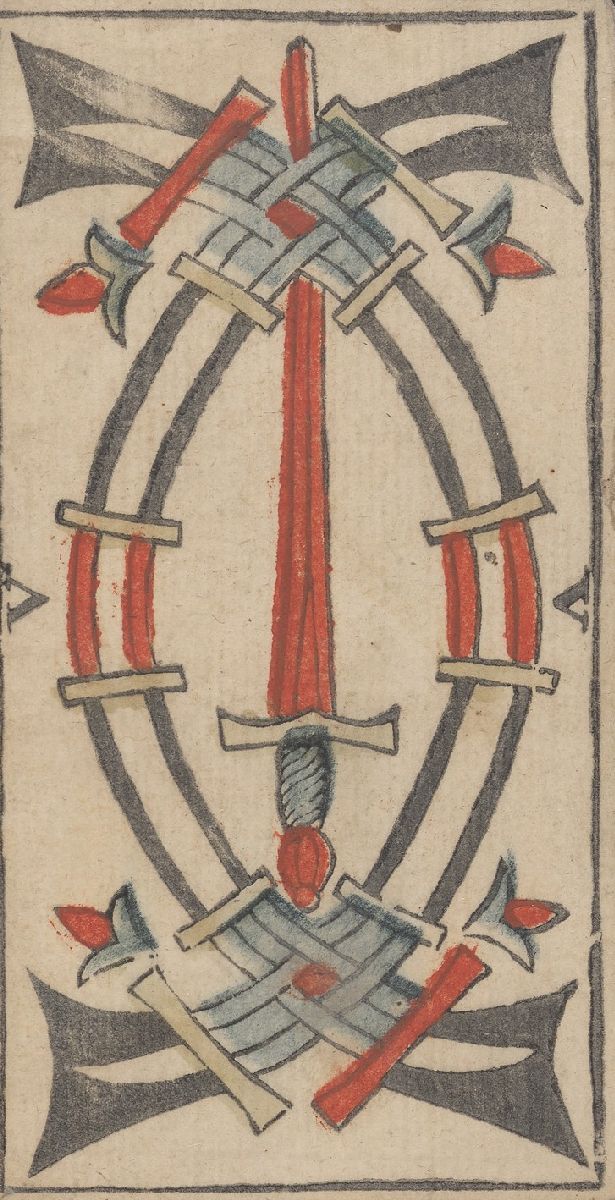
The Five of Swords · Jean-Pierre Payen, blocks dated 1713 · Cary Collection of Playing Cards (FRA166), Beinecke Rare Book and Manuscript Library, Yale University. Prepared for print by Surrealium at Vaxholm Fortress, Sweden.
The Marseille Five of Swords is organised around repeated curved blades and ornament. It does not contain the narrative scene found in some later decks. If you are using it in the position for your own stance, start with the actual image rather than describing figures that are not there. Repetition, enclosure or competing directions may suggest a question, but the response still belongs to your situation.
For the creative-project example, you might ask whether you are spending more attention on comparison than on making. That is one possible prompt, not a universal meaning extracted from the number five. Then test it against ordinary evidence: how much time did you spend working this week, and how much time did you spend looking at other people’s results? A useful reflection should survive that question. The Marseille tarot art story helps distinguish this deck’s visual language from later illustrated systems. Keeping the actual card in view prevents a remembered meaning from replacing the object in front of you.
Treat the last card as a question to carry forward
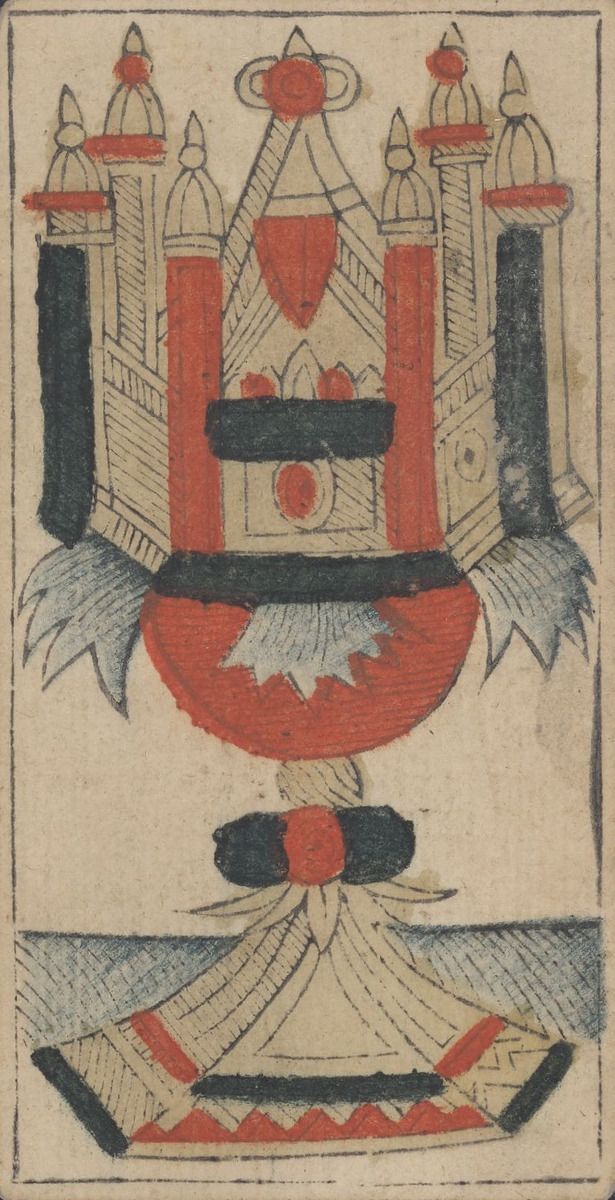
The Ace of Cups · Jean-Pierre Payen, blocks dated 1713 · Cary Collection of Playing Cards (FRA166), Beinecke Rare Book and Manuscript Library, Yale University. Prepared for print by Surrealium at Vaxholm Fortress, Sweden.
Suppose the Ace of Cups appears in the final position. The Marseille image presents an elaborate vessel, which can prompt a question about what the project is making room for. You might decide that the first result should be something you can share with one trusted person. That is a possible direction, not a guarantee of approval or success.
Finish by writing one action and one uncertainty. An action might be setting aside an hour to make a rough version; an uncertainty might be whether the chosen format suits the idea. Both can be revisited with real information. Browse Masterworks if you want to study the historical card images more closely, or read the history of tarot for their changing contexts. The spread has done enough when it helps you form a clearer question or a proportionate next step. You do not need to repeat it until it supplies the answer you hoped to receive.
A Celtic Cross works best when its layout is explicit and its question remains small enough to examine. Keep the ten positions consistent, compare the images before settling on a story, and let disagreement between cards remain an invitation to think more carefully.
At the end, return to the written question. Decide what you can do, what you need to ask and what you still do not know. The reading can help organise reflection, while the next conversation or practical action provides information that the cards themselves cannot supply.
The online tarot reading guide considers how to bring a focused question to the reading desk.
- How many cards are in a Celtic Cross?
- This version uses ten drawn cards. Some traditions add a separate significator, but the adaptation here does not require one. Keep the stated layout consistent rather than mixing instructions from several systems.
- Is the Celtic Cross an ancient Celtic practice?
- Waite used that description in his 1910 book, but the name alone does not prove an ancient origin. This guide identifies its layout as a modern adaptation of a documented published method.
- Does the final card predict what will happen?
- No. Here it offers a possible direction to examine. Finish with an action you can take and an uncertainty you can investigate, rather than treating a card as a guaranteed outcome.