Birth card: a tarot calculation and a way to reflect
Work through one named birth-card method, then use historical tarot images as prompts rather than fixed descriptions of a person.
A birth card in tarot is a card or group of cards associated with a date through a numerological calculation. It is not a birth announcement, an identity document or a factual test of personality. Different systems can produce different results, so a useful guide should name its method before asking you to interpret the answer.
This guide uses the Tarot School’s published calculation as a defined example, with original worked dates below. The historical cards pictured are visual references; they were not made to illustrate this modern calculation system. The distinction matters because an old card does not make a new numerological practice ancient. Start with the major arcana visual guide if the card names are unfamiliar, and use the calculation as an invitation to look at a pair of images. The result can frame a question without deciding who you are or what must happen next.
Choose one method and write the arithmetic down
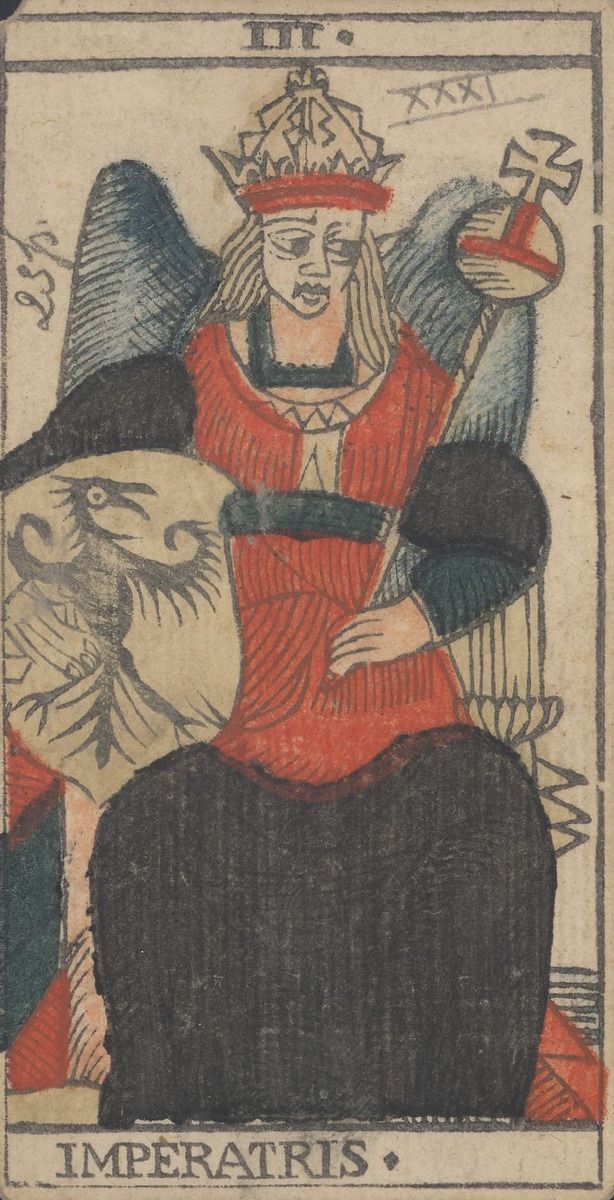
The Empress · Jean-Pierre Payen, blocks dated 1713 · Cary Collection of Playing Cards (FRA166), Beinecke Rare Book and Manuscript Library, Yale University. Prepared for print by Surrealium at Vaxholm Fortress, Sweden.
The Tarot School method adds the month, day and the two halves of the year: MM + DD + CC + YY. With a three-digit total, add the first two digits as one number to the final digit. Continue to the corresponding numbered card and its reduced partner; the school publishes a pairing table and treats nineteen as a three-card exception. Other methods use different reductions, so do not silently combine their rules.
For 15 February 1984, the calculation is 02 + 15 + 19 + 84 = 120. Then 12 + 0 = 12, and 1 + 2 = 3. In this system the pair is the Hanged Man and the Empress. Write those steps beside the result so you can check an arithmetic error without turning it into a mysterious disagreement. The Empress pictured here belongs to a historical Marseille deck. Her image can be explored after the calculation, but her historical existence is separate from the reason this modern method assigned her number to that example date.
A second example shows why the grouping matters
For 11 June 1992, add 06 + 11 + 19 + 92 to reach 128. Using the same rule, 12 + 8 gives 20, which reduces to 2. The pair in the named system is Judgement and the High Priestess. Adding all the individual digits immediately would conceal the intermediate twenty, so writing the steps is part of understanding the method rather than unnecessary bookkeeping.
These examples do not demonstrate that a date reveals a person’s character. They demonstrate how a particular set of rules produces a particular symbolic starting point. If another calculator disagrees, compare its rules before looking for a deeper reason. You might find a different treatment of the century, a different reduction or another card-number convention. For a special case, consult the method’s own table instead of inventing a missing step. The Judgement card story provides a closer look at one of the images named by the second example, with interpretation kept separate from prediction.
Look at the image before reading a personality label
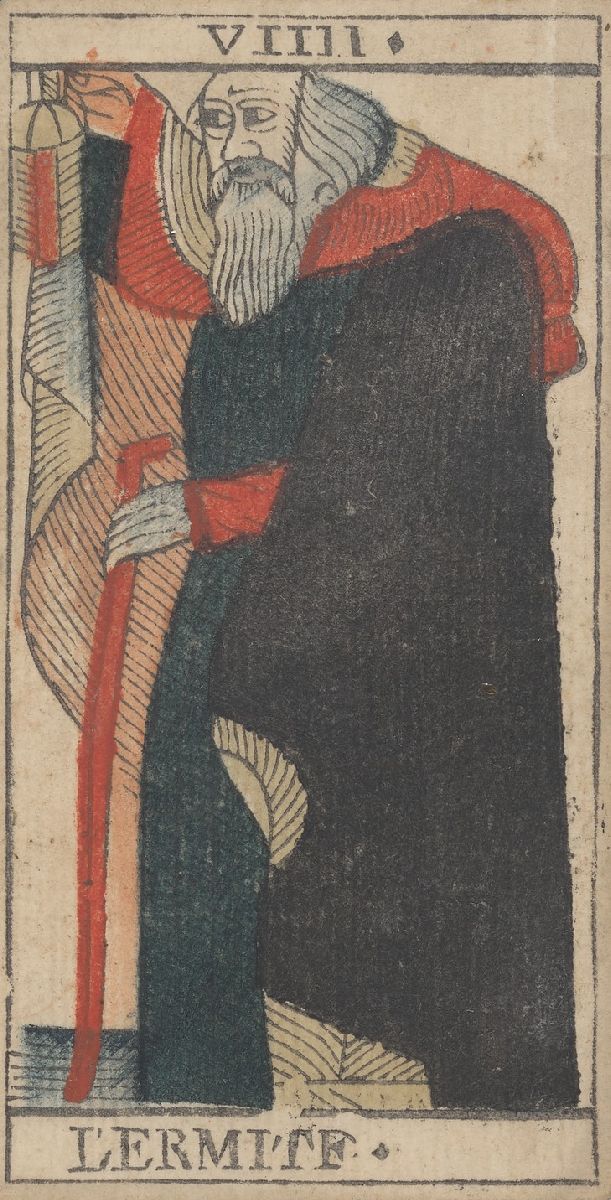
The Hermit · Jean-Pierre Payen, blocks dated 1713 · Cary Collection of Playing Cards (FRA166), Beinecke Rare Book and Manuscript Library, Yale University. Prepared for print by Surrealium at Vaxholm Fortress, Sweden.
The Hermit in the Marseille deck is a standing figure with a staff and a light held forward. Before deciding what the card means for you, describe what you can actually see. Notice the body’s direction, the covered head and the relationship between the small light and the surrounding field. Those observations give you more to work with than an immediate declaration that a particular person must be solitary or wise.
A reflection can begin with a question: where would a little more time or attention help me see clearly? The question belongs to the present situation, not permanently to everyone associated with the number. Someone may find it useful one week and irrelevant the next. That flexibility is a strength when tarot is used as a symbolic practice. The Hermit card guide develops the image’s place in the major arcana. Keep the card available as a conversation partner rather than turning it into a label that has to explain every decision a person makes.
Read a pair as a contrast, not a verdict
For 1 September 1970, the addition gives 09 + 01 + 19 + 70 = 99, followed by 9 + 9 = 18 and 1 + 8 = 9. In the named system, Moon and Hermit form the pair. A productive reading need not announce that one card is your public self and the other your hidden truth. You can simply compare what each image brings into view.
The Hermit’s small held light and the Moon’s broad night scene offer different scales of illumination. One question might concern what you can examine closely; another might concern what remains uncertain when you try to understand the whole situation. Those questions arise from the images and your present concerns, not from proof that the date controls your life. Write two possible readings and see which one helps you describe something concrete. If neither does, leave them aside. A symbolic exercise does not become more responsible by forcing every detail of a person’s experience to fit the assigned cards.
Let uncertainty remain visible
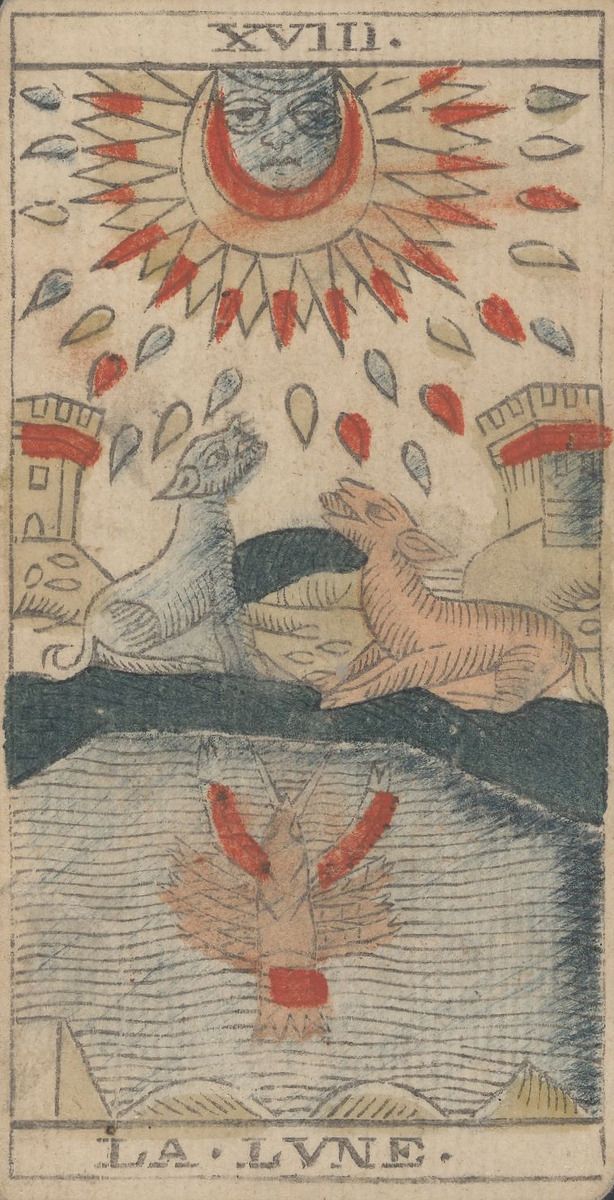
The Moon · Jean-Pierre Payen, blocks dated 1713 · Cary Collection of Playing Cards (FRA166), Beinecke Rare Book and Manuscript Library, Yale University. Prepared for print by Surrealium at Vaxholm Fortress, Sweden.
The Marseille Moon contains a large celestial form above animals, towers and a lower body of water. It gives the eye several zones to move between. You can notice those zones without assuming that they reveal hidden facts about another person. The image is especially useful for asking what you do not yet know, provided the question leads back to observation or conversation rather than suspicion.
For example, if you are uncertain how a friend feels about a shared plan, a card can help you name that uncertainty. It cannot tell you the friend’s private answer. The practical next step is to ask them. This keeps reflection connected with ordinary evidence and gives the other person room to speak for themselves. The tarot history story provides context for the cards as objects with changing uses. A birth-card exercise is one contemporary use among others; it should not flatten that history into a claim that every old deck was designed to diagnose modern personalities.
Keep the practice proportionate to the question
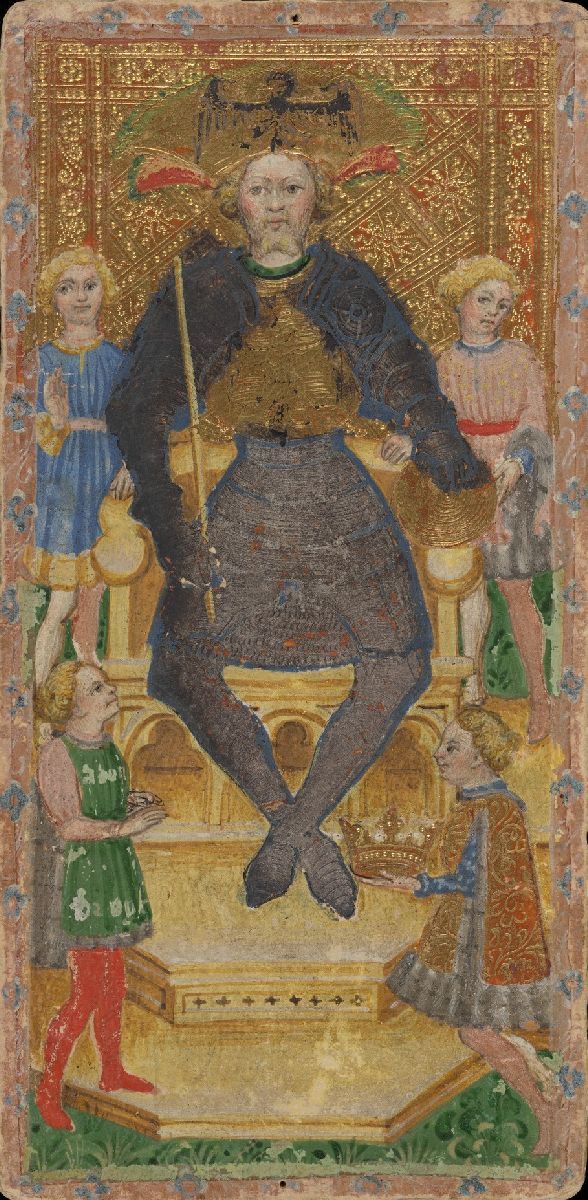
The Emperor · Unidentified Milanese workshop, 1442–1447 · Cary Collection of Playing Cards, Beinecke Rare Book and Manuscript Library, Yale University. Prepared for print by Surrealium at Vaxholm Fortress, Sweden.
The Cary-Yale Emperor offers a historical image of a seated ruler, with clothing and regalia giving the body a formal presence. It can prompt a question about responsibility or structure, but it does not establish that someone is destined to command others. As with every card in this guide, the useful movement is from visible image to a thoughtful question, then from that question to something you can examine in your actual life.
Keep a short note of the calculation, the image you considered and the action you chose. That record lets you see whether the practice helped clarify a concern or merely produced an attractive description. You can explore the pictured works through Masterworks, or compare the more situational approach in the Celtic Cross guide. Neither a birth-card pair nor a spread needs to become a final authority. Let the practice stay small enough to be useful: a way to pause, look and form a question that remains yours to answer.
A birth-card calculation is most useful when its rules are visible and its claims stay modest. Name the system, show the arithmetic and keep the resulting images distinct from a factual description of a person. The historical cards can then offer texture and surprise without being asked to prove more than they can.
If you continue at the reading desk, bring one question you can influence and enough openness to find the image unhelpful as well as helpful. Reflection works best when you remain free to decide what belongs in your life and what does not.
The personalised tarot card story explores another contemporary use of historical imagery.
- Why do birth-card calculators give different results?
- They may use different reduction methods, pairings or numbering conventions. Compare the stated method and the written arithmetic before assuming one unexplained result has a deeper authority.
- Does a birth card prove my personality or future?
- No. It is a symbolic association produced by a chosen numerological method. You can use the image to frame a question without treating it as evidence about your identity or a prediction.
- Were medieval tarot cards made for birth-card calculations?
- The historical cards shown here are visual references, not evidence that their makers used this modern calculation system. Keep the date of the object separate from the date and purpose of a later interpretive practice.