The Hermit card: a lamp, a staff and time to look
The Hermit card’s historic figure and its upright and reversed meanings, with a quiet exercise that leaves room for company.
The Hermit card is commonly read through solitude, reflection and the search for understanding. Solitude can help with those things, but the card does not prescribe isolation. Its most useful question may be what kind of quiet you need, and who can help you think well.
Payen’s old figure bends within a narrow frame, holding a staff and lifting a small lamp. It is a compact image of limited illumination: enough light for an immediate task, rather than a complete view of everything ahead. That visual modesty is a good place to begin. The major arcana guide situates the figure among more public displays of power and movement.
Look for the small source of light
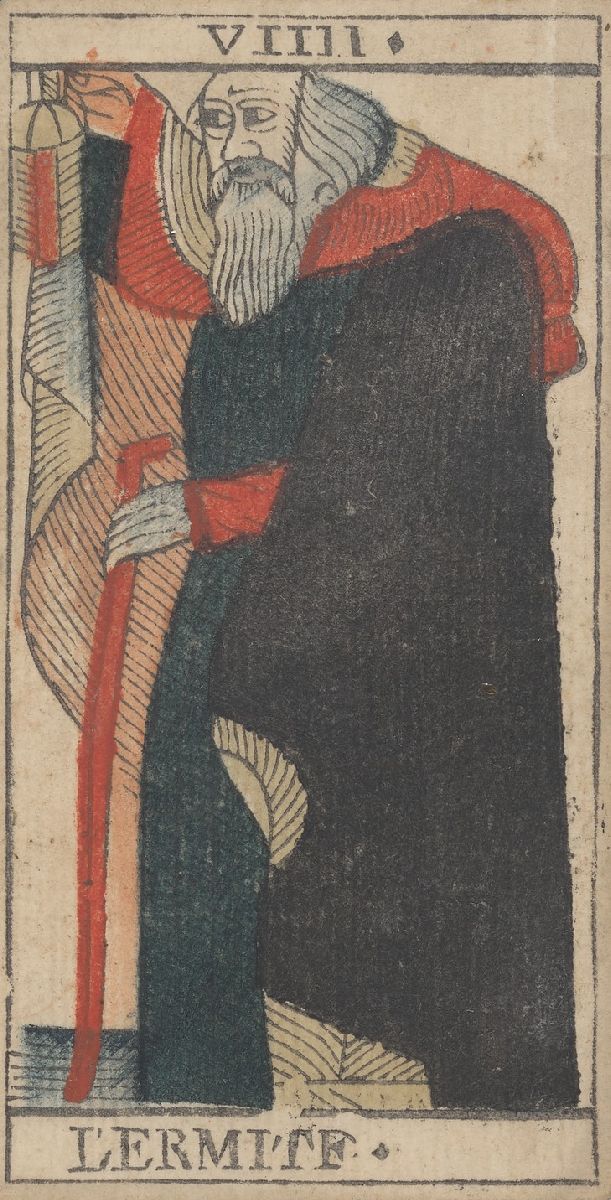
Hermit — Jean-Pierre Payen, 1713. Beinecke Rare Book and Manuscript Library, Yale University. Prepared for print by Surrealium at Vaxholm Fortress, Sweden.
The Hermit’s cloak occupies much of Payen’s card. A staff runs down beside the body, while a small lantern is held near the face. The posture and beard suggest age, but the image does not tell us the figure’s biography. Red edging and blue fabric keep the silhouette clear against the pale card.
Instead of treating every detail as a password, notice their practical relationships. The staff reaches towards the ground; the lamp lifts towards the eyes; the clothing wraps around the body. The picture concentrates attention rather than scattering it across a crowd. In the Marseille deck story, these economical forms belong to a repeatable printed pattern. Their simplicity leaves space for many later interpretations without proving any one of them original.
Upright: make a place for concentration
An upright Hermit reflection can concern a period of study or a pause before answering. It may be useful when you have been reacting to other people’s demands faster than you can consider them. The practical question is how to create enough room for thought without disappearing from commitments that matter.
Try naming the task that needs quiet. Reading a difficult letter, reviewing a decision or learning a skill each calls for a different kind of attention. Set a modest boundary around that task and decide when you will return to the conversation. This turns solitude into a chosen condition for thinking, rather than a claim that wisdom requires separation from other people. A teacher, friend or colleague can still belong in the process.
Falco is a named figure, not the Hermit
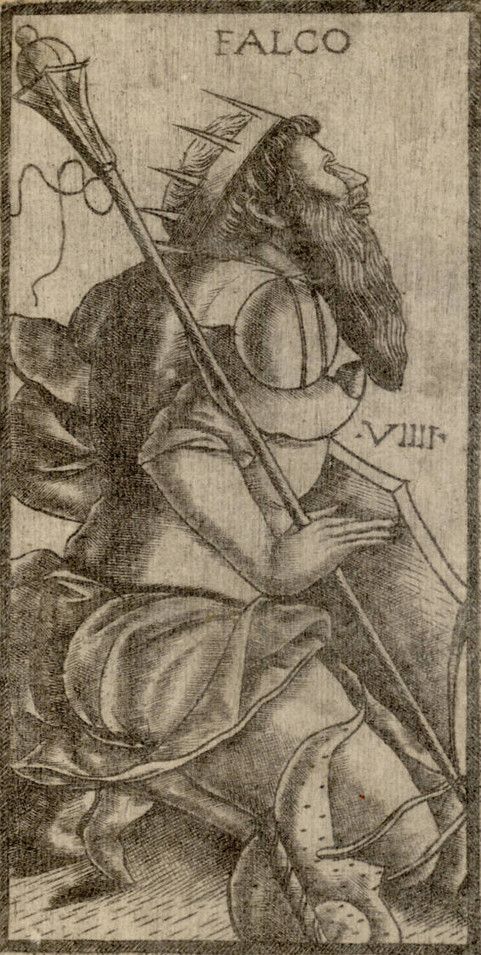
09 Falco — Unknown engraver, Sola Busca deck, c. 1490. ALBERTINA, Vienna. Prepared for print by Surrealium at Vaxholm Fortress, Sweden.
The Sola Busca trump Falco is numbered IX, but it depicts an armoured figure, not Payen’s cloaked lamp-bearer. The engraving’s named character, equipment and pose belong to a different pack. A matching number cannot establish that it is simply an older version of the same image.
Place the two side by side and consider what each makes conspicuous. Payen presents a wrapped body and a small light; the engraving presents armour, a weapon and a name. The comparison is useful because it frustrates an easy assumption about a universal tarot sequence. Historic decks are related objects with differences, not transparent containers for one timeless dictionary. Keeping Falco’s identity intact makes the historical account stronger, even if it makes the modern reading less tidy.
Reversed: quiet can become a closed door
A reversed Hermit interpretation may ask whether reflection has turned into avoidance, or whether you have had too little room to think. Those situations require opposite adjustments. Begin with what your recent days actually look like rather than deciding from the card’s orientation alone.
Have you postponed a conversation because you need information, or because the conversation is uncomfortable? Have you been alone by choice, or because support is difficult to access? The image cannot answer those questions for you. It can help you formulate them without making withdrawal a virtue in itself. If connection is what you need, contacting someone can be as consistent with a thoughtful reading as taking an hour alone. There is no prize for doing every difficult thing privately.
Four swords and a pause in the sequence
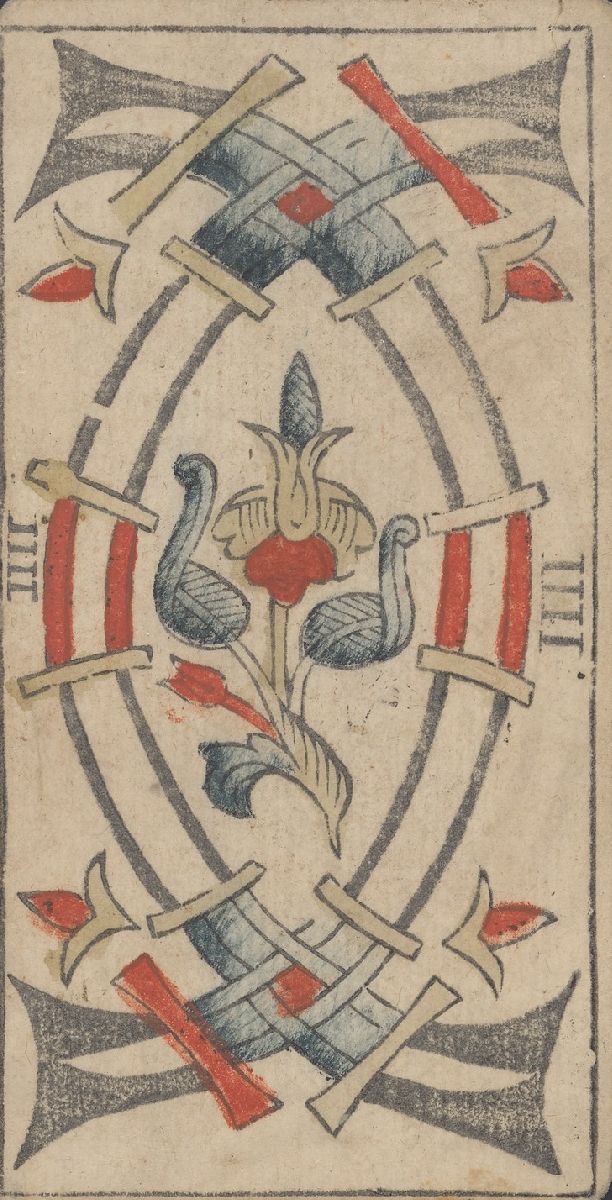
Swords Four — Jean-Pierre Payen, 1713. Beinecke Rare Book and Manuscript Library, Yale University. Prepared for print by Surrealium at Vaxholm Fortress, Sweden.
Payen’s Four of Swords arranges curved blades around a small central ornament. It does not show a reclining figure, although that later image is familiar to many readers. Here the stillness is a property of pattern: repeated lines surround a centre without depicting a human action.
The Hermit is IX in the Marseille order, between Justice and the Wheel of Fortune. You might use those neighbours to ask how judgement benefits from reflection before circumstances change again. Treat that as a proposed line of thought, not a promise about what will happen next. The card’s place can organise a conversation while the practical decisions remain grounded in the circumstances you can actually observe.
Find the question your lamp can reach
Choose one question small enough to investigate today. Instead of asking what your whole future should be, ask what you need to understand about a particular choice. Write the question on a page and leave space beneath it for facts, impressions and further questions. Keeping those separate helps each retain its proper weight.
Then identify a person or source that could extend your view. The lamp in the picture is small; it is not a failure that it cannot illuminate the entire world. End the exercise with a manageable period of attention and a point of return. The Hermit can suggest care in how you look, without demanding certainty, withdrawal or an answer more complete than the available light allows.
- Does the Hermit mean I should be alone?
- Not necessarily. It can encourage concentration or reflection, but a useful reading can also identify a need for guidance or company. It is not an instruction to isolate yourself.
- What does the lantern mean?
- The lantern is a visible attribute of the historic figure. Later readers often connect it with guidance or understanding; those symbolic associations are interpretations, not a literal source of hidden knowledge.
- Is Sola Busca’s Falco the Hermit?
- No. Falco is a named trump IX in a different historical sequence. The shared number provides a comparison, but the pictures and identities should not be collapsed together.