Justice card: balance, evidence and a clear response
Read the historic Marseille Justice image and use upright and reversed meanings as questions about your own choices.
The Justice card presents a seated figure with a sword and scales. In a symbolic tarot practice, those objects can prompt questions about balance, responsibility and how you reach a decision. They do not reveal the outcome of a legal case or prove that the reader’s preferred account is correct. The most useful response begins with what you can examine and what you still need to ask.
The image here comes from Jean-Pierre Payen’s historical Marseille deck in Yale’s Cary Collection. It is an old card with its own printed details, not the later Rider–Waite–Smith design. The major arcana visual guide gives the broader sequence, while the Marseille tarot story introduces this deck’s visual language. Look at the figure and objects first; interpretation should add a question to the image, rather than replace it with a verdict about someone else.
The sword and scales do different work
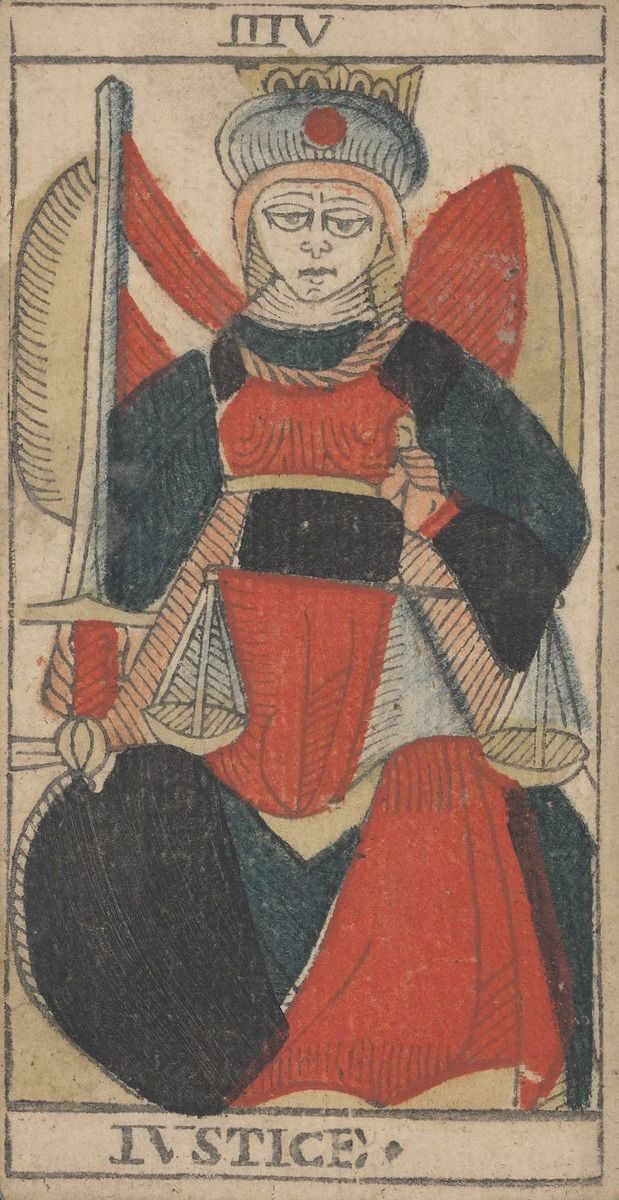
Justice · Jean-Pierre Payen, blocks dated 1713 · Cary Collection of Playing Cards (FRA166), Beinecke Rare Book and Manuscript Library, Yale University. Prepared for print by Surrealium at Vaxholm Fortress, Sweden.
The sword rises beside the figure while the scales extend to the other side. One form is long and direct; the other depends on a relationship between two suspended pans. The seated body holds those different shapes together. That arrangement gives the card its visual clarity before you attach any modern reading to it.
Begin by describing the relationship rather than deciding that every detail proves a moral conclusion. A scale suggests weighing, but it does not tell you which evidence you have omitted. A sword can suggest a decisive distinction, but it does not establish that the distinction is justified. The picture becomes more useful when it prompts you to examine the process behind a decision. Ask what you are comparing, whether the terms are equivalent and what information would change your view. These are practical questions available to anyone, whether or not the card appeared in a spread.
Upright: examine the basis of a choice
An upright interpretation can invite a clear review of evidence and responsibility. Choose one decision and separate what you know from what you assume. Then ask who is affected and whether your account gives their position a fair description. The card does not supply missing testimony; it can remind you that the testimony is missing.
For an everyday example, consider a shared task that has become uneven. Before deciding that another person is careless, write down the work each person understood they had agreed to do. There may be a real imbalance, a misunderstanding or a practical obstacle you had not considered. The next step could be a conversation about the agreement. This is a symbolic use of Justice because the image helps frame the question. The answer still comes from ordinary evidence and communication, and it remains open to correction when the other person explains their experience.
Justice and Strength do not keep one number everywhere
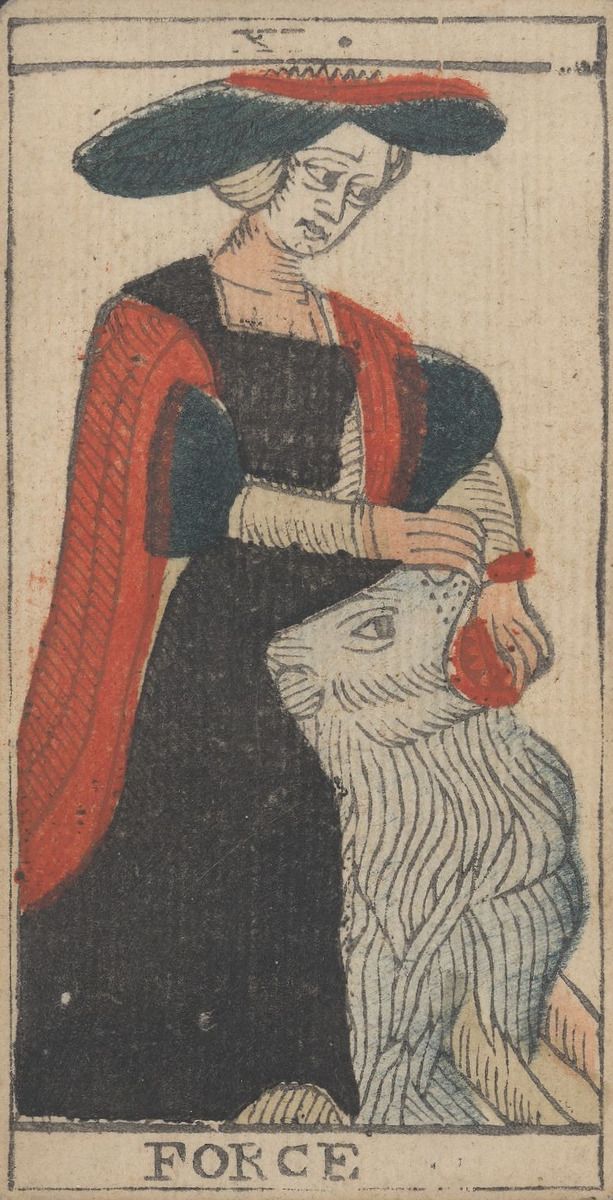
Strength · Jean-Pierre Payen, blocks dated 1713 · Cary Collection of Playing Cards (FRA166), Beinecke Rare Book and Manuscript Library, Yale University. Prepared for print by Surrealium at Vaxholm Fortress, Sweden.
The Marseille order places Justice at eight and Strength at eleven. The later Rider–Waite–Smith convention exchanges those positions. This difference matters when you compare a card guide with an actual deck: a number can identify a different image in another system. The Payen Justice also has an unusual printed numeral, which Fable’s deck record normalises to VIII while retaining the historical picture.
Strength is shown here as a comparison, with a figure engaging a lion. Its bodily action differs from the seated figure holding scales. You can compare the images without deciding that they describe opposite kinds of person. One prompt might concern the basis of a decision; another might concern how effort is applied. The Strength card story develops that neighbouring idea in its own right. Keep the deck convention named so a useful comparison does not become a mistaken claim that every historical pack used the same ordering.
Reversed: look for an uneven account
A reversed Justice reading can ask whether you are overlooking information, judging yourself by a different standard or insisting on a conclusion before hearing the whole account. Those are possible reflective prompts, not proof of dishonesty or an accusation against anyone. A reversed card does not establish that someone has acted unfairly.
Try rewriting your account in the most neutral language you can manage. Replace always and never with specific examples, and distinguish an action you observed from a motive you inferred. Then decide which uncertainty can be resolved through a question. If the subject is too emotionally charged to consider carefully, a pause may be more useful than another draw. Tarot need not settle the matter. It can simply help you notice the point where a story has become more certain than the evidence supporting it, leaving you free to seek information or support outside the reading.
The Hermit follows in the Marseille sequence
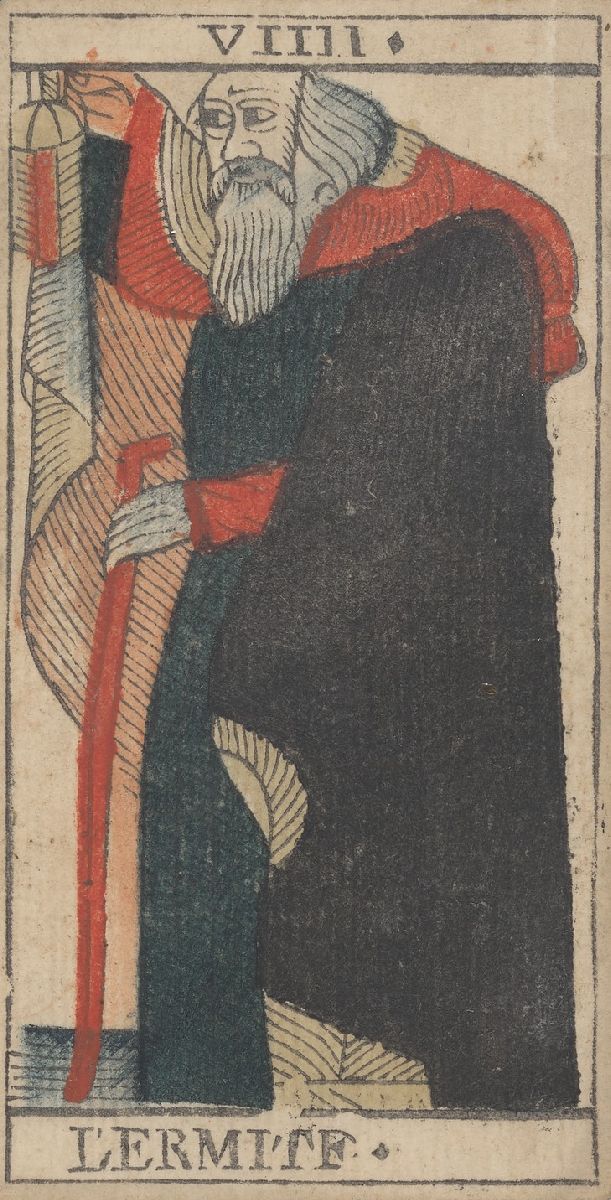
The Hermit · Jean-Pierre Payen, blocks dated 1713 · Cary Collection of Playing Cards (FRA166), Beinecke Rare Book and Manuscript Library, Yale University. Prepared for print by Surrealium at Vaxholm Fortress, Sweden.
In the Marseille order, Justice comes after the Chariot and before the Hermit. The Hermit’s held light and turned body offer a different tempo from the frontal Justice figure. After weighing a question, you may need time to inspect one part more closely rather than immediately turning the decision into action.
This is a comparison between images, not a required sequence of events in life. The cards do not promise that confidence will arrive in a particular order. For close study, keep each work whole and look at how the hand-held objects change the figure’s relationship to surrounding space. The historical cards can be explored through Masterworks, where their visual details remain interesting outside a reading. A deck’s order can help you organise a comparison, while the actual pictures give you something more specific than a list of abstract keywords.
A short reflection about fairness
Choose one small decision that you can revisit. Write the evidence you have, one assumption you may be making and one person whose perspective is missing. Then decide whether the next useful step is a conversation, a check or a pause. Keep the action proportionate to the question.
Justice can serve as a reminder that clarity depends on how you look as well as what you conclude. It does not grant the authority to judge another person from a card. If the exercise helps you make a fairer account of the situation, it has already done enough without predicting the result.
Return to the scales and sword together. Let them prompt both careful comparison and a clear next step, with enough humility to change your mind when the evidence changes.
- What does Justice mean upright in tarot?
- It can prompt reflection on evidence, balance and responsibility. The interpretation is symbolic; it does not prove that a particular judgment is correct or reveal the result of a legal matter.
- Is Justice card eight or eleven?
- Justice is eight in the Marseille convention discussed here and eleven in the later Rider–Waite–Smith convention. Name the deck before comparing numbered meanings.
- Does reversed Justice mean someone is lying?
- No. A card cannot establish another person’s motives or honesty. You can use the image to ask what information is missing and then seek that information through ordinary means.